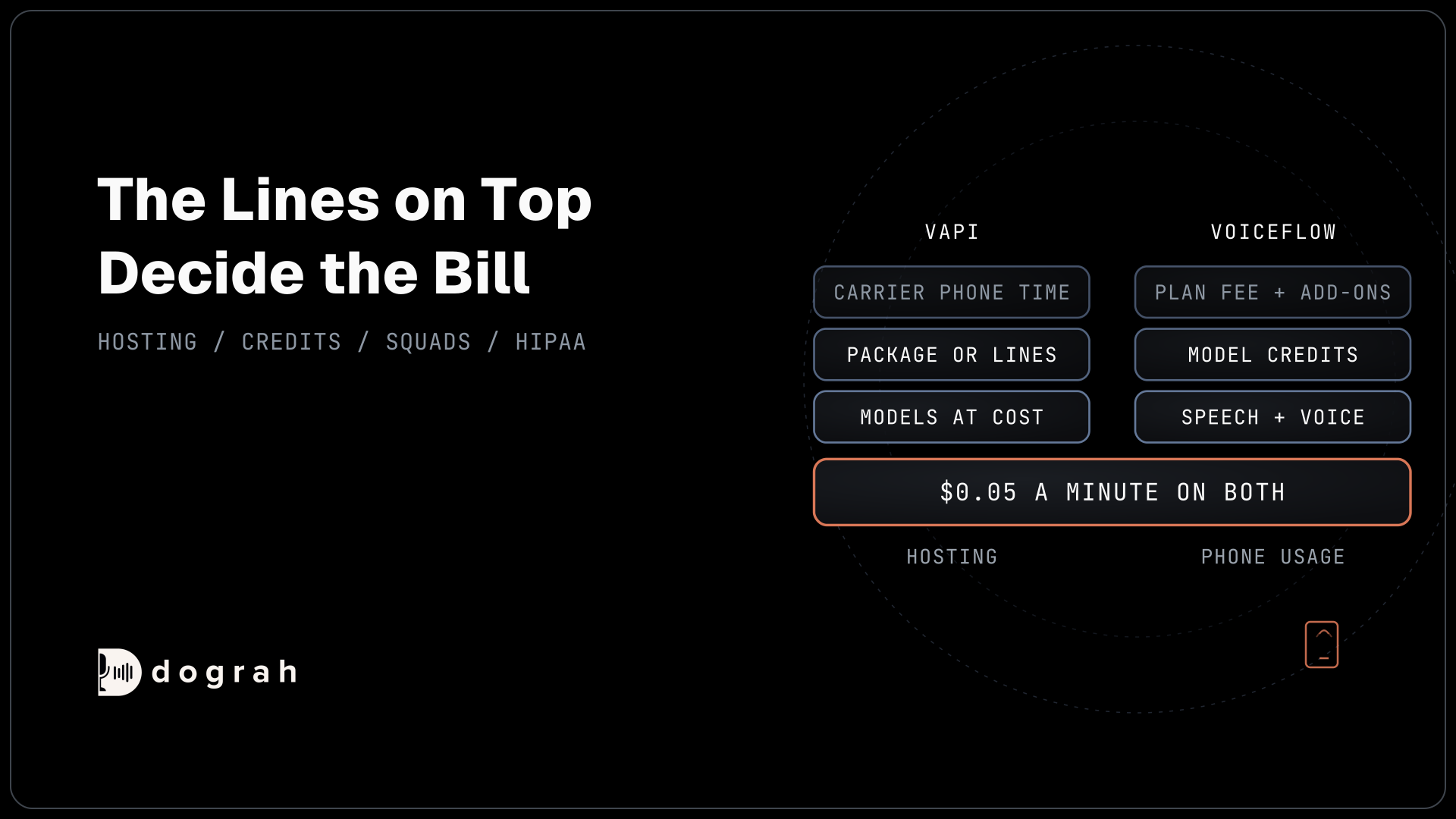

Vapi and Voiceflow are both hosted, closed-source platforms, and both lead with $0.05 a minute. Vapi is a developer API that adds models at provider cost. Voiceflow is a support-agent platform for chat, phone and SMS that adds speech, voice and model credits. For code you can run yourself, there is Dograh, an open-source, self-hostable voice agent platform.
Key Takeaways
- Both lead with $0.05 a minute, and the lines on top decide the bill.
- Voiceflow's own numbers can't place outbound calls, so bring Twilio, Vonage or Telnyx.
- For on-prem without an Enterprise contract, self-host Dograh, which is open source.
This post is part of our guide to Voiceflow alternatives. The guide's section "Hosted voice platforms: Vapi, Retell, Bland, Synthflow" notes that Vapi charges "$0.05 a minute for hosting, the same headline as Voiceflow's phone minute." This post puts the two side by side on what sits on top of that $0.05, plus every other point that changes a buying decision.
A developer API against a support-agent platform
Vapi is built for developers who assemble a phone agent from parts, while Voiceflow is built for support teams that run one agent across chat, phone and SMS. Most rows below follow from that.
| Row | Vapi | Voiceflow |
|---|---|---|
| Who it is built for | Developers, working in the dashboard or through the API | Customer-support teams running one agent over chat, phone and SMS, with native Zendesk, Salesforce, HubSpot and Shopify tools |
| How you pay | Prepaid: $0.05/min hosting, models passed through at cost, $5 of free credits to start. But you pick and pay for each model | A monthly plan fee, add-ons such as editor seats and numbers, and credits: $0.05/min phone usage on self-serve plans. But speech-to-text, voice and model credits sit on top |
| Packages and plans | None needed; Core $29/mo; Pro 10% of hosting with a $999/mo minimum; Premier custom | Free, Pro, Business and Enterprise. Plan prices show inside the app under Plans and Billing; for businesses, pricing is on request |
| Models | Any supported provider, your own keys, a custom model for any part of the call, or OpenAI's realtime speech-to-speech models | Your choice of speech-to-text, language model and voice from Voiceflow's provider list, Voiceflow's own model, or your own model |
| Builder | Assistants and Squads. But the visual Workflows builder was retired on 18 August 2026 | A global prompt, playbooks for goals and workflows for fixed steps, with environments and traffic splits for A/B tests |
| Calls at once | 4 with no package, 10 on Core, 30 on Pro; extra lines $10/mo each | A limit set by your plan, raised with the concurrent calls add-on; inbound and outbound share one pool |
| Phone | 1, 5 or 10 Vapi numbers by package, or your own carrier; Vapi telephony and SIP carry no transport fee | One US or Canadian Voiceflow number per workspace, more as an add-on, or your own Twilio, Vonage or Telnyx number. But Voiceflow's own numbers can't place outbound calls |
| HIPAA | A $2,000/mo add-on with a business associate agreement (BAA) | Supports HIPAA-compliant deployments; the BAA is arranged through Voiceflow's security team |
| Where it runs | Runs on Vapi's cloud | Hosted on Voiceflow; private cloud on Enterprise |
| Certificates listed | SOC 2 Type II, HIPAA, GDPR | SOC 2 Type II, ISO/IEC 27001:2022, GDPR, HIPAA deployments |
What sits on top of the $0.05
Both bills start at $0.05 a minute, and on both the rest of the bill depends on the models you pick.
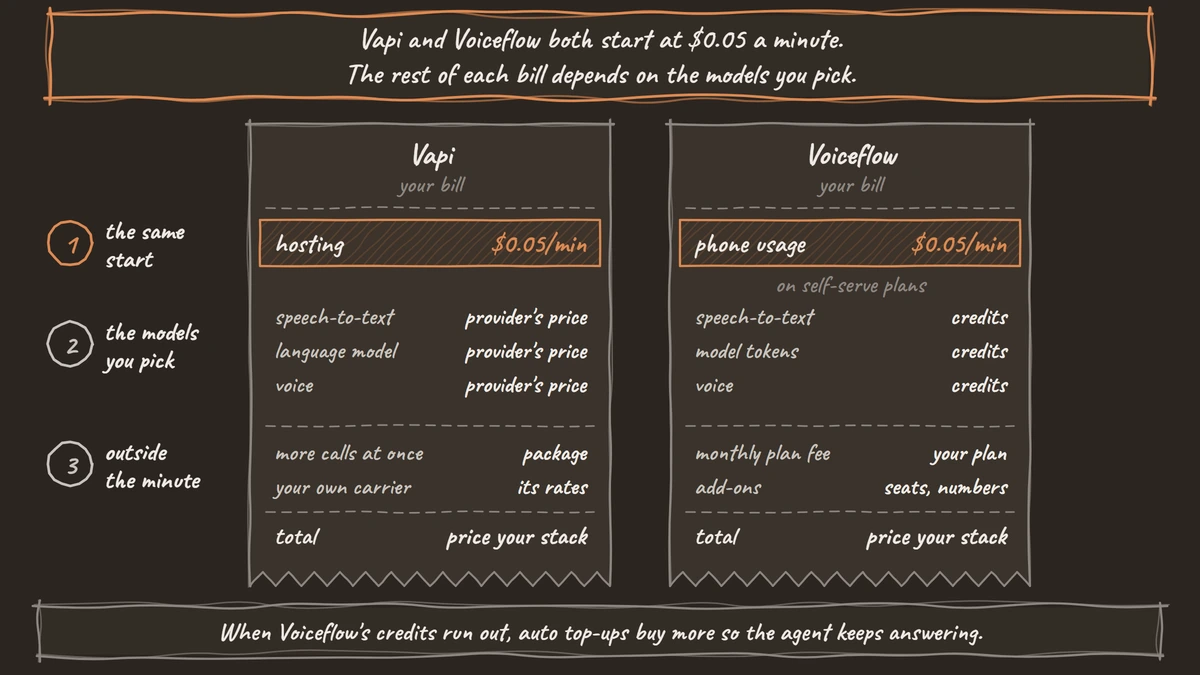
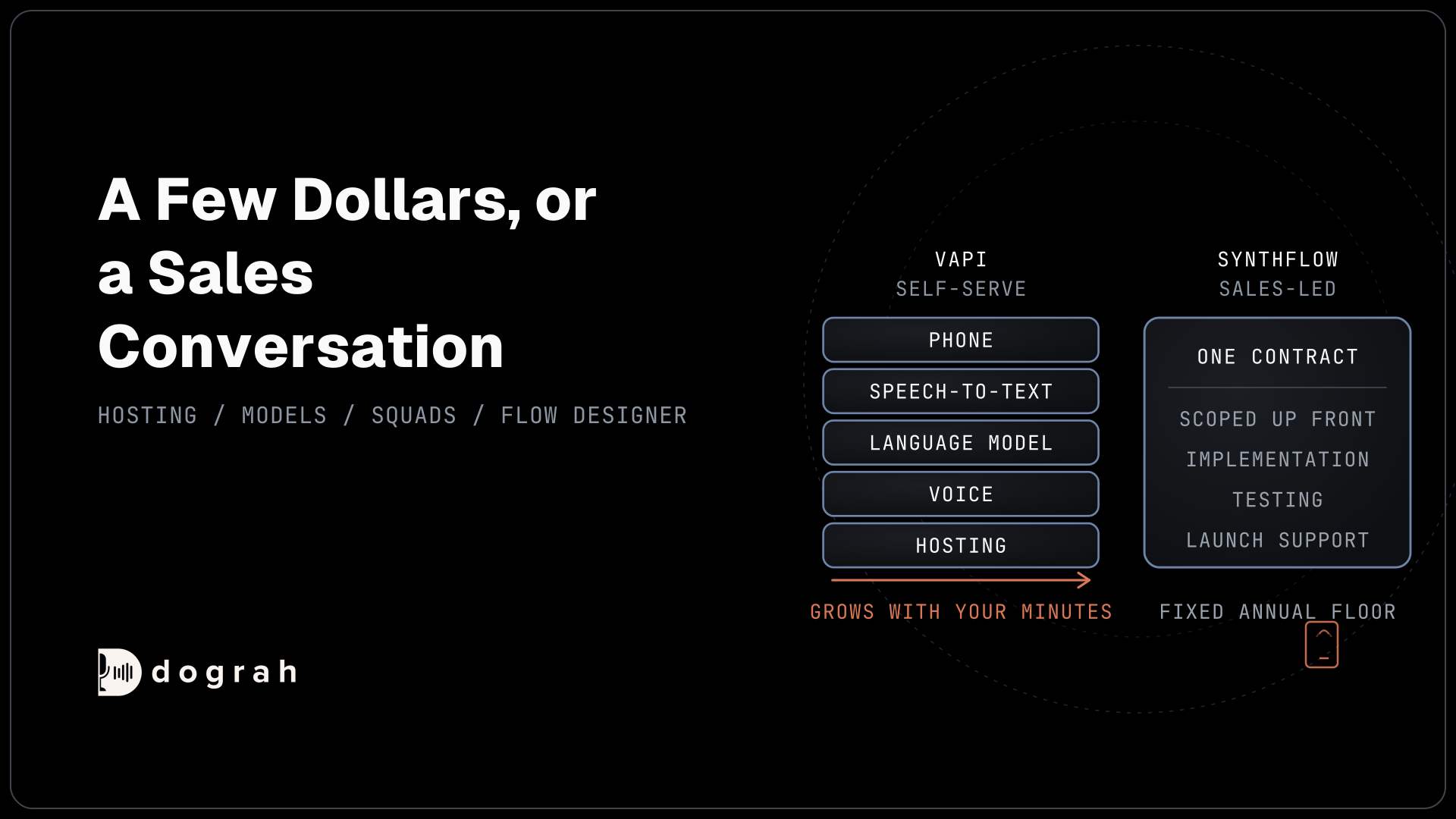
On Vapi, $0.05 is the hosting fee. Speech-to-text, the language model and the voice are passed through at each provider's price, and Vapi's pricing page shows sample ranges: Deepgram at $0.0095 to $0.0099 a minute, an OpenAI model at $0.0077 to $0.0452 and an ElevenLabs voice at $0.0146 to $0.0238. Past 4 calls at once you need a package or $10 lines, and your own carrier bills phone time at its own rates.
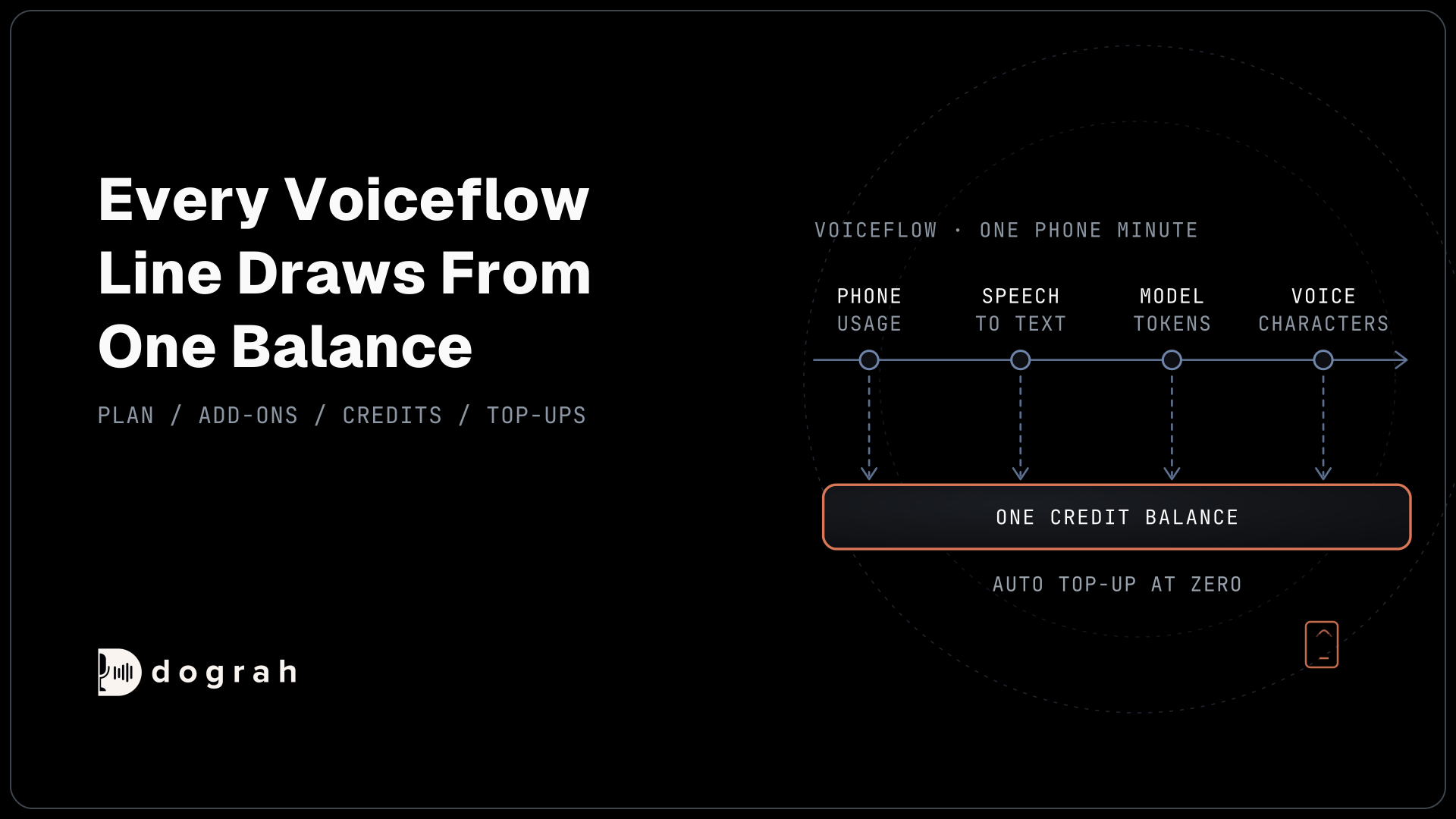
On Voiceflow, $0.05 is the phone usage charge on self-serve plans. Voiceflow's billing page says a bill is "made up of a monthly plan fee, optional add-ons like editor seats and phone numbers," plus credit-based usage. Speech-to-text minutes, voice characters and model tokens each use credits on top, at a rate set by the provider and model. When the balance hits zero, auto top-ups can buy more credits so the agent keeps answering.
Take the platform line alone, by our arithmetic. At 10,000 minutes a month, Vapi's hosting comes to $500 and Voiceflow's phone usage comes to $500. Neither figure includes models, voices, a package or plan fee, or carrier charges, so neither platform is cheaper until you price your own stack. Our breakdowns of Vapi pricing and Voiceflow pricing price every line.
Models and building an agent
Vapi lets you swap every layer of the call, while Voiceflow gives you a provider list and a builder shaped around support work.
Vapi's FAQ says "You can bring your own custom models for any part of the pipeline," through your own provider keys or a custom language model. Vapi also runs OpenAI's realtime speech-to-speech models, where one model takes the caller's audio in and sends speech back. That makes it easy to try a newer or cheaper model, and it makes you responsible for testing each combination.
Voiceflow has you pick each layer from its list. Speech-to-text comes from Deepgram, Gladia, Cartesia, AssemblyAI or Google, and Voiceflow recommends Deepgram's Flux model. Voices come from ElevenLabs, Cartesia, Rime, Google, Amazon or Microsoft. For the language model, Voiceflow's pricing page says to "choose from the biggest LLM providers, or bring your own model," and Voiceflow Core is its own. Callers can also type digits on their keypad.
Vapi builds with Assistants, single agents set up in the dashboard or by API, and Squads, groups of assistants that hand a call between them. Vapi's Workflows notice says Workflows were retired on 18 August 2026, with Squads as the recommended replacement.
A Voiceflow agent combines a global prompt with playbooks, each pursuing one goal, and workflows for steps that must run the same way every time. Native Zendesk, Salesforce, HubSpot and Shopify tools come ready to use. Environments hold separate versions of the agent, and a traffic split sends a share of traffic to each version for A/B tests.

Open Source Alternative to Vapi / Retell
Self-hosted voice agent platform — no per-minute fees
dograh-hq/dograh
Star on GitHub
Phone numbers and outbound calls
Vapi treats the phone line as one more part you wire in, while Voiceflow's own numbers answer calls but can't place them.
Vapi includes 1, 5 or 10 of its own numbers depending on the package, and you can bring your own carrier. Transport over Vapi's own telephony and SIP is free, while other carriers bill at their own rates.
Voiceflow can provision one US or Canadian number per workspace with your plan, with more as an add-on, and you can connect your own Twilio, Vonage or Telnyx number. Outbound is where that choice matters. Voiceflow phone numbers currently don't support outbound calling, so outbound calls go out through your own Twilio, Vonage or Telnyx number. Each call starts with one API request to that number's endpoint, with answering machine detection as an option, and outbound calls share one concurrency pool with inbound.
To reach a person on a call, Voiceflow's Call forward step transfers the caller to a phone number, an international number or a SIP address. It can show the caller's own number to the person answering, except on Vonage numbers. On chat, the live agent handoff step passes the conversation to Zendesk, Genesys, UJET, Kustomer or Dixa.
HIPAA, hosting and certificates
Vapi sells HIPAA as a monthly add-on, while Voiceflow arranges its BAA through its security team.
Vapi's HIPAA add-on costs $2,000 a month and includes a data processing agreement and a business associate agreement (BAA), the contract HIPAA requires before a vendor handles patient data. Voiceflow "supports HIPAA-compliant deployments," and its HIPAA page asks you to contact its security team about the BAA for your use. Generally, whichever vendor signs, a BAA hands it obligations while your own HIPAA duties stay with you; confirm your position with counsel.
On hosting, Vapi runs on Vapi's cloud. Voiceflow's pricing page says "All hosted on Voiceflow," and its billing page lists private cloud hosting on Enterprise, next to single sign-on. Both are closed source.
For certificates, Vapi lists SOC 2 Type II, HIPAA and GDPR. Voiceflow lists SOC 2 Type II, ISO/IEC 27001:2022 and GDPR, and sells PII redaction as an add-on through its sales team.
Vapi vs Voiceflow: picking between them
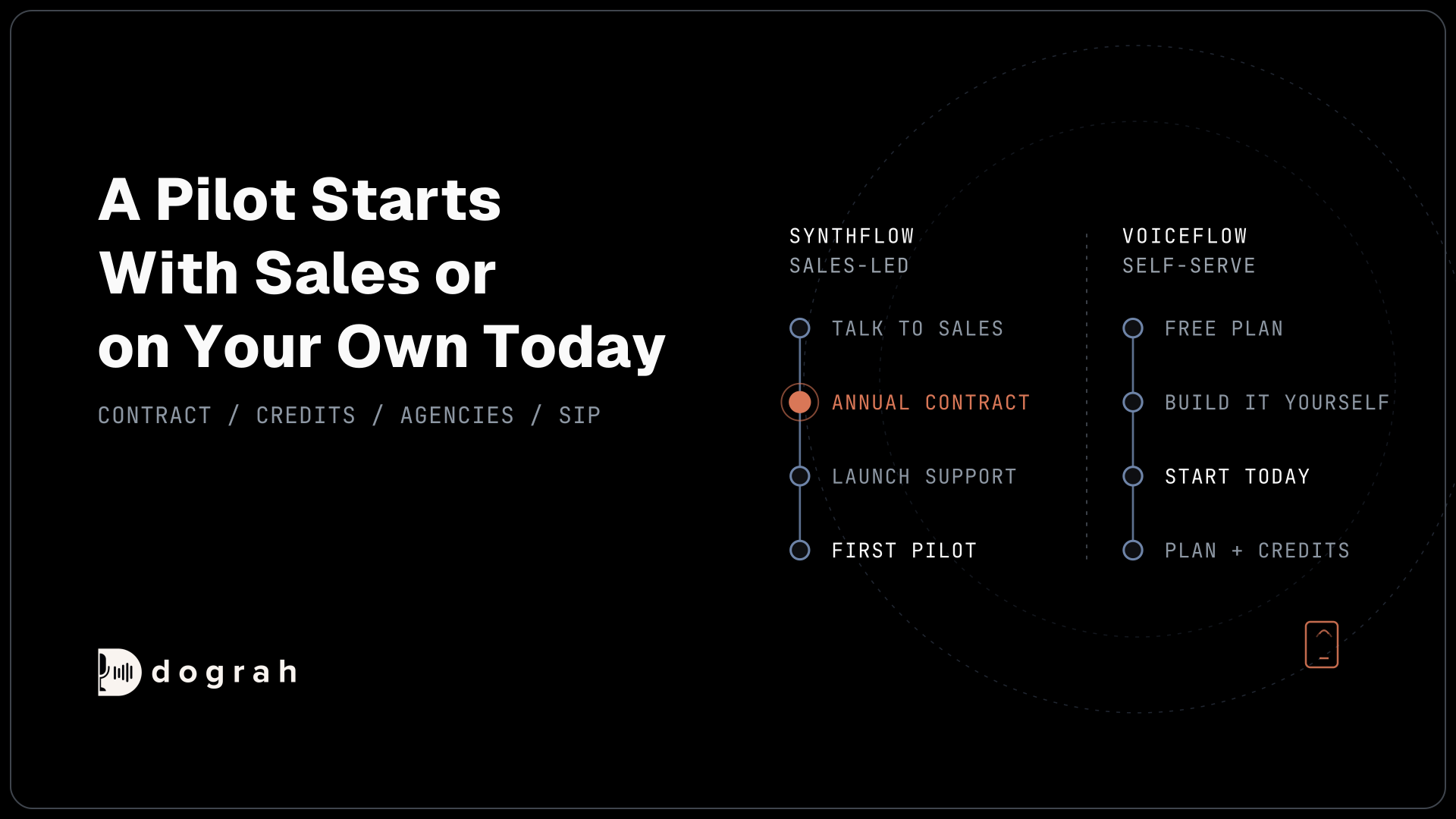
Pick Vapi if your developers want to choose every model, or you want HIPAA on a self-serve package. Pick Voiceflow if one agent has to answer on chat and phone, or your support team relies on its native helpdesk and CRM tools.
Outbound-heavy teams should settle the number question first. On Voiceflow, outbound calls need your own carrier number and one API request per call. Teams weighing another hosted option can read Retell AI vs Voiceflow and Bland AI vs Voiceflow.
Run the same call script on both over a real phone line before you sign. Most phone calls still reach the agent as 8 kHz audio, while a browser demo runs at 16 kHz, so a demo that sounds sharp can mishear callers on the phone.
Where an open-source platform fits
Vapi runs on its own cloud, and Voiceflow runs on its own, with private cloud on Enterprise. Neither gives you code you can run without a vendor contract, and that gap is where Dograh fits.
| Question | Vapi | Voiceflow | Dograh |
|---|---|---|---|
| Open source | No | No | Yes, BSD-2-Clause |
| Run it on your own servers | Runs on Vapi's cloud | Hosted on Voiceflow; private cloud on Enterprise | Yes, self-host for free |
| Choose the models | Yes | From Voiceflow's list, or your own model | Yes, including open-weight models you host |
| Platform fee | $0.05/min hosting | $0.05/min phone usage, plus a plan fee | Self-hosted: none |
Dograh is open source under BSD-2-Clause, and its GitHub repository, with more than 5,900 stars, holds the whole platform. Its visual workflow builder joins nodes with pathways, each with a written condition the AI reads to pick its route, so a team used to drawing flows in Voiceflow will find the idea familiar.
Dograh is the orchestration layer: it runs the call flow, tools and telephony, and the speech and language models are a separate layer you choose. That can be Dograh's own models, any supported provider on your own key, or open-weight models you host, so like Vapi you choose every model. The call audio stays in-house only when the speech and language models run on your own servers too.
Dograh starts every account on its own managed models. To keep call audio away from Dograh, open Models, switch the Organization default to BYOK with your own speech and language providers (or local models), and check that no agent has its own model override.
Your numbers stay with your carrier, such as Twilio, Vonage, Plivo or Telnyx, and outbound lists run as campaigns on those numbers. Transfer Call works on Twilio, Telnyx and Asterisk ARI. It passes no summary by default; on Twilio it can play a short spoken introduction to both people. Write the details to your system with an HTTP API tool before the transfer.
Dograh is built for phone calls and also offers a text chat widget for websites, though teams whose main channel is text chat may prefer Voiceflow.
Self-hosted Dograh has no per-minute platform fee (servers, model keys and phone minutes still cost); Dograh Cloud has a 1¢-a-minute platform fee, with 10 concurrent calls included. Self-hosting puts uptime in your team's hands, and there is no one-click import from Vapi or Voiceflow, so each agent is rebuilt.
Dograh is the strongest fit when you want Vapi's model choice with a drawn flow, on code you run yourself and without an Enterprise contract. To try it, self-host it with Docker Compose, or start on Dograh Cloud.
Join the Dograh Community
Dograh is an OSS alternative to Vapi. Join our Slack community for queries, releases, best practices & community interactions.
Glossary
- Squads
- Vapi's way of building a call from several assistants that hand the conversation between them. Vapi recommends it in place of Workflows, which were retired in August 2026.
- Playbook
- In Voiceflow, a part of the agent that pursues one goal, such as checking an order, alongside workflows for steps that must always run the same way.
- Credits
- Voiceflow's unit for usage. Phone minutes, speech-to-text minutes, voice characters and model tokens each use credits at a rate set by the provider and model, on top of the plan fee.
- Call forward
- Voiceflow's step for handing a phone call to a person. It transfers the caller to a phone number, an international number or a SIP address.