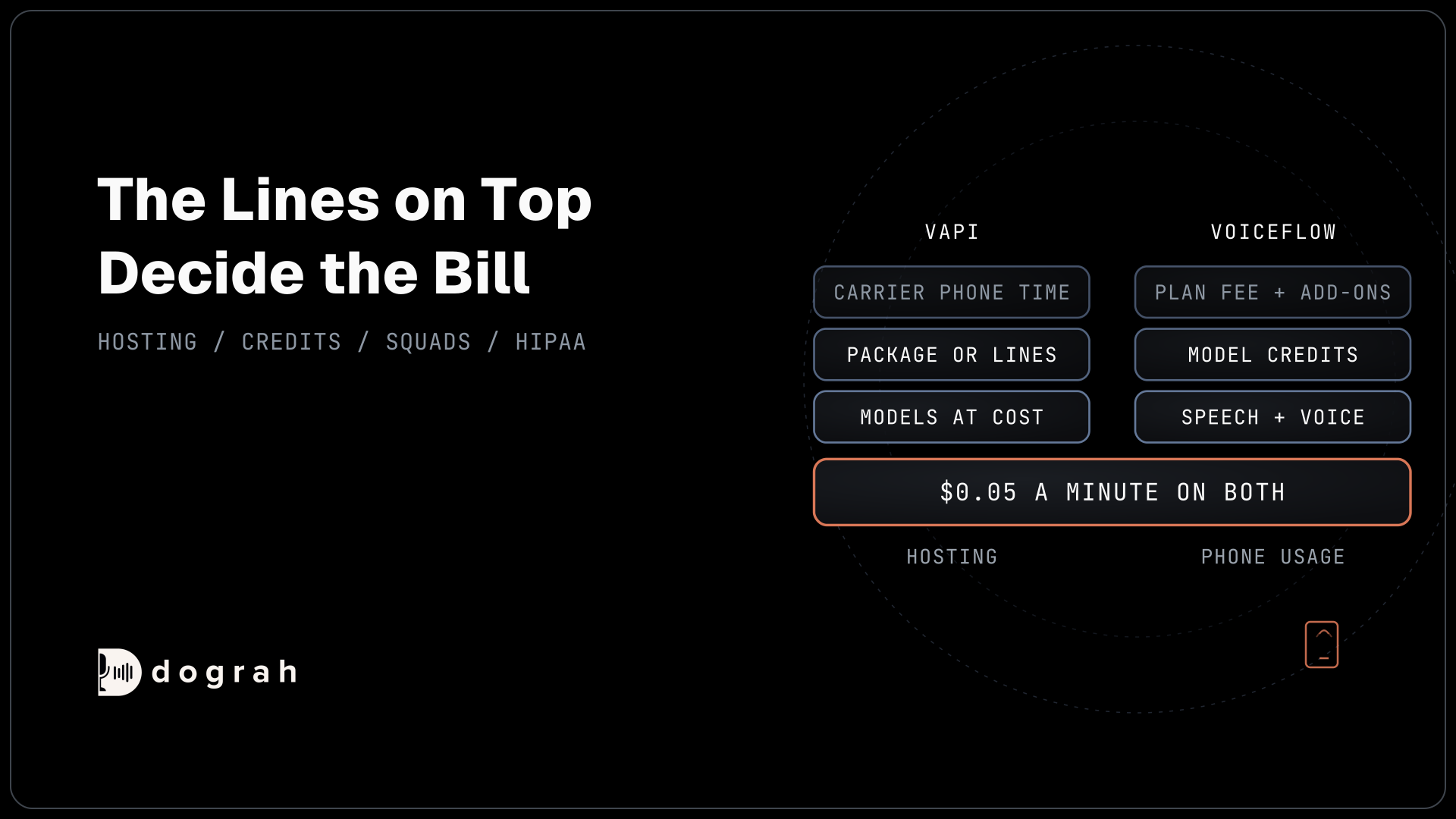

Voiceflow pricing combines a monthly plan fee, add-ons such as extra phone numbers and concurrent calls, and credits for usage. On self-serve plans a phone minute costs $0.05, which is 10 credits at $0.005 each, and speech-to-text, voice and model credits come on top. Dograh, an open-source, self-hostable voice agent platform, has no per-minute platform fee when self-hosted.
Key Takeaways
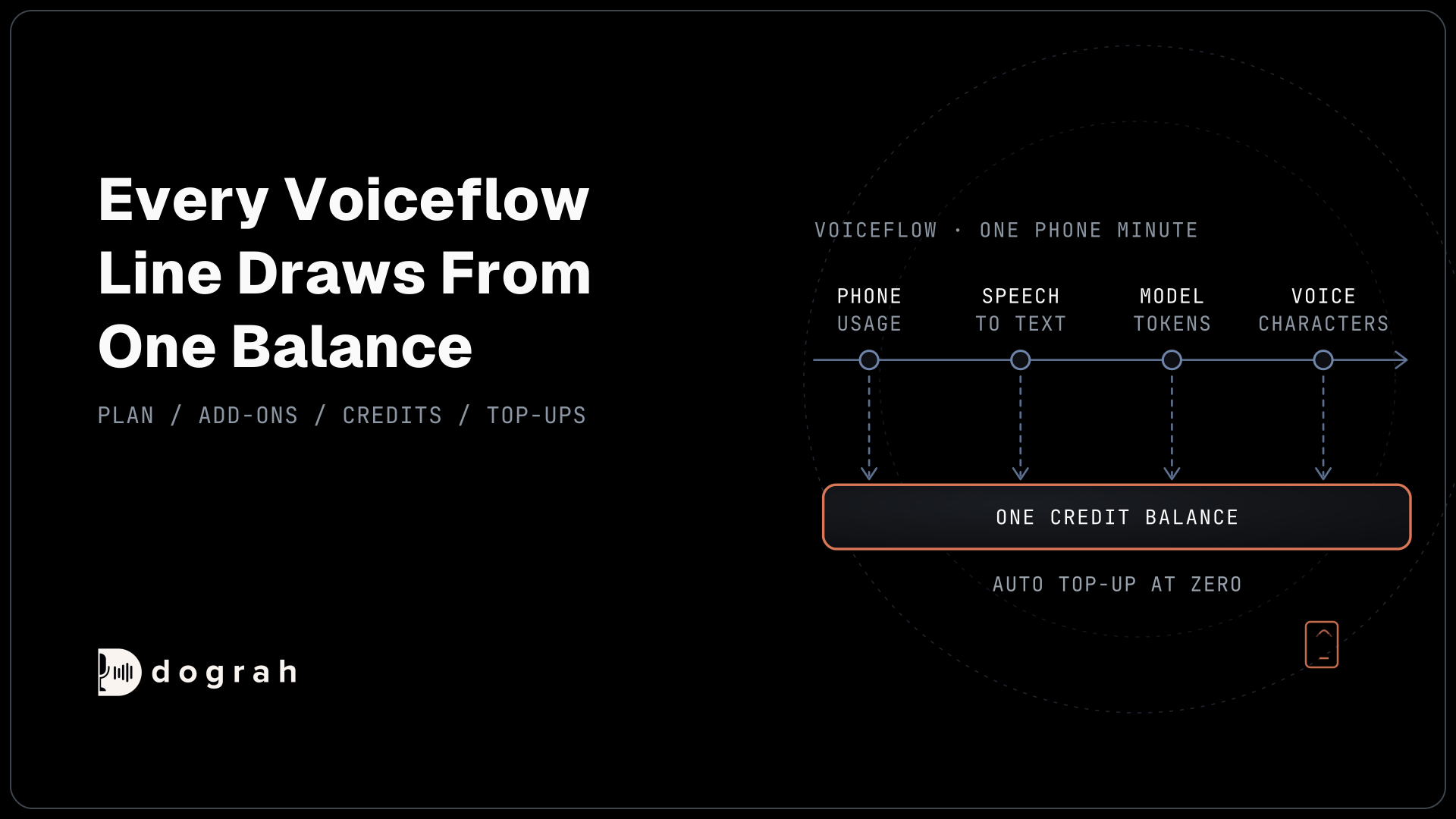
- One Voiceflow phone minute draws several credit lines from one balance.
- Plan prices show inside Plans and Billing; Business and Enterprise are quoted on request.
- To pay model providers directly with no per-minute platform fee, self-host Dograh.
This post is part of our guide to Voiceflow alternatives. The guide's section "Why teams look beyond Voiceflow for phone agents" names the $0.05 phone minute and the credits on top in one paragraph. This post prices each line a phone call can draw, rate by rate, then sets the same calls against Dograh, an open-source, self-hostable voice agent platform.
Voiceflow pricing: what makes up the bill
A Voiceflow bill has three parts: the plan, the add-ons and the credits you use. Voiceflow's billing page describes the bill as a monthly plan fee, optional add-ons such as editor seats and phone numbers, and credit-based usage. There are four plans. Free comes with a one-time credit grant that does not renew, so it is not meant for production. Pro is for individual builders and includes all language models. Business adds fallback language models and priority support. Enterprise includes unlimited product usage, single sign-on, private cloud hosting and custom credit allotments.
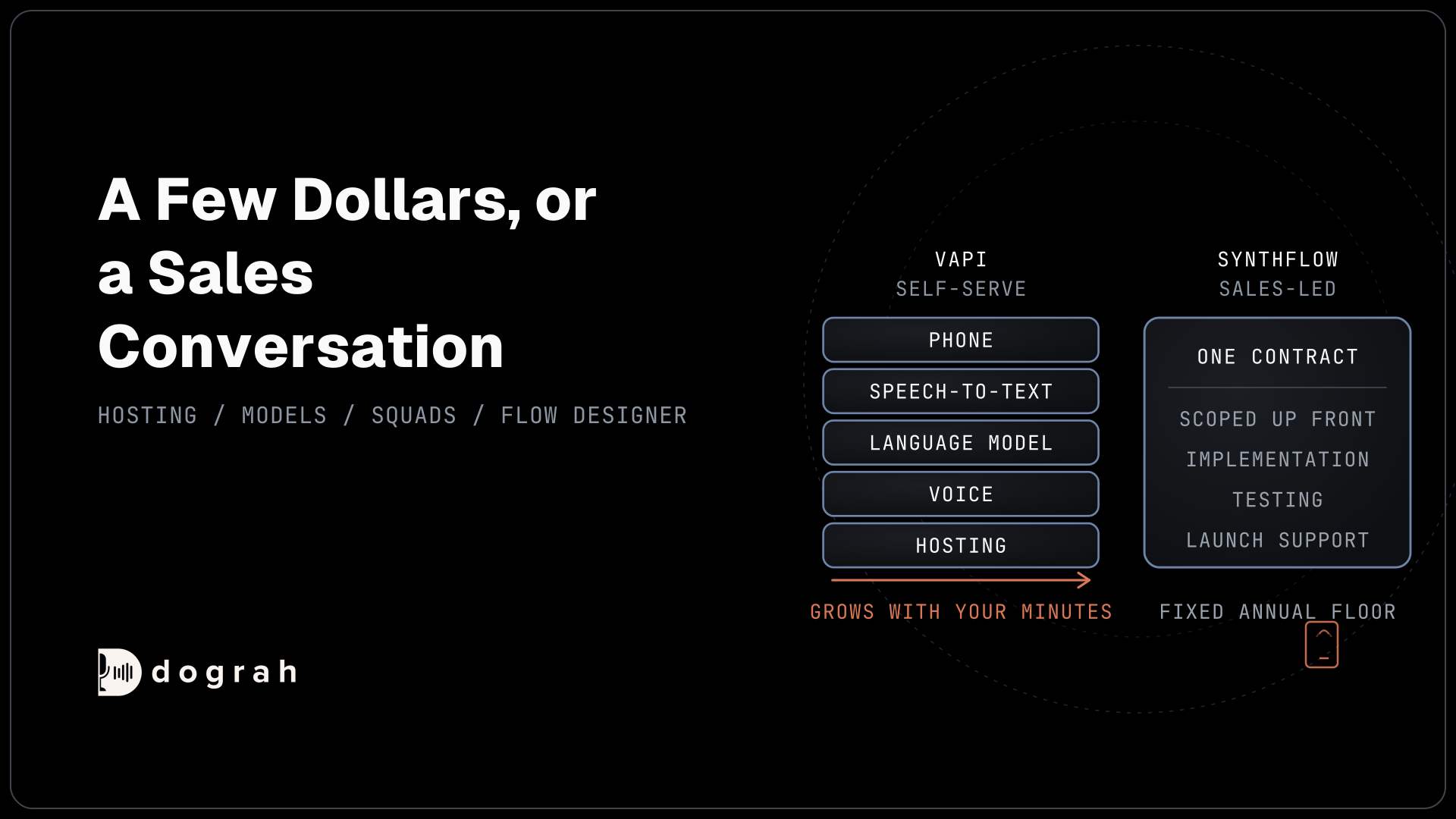
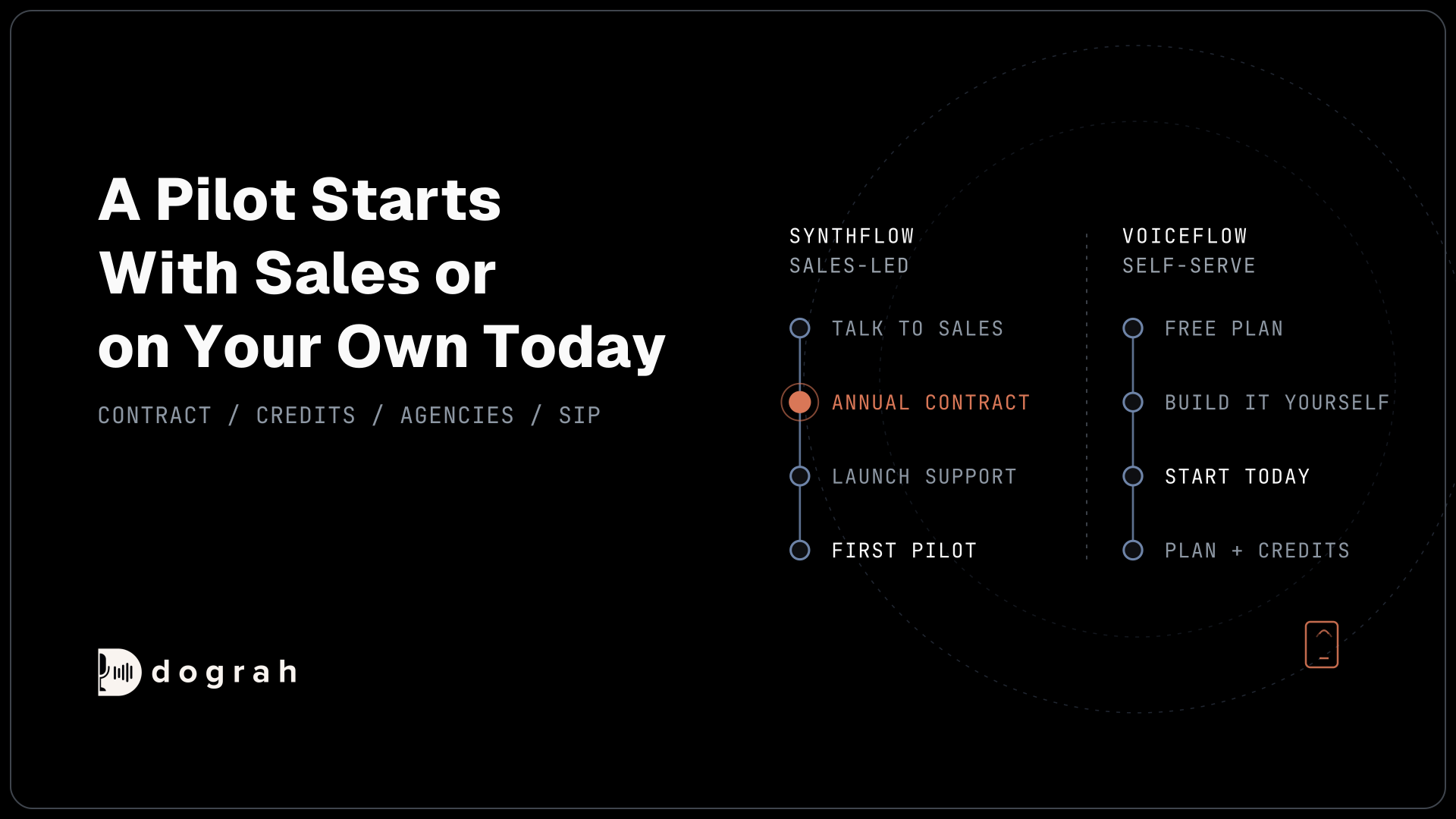
Plan, add-on and credit bundle prices show inside Voiceflow, under Plans and Billing. For businesses, Voiceflow's pricing page offers a demo and pricing on request, and agencies get a free trial with no credit card. For a phone agent, the credits matter most, because every minute of every call draws on them.
How Voiceflow credits work
Credits are Voiceflow's single unit for usage, and every line on the bill draws from one balance. Every chat message, phone minute, speech-to-text minute, voice character and language model token uses credits, at a rate set by the vendor and model. On self-serve plans one credit is worth $0.005. A chat message costs 1 credit, and a phone minute costs 10.
Paid plans include a monthly credit allotment that resets at the start of each billing cycle. When the balance hits zero, auto top-ups buy more credits so the agent is not cut off mid-month. You switch them on from the Plans page.
That makes the bill easier to run than it first looks, since there is no separate overage rate. It also means one long call and one chat message spend the same currency, so a busy phone line drains the balance faster than any chat channel.
What a phone minute draws from your credits
A phone minute on Voiceflow is several charges added together: the call itself, plus each model it uses. The rates below come from Voiceflow's credits pricing table, at $0.005 a credit on self-serve plans.
| Line | Unit | Credits | Self-serve price |
|---|---|---|---|
| Phone usage | per minute on a call | 10 | $0.05 |
| Speech-to-text: Deepgram Flux | per minute | 1.425 | $0.007125 |
| Speech-to-text: Deepgram | per minute | 1 | $0.005 |
| Speech-to-text: AssemblyAI or Gladia | per minute | 0.625 | $0.003125 |
| Speech-to-text: Cartesia | per minute | 0.56 | $0.0028 |
| Voice: ElevenLabs Flash v2.5 or Turbo | per 1,000 characters | 9 | $0.045 |
| Voice: ElevenLabs Multilingual v2 | per 1,000 characters | 18 | $0.09 |
| Voice: Cartesia | per 1,000 characters | 9.5 | $0.0475 |
| Voice: Rime | per 1,000 characters | 6 | $0.03 |
| Voice: Amazon | per 1,000 characters | 1 | $0.005 |
| Model: Claude Sonnet 4.6 | per 1,000 input / output tokens | 0.75 / 3.75 | $0.00375 / $0.01875 |
| Model: GPT-5 mini | per 1,000 input / output tokens | 0.0625 / 0.5 | $0.0003125 / $0.0025 |
| Model: Voiceflow Core 4.1 | per 1,000 input / output tokens | 0.56 / 1.76 | $0.0028 / $0.0088 |
Two lines are charged by time: the phone minute and the speech-to-text minute. Deepgram's Flux model, which Voiceflow recommends because it is good at telling when a caller has finished speaking, adds $0.007125 to every minute. The other two lines depend on how much your agent says and how long its prompts are. A chatty agent with a long knowledge base answer spends far more on voice characters and tokens than a short one.
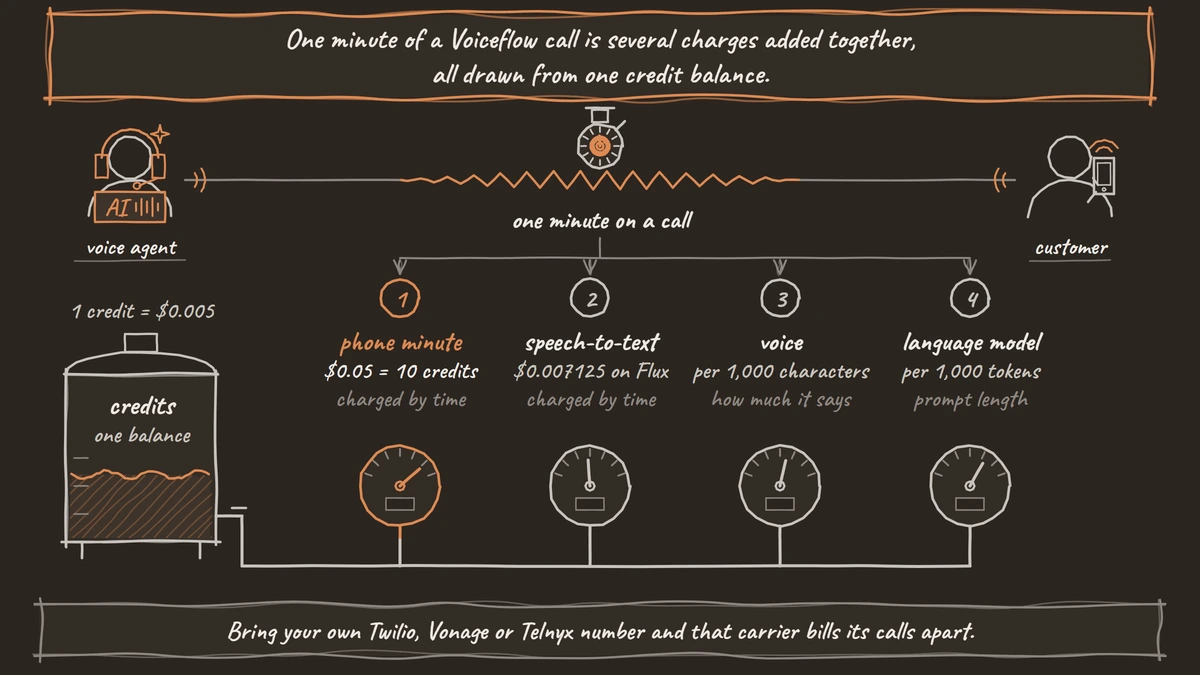
To estimate your own minute, run a few test calls, count the characters the agent spoke and the tokens each turn used, and multiply by the rates for your chosen voice and model. If you connect your own Twilio, Vonage or Telnyx number, that carrier also bills its own call charges to your account, apart from Voiceflow's credits.
The $0.05 phone minute matches Vapi's hosting rate, which our Vapi pricing post breaks down, and on both the models come on top.
Add-ons and limits that change the bill
The credit rates are not the whole bill. A phone agent usually needs some add-ons too. One Voiceflow phone number per workspace comes with your plan, and more numbers are an add-on. Voiceflow-provisioned numbers are US or Canadian. They also can't make outbound calls, so an outbound agent needs your own Twilio, Vonage or Telnyx number, and that number sits in your own carrier account.
Each plan caps how many calls run at once. The cap applies to calls, not to chat or API sessions, and outbound calls share the same concurrency pool as inbound ones. If an outbound campaign and your inbound support line run at the same time, they compete for the same slots, and the concurrent calls add-on is how you raise the cap.
Every paid plan includes some editor seats, and more can be bought, while viewers are free. The PII redaction feature is an add-on you subscribe to through Voiceflow's sales team.

Open Source Alternative to Vapi / Retell
Self-hosted voice agent platform — no per-minute fees
dograh-hq/dograh
Star on GitHub
What the same calls cost on Dograh
Dograh charges for the platform only, if at all, and the models are billed by the providers you pick. Self-hosted Dograh has no per-minute platform fee (servers, model keys and phone minutes still cost); Dograh Cloud has a 1¢-a-minute platform fee, with 10 concurrent calls included, as Dograh's pricing page sets out.
Dograh is the orchestration layer: it runs the call flow, tools and telephony, and the speech and language models are a separate layer you choose, billed by those providers on your own keys at their own rates. Many of the providers in Voiceflow's table, such as Deepgram, ElevenLabs and Cartesia, can be used that way. Host open-weight models on your own GPU instead, and you pay only for that hardware. The call audio stays in-house only when the speech and language models run on your own servers too.
| A phone minute | Voiceflow (self-serve) | Dograh Cloud | Dograh, self-hosted |
|---|---|---|---|
| Platform | $0.05 phone usage, 10 credits | 1¢/min platform fee | No platform fee |
| Speech-to-text, voice and model | Credits at Voiceflow's rate for each provider | Dograh's models or your own keys, billed by the provider | Your own keys, or open-weight models you host |
| Phone | Voiceflow number (one included), or your own carrier account | Your own carrier | Your own carrier |
| Monthly plan | Plan fee, shown in Plans and Billing | None; prepaid credits from $5 | None |
| Calls at once | Plan limit, raised by an add-on | 10 included, more on request | 10 by default, adjustable |
| Servers | None to run | None to run | Yours, from one server with 8 GB of RAM and 4 vCPUs |
The trade is work for money. Self-hosting removes the platform fee, but your team runs the servers and the updates. Our Dograh vs Voiceflow comparison covers the rest of the differences, from phone numbers to compliance.
Which way to price your calls
The right way to price your calls depends on what your agent does most. If your support runs mostly over chat, with phone as a smaller channel, Voiceflow's single credit balance is simple to live with. Dograh is built for phone calls and also offers a text chat widget for websites. Teams whose main channel is text chat may prefer Voiceflow.
If phone minutes are most of your bill, price your own call mix on both: Voiceflow's credit rates for your chosen models against Dograh with the same providers on your own keys. Do it with real test calls over a phone line, not a browser demo, since the minutes and characters are what you pay for. Our guide to migrating from Voiceflow to open-source voice AI shows how to test one number before moving the rest.
Join the Dograh Community
Dograh is an OSS alternative to Vapi. Join our Slack community for queries, releases, best practices & community interactions.
Glossary
- Credit
- Voiceflow's single unit for usage. Phone minutes, chat messages, speech-to-text minutes, voice characters and model tokens all draw credits; on self-serve plans one credit is worth $0.005.
- Credit allotment
- The credits a paid Voiceflow plan includes each month. It resets at the start of each billing cycle, and auto top-ups cover any usage beyond it.
- Auto top-up
- A Voiceflow setting that buys more credits automatically when the balance reaches zero, so agents keep answering mid-month instead of stopping.
- Concurrent calls add-on
- The Voiceflow add-on that raises a plan's limit on calls running at the same time. Inbound and outbound calls share that one limit.