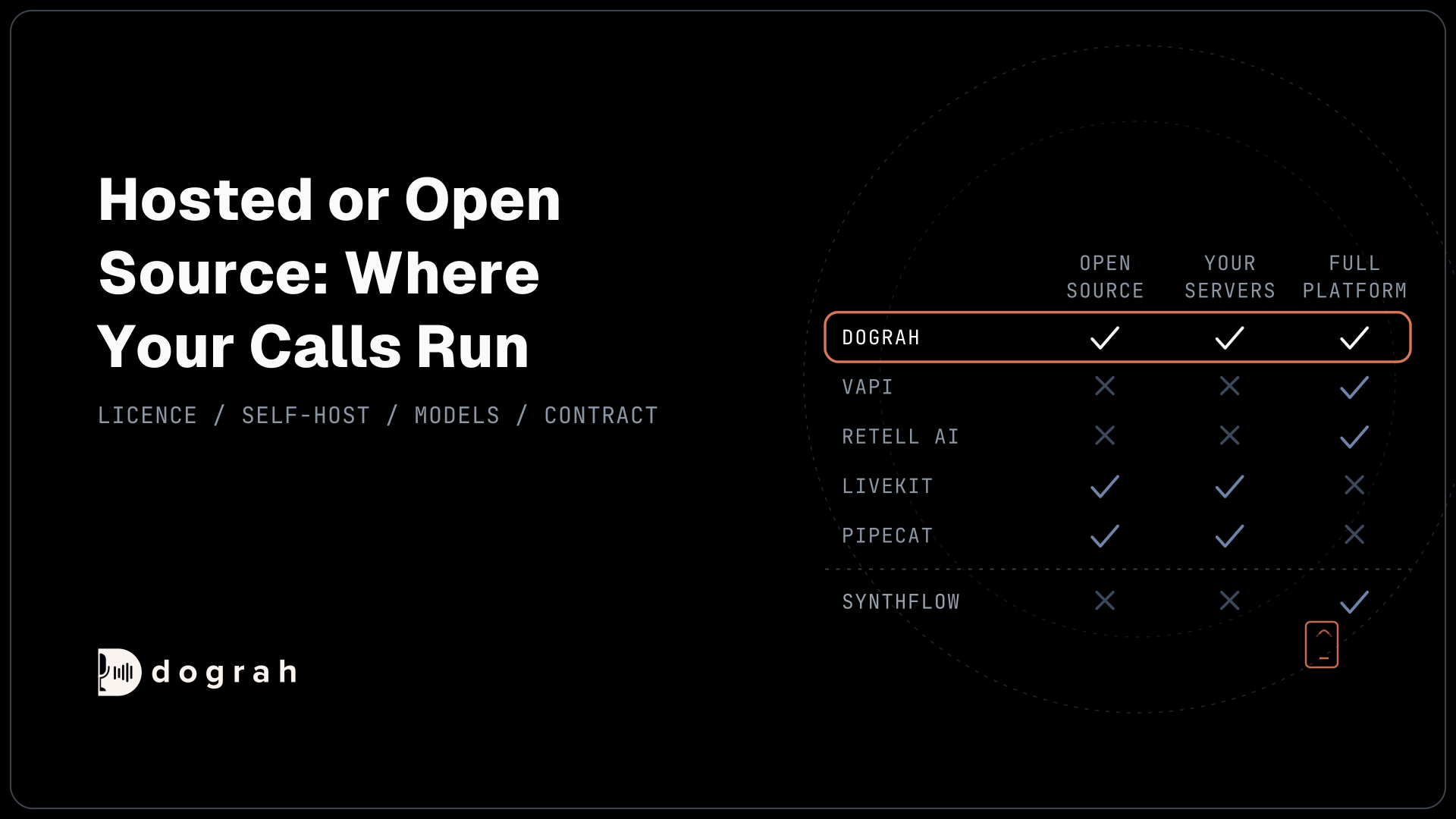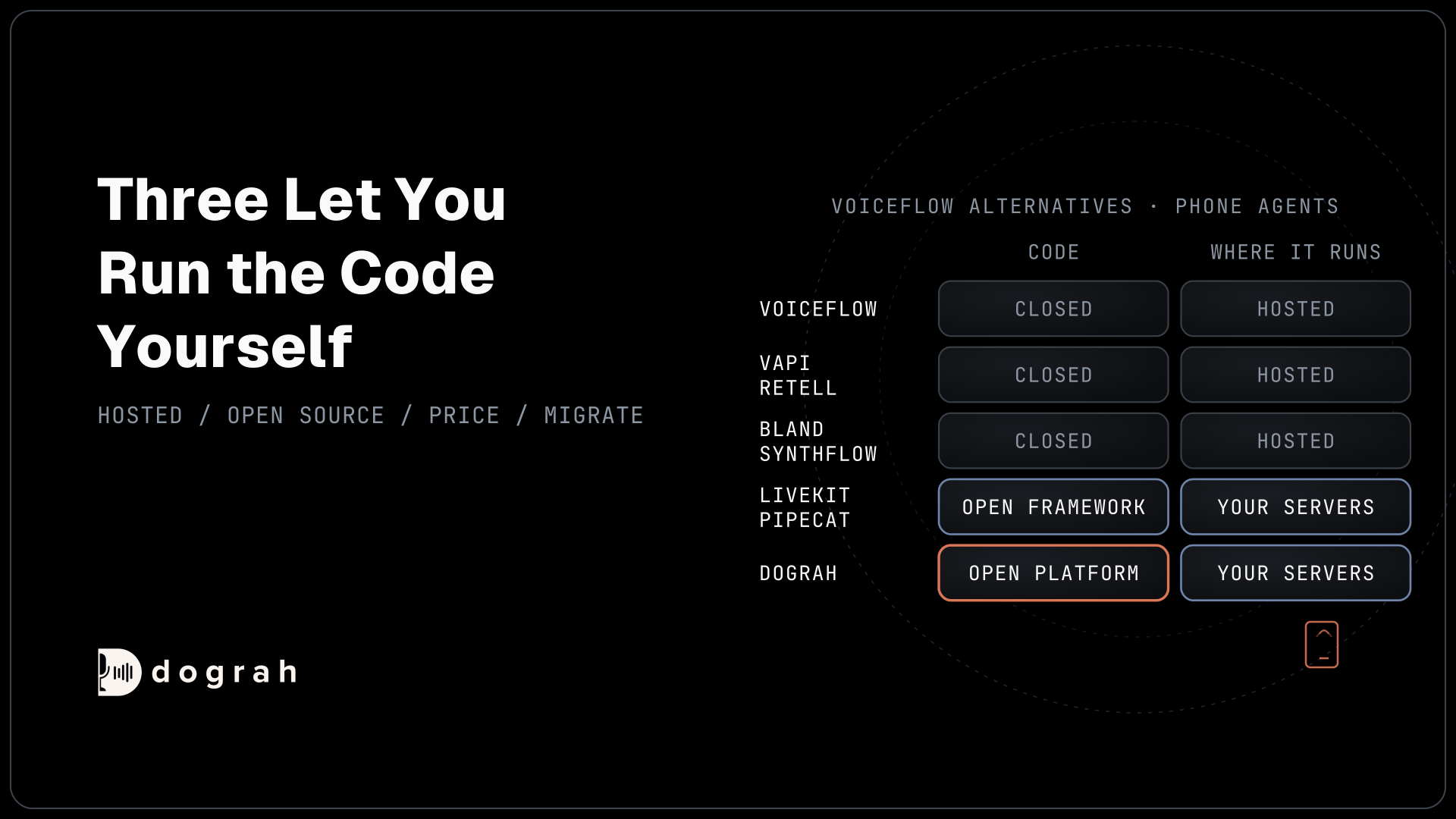

Voiceflow alternatives for phone agents fall into two groups. Vapi, Retell AI, Bland AI and Synthflow are hosted and closed source, like Voiceflow. Dograh, an open-source, self-hostable voice agent platform, runs on your own servers as a full platform with a visual builder. LiveKit Agents and Pipecat are open-source frameworks your developers build on.
Key Takeaways
- A Voiceflow phone minute is $0.05 before speech, voice and model credits.
- Dograh is open source, and self-hosted it charges no per-minute platform fee.
- Rebuild one agent, test it on a real phone line, then move one number at a time.
This guide compares the main Voiceflow alternatives for phone agents on cost and on where each one runs, then covers when to stay and what moving off Voiceflow takes. One of them is Dograh, an open-source voice agent platform that reads and writes your help desk or CRM during the call. You can self-host it or run it on Dograh Cloud.
What Voiceflow does on the phone today
Voiceflow is a platform for customer-support agents that work over chat, phone and SMS. Voiceflow can give you a US or Canadian number, with one number per workspace on your plan and more as an add-on. You can also connect your own Twilio, Vonage or Telnyx number.
Voiceflow phone numbers currently don't support outbound calling, so outbound calls go through a number you connect, one API request per call. Outbound and inbound calls share the same concurrency pool, so size the plan for both.
Inside a call, a Call forward step hands the caller to a phone number or a SIP address, callers can press keys on their keypad (DTMF), and Voiceflow can store call recordings. You pick the speech-to-text provider, the language model and the voice from Voiceflow's list.
Why teams look beyond Voiceflow for phone agents
Teams who search for an alternative to Voiceflow for phone calls usually want a different place to run it, a phone bill they can predict, or code they can keep.
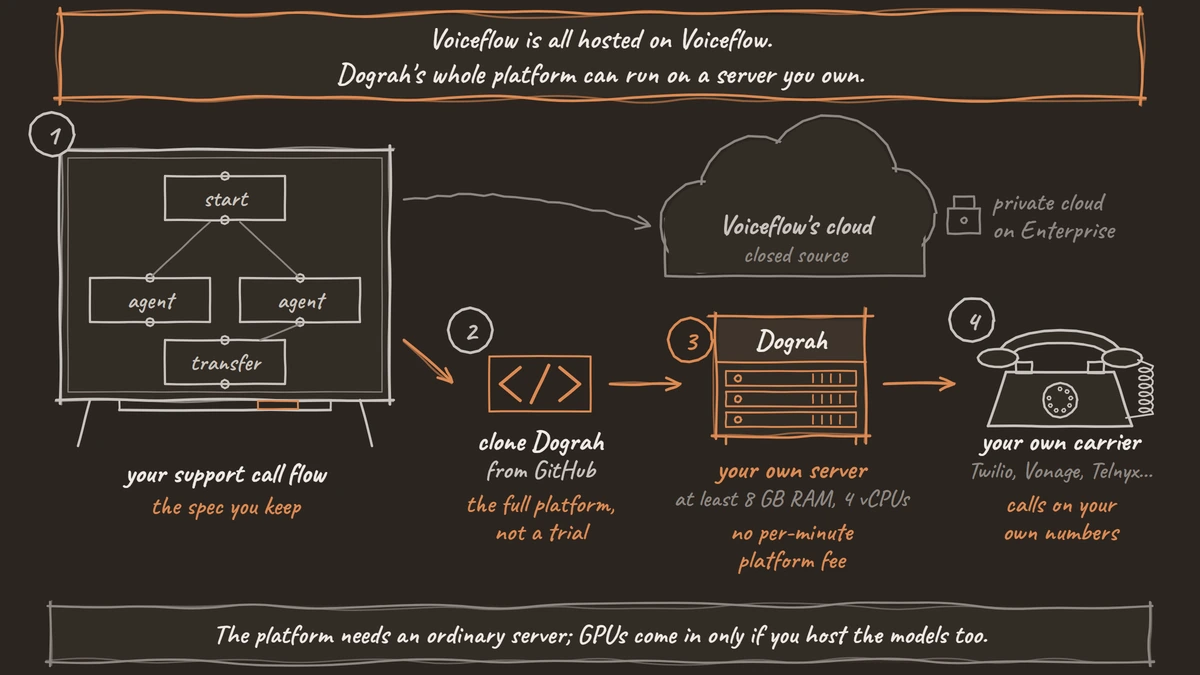
Start with hosting: Voiceflow's pricing page says its platform is "all hosted on Voiceflow", with private cloud hosting on the Enterprise plan.
Then the bill. Voiceflow's billing page says a bill is a monthly plan fee, add-ons such as editor seats and phone numbers, and credits for usage. In Voiceflow's credits pricing table, a phone minute is $0.05 on self-serve plans. Speech-to-text minutes, voice characters and language model tokens are each charged as credits on top, at a rate set by the provider and model you pick.
Plan prices show inside the app, under Plans and Billing, and Voiceflow quotes Business and Enterprise pricing on request. Each plan caps calls at once, and an add-on raises the cap. For the full bill, read Voiceflow Pricing Explained.
The last reason is lock-in. Voiceflow is closed source: its public GitHub holds libraries, demos and a command-line tool, not the platform. In a Zapier survey of US enterprise executives, 58% of those who had tried to change AI vendors said the move failed or took significantly more effort than planned. Keep each agent's spec in a file you own.
How we compared the alternatives
We judged each product on four things: the licence (can you read, change and keep running the code?), where it runs (your own servers, or on-prem without a sales contract), the list price, and what you get. A full platform ships the builder, telephony, call history and QA, while a framework gives developers building blocks and leaves the product to them.
Prices are each vendor's regular list price, never averaged into one "typical" rate, because the total depends on the models you pick. Latency is left out because it depends on your models and your phone path far more than on the platform, so measure it on your own calls.
PolyAI, Thoughtly, Leaping AI and Smallest AI are hosted voice agent platforms too. Air AI also appears, though the US Federal Trade Commission sued it in August 2025 over its marketing claims. The table keeps to the products most often weighed against Voiceflow for phone agents.
Voiceflow alternatives compared in one table
| Product | Open source | Self-host or on-prem | List price | What you get, and what's missing |
|---|---|---|---|---|
| Voiceflow (baseline) | No | Hosted on Voiceflow; private cloud on Enterprise | Plan fee plus credits: $0.05/min phone usage on self-serve plans, with speech-to-text, voice and model credits on top | One support agent across chat, phone and SMS, with native help desk and CRM tools, keypad input and SOC 2 Type II. But the code is closed, and outbound calls need your own Twilio, Vonage or Telnyx number |
| Dograh | Yes, BSD-2-Clause | Yes, free with Docker Compose; on-prem or private cloud on Enterprise; or Dograh Cloud | Self-hosted: no per-minute platform fee. Dograh Cloud: 1¢/min platform fee. Models and phone extra | Full platform: visual builder, your own carrier, inbound calls and outbound campaigns, per-step QA, any model layer including local models. Self-hosting puts uptime in your team's hands |
| Vapi | No | No. Runs on Vapi's cloud | $0.05/min hosting plus models and phone. Core $29/mo, Pro from $999/mo. HIPAA add-on $2,000/mo | Developer platform with any model for each part of the call. But HIPAA costs extra every month |
| Retell AI | No | Runs on Retell's cloud; a dedicated server is an Enterprise add-on | $0.07 to $0.31/min. 20 concurrent calls included, then $8/mo each | A choice of models, speech-to-speech and no charge for your own SIP trunk. But the code is closed |
| Bland AI | No | On-prem or VPC on Enterprise only | Start $0.14/min. Build $0.12/min plus $299/mo. Phone billed separately | One rate that covers Bland's own models. But Start allows 100 calls a day and Build 2,000 |
| Synthflow | No | Synthflow's cloud, hosted in the US or EU | Enterprise contracts from $30,000 a year | Voice-first, with native telephony or SIP and launch support. But every plan is an annual contract |
| LiveKit Agents | Yes, Apache-2.0 | Yes, or LiveKit Cloud | Free to self-host. LiveKit Cloud: free Build plan (1,000 min/mo), paid plans from $50/mo, then $0.01/min | Open-source framework with any model you wire in. But your developers build the agent and the product |
| Pipecat | Yes, BSD-2-Clause | Yes, or Pipecat Cloud | Free to self-host. Pipecat Cloud from $0.01/min per active agent | Open-source Python framework from Daily. But phone wiring, call history and live QA are yours to build |
Three let you run the code yourself, and only Dograh ships as a full platform. The prices use different units, so convert each one to your own monthly minutes before you compare.
Dograh: the open-source Voiceflow alternative
Dograh is open source under BSD-2-Clause, and its GitHub repository, with more than 5,900 stars, holds the full platform, not a trial.
You build the call in a visual workflow builder. A start step greets the caller, agent steps handle each part of the conversation, and pathways decide where the call goes next.
Dograh runs on the phone setup you already have: Twilio, Vonage, Plivo, Telnyx, Cloudonix, Exotel, Vobiz or Asterisk ARI. Inbound calls and outbound campaigns both run on your own numbers, and a campaign can be split between versions of the agent to test two openings.
To hand a caller to a person, Transfer Call works on Twilio, Telnyx and Asterisk ARI. It passes no summary by default; on Twilio it can play a short spoken introduction to both people. Write the details to your system with an HTTP API tool before the transfer.
Dograh also offers a text chat widget. You can add it to your website for voice or typed chat.
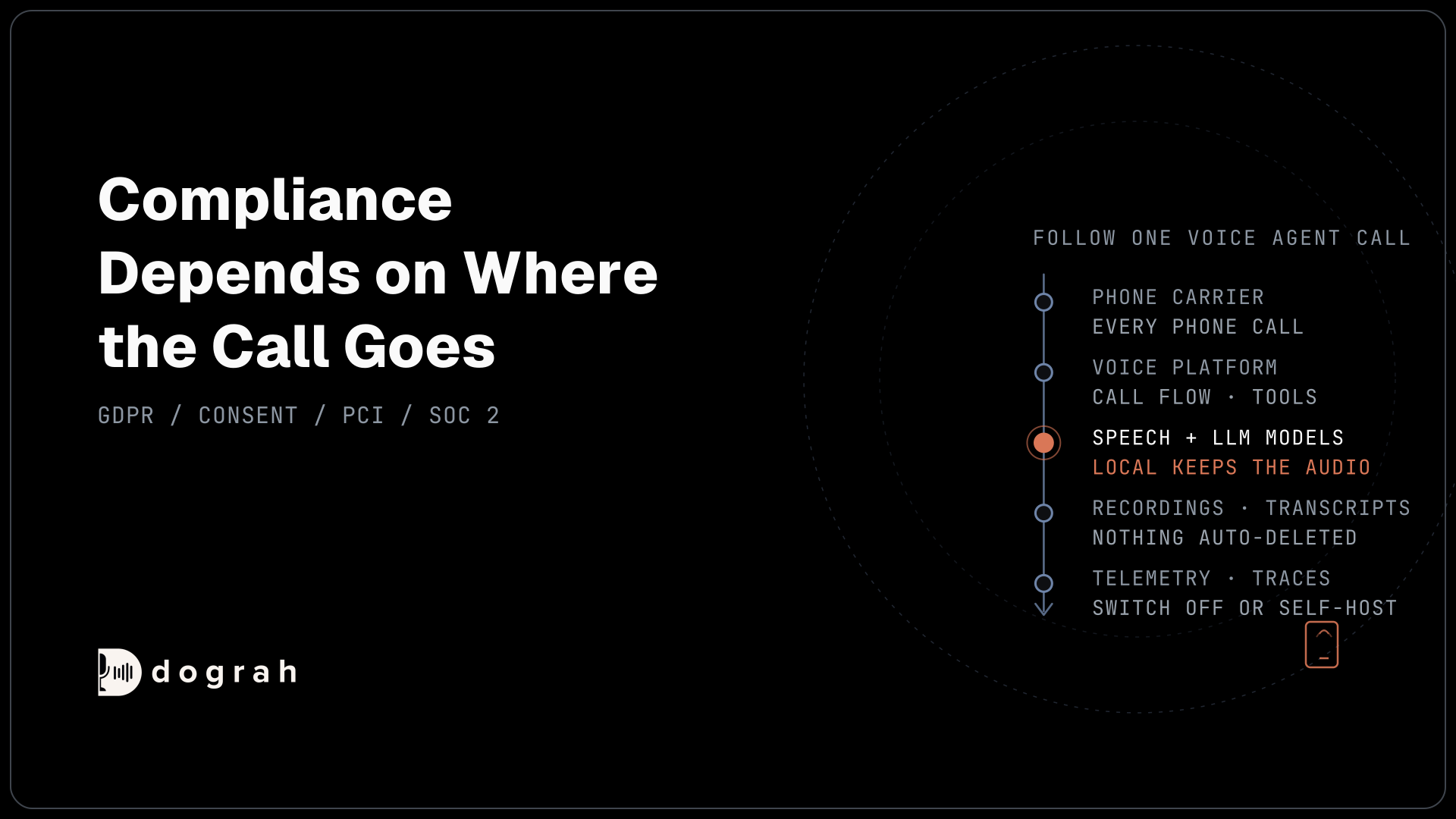
Dograh is the orchestration layer: it runs the call flow, tools and telephony, and the speech and language models are a separate layer you choose. That can be Dograh's own models, a provider on your own API key (bring your own key, or BYOK), or open-weight models you host yourself. With your own key, the audio still reaches that provider. The call audio stays in-house only when the speech and language models run on your own servers too. Our guide to running voice AI on local, self-hosted models covers that stack.
For patient calls, self-host Dograh. No BAA with Dograh is needed, because Dograh never sees the data. Your speech and language providers may need their own BAA, and your phone carrier may too. Dograh starts every account on its own managed models. To keep call audio away from Dograh, open Models, switch the Organization default to BYOK with your own speech and language providers (or local models), and check that no agent has its own model override.
Self-hosting uses Docker Compose on a server with at least 8 GB of RAM and 4 vCPUs, and runs 10 calls at once by default, a limit you can raise. Self-hosted Dograh has no per-minute platform fee (servers, model keys and phone minutes still cost); Dograh Cloud has a 1¢-a-minute platform fee and includes 10 concurrent calls. Dograh Cloud handles the security work for you. Our Dograh vs Voiceflow comparison goes through the two row by row.

Open Source Alternative to Vapi / Retell
Self-hosted voice agent platform — no per-minute fees
dograh-hq/dograh
Star on GitHub
Hosted voice platforms: Vapi, Retell, Bland, Synthflow
Four hosted, closed-source products come up most often as Voiceflow competitors for phone agents, each priced differently.
Vapi
Vapi is a developer platform. It charges $0.05 a minute for hosting, the same headline as Voiceflow's phone minute, and passes model costs through at the provider's price. Core is $29 a month for 10 concurrent calls, Pro costs 10% of your hosting fee with a $999 monthly minimum, and HIPAA is a $2,000 monthly add-on.
Vapi retired its visual Workflows on 18 August 2026, so agents are now set up as Assistants and Squads. See Vapi vs Voiceflow and Vapi alternatives.
Retell AI
Retell AI prices AI voice agents at $0.07 to $0.31 a minute, starting with $0.055 a minute for its voice infrastructure. Twenty concurrent calls are included, then $8 a month each. Retell offers OpenAI realtime speech-to-speech models, charges nothing for your own SIP trunk, and lets pay-as-you-go customers sign its BAA themselves. See Retell AI vs Voiceflow and Retell AI alternatives.
Bland AI and Synthflow
Bland AI runs its own speech and language models and folds them into one rate. Start is $0.14 a minute with no platform fee, 10 concurrent calls and 100 calls a day. Build is $0.12 a minute plus $299 a month, with 50 concurrent calls and 2,000 a day. Phone time is billed separately, and on-prem or VPC deployment comes with its custom Enterprise plan. Bland AI vs Voiceflow weighs Bland's own models against Voiceflow's pick-your-providers approach.
Synthflow sells one plan, Enterprise, with contracts from $30,000 a year. It suits larger teams that want a vendor to scope and launch the project with them. See Synthflow vs Voiceflow and Synthflow alternatives.
Open-source frameworks: LiveKit Agents and Pipecat
Pipecat is an open-source Python framework from Daily under the BSD-2-Clause licence, with more than 16,700 GitHub stars, and Dograh itself is built on a fork of it. A production phone agent needs more on top: phone wiring, call history, QA on live calls and the call lifecycle. Daily's managed version, Pipecat Cloud, starts at $0.01 a minute per active agent.
LiveKit Agents, also an open-source framework, runs on the LiveKit media server under Apache-2.0, with more than 14,800 stars. Its managed version, LiveKit Cloud, has a free Build plan with 1,000 agent minutes a month. Ship starts at $50 a month and Scale at $500, then $0.01 a minute.
Self-hosting the platform that runs your calls needs an ordinary server. Self-hosting the AI models needs GPUs, which cost money whether calls are flowing or not, and you can do the first without the second. If open source is the main reason you are leaving, our Open-Source Alternative to Voiceflow post explains how private cloud differs from open source.
When staying on Voiceflow makes sense
If your support runs mostly over text, Voiceflow is built for it. One agent answers on web chat, phone and SMS, and its live agent handoff step passes chats to Zendesk, Genesys, UJET, Kustomer or Dixa. Its native Zendesk, Salesforce, HubSpot and Shopify tools, keypad input, traffic splits across environments and PII redaction add-on save build time. If you want no servers at all, Voiceflow reports SOC 2 Type II, ISO/IEC 27001:2022 and GDPR compliance, and supports HIPAA deployments with a BAA.
Dograh covers the same needs its own way: HTTP API tools connect any help desk or CRM, outbound campaigns split calls between versions, and self-hosted Dograh runs inside your own perimeter, so there's no vendor to certify.
What moving off Voiceflow takes
Dograh has no Voiceflow importer, so each agent is rebuilt. Voiceflow's export environment API writes the agent, playbooks, tools and knowledge base into one document, which you keep as the spec. Rebuild the flow in Dograh's builder, or ask an AI assistant such as Claude Code or Cursor to build it through Dograh's MCP server. Prompts, provider keys and voice IDs (from ElevenLabs, for example) carry over.
A Twilio, Vonage or Telnyx number you connected stays in your own carrier account, so you connect that account to Dograh. For a number Voiceflow provisioned, set up a number with your own carrier. Copy each number's settings first, so you can roll back. When you save an inbound workflow on a number, Dograh sets the carrier's webhook for you if the credentials are correct, so check it rather than set it. For Vonage, the number must also be linked to the Vonage application, and a Signature Secret must be set.
Move one number at a time and keep Voiceflow running as the fallback. Test every transfer over a real phone call, because a browser call cannot transfer. Testing voice agents before you go live lists the checks in order, and How to Migrate From Voiceflow to Open-Source Voice AI has the full step-by-step.
Join the Dograh Community
Dograh is an OSS alternative to Vapi. Join our Slack community for queries, releases, best practices & community interactions.
Picking your Voiceflow alternative
If you want open source but will build the product yourself, LiveKit Agents and Pipecat are solid frameworks. If you want a hosted product, compare Vapi, Retell AI and Bland AI at your own call volume, and expect an annual contract with Synthflow. If your support runs mostly over chat, or leans on Voiceflow's native tools and keypad input, stay.
If call data has to stay on your own servers, or you want to stop paying a platform fee on every minute, Dograh gives you an open-source phone agent platform with the builder, telephony, transfers and per-step QA in place, on any model layer, including local models. Run one real call flow on it before you move a number: clone Dograh from GitHub and test on your own server with no contract, or start on Dograh Cloud.
Each Voiceflow comparison above has its own deep dive:
- Dograh vs Voiceflow
- Open-Source Alternative to Voiceflow
- Voiceflow Pricing Explained
- How to Migrate From Voiceflow to Open-Source Voice AI
- Vapi vs Voiceflow
- Retell AI vs Voiceflow
- Bland AI vs Voiceflow
- Synthflow vs Voiceflow
Glossary
- Credits
- Voiceflow's unit for usage. Phone minutes, chat messages, speech-to-text minutes, voice characters and language model tokens each use credits at a rate set by the provider and model, on top of the plan fee.
- Private cloud hosting
- Running a vendor's platform in a dedicated cloud set up for one customer, still under the vendor's contract and closed code. Voiceflow lists it on Enterprise; open-source self-hosting needs no contract.
- Traffic split
- Sending a share of calls to each version of an agent to compare them. Voiceflow splits traffic across environments; Dograh splits outbound campaigns across up to five agents or versions.
- Bring your own key (BYOK)
- Using your own account with a model provider instead of the platform's. You hold the contract and the bill, but the call audio still goes to that provider.