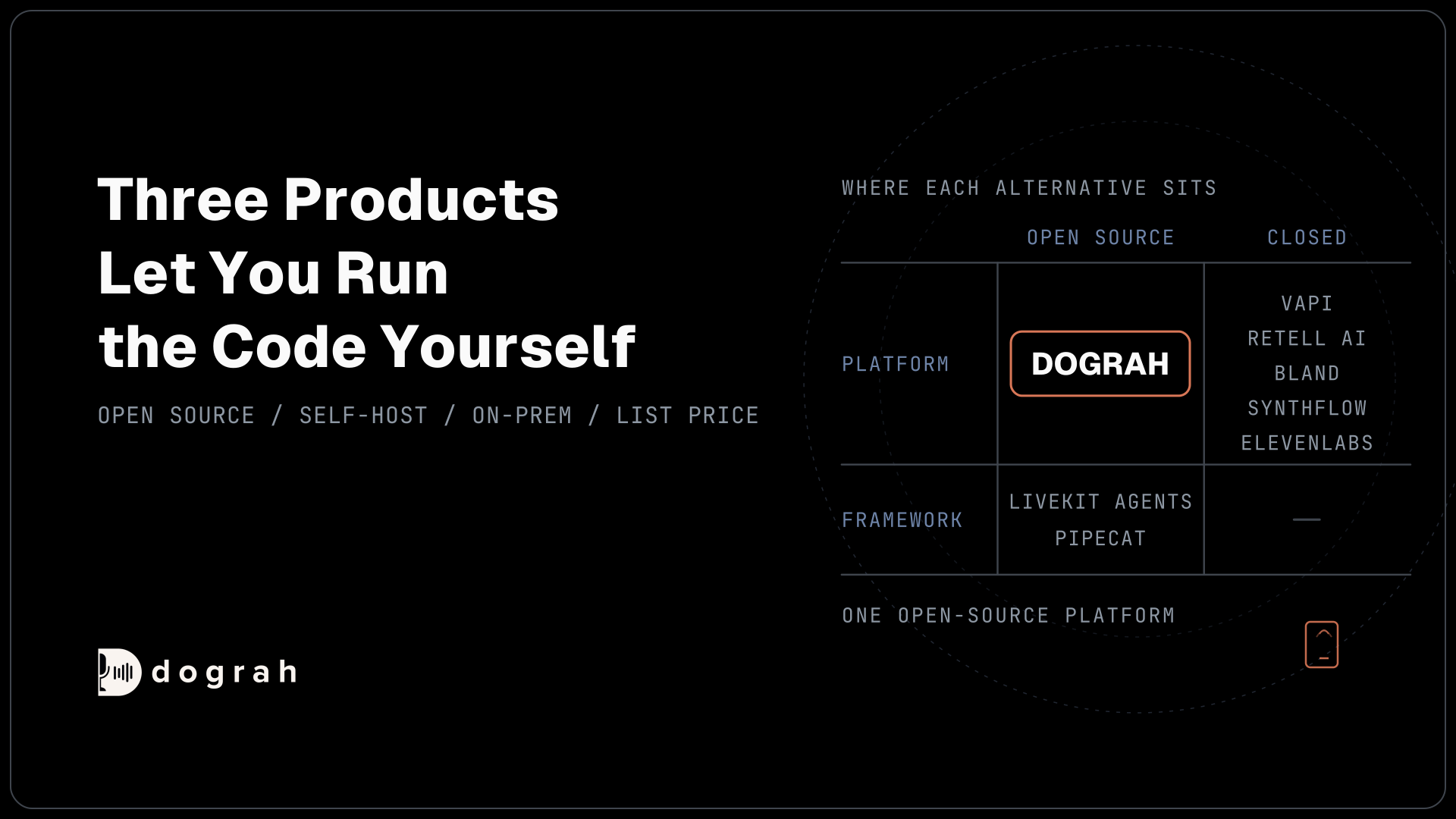

Teams leaving Vapi usually pick between hosted platforms and open-source options. Retell AI, Bland, Synthflow and ElevenLabs Agents are hosted and bill per minute on the vendor's cloud. Dograh, LiveKit Agents and Pipecat are open source and run on your own servers; Dograh comes ready to use as a full platform; the other two are frameworks you build on.
Key Takeaways
- Vapi's $0.05 hosting fee comes before models, voices and phone lines.
- Self-hosting Dograh removes the platform fee; servers, models and phone lines still cost money.
- When you switch, move your phone numbers over one at a time and keep Vapi running until each one works on the new platform.
Why teams look for a Vapi alternative
Teams usually start looking for an alternative to Vapi for one of two reasons: the bill grows with every minute, or they need to run the platform somewhere Vapi cannot go.
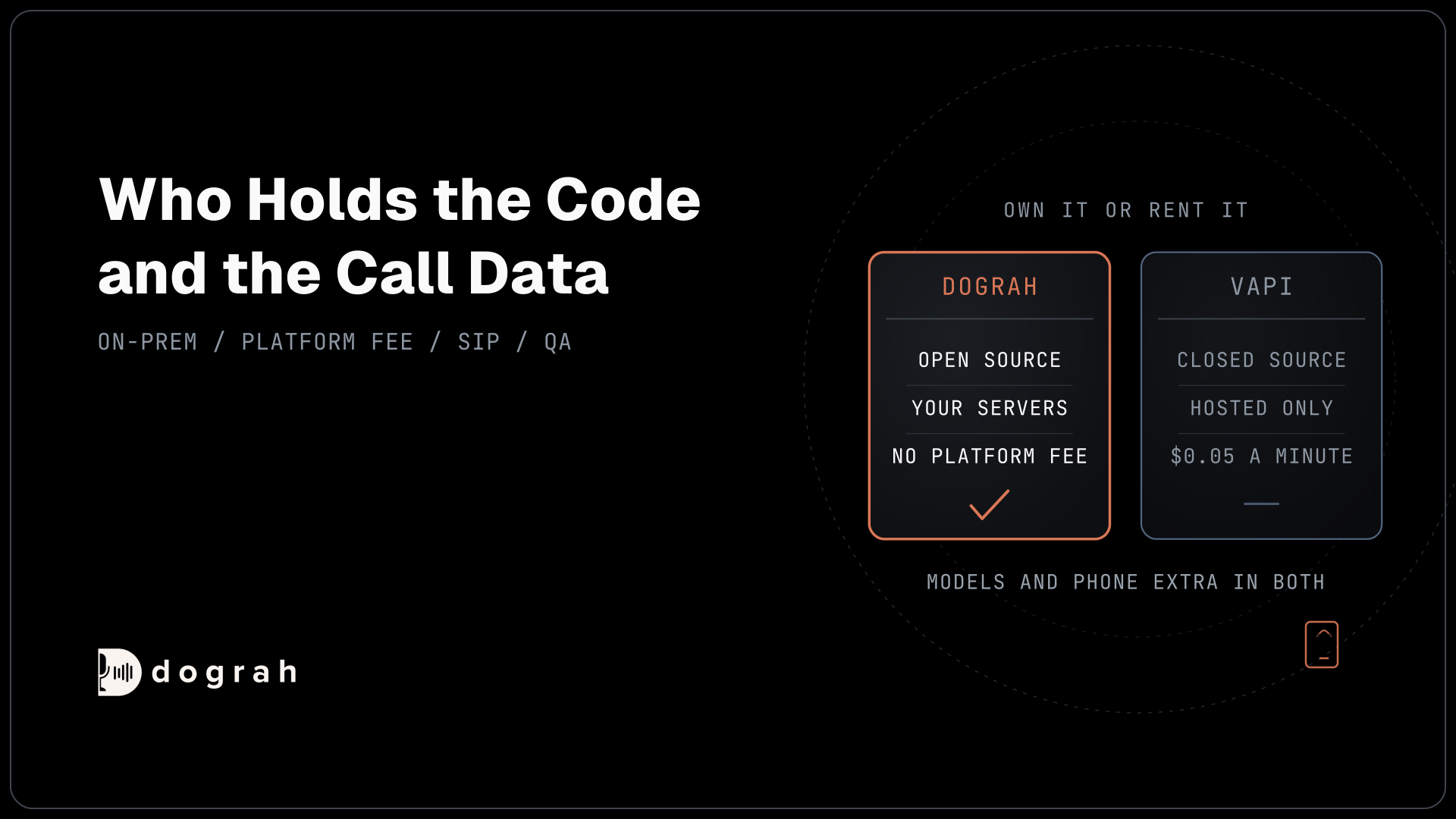
Start with the bill. Vapi charges a prepaid $0.05 a minute for hosting. Speech-to-text, the language model, the voice and the phone line are all billed on top, at each provider's price. At 1,000 minutes a day, that is about $18k a year in hosting fees alone, before models and phone ($0.05 x 365,000 minutes = $18,250).
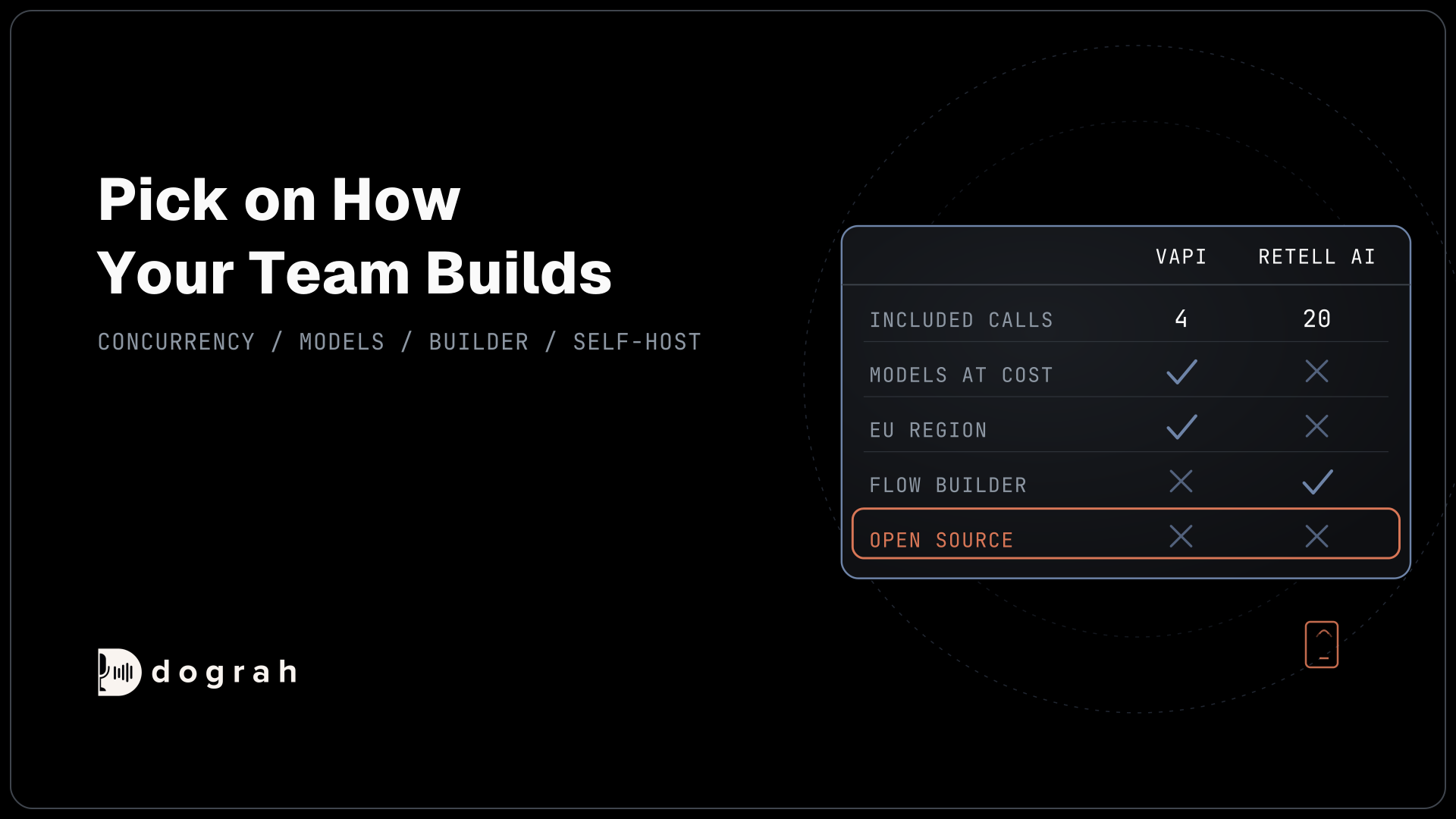
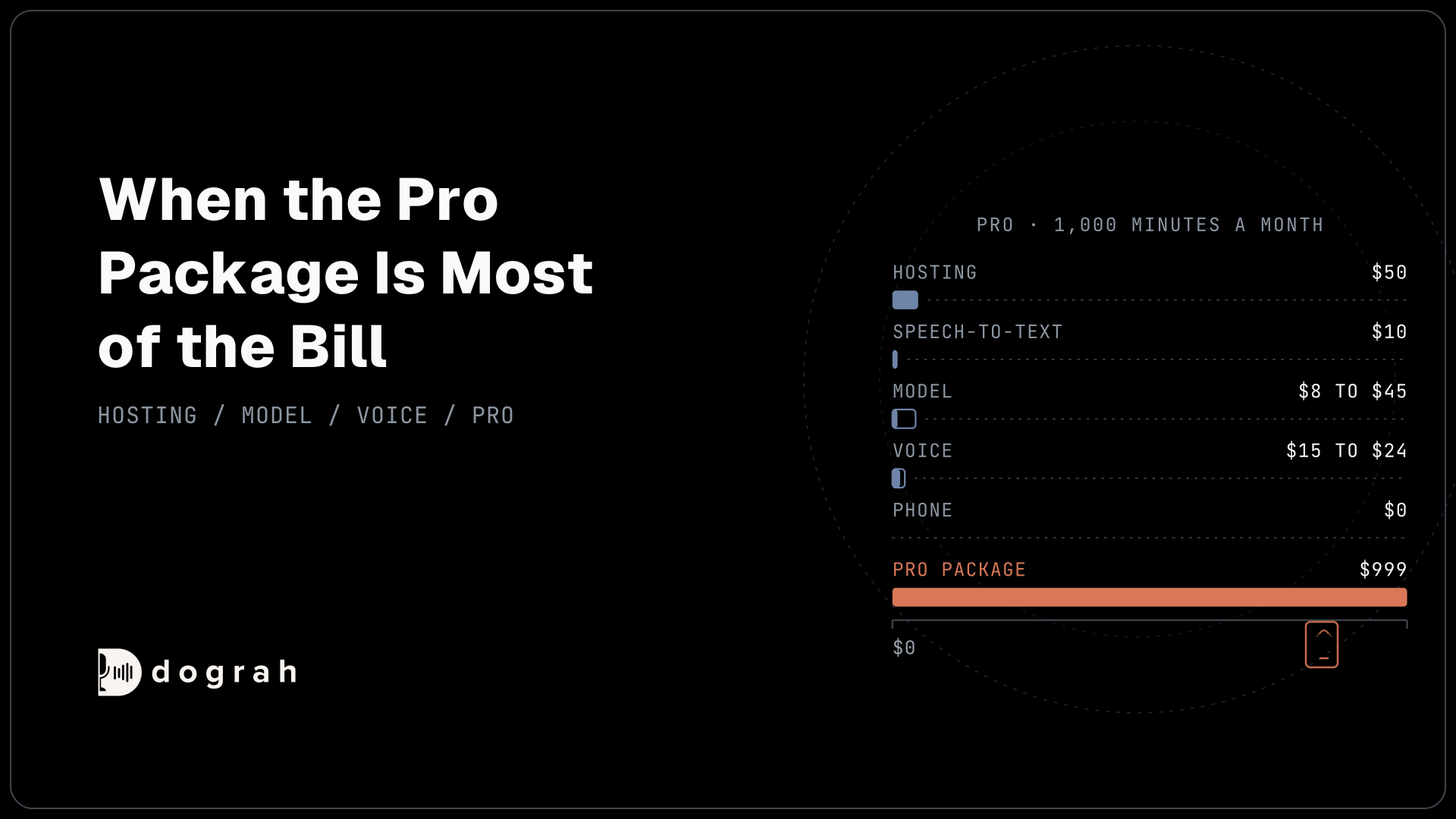
Vapi also changed its plans in mid-September 2026. With no package you get 4 concurrent calls. Core is $29 a month for 10, and Pro costs 10% of your hosting fee with a $999 monthly minimum, for 30. Premier is sold by contract. HIPAA handling is a $2,000 a month add-on that comes with a business associate agreement (BAA), and HIPAA mode cannot be combined with zero data retention. Customers who joined before the change may still be on their older terms.
Then there is control. Vapi is closed source, runs only on Vapi's cloud and does not support on-premise deployments. For a bank or a hospital that must keep call data inside its own walls, that ends the conversation.
One more change matters if you built visual call flows. Vapi retired its visual Workflows flow builder on 18 August 2026, and existing workflows stopped running the next day. Vapi agents are now Assistants and Squads, set up in the dashboard or in code.
So the cheaper alternative to Vapi depends on your volume and on where your data has to live. Our breakdown, Vapi Pricing Explained, works through the full bill for three different setups, line by line.
How we compared the alternatives
We judged every product on four things a team leaving Vapi actually has to live with.
The first is the licence. Can you read the code, change it and keep running it if the vendor changes course? The second is where it runs, and whether that can be your own servers or on-prem inside your network. The third is how it bills. Every price below is the vendor's regular list price, not a limited-time promotion. We never average them into one "typical" per-minute rate, because the total depends on the models you pick. The fourth is what you get out of the box. A full platform ships the builder, telephony, call history and QA. A framework gives you building blocks and leaves the product to you.
We left latency out of the table. It depends on your models and your phone path far more than on the platform name, so test it on your own calls before you commit.
We also kept the list to platforms you can actually run a Vapi-style phone agent on. Chat-first support suites and phone carriers solve a different problem, so they are left out. So is Vocode, an open-source framework that is no longer being updated, because a team leaving Vapi needs a project that will still get fixes next year.
Vapi alternatives compared side by side
The table puts every product next to Vapi on the same four questions. All prices are regular list prices.
| Product | Open source | Self-host or on-prem | List price | What you get, and what's missing |
|---|---|---|---|---|
| Vapi (baseline) | No | No. Runs only on Vapi's cloud, in the US or its EU region. Vapi does not support on-premise deployments | $0.05/min hosting, plus models and phone. Core $29/mo, Pro $999/mo minimum, HIPAA add-on $2,000/mo | Hosted developer platform with Assistants and Squads, set up in code or the dashboard. But it is closed source, its visual flow builder was retired in August 2026, and its scorecards grade the whole call rather than each step |
| Dograh | Yes, BSD-2-Clause | Yes. Self-host the full platform for free on your own servers with Docker Compose. On-prem inside your own network on Enterprise. Or use managed Dograh Cloud | Self-hosted: no per-minute platform fee. Dograh Cloud: 1¢/min platform fee. Models and phone extra | Full platform with a visual call-flow builder, telephony, call transfer, call traces and QA that scores each step of every call. The free version has community support rather than a vendor SLA |
| Retell AI | No | No self-host package. Runs on Retell's cloud; on-prem may be available for Enterprise customers, so ask Retell | No platform fee. $0.055/min voice infra, plus the language model per minute, plus $0.015/min telephony | Hosted platform with prompt agents and a visual Conversation Flow builder. But it is closed source with no self-host option, and its AI QA grades whole calls from a sample rather than each step, at $0.10/min after 100 free minutes |
| Bland | No | Only on Enterprise: on-prem or in your own VPC, by custom contract. The Start and Build plans run on Bland's cloud | Start $0.14/min. Build $0.12/min plus $299/mo. Enterprise custom | Hosted platform with self-serve per-minute plans and a visual Pathways builder. But on-prem needs an Enterprise contract |
| Synthflow | No | No self-host package. Runs on Synthflow's cloud | Enterprise only, from $30,000 a year | Hosted platform with a visual Flow Designer. But there is no self-serve plan, contracts start at $30,000 a year, and there is no self-host option |
| ElevenLabs Agents | No | No self-host package. Runs on ElevenLabs' cloud; on-prem may be available for enterprise customers, so ask ElevenLabs | Free plan with 15 min/month. Paid plans $6 to $990/month with included minutes; extra minutes $0.08/min, over-limit calls $0.16/min. AI model billed on top. Telephony at cost from your own carrier | Hosted agent platform from a text-to-speech company, with a visual workflow builder and plans that start free. But it is closed source, with no package you can host yourself |
| LiveKit Agents | Yes, Apache-2.0 (its turn-detector model has a separate LiveKit licence) | Yes. Self-host the framework and the LiveKit media server on your own servers or on-prem. You build and run the rest of the product. Managed option: LiveKit Cloud | Free to self-host. LiveKit Cloud: free plan with 1,000 min/month; $50/month for 5,000 min or $500/month for 50,000 min, then $0.01/min | Open-source framework with telephony and a managed cloud. But its Agent Builder is a single prompt with no workflows, so there is no visual flow builder, and call insights with recordings exist only in LiveKit Cloud |
| Pipecat | Yes, BSD-2-Clause | Yes. Self-host the framework on your own servers or on-prem. You build and run the phone wiring, call history and live-call QA. Managed option: Pipecat Cloud | Free to self-host. Pipecat Cloud from $0.01/min per active agent | Open-source Python framework with a visual flow editor. But its evals are for development, so there is no built-in QA for live calls, and call transfer does not work on the Twilio WebSocket route |
The table splits into two groups. Five hosted products bill per minute or by contract for as long as you use them, and none of them gives you code you can run yourself. Where on-prem is offered at all, it sits behind an Enterprise contract.
Three products let you run the code yourself. Two of them, LiveKit Agents and Pipecat, are frameworks. Dograh is the only open-source option that comes ready to use, with the builder, telephony and QA already in place, so your team starts from a working product rather than a toolkit.
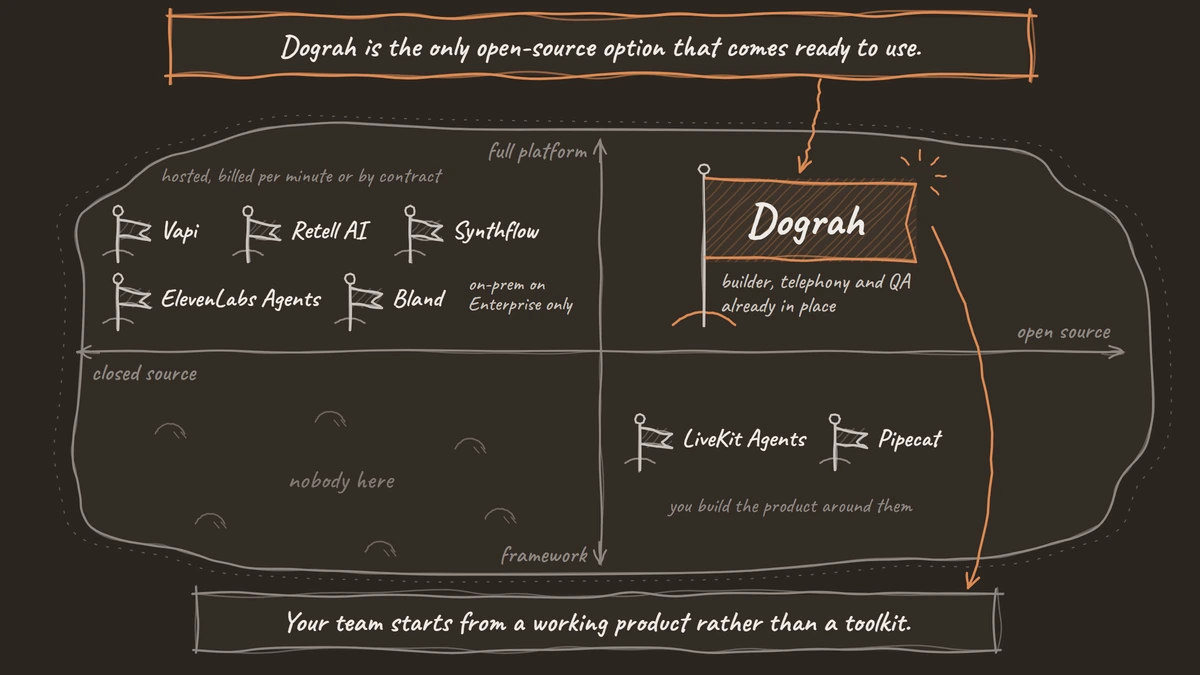
The prices use different units, so convert each one to your own monthly minutes before you compare them. Self-hosting removes the platform fee. Servers and AI models still cost money, and so do phone lines.
Dograh: the open-source Vapi alternative you can run on-prem
Dograh is an open-source voice agent platform under the BSD-2-Clause licence, and you can run all of it on your own servers. Dograh on GitHub has more than 5,800 stars. Of the platforms in this guide, it is the only one that is open source and also ships the full product: a visual flow builder, telephony, call transfer, call history, and QA that scores each step of every call, on test calls and live calls.
You build the call as a visual flow of steps joined by pathways. A greeting starts the call, agent steps handle each part of the conversation, and pathways decide where the call goes next. If your team built visual flows on Vapi before Workflows was retired, this is the closest match to how you already think about a call.
Dograh runs on the phone setup you already have. It works with Twilio, Vonage, Plivo, Telnyx, Cloudonix, Asterisk ARI or your own SIP trunk, and the numbers stay in your own carrier account. Call transfer to a person works on Twilio today. After each call, automatic QA reviews the transcript and gives each step of the flow its own score. It runs on test calls from the editor too, so you can catch problems before a single customer calls. When you need to debug, call traces show how long each part of every turn took.
You choose where it runs. Self-hosting uses Docker Compose on a server with at least 8 GB of RAM and 4 vCPUs. You need no GPU when you use model providers through API keys. For enterprises that must keep everything inside their own network, Dograh Enterprise offers on-prem deployment inside your data perimeter. Our post on why on-prem will win enterprise voice AI explains the case in full. If you would rather not run servers at all, Dograh Cloud is the managed version, with a 1¢/min platform fee.
Dograh is the orchestration layer. It runs the call, and it is not itself a model. You can fill the model layer with Dograh's own models, with any supported provider using your own API key, or with open-weight models you host yourself. Only the last option keeps the audio entirely on your servers. With your own key, you hold the contract, but the audio still reaches that provider. The phone carrier also carries the call either way. Our guide to running voice AI on local, self-hosted models covers that stack.
Self-hosting is real work. You run the server and the database and apply upgrades yourself, and the open-source version comes with community support rather than a vendor SLA. Custom SLAs come with Enterprise. That work is the price of a voice AI platform without vendor lock-in. Our side-by-side, Dograh vs Vapi, goes through every row from licence to QA.

Open Source Alternative to Vapi / Retell
Self-hosted voice agent platform — no per-minute fees
dograh-hq/dograh
Star on GitHub
Hosted alternatives to Vapi
Four hosted products come up most often as Vapi competitors. Like Vapi, each runs on the vendor's cloud and bills for as long as you use it.
Retell AI
Retell AI has no platform fee. Instead it charges $0.055 a minute for its voice infrastructure, then a separate per-minute price for the language model you pick, and $0.015 a minute for telephony. Models are billed per model, from $0.0016 a minute (GPT 5 nano) to $0.32 (GPT 6 Astra) at standard speed. Its faster tier and speech-to-speech models cost more.
It includes 20 concurrent calls, then charges $8 a month for each extra one. Retell reports SOC 2 Type 1 and Type 2 compliance and charges no extra fee to sign its BAA, though it is worth asking which plan you need before you budget on that. It offers prompt agents plus a visual Conversation Flow builder. Its code is closed, and its AI QA grades whole calls from a sample rather than each step, at $0.10 a minute after the first 100 free minutes. On-prem may be available for Enterprise customers; ask Retell directly.
Retell suits teams that want a hosted visual builder and more included concurrency than Vapi's base plan. Our head-to-head, Vapi vs Retell AI, compares the two row by row.
Bland
Bland sells by the minute. Its Start plan is $0.14 a minute with no platform fee and 10 concurrent calls. Build is $0.12 a minute plus $299 a month, with 50 concurrent calls.
Bland lists on-prem or VPC deployment, but only on its custom Enterprise plan. It suits high-volume teams that are ready to negotiate a contract to get there. The open-source options further down can go on-prem without a contract, though your team then runs them.
Synthflow and ElevenLabs Agents
Synthflow no longer sells self-serve plans. Enterprise contracts start at $30,000 a year, scoped around call volume, concurrency, telephony, integrations and security needs. It suits larger teams that want a vendor to scope and launch the project with them.
ElevenLabs Agents has a free plan with 15 call minutes a month, then paid plans from $6 a month for 75 minutes up to $990 a month for 12,375 minutes. Extra minutes cost $0.08 each, calls above your plan's concurrency limit cost $0.16 a minute, and the AI model is billed on top. ElevenLabs adds no telephony fee; your own carrier, such as Twilio or a SIP trunk, bills you directly at its own rate. It comes from a text-to-speech company, and it suits teams that already use ElevenLabs voices and want the agent from the same vendor. Both are closed source, and ElevenLabs may offer on-prem to enterprise customers, so ask them directly.
Open-source frameworks: LiveKit Agents and Pipecat
LiveKit Agents and Pipecat are open-source frameworks. They give developers strong building blocks for a voice agent, and you build the product around them.
Pipecat is a Python framework from Daily under the BSD-2-Clause licence, with more than 16,000 GitHub stars. Dograh itself is built on a fork of Pipecat. In our experience Pipecat is an excellent base, but a production deployment needs a lot of extra plumbing: phone integrations, call history, QA on live calls and the call lifecycle. Pipecat has a visual flow editor, but its evals are built for development, so checking live calls is left to third-party tools. Daily also runs a managed version, Pipecat Cloud, from $0.01 a minute per active agent on its smallest agent size.
LiveKit Agents runs on the LiveKit media server under Apache-2.0, with more than 14,000 stars. One detail matters if open source is the reason you are leaving. LiveKit's turn-detector model ships under a separate LiveKit Model License rather than Apache-2.0. Its Agent Builder is a single-prompt form for simple agents, with no workflows or handoffs, and call insights with recordings are only available in LiveKit Cloud, not when you self-host. The managed version, LiveKit Cloud, has a free plan with 1,000 agent minutes a month. Paid plans start at $50 a month for 5,000 minutes and $500 for 50,000, then $0.01 a minute.
Keep two decisions apart here. Self-hosting the platform that runs your calls needs an ordinary server. Self-hosting the AI models needs GPUs, which cost money whether calls are flowing or not. You can do the first without the second.
If open source is your main reason for leaving, our guide to the Open-Source Alternative to Vapi goes deeper into licences and the real cost of self-hosting.
When staying on Vapi makes sense
Vapi still fits some teams well, and a switch only pays off if it fixes a real problem for you.
If you are still testing an idea, Vapi is quick to start. You get $5 in free credits and one free US phone number for inbound calls, and the per-minute cost only starts to hurt at production volume. Do the cost math once you move past the prototype.
If your engineers like configuring agents in code, already run their agents as Squads, and have priced the full stack into the product's margins, moving costs engineering time and may not save enough to be worth it.
If you want no servers at all and need the vendor to hold the certifications, Vapi reports SOC 2 Type II, HIPAA and GDPR compliance. If you need written uptime terms, its Pro package includes a 99% uptime SLA and Premier a 99.9% one. Self-hosted Dograh puts uptime in your hands.
If none of those describes you, and the bill or the data question is what brought you here, keep reading.
What moving off Vapi takes
Switching AI vendors is harder than it looks, so plan the move before you start it.
Three parts of the move take the most work. Every assistant is rebuilt, because Vapi has no export button and Dograh has no Vapi importer. Free Vapi numbers can't be ported out, so those numbers change. And a tool server written for Vapi's message format needs a small adapter. Plan for all three before you move a single number.
Start with the agent itself. Read each assistant's settings through Vapi's API and keep that file as the spec. Then rebuild the flow, either in the visual builder or by asking an AI assistant such as Claude Code or Cursor to build it through Dograh's MCP server. Your prompts and provider keys carry over, and so do voice IDs from providers such as ElevenLabs. Vapi's own voices do not.
Phone numbers need the most care. Free Vapi numbers cannot be ported out, so you replace them. A Twilio number you own stays in your account. In Dograh, saving an inbound workflow on a Twilio number switches that number to Dograh at once, and removing it later leaves the number blank rather than switching it back. Copy the number's current settings in Twilio before you save, so you can roll back.
Move one number at a time and keep your Vapi account running as the fallback. Dograh can split calls between agents only for outbound campaigns, so for incoming calls, the number is the unit you move. Test every call transfer over a real phone call, because a browser test call cannot transfer. Our guide to testing voice agents before you go live lists the checks in order.
The full step-by-step, from export to cutover, is in How to Migrate From Vapi to Open-Source Voice AI.
Join the Dograh Community
Dograh is an OSS alternative to Vapi. Join our Slack community for queries, releases, best practices & community interactions.
Picking your Vapi alternative
The right choice depends on where your calls must run and who will run the platform.
If call data has to stay on your own servers, or on-prem inside your network, Dograh gives you that as an open-source platform, with on-prem deployment on Enterprise when you need a contract behind it. If you want open source but will build most of the product yourself, LiveKit Agents and Pipecat are solid frameworks to start from. If you want a hosted product and accept per-minute billing, compare Retell AI, Bland and ElevenLabs Agents at your own call volume, and expect an annual contract with Synthflow. And if Vapi's cost and hosting already work for you, stay.
Whichever way you lean, run one real call flow on the new platform before you move a number. With an open-source platform you can do that test on your own server, with no contract and no platform fee.
Each part of this comparison has its own deep dive:
- Dograh vs Vapi
- Open-Source Alternative to Vapi
- How to Migrate From Vapi to Open-Source Voice AI
- Vapi Pricing Explained
- Vapi vs Retell AI
Glossary
- Pass-through pricing
- Billing the speech-to-text, language model and voice at each provider's own list price, with no markup, on top of the platform's own fee. Vapi bills this way; Retell sets its own per-minute price for each model instead.
- Concurrent call line
- One slot for a live call. Hosted plans cap how many calls run at once, and when every slot is busy, new calls cannot start until one frees up.
- Orchestration layer
- The part of a voice agent that runs the call: the flow, turn-taking, tool calls and the phone connection. The AI models are a separate layer you can swap.
- Bring your own key (BYOK)
- Using your own account with a model provider instead of the platform's. You hold the contract and the bill, but the call audio still goes to that provider.