
For regulated enterprises in healthcare and finance, yes. Call audio and personal data cannot leave your infrastructure without breaking HIPAA and data residency laws like GDPR. On-prem voice AI keeps every layer inside your perimeter. It only works with open-source models you can self-host, and it removes per-minute vendor fees.
Key Takeaways
- Closed AI models cannot be self-hosted, so hosted on-prem still sends data out.
- Per-minute vendors cannot drop the meter because the meter is their business.
- Only open-source models let you keep call audio inside your own network.
Enterprise voice AI is quietly moving off the public API and back onto infrastructure the buyer owns, which is the shift we built the open-source Dograh platform around. Here is why the vendors charging by the minute cannot follow.
Why enterprises are pulling voice AI in-house
The pressure to run voice AI on-prem is coming from compliance and finance teams more than from engineering.
Demand for voice agents is climbing fast. The AI voice agents market was worth 2.54 billion dollars in 2025 and is projected to reach 35.24 billion by 2033. As call volume grows, so does the amount of sensitive audio flowing through these systems, and regulators have noticed.
Enterprises are reacting by pulling data back inside their own borders. Gartner expects more than 75 percent of European and Middle Eastern enterprises to move workloads into sovereign solutions by 2030, up from under 5 percent in 2025. The sovereign cloud market itself is forecast to grow from 154 billion dollars in 2025 to 823 billion by 2032. The buying signal is just as clear. In a Deloitte enterprise AI survey, 73 percent of enterprises named data privacy and security as their top AI risk, and 77 percent said they now weigh a vendor's country of origin before they buy. On-prem voice AI answers both concerns directly.
What on-prem really means, and why closed models cannot do it
On-prem is one of several deployment shapes, and the differences decide exactly what data ever leaves your network.
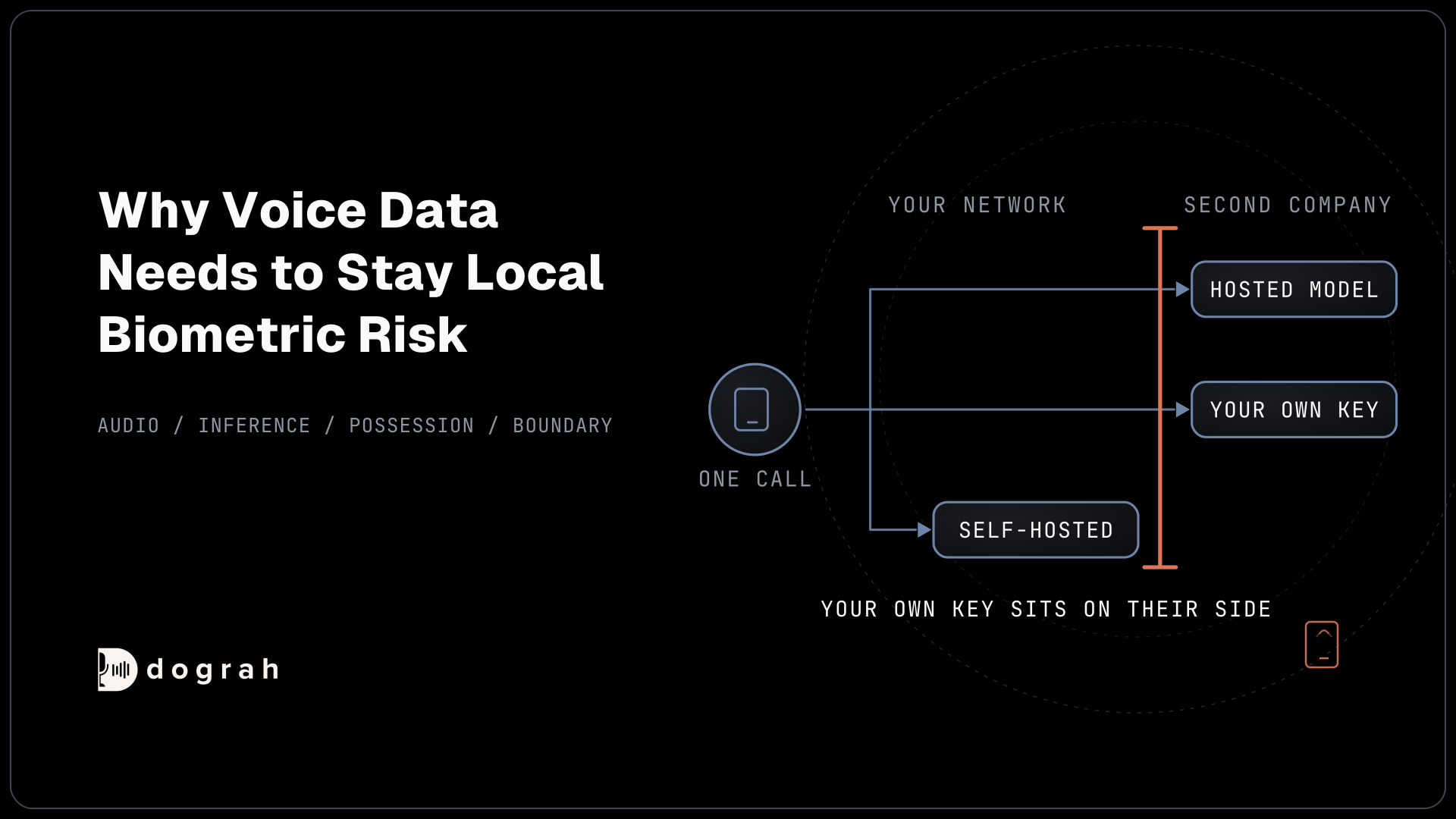
A fully hosted setup is the default for most per-minute platforms. The vendor runs everything, and you connect over an API or a SIP trunk, so your call audio and personal data pass through servers you do not control. A private-cloud or VPC deployment moves the vendor's software into your own cloud account. It narrows the exposure, though the underlying models still call out to the provider's endpoints in many cases, so the boundary is softer than it looks. True on-prem, sometimes called colocation, runs the whole pipeline inside your perimeter. Speech-to-text, the language model, text-to-speech, and the telephony layer all sit on hardware you own or rent, and no call data crosses the boundary. This is the only shape that satisfies the strictest residency rules, and it is the shape hosted vendors find hardest to offer.
There is a hard reason they find it hard. You cannot colocate a model whose weights you are not allowed to hold. Closed providers like GPT, Cartesia, ElevenLabs, and Deepgram sell you access to a model without ever handing over the model itself, so there is no artifact you can install on your own server. When one of these vendors says colocation, the best they can offer is picking a cloud region near your other services, and your audio still leaves your building to land on their machines. That single constraint decides the whole architecture. A platform built around closed APIs can bolt on a private-cloud tier, yet the sensitive processing still happens on someone else's hardware. If the models are closed, on-prem is a marketing word. If the models are open, on-prem is something you can actually audit.

Open Source Alternative to Vapi / Retell
Self-hosted voice agent platform — no per-minute fees
dograh-hq/dograh
Star on GitHub
Regulated industries cannot send call data to SaaS vendors
For healthcare and finance, handing raw call audio to a third-party API is enough to fail an audit.
Take HIPAA. A compliant voice deployment needs a signed Business Associate Agreement at every layer, covering the language model, the speech-to-text engine, the text-to-speech engine, the telephony provider, and the platform itself. Prosper AI's 2026 HIPAA analysis counts up to five separate agreements, with civil penalties reaching 2,190,294 dollars per violation category per year. Every closed vendor in the chain is one more BAA to negotiate and one more party that touches patient data. Patient scheduling is where this shows up first, and reducing healthcare no-shows with voice agents walks the same chain through a single reminder call. Finance has the same problem written into statute rather than contract, and right-party verification on collections calls shows why the recording has to stay somewhere you can produce it on demand.
The cost of getting this wrong keeps rising. IBM's 2025 Cost of a Data Breach Report found healthcare stayed the costliest sector for the fourteenth year running at 7.42 million dollars per breach, and breaches took 279 days on average to identify and contain, against a global average of 4.44 million dollars. Self-hosting removes the problem at the root. When every model runs inside your own perimeter, there is no third party to sign a BAA with and no audio leaving your network. That is why self-hosted voice AI for regulated industries has become the default ask from hospitals and banks rather than a nice-to-have.
The open-source stack that makes on-prem pay off
A fully self-hosted voice pipeline is now buildable from open models at every layer, and the economics improve as you go.
For speech-to-text, Whisper and Voxtral run well on your own GPUs. For the reasoning layer, open language models like Llama and Qwen serve through vLLM or Ollama, so the model never leaves your network. For the voice itself, Kokoro and Piper generate natural speech locally, with Coqui and Chatterbox as further options, while the telephony layer sits on Asterisk and standard SIP trunking with ARI for low-level call control on your own hardware. Running these together on one server or in one availability zone is what colocation actually buys you. Every network hop between services adds delay, and voice is unforgiving about delay, so keeping the models next to each other is one of the biggest levers for sub-800ms speech latency, which in turn shapes how natural the agent sounds in the opening seconds of a call.
Open models also change the cost base, since you pay for compute instead of a per-token retail markup. The advertised rate is rarely the real one. Once speech-to-text, the model, voice synthesis, and telephony are stacked on the platform fee, the all-in cost of a hosted deployment runs 0.12 to 0.25 dollars per minute for most production workloads. Most platforms charge a platform fee of roughly 5 to 7 cents a minute on its own, before any AI usage is added on top. Run the math at volume. A workload of 1,000 minutes a day at those rates lands somewhere between 15,000 and 30,000 dollars a year, and it climbs with every new campaign. Self-hosting turns that meter into a fixed infrastructure line, so you pay for the servers and the marginal cost of another minute is close to zero. Because you can bring your own keys or run open weights across every layer, the AI usage charge that dominates the per-minute bill drops sharply. This is the same fixed-versus-metered gap that shows up in automation versus traditional systems, where the metered option looks cheaper on day one and costs more every day after.
Join the Dograh Community
Dograh is an OSS alternative to Vapi. Join our Slack community for queries, releases, best practices & community interactions.
Why per-minute vendors cannot follow you on-prem
Hosted platforms can advertise a private deployment, yet their closed models still send data out and their meter never stops.
Look closely at how per-minute platforms handle the enterprise ask. They will offer a private-cloud tier and a stack of compliance documents, and both help. What they cannot offer is a stack you fully own, because the speech and language models underneath are closed. The residency guarantee ends at the model boundary, and the per-minute charge stays exactly where it was. This is the gap Dograh was built to close. It is an open-source voice agent platform under a BSD-2 license, designed to be self-hosted from the ground up. You can colocate an open stack and bring your own keys for any commercial model, or drop commercial models entirely and run open weights from end to end. There is no per-minute platform fee, and because the whole system is open, data residency and auditability come with the deployment instead of a contract addendum.
The reason a hosted rival cannot simply copy this is structural. Vendor lock-in is already a board-level worry. In a 2026 cloud computing survey, 94 percent of organizations said they were concerned about lock-in, and only 6 percent believed they could switch their main AI provider without serious operational disruption. A hosted voice vendor benefits from exactly that friction, because a customer who cannot leave keeps paying the meter. Now imagine that vendor genuinely lets you self-host open models on your own hardware with no per-minute charge. Their revenue is the meter. Remove it, and there is very little company left. They can announce an on-premise option, yet they cannot hand you the open weights and switch off billing without dismantling the thing that makes them a business. An open-source platform starts from the other side, because there was never a meter to protect, so self-hosting is the default rather than a threat to the model.
What to check before you move voice AI on-prem
Before you commit, confirm the platform is genuinely self-hostable and free of hidden model dependencies.
Start with the license, since a platform you can install and run yourself is auditable in a way a closed product never is. Then check the model layer. Ask whether you can bring open weights at every model layer, and whether any step quietly falls back to a closed API that ships audio out. Confirm that telephony can run on your own SIP or Asterisk setup so the call path stays inside your network too. Finally, follow the money. A real on-prem option should turn your cost into fixed infrastructure, with no per-minute fee riding on top, and if a vendor cannot remove the meter, the deployment is not truly yours.
For regulated enterprises, the direction is set. Sovereignty and cost are pushing voice AI onto infrastructure the buyer controls, and only an open, self-hosted stack can deliver both. The vendors built around a per-minute API will keep offering half-measures, because following you all the way on-prem would mean giving up the meter that pays their bills.
Glossary
- Colocation
- Hosting speech-to-text, the language model, and text-to-speech on the same server or availability zone to cut network hops. It only works with open models you can self-host.
- Data residency
- The requirement that call audio and personal data physically stay inside a specific country or jurisdiction.
- Business Associate Agreement (BAA)
- A HIPAA contract that makes a vendor legally liable for protecting patient data. A hosted voice stack needs one at every layer.
- Geopatriation
- Moving cloud and AI workloads back inside national borders to satisfy sovereignty rules.