
Open-source options for replacing Vapi come in two kinds. Pipecat and LiveKit Agents are frameworks: you build the platform around them. Dograh is a full platform under BSD-2-Clause, with a visual builder, telephony, call transfer and QA included. Self-hosting it with API model keys needs a server, not a GPU, and has no per-minute platform fee.
Key Takeaways
- Frameworks run the conversation; Dograh adds the product around it, including QA on live calls.
- Self-hosting Dograh with API keys runs on 8 GB RAM and 4 vCPUs, no GPU.
- Self-hosted Dograh keeps call records on your servers; the carrier and model APIs still hear the audio.
This post is part of our guide to Vapi alternatives. The guide compares hosted and open-source options side by side. This one is for developers who have already decided they want the code, and it covers what changes once that code runs on your own servers.
Frameworks and platforms solve different halves of the job
"Open source" covers two different things when you leave Vapi, and only one of them replaces Vapi as a product.
Pipecat and LiveKit Agents are frameworks. Pipecat (BSD-2-Clause) has more than 16,000 GitHub stars and LiveKit Agents (Apache-2.0) more than 14,000. They handle the live conversation in code, and much of the product around it is left to you. LiveKit's Agent Builder is a single prompt with no workflows, and its call insights with recordings exist only in LiveKit Cloud. Pipecat has a visual flow editor, but its evals are for development, so checking live calls needs a third-party tool.
Dograh itself runs on a fork of Pipecat. Pipecat is an excellent base, but a production deployment on it needs a lot of extra plumbing, and Dograh ships that plumbing as a platform: a visual workflow builder, telephony with Twilio, Vonage, Plivo, Telnyx, Cloudonix, Asterisk ARI or your own SIP trunk, call transfer, automatic QA and call traces. It is BSD-2-Clause too, with more than 5,800 GitHub stars. If you are weighing Pipecat vs Dograh, the real question is how much of the product you want to build yourself.
Two other names come up when developers search for this. Bolna (MIT) opens its orchestration layer, while its hosted APIs and no-code UI stay closed source. TEN Framework uses Apache 2.0 with added conditions tied to Agora. LiveKit's turn-detector model also ships under its own LiveKit Model License rather than Apache-2.0.
The table shows what each path leaves on your desk.
| What changes | Vapi (hosted) | Dograh, self-hosted | Pipecat or LiveKit Agents |
|---|---|---|---|
| Licence | Closed source | BSD-2-Clause | BSD-2-Clause (Pipecat), Apache-2.0 (LiveKit Agents) |
| Who runs the servers | Vapi, on its own cloud | You, on your own servers or on-prem | You, on your own servers or on-prem (or their paid managed clouds) |
| Where call records live | Vapi's storage | Your own database and object storage | Wherever you build it to store them |
| Platform fee | $0.05/min hosting, plus models and phone | None. You pay for servers, models and phone | None when self-hosted. You pay for servers, models and phone |
| What you still build | Your assistants, prompts and integrations | Your call flows and integrations. The builder, telephony, transfer, QA and call history come with it | Your agent in code, plus live-call QA and, on self-hosted LiveKit, a call-history dashboard |
| When upgrades happen | When Vapi ships them, for every customer at once | When you choose to install a new release | When you choose to install a new release |
Self-hosting Dograh needs a server, not a GPU
Running the platform and running the AI models are two separate decisions, and you can make the first without the second.
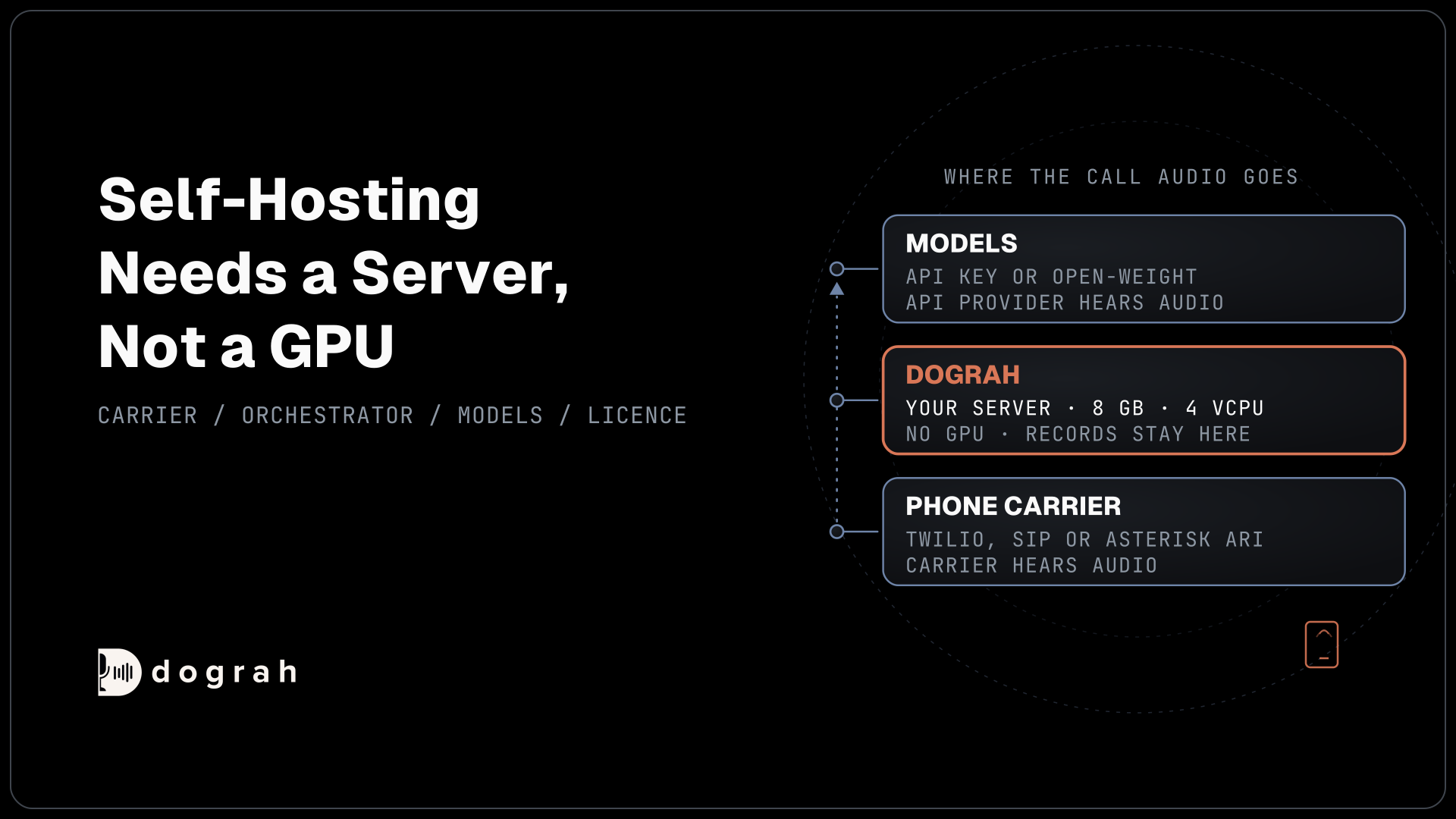
Dograh is the orchestrator. It holds the workflow, turn-taking, tool calls, the phone connection and the call lifecycle. It is not a model. A remote self-hosted install needs at least 8 GB of RAM and 4 vCPUs, which is an ordinary cloud server.
The models are a separate layer, and you choose how to fill it. You can use Dograh's own models, any supported provider through your own API key, or open-weight models you host yourself. With the first two, speech-to-text, the language model and the voice all run on the provider's hardware, so your server needs no GPU at all.
A GPU enters only with the third option, and it bills by the hour whether calls are flowing or not. RunPod lists an L4 at $0.49 an hour on its Secure Cloud (RunPod's on-demand GPU prices). By our arithmetic, one card running all month costs about $358. That decision has its own sizing questions, and our guide to running voice AI on local, self-hosted models covers which models fit on which card.

Open Source Alternative to Vapi / Retell
Self-hosted voice agent platform — no per-minute fees
dograh-hq/dograh
Star on GitHub
Where your call data goes once you run it
Self-hosting moves your call records onto your servers, while the live audio still passes through everyone in the call path.
On a self-hosted install, call state, transcripts, recordings and logs sit in your own PostgreSQL database and your MinIO or S3-compatible storage. A hosted platform works differently. In Vapi's HIPAA mode, call recordings, transcripts and logs are still stored, in Vapi's own HIPAA-compliant storage.
The audio itself still reaches every outside party in the path. The phone carrier carries the call, and any model provider you reach with your own key receives the audio it processes. Bring your own key changes who holds the contract. The data path stays where it was.
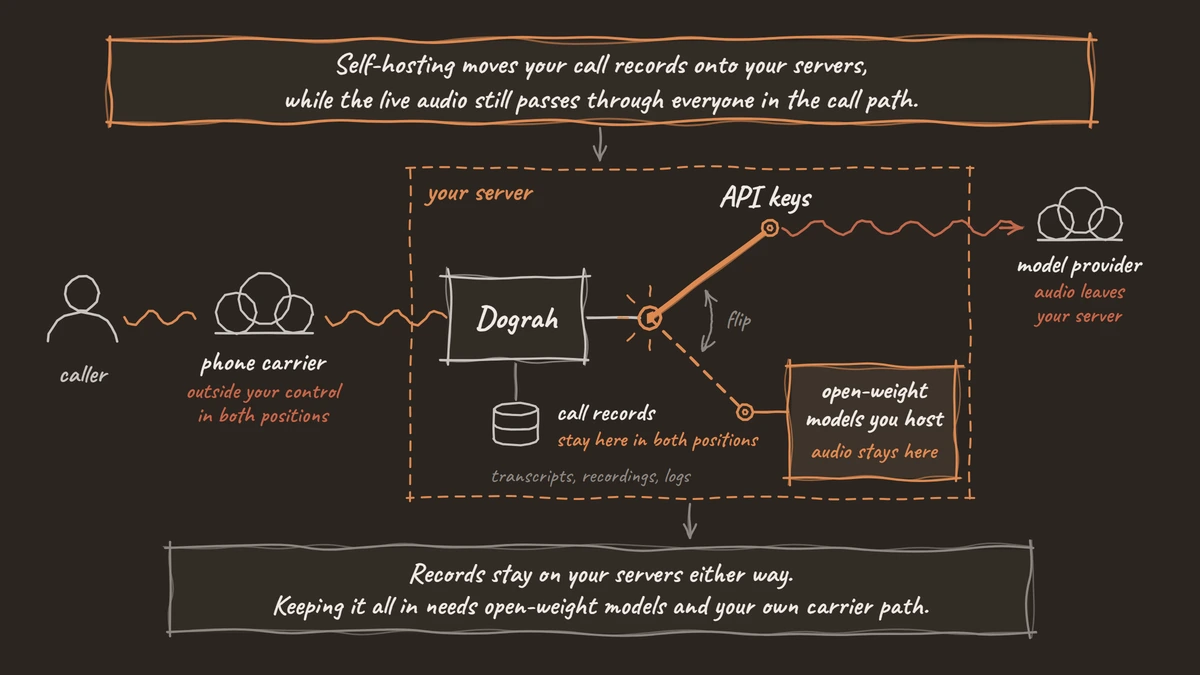
Hosting the models yourself leaves the carrier side open as well. The public phone network is shared infrastructure, so a call that rides a hosted carrier leaves your control before it reaches your servers. If that matters to you, control the carrier path too. On Dograh Cloud the SIP connection is ready-made. A self-hosted setup connects through Asterisk ARI or your own Cloudonix account.
Colocation follows the same line. You can put open-weight models on the same server or zone as Dograh to cut network hops. Closed providers such as Deepgram or ElevenLabs do not hand out their model weights, so with them colocation means picking providers in the same cloud region. Our post on why voice data needs to stay local explains why the audio itself is the sensitive part.
What self-hosting really costs
Self-hosting removes the platform fee, and every other line on the bill stays.
Vapi charges $0.05 a minute for hosting, with models and phone billed on top at each provider's price. At 1,000 minutes a day, that is about $18k a year in hosting fees alone by our arithmetic ($0.05 x 365,000 minutes), before models and phone. The open-source Dograh platform has no per-minute platform fee. If you would rather not run it, Dograh Cloud charges a 1¢/min platform fee.
Phone and model costs appear on both sides. Twilio's US voice pricing lists local calls at $0.0140 a minute outbound and $0.0085 inbound. Our breakdown, Vapi Pricing Explained, works through the full bill for three setups.
Concurrency changes shape too. On Vapi with no package you get 4 concurrent calls. Self-hosted Dograh allows 10 calls at once by default, adjustable with the DEFAULT_ORG_CONCURRENCY_LIMIT setting, and your servers and phone provider set the practical ceiling. Dograh can also rotate several API keys per provider when a model's rate limit gets in the way.
The cost that never shows on an invoice is people. Someone on your team has to own uptime and backups. If nobody can, or you are running a short pilot, a hosted platform is the better choice for now.
Join the Dograh Community
Dograh is an OSS alternative to Vapi. Join our Slack community for queries, releases, best practices & community interactions.
What you own after the install
Day one is a short checklist, and after that you own upgrades and the licence terms.
A remote install runs PostgreSQL, Redis, MinIO, the Dograh API and UI, plus nginx for HTTPS and coturn as a TURN relay for browser audio. It opens TCP ports 80, 443, 3478 and 5349, and UDP ports 3478, 5349 and 49152 to 49200. Keep the HTTPS certificate valid, because browsers will not open the microphone without it.
The first-hour checklist
Four settings need your attention before real calls reach the server:
- Set your AI models in Model Configurations.
- Close the public link or put it behind authentication. A fresh install opens a public Cloudflare tunnel to the API by default.
- Turn off open signup with
ENABLE_SIGNUP=false. Signup is on by default. - Switch off telemetry with
ENABLE_TELEMETRY=falseif you do not want it.
Upgrades and the licence
You decide when to upgrade by pulling new images, so no vendor change lands in the middle of a campaign. You also track releases yourself, and a fork you change is a fork you maintain.
The BSD 2-Clause licence is short. You can change the code and use it commercially, and your changes can stay private. If you redistribute it, keep the copyright notice, the two conditions and the disclaimer. Running it inside your own company generally triggers none of those notice duties, but confirm your own case with counsel. The open-source edition comes with community support on Slack and no vendor SLA.
Glossary
- Orchestration layer
- The part of a voice agent that runs the call: the workflow, turn-taking, tool calls and the phone connection. It is separate from the AI models, so self-hosting it needs no GPU.
- Open-weight model
- A model whose weights you can download and run on your own hardware. It is the only kind you can colocate with Dograh on one server, and the only kind that keeps audio off a provider's machines.
- Permissive licence
- A licence such as BSD-2-Clause that lets you change and sell the code without publishing your changes. Its duties apply when you redistribute the code, mainly keeping the copyright notice.
- TURN server
- A relay that carries browser audio when a direct connection between the caller and the server is blocked. Dograh's self-hosted stack runs coturn for this, which is why the UDP port range must be open.
If someone on your team can look after a small server, start small. Install Dograh, connect the same AI providers you use on Vapi through their API keys, and rebuild one of your Vapi call flows to test it. You can decide later whether to host the AI models yourself too. When you are ready to move real traffic, How to Migrate From Vapi to Open-Source Voice AI walks through the cutover one number at a time.