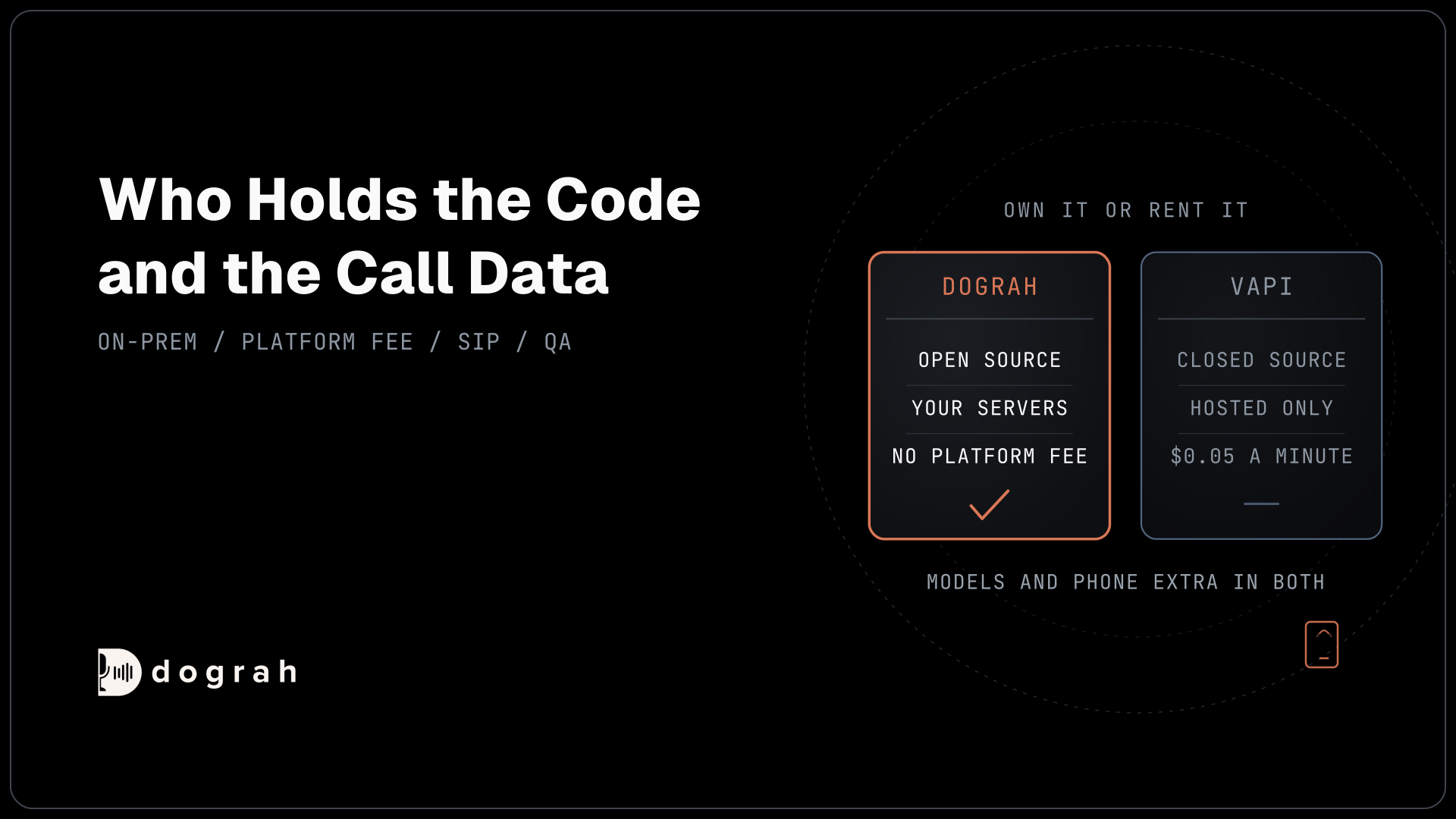

Vapi and Retell AI are both hosted, closed-source voice agent platforms billed per minute. Vapi charges $0.05 a minute for hosting and passes model costs through at provider cost. Retell charges $0.055 a minute for voice infrastructure plus the models it bills. Retell includes 20 concurrent calls to Vapi's 4. Neither is open source.
Key Takeaways
- Retell includes 20 concurrent calls; Vapi includes 4 without a package.
- Vapi's HIPAA add-on costs $2,000 a month; Retell charges no BAA signing fee.
- Both are closed source, unlike Dograh, and neither offers on-prem on its standard plans.
This post is part of our guide to Vapi alternatives. The guide covers every option, and this post puts the two hosted platforms people compare most often side by side.
Vapi and Retell AI side by side
Both platforms run your agent on their cloud and bill by the minute, so the real differences sit in the rows below.
| Feature | Vapi | Retell AI | Dograh |
|---|---|---|---|
| Platform charge | $0.05/min hosting, prepaid | $0.055/min voice infrastructure | Self-hosted: no per-minute platform fee. Cloud: 1¢/min |
| AI models | Passed through at provider cost, or billed by the provider on your own keys | Billed by Retell per minute (e.g. GPT 5.1 $0.04/min; its own voices $0.015/min) | Your own keys, Dograh's models, or open-weight models you host |
| Plans | Optional packages: Core $29/mo; Pro 10% of hosting, $999/mo minimum; Premier by contract | Pay as you go; Enterprise custom | Open source free; Cloud pay as you go; Custom volume; Enterprise |
| Free credits | $5 | $10 | No free credits. The self-hosted software is free; Dograh Cloud credits are bought from $5 |
| Concurrent calls | 4 included (10 on Core, 30 on Pro); extra lines $10/mo each | 20 included; extra $8/mo each; burst surcharge $0.10/min on the whole call | Cloud: 10 included. Self-hosted: 10 at once by default, adjustable with the DEFAULT_ORG_CONCURRENCY_LIMIT setting; your servers and phone provider set the practical ceiling |
| Phone numbers | 1 free Vapi number (US, inbound only), more on packages. Or import from Twilio, Vonage or Telnyx, or bring a SIP trunk | $2/mo per Retell number; own numbers and SIP at no charge | Not sold. Use your own numbers on Twilio, Vonage, Plivo, Telnyx, Cloudonix, Asterisk ARI or your own SIP trunk |
| Builder | Assistants and Squads, with a visual prompt editor and the Composer AI builder; Workflows flow builder retired August 2026 | Single- and multi-prompt agents, plus a visual Conversation Flow builder | Visual workflow builder: steps joined by pathways |
| Knowledge base | Yes, no separate price | Yes, +$0.005/min and $8/mo per knowledge base after 10 free | Yes, no separate price |
| Outbound at volume | Campaigns from a CSV, up to 10,000 contacts | Batch calls, +$0.005 per dial | Outbound campaigns from a contact list |
| Testing and QA | Evals, simulations and scorecards, but scorecards grade the whole call rather than each step | Simulation testing, plus an AI QA add-on that grades whole calls from a sample (100 min free, then $0.10/min) | Automatic QA scoring each step, on test calls and live calls |
| HIPAA | $2,000/mo add-on with a BAA; cannot run with zero data retention | Signed BAA required for patient data; no fee to sign | No BAA published; self-host with local models to keep audio in-house |
| Security claims | SOC 2 Type II, HIPAA, GDPR; EU region available | SOC 2 Type 1 and Type 2; GDPR via a DPA; no services operated in the EU | Open code you can audit; on-prem or private cloud on Enterprise |
| Self-host or on-prem | No. Runs only on Vapi's cloud, in the US or its EU region | No self-host package. Runs on Retell's cloud; on-prem may be available for Enterprise customers, so ask Retell | Yes. Self-host the full platform for free with Docker Compose, or on-prem inside your own network on Enterprise |
All prices are regular list prices. Vapi changed its plans in mid-September 2026, so customers who joined earlier may still be on older terms. On both platforms, the AI models and the phone line are billed on top of the platform charge.
How the two bills differ
The two platform charges differ by half a cent a minute, so the real gap in your bill comes from elsewhere.
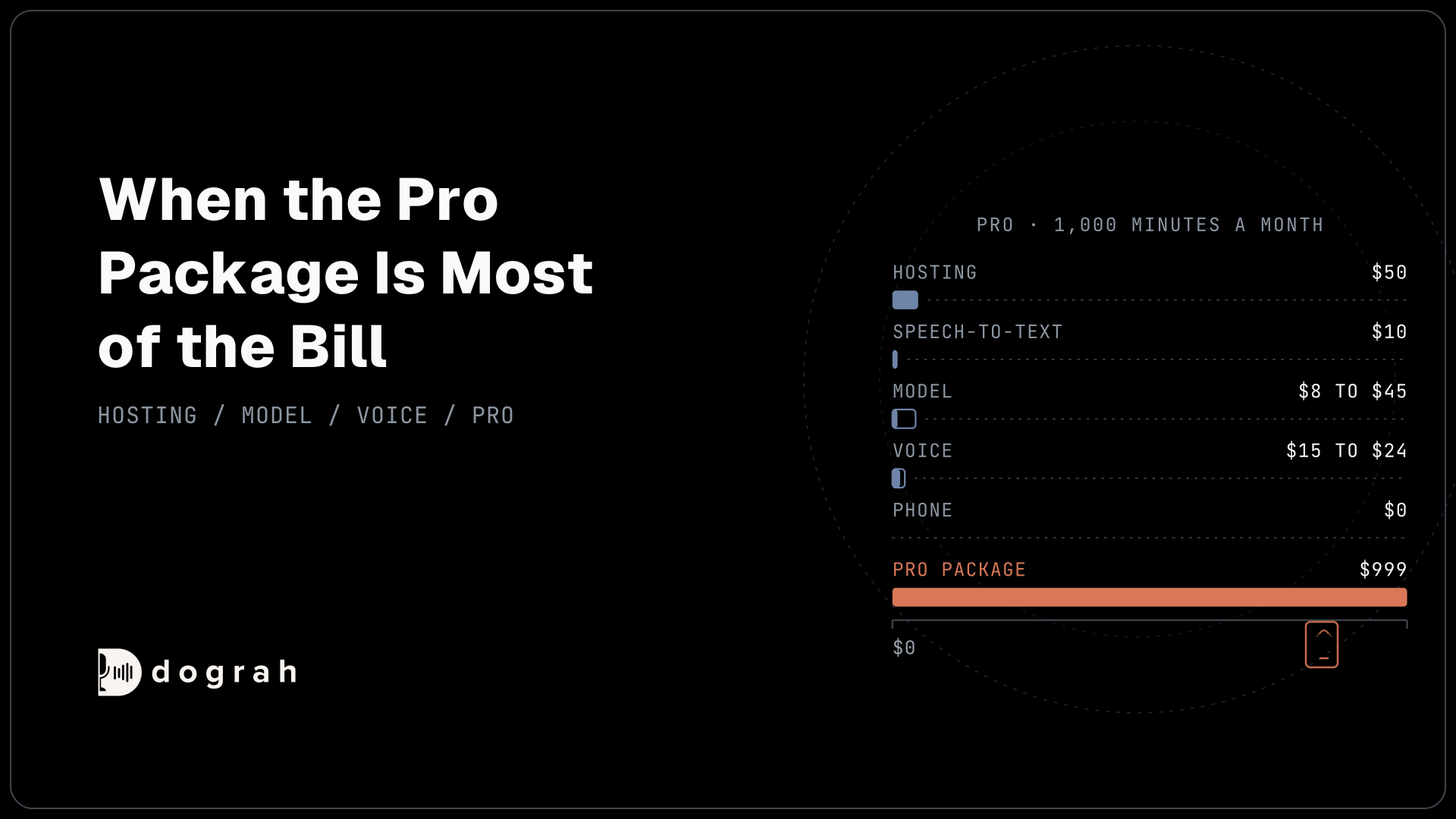
Vapi takes its $0.05 a minute hosting fee from prepaid credit. Speech-to-text, the model and the voice are passed through at the provider's cost, and if you add your own provider keys, the provider bills you directly. Success Packages are optional. Pro costs 10% of your hosting fee with a $999 monthly minimum, so by our arithmetic you pay the minimum until hosting passes $9,990 a month.
Retell bills $0.055 a minute for voice infrastructure, then a per-minute line for the model, such as $0.04 for GPT 5.1. Telephony through Retell is $0.015 a minute, and your own SIP trunk costs nothing extra.
At 1,000 minutes a day, the platform charge alone comes to about $18,250 a year on Vapi and $20,075 on Retell. That is our arithmetic from the list prices ($0.05 and $0.055 x 365,000 minutes), before models and phone.
Concurrency can move the bill more. Without a package, Vapi includes 4 concurrent calls and charges $10 a month for each extra line, so 30 lines cost $260 a month. Retell includes 20 and charges $8 for each extra, so 30 lines cost $80 a month. Retell also lets calls burst over your limit, but the $0.10 a minute surcharge applies to the whole call.
Cover under HIPAA (the Health Insurance Portability and Accountability Act) is the biggest fixed line. Vapi sells it as a $2,000 a month add-on, or $24,000 a year, with a business associate agreement (BAA). Retell charges no additional fee to sign its BAA, though it is worth asking which plan you need before you budget on that. A BAA delegates obligations to the vendor, but it does not move your own liability.
Our post Vapi Pricing Explained works through a full Vapi bill for three different setups.
How you build an agent on each
Vapi builds agents as Assistants and Squads, while Retell adds a visual flow builder for branching calls.
On Vapi, an Assistant is one agent with its own prompt, model, voice and tools. A Squad joins several assistants and hands the caller from one to the next. You set them up in the dashboard, through the API or as config in code, and the dashboard has a visual prompt editor and an AI builder called Composer. Vapi retired its visual Workflows flow builder in August 2026, existing workflows stopped running on 19 August, and Vapi points those users to Squads.
On Retell, an agent is either prompt-based (single or multi-prompt) or a Conversation Flow you draw as nodes, including a call transfer node for warm transfers.
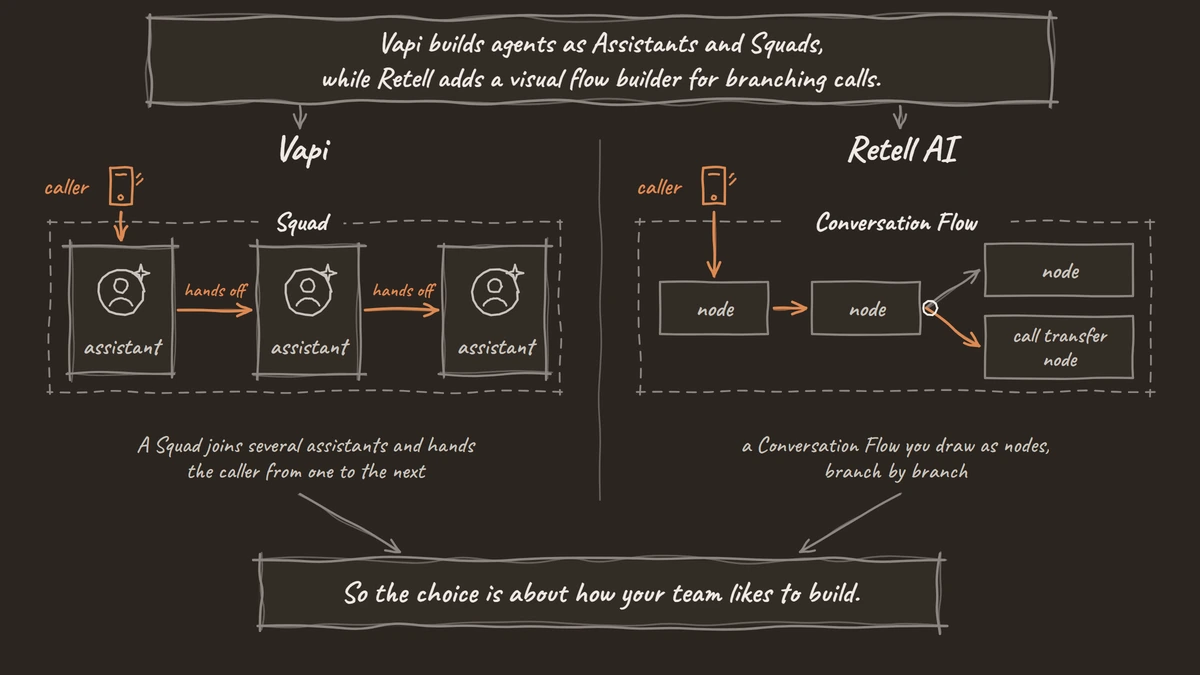
Both connect to your own language model server and offer simulated test calls. So the choice is about how your team likes to build. Specialist agents handing off to each other map onto Squads, and a call drawn out branch by branch maps onto Conversation Flow.

Open Source Alternative to Vapi / Retell
Self-hosted voice agent platform — no per-minute fees
dograh-hq/dograh
Star on GitHub
Compliance and where call data goes
Both vendors claim SOC 2 and HIPAA, but the terms and the data location differ.
Vapi reports SOC 2 Type II, HIPAA and GDPR (the EU's General Data Protection Regulation) compliance, and offers an EU region. Two details matter for healthcare. HIPAA mode and zero data retention cannot be switched on together. In HIPAA mode, recordings, transcripts and logs go to Vapi's HIPAA storage unless you connect your own. Raw call data is kept for 14, 30 or 180 days depending on the package.
Retell reports SOC 2 Type 1 and Type 2 compliance and requires a signed BAA before any patient data passes through it. It handles GDPR through a data processing addendum, and it does not currently operate services inside the European Union. For a team that needs calls processed inside the EU, that settles it.
On both platforms, the call audio is processed on the vendor's cloud.
Which one suits your team
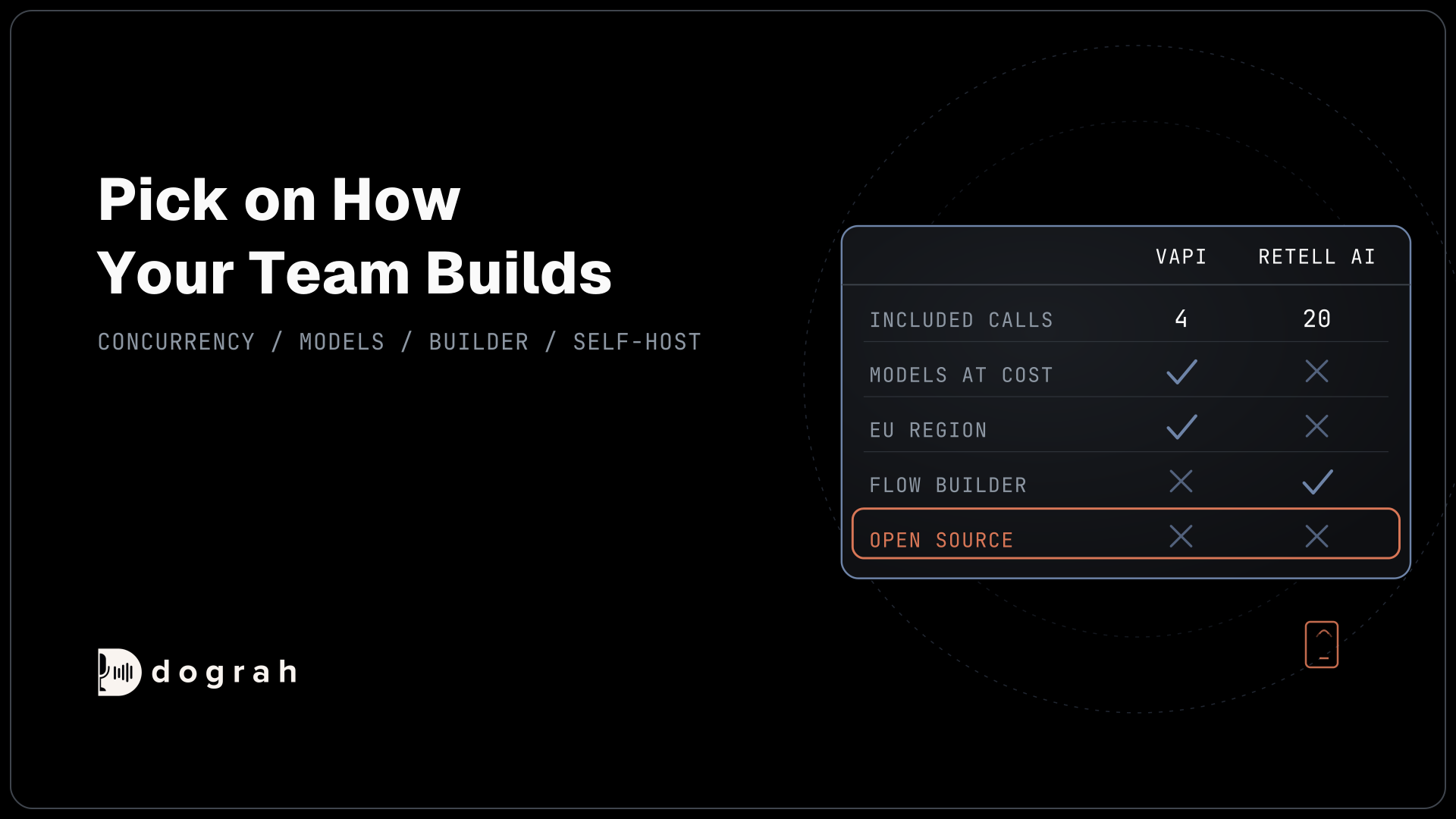
Pick on how your team builds and how many calls you run at once, then test both on your own phone line.
Vapi suits teams that build in its dashboard or in code, already run agents as Squads, and want to bring their own model keys at provider cost. It also suits workloads with few calls at once, where 4 included lines are enough.
Retell suits teams that want a drawn flow for branching calls and run many calls at once, since 20 lines come included. It also suits healthcare teams that need a BAA and prefer Retell's terms, with no fee to sign one, over a fixed monthly add-on, provided they accept Retell billing the models.
Both are established vendors. Vapi raised a $50 million Series B in May 2026, and the research firm Sacra estimates Retell's annualised revenue at about $80 million as of August 2026.
We left latency out of this comparison, because it depends on your models and your phone path far more than on the platform name. Run the same script on both over a real phone call. Phone audio often runs at 8 kHz, against 16 kHz on a browser call, and an agent that sounds fine in the browser can mishear callers on the phone. Our guide to testing voice agents before you go live lists the checks in order.
Join the Dograh Community
Dograh is an OSS alternative to Vapi. Join our Slack community for queries, releases, best practices & community interactions.
If you would rather own the stack
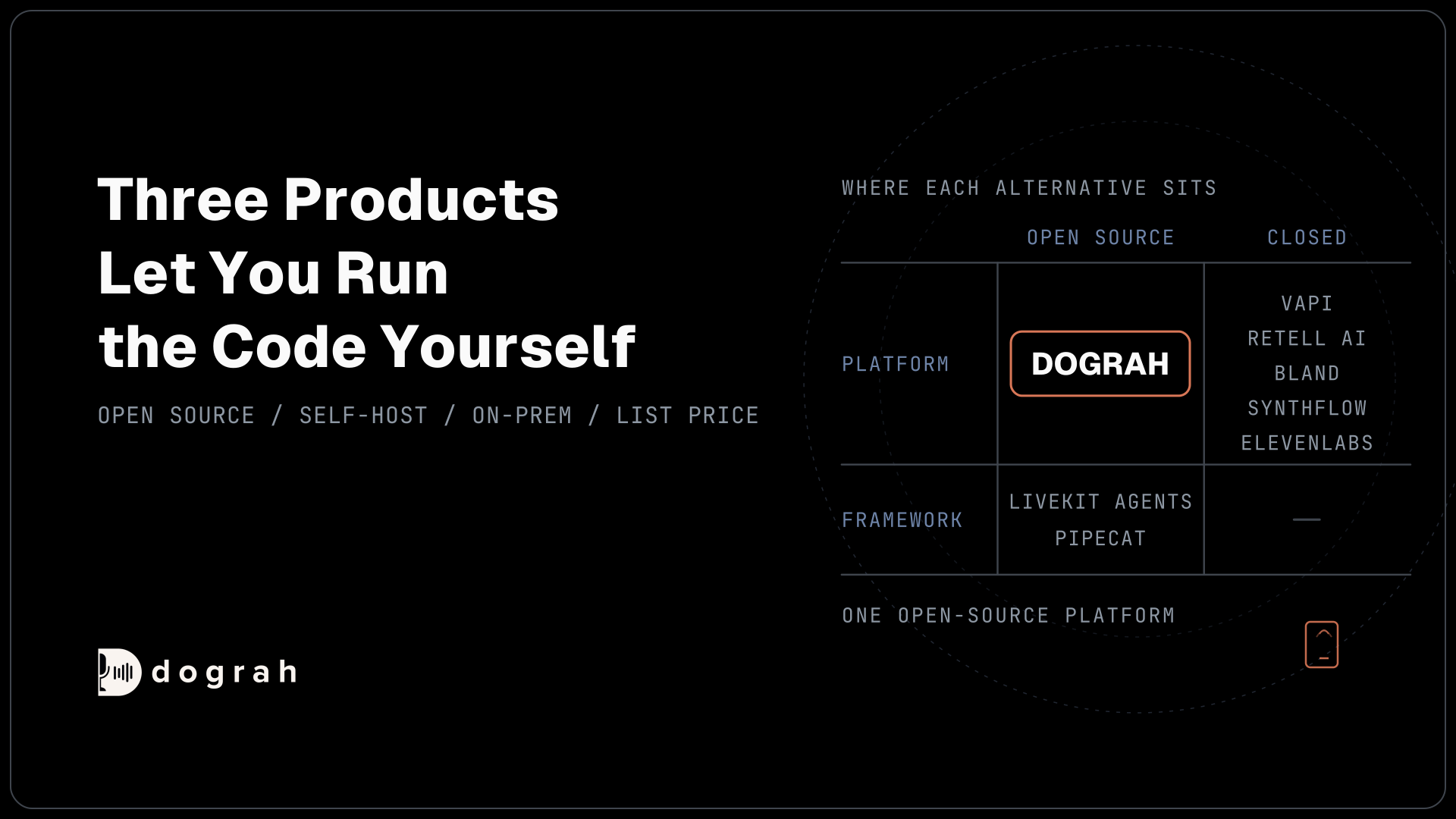
Neither Vapi nor Retell gives you code you can run yourself, so teams that need the code or the call data in-house have to look further.
Vapi does not support on-premise deployments, and Retell may offer on-prem only to Enterprise customers. Neither is open source, so code you can read, change and run yourself means looking beyond both vendors.
Dograh is one example. It is an open-source voice agent platform under the BSD-2-Clause licence, with a visual workflow builder and automatic QA that scores each step of the call. Call transfer to a person works on Twilio today. The code is on GitHub, so you can read it, change it and run it.
The open-source platform has no per-minute platform fee. You still pay for your servers and any paid model or phone accounts. Only open-weight models you host yourself keep the call audio entirely on your servers, because with your own API keys the audio still reaches that provider. If you would rather not run servers, Dograh Cloud charges a 1¢ a minute platform fee.
Self-hosting is real work. You run the servers and apply upgrades, and the open-source version comes with community support rather than a vendor SLA. Our guide to the Open-Source Alternative to Vapi covers that trade in full, and Dograh vs Vapi compares the two row by row.
If you are choosing between the two hosted platforms, price your own call volume and concurrency on both and test them over a real phone line. If owning the agent matters more, run the same test on an open-source platform such as Dograh.
Glossary
- Concurrent call limit
- How many calls an account can run at the same moment. When every line is busy, new calls cannot start, so hosted platforms sell extra lines by the month.
- Burst concurrency
- Retell's option to run calls over your concurrent call limit for a surcharge. The surcharge applies to the whole of each burst call, not only the time over the limit.
- Zero data retention (ZDR)
- A setting where the platform does not keep recordings, transcripts or logs after the call. On Vapi it cannot be switched on together with HIPAA mode.
- Business associate agreement (BAA)
- The HIPAA contract a vendor signs before it handles patient data for a healthcare provider. It delegates obligations to the vendor, but the provider keeps its own liability.