
Dograh vs Voiceflow comes down to who runs the platform. Voiceflow is a hosted, closed-source support-agent platform for chat, phone and SMS that bills a $0.05 phone minute plus credits. Dograh, an open-source, self-hostable voice agent platform, runs on your servers for free or on Dograh Cloud, with any model layer you choose.
Key Takeaways
- A Voiceflow phone minute is $0.05, plus speech, voice and model credits.
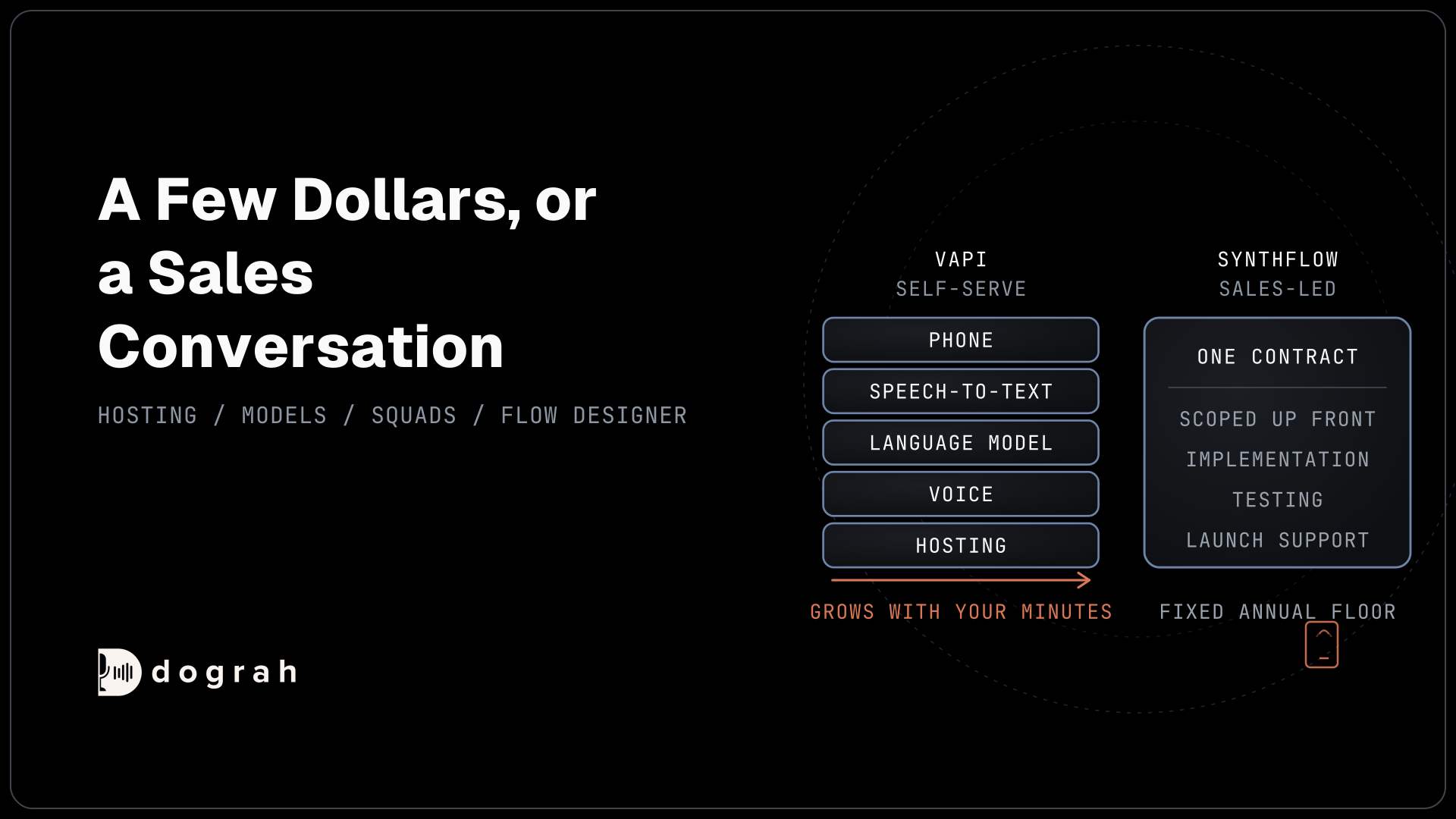
- Self-host Dograh from GitHub to skip a per-minute platform fee and an Enterprise contract.
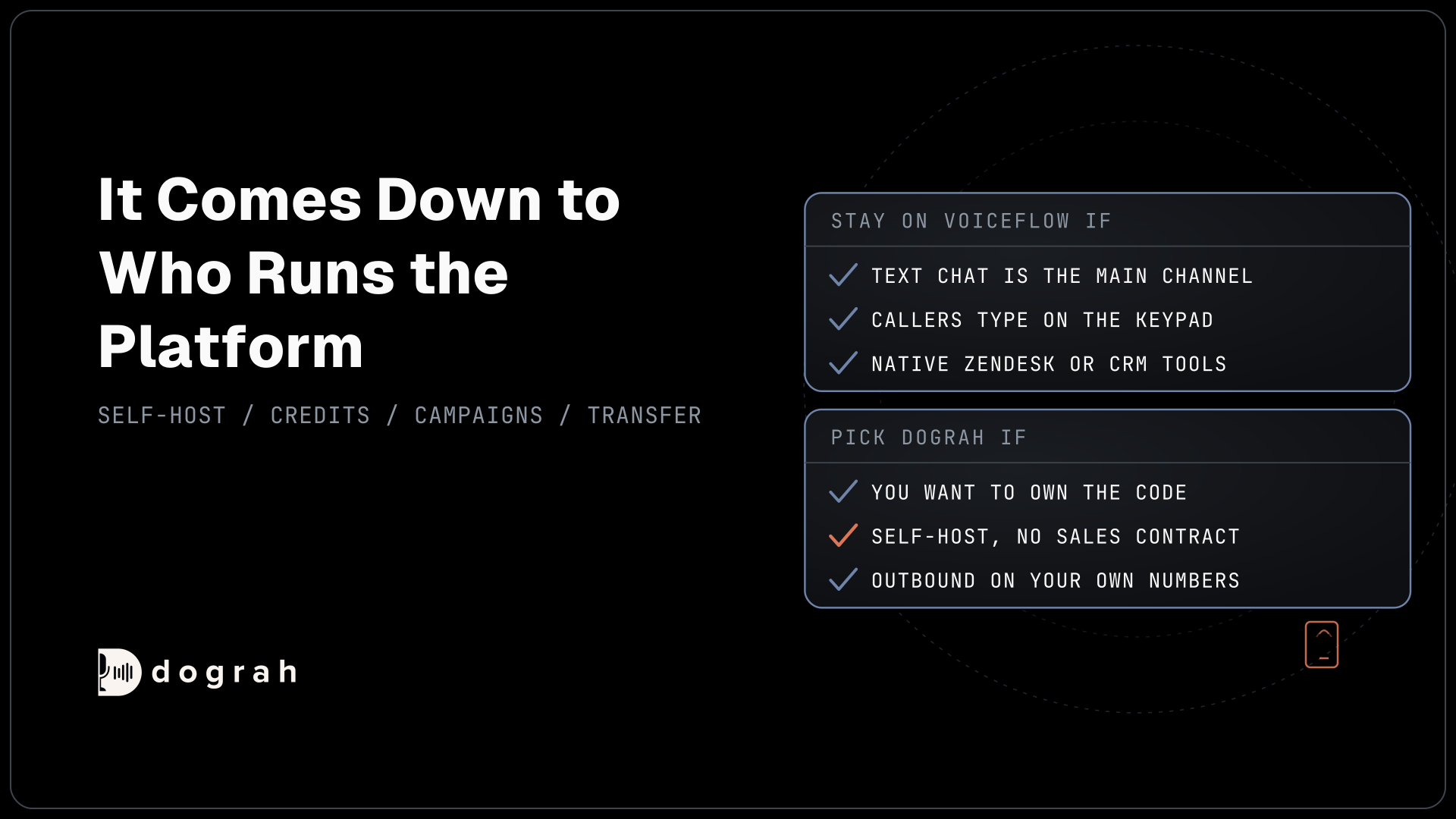
- Stay on Voiceflow if text chat, keypad input or native CRM tools drive your agent.
This post is part of our guide to Voiceflow alternatives. The guide's section "Dograh: the open-source Voiceflow alternative" gives Dograh one place among seven options. This post puts Dograh, an open-source, self-hostable voice agent platform, against Voiceflow, row by row, and ends with who should stay on Voiceflow.
Dograh vs Voiceflow, row by row
Voiceflow rents you a hosted platform built for support teams, while Dograh is open-source software you can run anywhere. Each cell says what you get, then the gap.
| Row | Voiceflow | Dograh |
|---|---|---|
| Licence | Closed source. Its public GitHub holds libraries, a command-line tool and demos, not the platform | Open source under BSD-2-Clause, with the full platform in the repository |
| Where it runs | Hosted on Voiceflow; private cloud on Enterprise | Self-host it for free with Docker Compose, use Dograh Cloud, or get on-prem or private cloud on Enterprise |
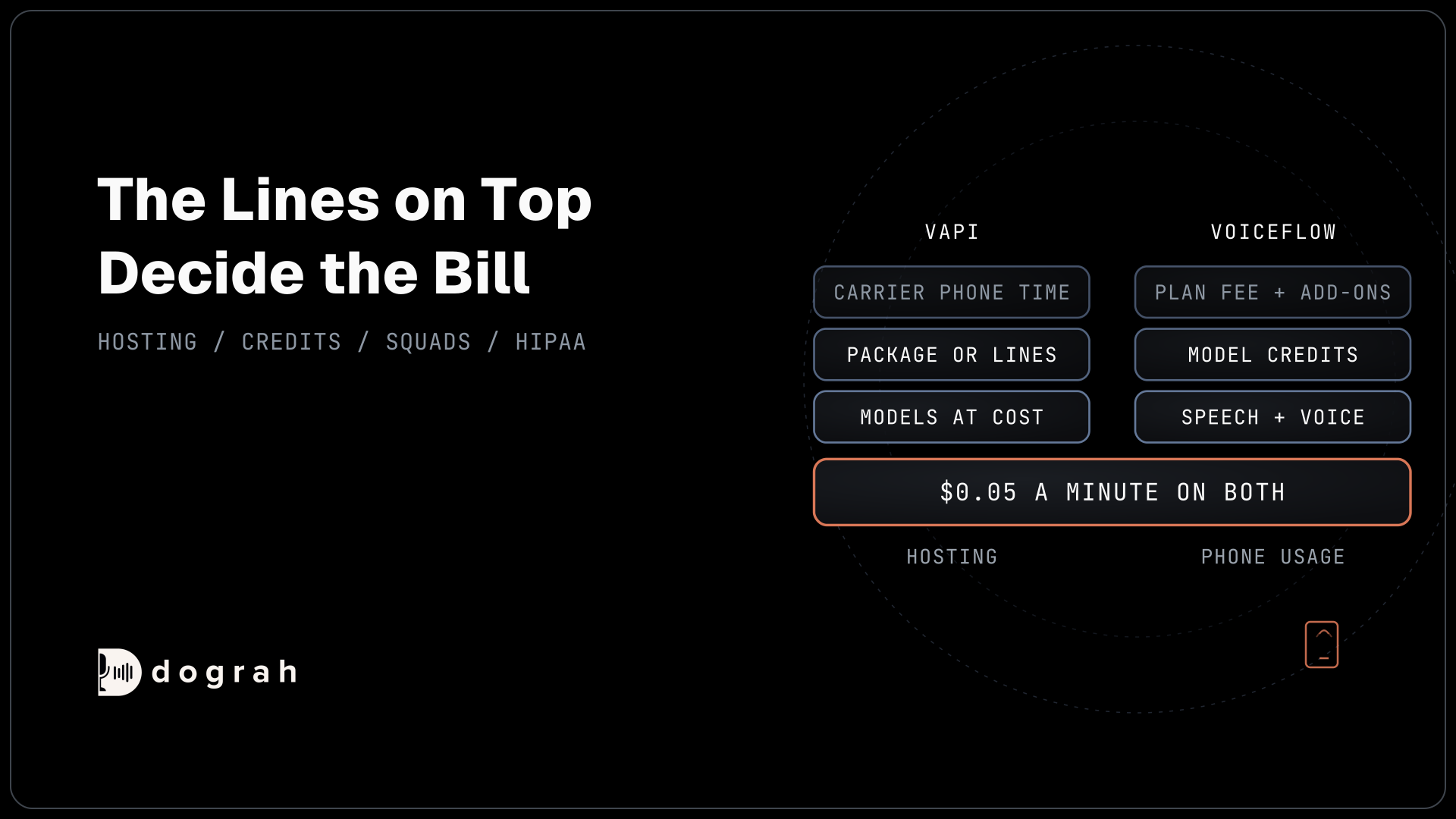
| How you pay | A plan fee and add-ons, plus credits: $0.05 a phone minute on self-serve plans, with speech-to-text, voice and model credits on top. Business and Enterprise are priced on request | Self-hosted: no per-minute platform fee. Dograh Cloud: a small per-minute platform fee (see below). Model providers and the carrier bill you directly |
| Models | Language models from several providers plus Voiceflow Core, its own model, with fallback models on Business. But usage of the listed models is billed in Voiceflow credits | Dograh's own models, your own keys for supported providers, or open-weight models you host, plus speech-to-speech models |
| Builder | Playbooks for goal-driven parts of the conversation and workflows for fixed steps, with Code and Function steps that run JavaScript | A visual workflow builder of nodes joined by pathways, with QA that scores each step. The AI picks each pathway by reading its written condition |
| Phone numbers | US and Canadian numbers provisioned by Voiceflow, one per workspace included, or your own Twilio, Vonage or Telnyx number | Your own carrier: Twilio, Vonage, Plivo, Telnyx, Cloudonix, Exotel, Vobiz or Asterisk ARI, or Dograh Managed SIP on Dograh Cloud |
| Outbound calls | One API request per call, from a Twilio, Vonage or Telnyx number. But Voiceflow's own numbers can't dial out | Campaigns for call lists, with retries and calling hours, or the API Trigger from your own system |
| Transfer to a person | Call forward to a phone number or SIP address, with extension digits and caller ID passthrough (not on Vonage numbers) | Transfer Call on Twilio, Telnyx and Asterisk ARI, with no summary passed by default |
| Keypad input | Callers can enter digits on the keypad (DTMF) | Callers answer by voice |
| Text chat | A web chat widget with a voice mode, SMS, and chat handoff to Zendesk, Genesys, UJET, Kustomer or Dixa | A text chat widget for websites. But phone calls are its main job |
| Testing versions | Environments with traffic splits for A/B tests, phone calls included | Outbound campaigns split across up to 5 agent versions |
| Compliance | SOC 2 Type II, ISO/IEC 27001:2022 and GDPR; HIPAA deployments with a BAA arranged through its security team | For patient calls, self-host: no BAA with Dograh is needed, because Dograh never sees the data. Your model providers and carrier may need their own |
How you pay for a phone minute
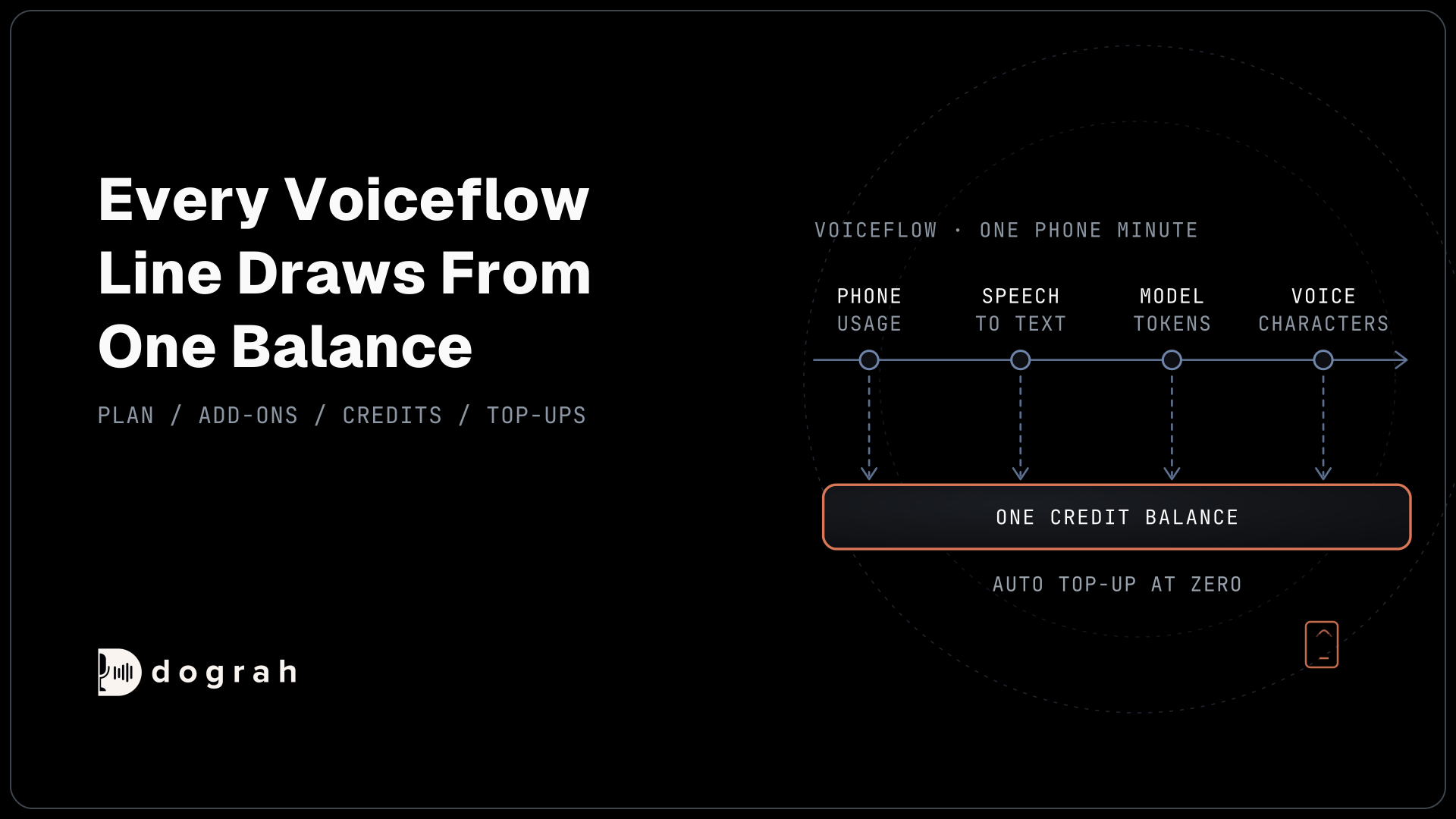
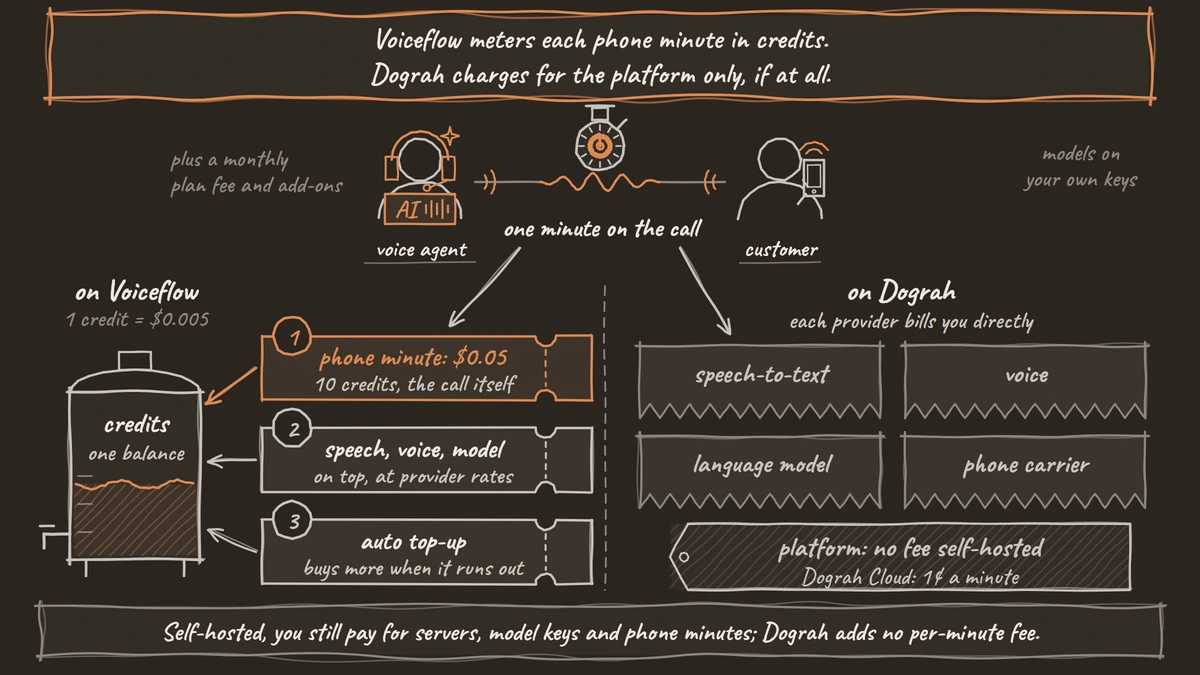
Voiceflow meters each phone minute through credits, while Dograh charges for the platform only, if at all. A Voiceflow bill has three parts: a monthly plan fee, add-ons such as editor seats, extra phone numbers and more concurrent calls, and credits for usage. In Voiceflow's credits pricing table, a phone minute is 10 credits, which is $0.05 on self-serve plans. Speech-to-text, the voice and the language model each draw credits on top, at a rate set by the provider.
Plan prices show inside Voiceflow under Plans and Billing, and Business and Enterprise are quoted on request. When credits run out, auto top-ups buy more so the agent keeps answering. Our post on Voiceflow pricing goes through every credit line.
Self-hosted Dograh has no per-minute platform fee (servers, model keys and phone minutes still cost); Dograh Cloud has a 1¢-a-minute platform fee, with 10 concurrent calls included. The model bill goes straight to the providers you pick, such as Deepgram, ElevenLabs or Cartesia, on your own keys. If you host open-weight models, you pay only for the GPU time.
Building the agent in each platform
Both platforms draw the conversation as steps, but they split the work between the AI and fixed logic differently. Voiceflow builds an agent from a global prompt, playbooks and workflows. A playbook is a goal the AI works toward, calling tools as it needs them. A workflow is a fixed sequence of steps. Code steps run short JavaScript snippets, and Function tools run reusable JavaScript during the call. An initialization workflow can run before the agent takes over, for example to look up the caller.
Dograh's visual workflow builder uses a Start Call node, Agent nodes and an End Call node, joined by pathways that each carry a written condition the AI reads. A Global Node holds a shared prompt for every step that switches it on. HTTP API tools and MCP tools read and write your systems during the call, and Pre-Call Data Fetch loads fresh data once the call is connected. Logic that lived in a Code step moves to an endpoint you host, which an HTTP API tool calls.
Two more pieces matter to builders. A QA node scores each step of a call after it ends, with its own tags and summary. And Dograh's MCP server lets an assistant such as Claude Code create and edit agents. A new agent publishes as version 1 at once, while edits to an existing one save as drafts.

Open Source Alternative to Vapi / Retell
Self-hosted voice agent platform — no per-minute fees
dograh-hq/dograh
Star on GitHub
Phone numbers, outbound calls and transfers
Voiceflow gives you a number but no outbound calling on it, while Dograh dials out on the numbers you already have with your carrier. Voiceflow can provision a US or Canadian number, and one per workspace comes with your plan. Voiceflow phone numbers currently don't support outbound calling, so an outbound agent needs your own Twilio, Vonage or Telnyx number, and each call starts with one API request. Outbound and inbound calls share one concurrency pool, which the concurrent calls add-on raises.
Dograh connects to your own carrier for both directions. Call lists run as Campaigns, with up to 10 retries and calling hours by weekday in one time zone per campaign. To test two openings, split the campaign between two versions of the agent, and Dograh shows each version's share of calls and outcomes.
To hand a caller to a person, Transfer Call works on Twilio, Telnyx and Asterisk ARI. It passes no summary by default; on Twilio it can play a short spoken introduction to both people. Write the details to your system with an HTTP API tool before the transfer. If nobody answers, the caller stays with the agent; tell it in the prompt to offer a callback. The transfer timeout defaults to 30 seconds. Web calls cannot transfer, so test transfers on a real phone line.
Where it runs and who holds the data
Voiceflow keeps your agent on its cloud, while Dograh lets you choose where the platform and the models run. Voiceflow runs on its own cloud, built on AWS and GCP, with private cloud hosting on its Enterprise plan. Call recordings, when you switch them on, are stored by Voiceflow. Voiceflow says the model providers it connects keep no copies of your data, and that it does not train models on customer data. Those are real protections, but the call still runs on software and servers you don't control.
Dograh is the orchestration layer: it runs the call flow, tools and telephony, and the speech and language models are a separate layer you choose. Self-hosting keeps recordings and transcripts on your servers. The call audio stays in-house only when the speech and language models run on your own servers too, because bringing your own key (BYOK) moves the contract, not the data. Our post on the open-source alternative to Voiceflow covers that setup. If you would rather run no servers at all, Dograh Cloud handles the security work for you.
For patient calls, self-host Dograh. No BAA with Dograh is needed, because Dograh never sees the data. Your speech and language providers may need their own BAA, and your phone carrier may too. Dograh starts every account on its own managed models. To keep call audio away from Dograh, open Models, switch the Organization default to BYOK with your own speech and language providers (or local models), and check that no agent has its own model override.
Lock-in is the other cost. In a Zapier survey of US enterprise executives, only 6% said they could stop using their main AI vendor without disruption. Code you can run yourself keeps working whatever the vendor decides.
Who should stay on Voiceflow
Voiceflow is the better fit for some teams, and the reasons are concrete. Dograh is built for phone calls and also offers a text chat widget for websites. Teams whose main channel is text chat may prefer Voiceflow. The same goes for SMS conversations, and for chats handed to Zendesk or Genesys agents.
Stay too if your agent leans on Voiceflow's native Zendesk, Salesforce, HubSpot or Shopify tools, since each would become an HTTP API tool you write and test. Keypad input and the PII redaction add-on have no match in Dograh, and Dograh splits only outbound campaigns between versions, not inbound calls. And if you want no servers at all and need the vendor to hold SOC 2 and ISO 27001 reports, Voiceflow has them.
When Dograh is the stronger fit
Dograh is the strongest fit for teams that want to own the phone agent platform, because it answers the reasons most teams look away from Voiceflow. It is open source under BSD-2-Clause, so you can self-host it today without a sales contract, and self-hosted it has no per-minute platform fee. Outbound calls run as campaigns on your own numbers, you choose every model down to open-weight ones on your own servers, and QA scores each step of every call. Self-hosting puts uptime and upgrades in your team's hands.
Run your real call script on both over a phone line, since most phone calls still reach the agent as 8 kHz audio while a browser demo runs at 16 kHz. To try Dograh, self-host it with Docker Compose from GitHub, or start on Dograh Cloud.
When you are ready to switch, our guide to migrating from Voiceflow to open-source voice AI has the steps. Dograh vs Vapi sets Dograh against another hosted platform.
Join the Dograh Community
Dograh is an OSS alternative to Vapi. Join our Slack community for queries, releases, best practices & community interactions.
Glossary
- Playbook
- In Voiceflow, a set of instructions that drives the agent toward a goal, calling tools as it needs them. Fixed sequences of steps go in workflows instead.
- Pathway
- In Dograh, the link between two nodes, with a written condition the AI reads to decide where the call goes next. It is a judgement by the model, not a fixed rule.
- Traffic split
- Sending a share of calls to each version of an agent to compare them. Voiceflow splits traffic across environments; Dograh splits outbound campaigns across up to five agent versions.
- Orchestration layer
- The part of a voice agent platform that runs the call flow, tools, telephony and turn-taking, kept separate from the speech and language models.