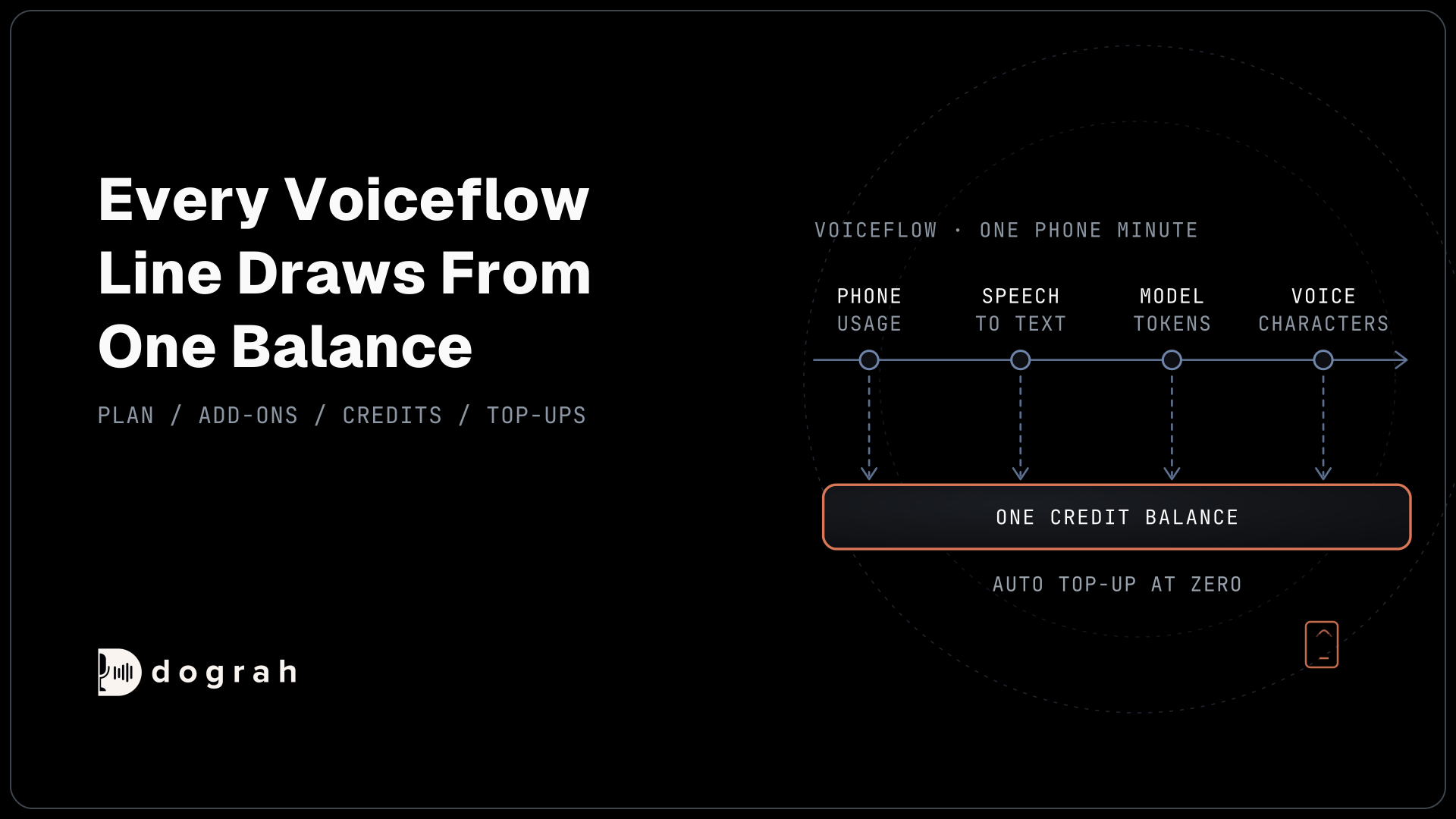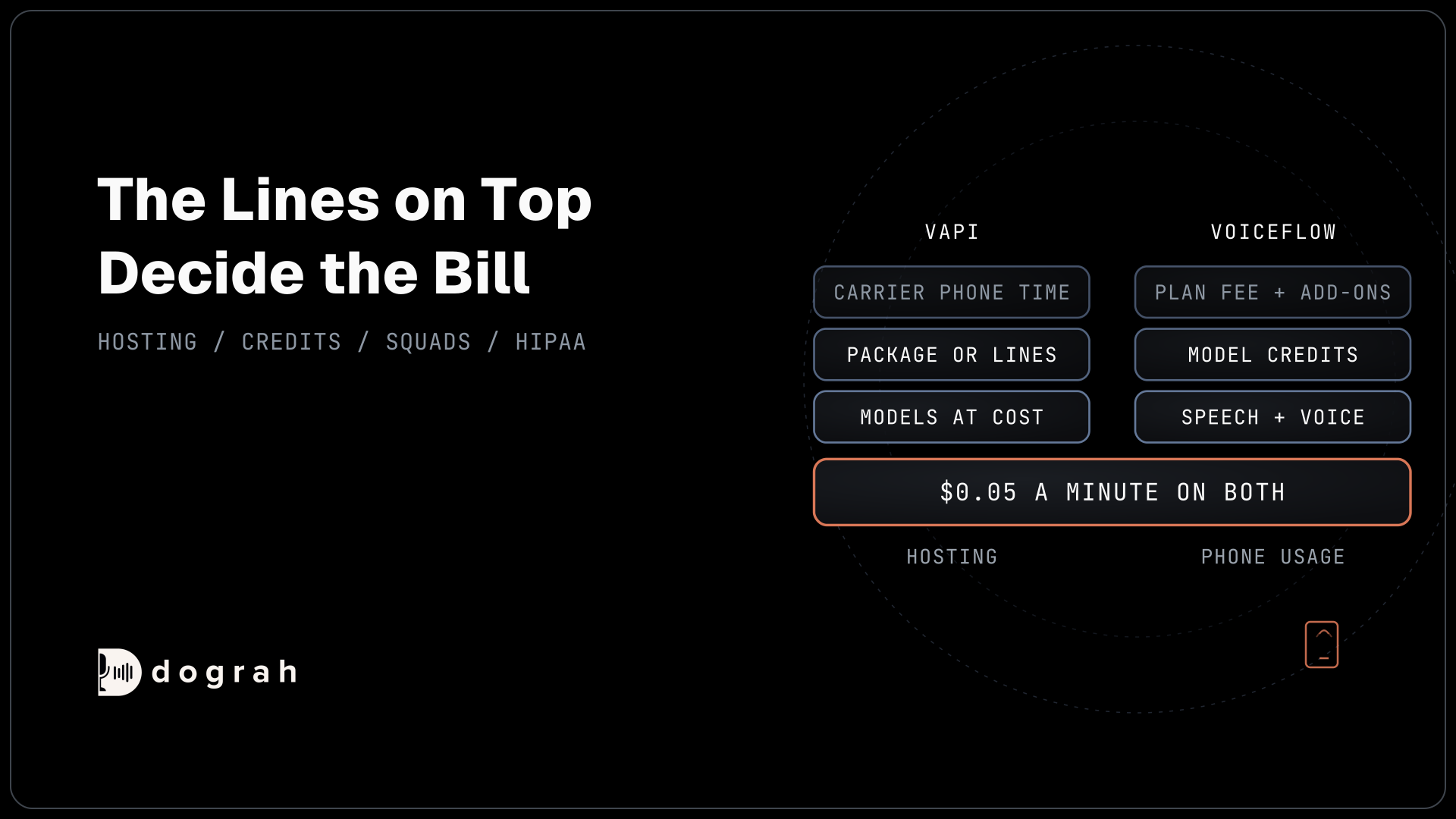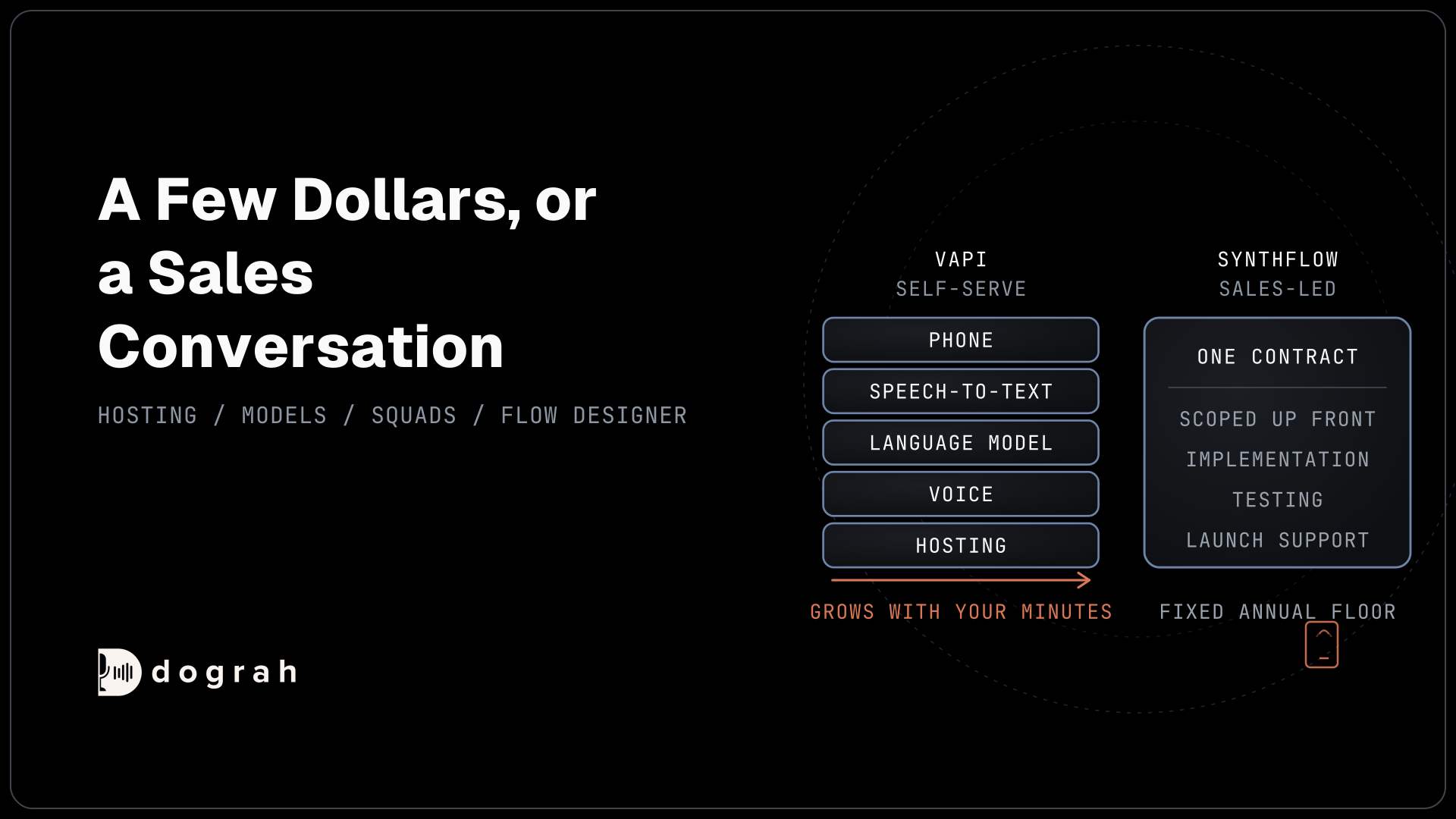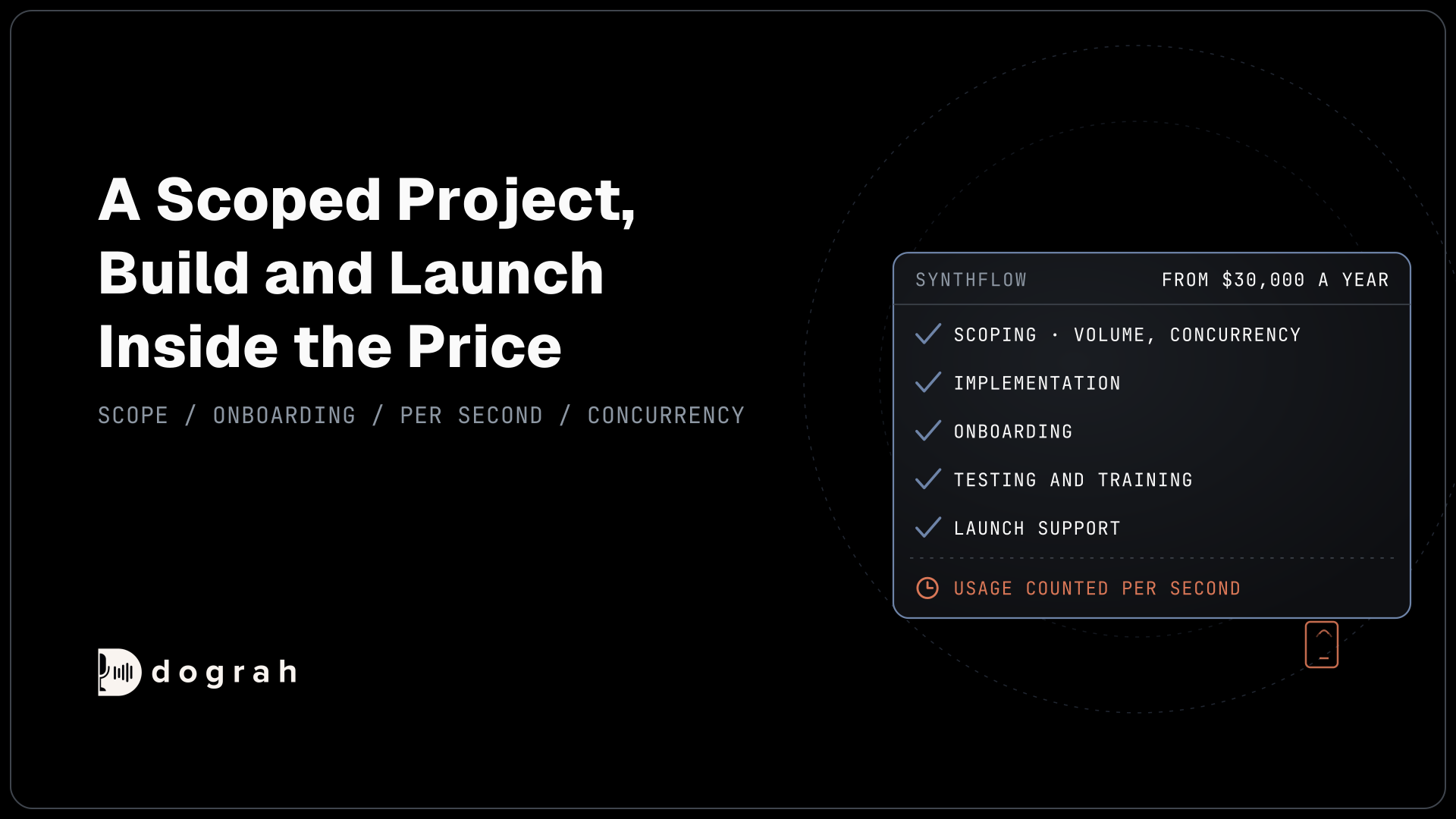

Synthflow sells one plan, Enterprise, with contracts from $30,000 a year, or $2,500 a month, scoped around call volume, concurrency, telephony, integrations, security and launch support. Calls are measured per second against the rates in your agreement. Dograh, an open-source, self-hostable voice agent platform, has no per-minute platform fee self-hosted and a per-minute fee on Dograh Cloud.
Key Takeaways
- Synthflow's floor is $30,000 a year, about $2,500 a month before usage.
- The same $2,500 covers 50,000 minutes of Vapi's hosting fee.
- Self-hosted Dograh has no per-minute platform fee; servers, models and phone still cost.
This post is part of our guide to Synthflow alternatives. The guide's section "What Synthflow costs, and what the contract covers" says the contract buys more than minutes. This post goes through what it covers, how usage is counted, what the floor works out to each month and what the same calls cost on Dograh, an open-source, self-hostable voice agent platform.
Synthflow's one plan, and what changed
Synthflow has one price on its public page, and it is a contract floor rather than a rate. Synthflow's pricing page reads: "Enterprise contracts start at $30,000 annually." By our arithmetic that is $2,500 a month before a single call is counted against it. The final price is "scoped around call volume, concurrency, telephony setup, integrations, security needs, and launch support," so two teams on the same floor can pay different amounts.
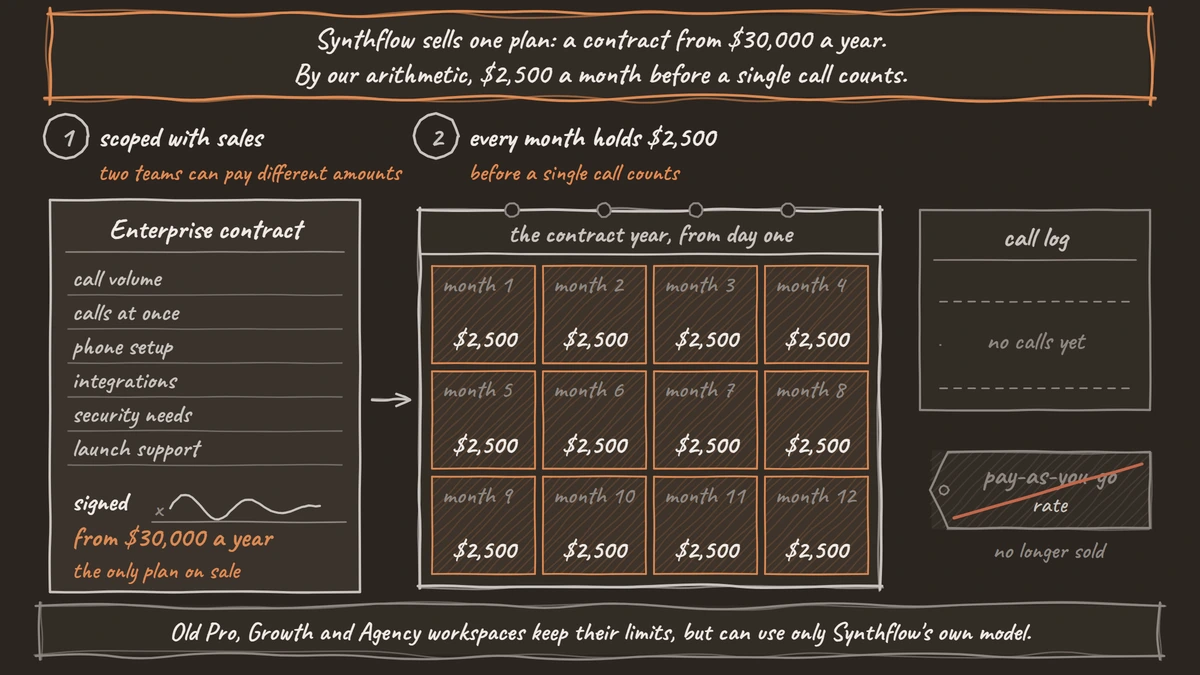
This is recent. Until June 2026 Synthflow listed a pay-as-you-go rate, and now it sells one Enterprise plan, as dated captures of the pricing page show. So an undated Synthflow pay-as-you-go rate describes a plan a new customer can no longer sign.
The older plans have closed. Synthflow's concurrency docs say Pro, Growth and Agency "are no longer sold, and existing workspaces keep their limits." On those workspaces, Synthflow LLM is the only language model; GPT and other third-party models need Enterprise.
What the $30,000 contract covers
The floor buys a scoped project, with the build and launch inside the price. The pricing page starts with telephony, which can be Synthflow's own, SIP trunking or approved enterprise telephony. It adds concurrency planning, routing and fallback logic, plus integrations with your CRM, calendar, contact-centre stack, webhooks and knowledge sources. On the legal side you get MSA and DPA support with a security review, and the rest is people time: implementation, onboarding, testing, training, launch support and ongoing optimisation. Support terms and the SLA are scoped in the contract too.
Several features are Enterprise only, and since every new contract is Enterprise, they belong in the scope you agree. Connecting your own SIP trunk or phone system (PBX) requires Enterprise, and so does Workflows, Synthflow's automation around the call. The GPT model list is Enterprise only. Your own OpenAI key is a separate switch: it appears only when BYOK access is enabled for your account, so ask for it during scoping if you want to pay OpenAI directly.
How Synthflow counts usage
Usage is measured finely, and the price of each unit comes from your own agreement. Synthflow's usage docs say phone calls are measured per second, "starting when the human and the AI agent connect and ending when the call terminates," with partial seconds rounded up. Chat counts too: "every 5 AI-generated messages count as 1 usage minute." The rate applied to those minutes, your allowances and your invoice terms "come from your agreement or account setup."
Concurrency, how many calls run at once, is scoped with Synthflow as well. Over the limit, extra calls either get an error or wait briefly in a queue, depending on your account setup. So the number to agree up front is your busiest hour, not your monthly total.

Open Source Alternative to Vapi / Retell
Self-hosted voice agent platform — no per-minute fees
dograh-hq/dograh
Star on GitHub
What $2,500 a month buys elsewhere
The fairest comparison puts Synthflow's monthly floor against the platform fee of other options, since models and phone lines cost extra almost everywhere.
| Platform | Platform fee | What $2,500 a month covers on that line | Extra on top |
|---|---|---|---|
| Synthflow | Contract from $30,000 a year | The monthly share of the floor, whatever you use | Whatever the contract scopes |
| Vapi | $0.05/min hosting | 50,000 minutes | Models at provider cost, phone, any package or the $2,000/mo HIPAA add-on |
| Retell AI | $0.055/min voice infrastructure | About 45,450 minutes | Language model, voice and phone, for $0.07 to $0.31/min in total |
| Dograh Cloud | Per-minute platform fee (see below) | 250,000 minutes | Models and phone |
| Dograh, self-hosted | None | No platform fee to cover | Servers, models and phone |
These are list prices and our own arithmetic, platform layer only. Vapi and Retell start on self-serve plans, so a team using 5,000 minutes pays for 5,000 minutes, where Synthflow's floor stays at $2,500. Our posts on Vapi pricing and Retell AI pricing add up the full bills.
Bland AI is a different shape, because its per-minute rate already includes its own models: $0.14 a minute on Start, or $0.12 plus $299 a month on Build, with phone time on top. Our breakdown of Bland AI pricing prices every line.
When the Synthflow contract is worth it
The floor suits some teams well, and the reasons are about scope more than price. If your volume is high enough that the floor is a small share of the bill, the usage rate in your agreement matters more than the $30,000. If you want the vendor to scope, build and launch the agent, with onboarding and testing in the price, the contract is buying a project team as well as a platform. And if your buyers need certificates on the vendor, Synthflow's trust center lists SOC 2 Type 2, ISO/IEC 27001 and PCI DSS v4.0.1. Dograh covers that need its own way: because you self-host Dograh inside your existing compliance perimeter, you don't need a separate vendor review for Dograh.
Agencies should read the contract closely. Synthflow removed in-product reselling through Stripe on 15 September 2026, so client billing now runs through your own Stripe account or another system. For client billing, Dograh connects to Paygent, which tracks each call's usage and invoices your clients at your own rates.
What the same calls cost on Dograh
Dograh charges for the platform only when you use its cloud, and never when you run it yourself. Self-hosted Dograh has no per-minute platform fee (servers, model keys and phone minutes still cost); Dograh Cloud has a 1¢-a-minute platform fee. Cloud includes 10 concurrent calls, with more on request, and needs no contract. Your phone minutes are billed by your own carrier.
Dograh is the orchestration layer: it runs the call flow, tools and telephony, and the speech and language models are a separate layer you choose, from Dograh's own models to your own provider keys or open-weight models on your own servers. The call audio stays in-house only when the speech and language models run on your own servers too.
The trade is the work: self-hosting puts the servers, updates and uptime in your team's hands. To compare features as well as price, our Dograh vs Synthflow comparison goes row by row. To price your own case, take your busiest hour and your monthly minutes, and run the same call script on each option over a real phone line.
Join the Dograh Community
Dograh is an OSS alternative to Vapi. Join our Slack community for queries, releases, best practices & community interactions.
Glossary
- Contract floor
- The minimum a vendor charges under contract, whatever you use. Synthflow's is $30,000 a year, which by our arithmetic is $2,500 a month.
- Usage minute
- The unit Synthflow bills against. Calls count per second from connect to hang-up, rounded up, and every five AI-generated chat messages count as one usage minute.
- Platform fee
- What a voice AI vendor charges for running the call itself, separate from the models and the phone line. Self-hosted Dograh has no per-minute platform fee.
- Concurrency
- How many calls a platform runs at the same time. Synthflow scopes it in the contract; Dograh Cloud includes 10 and self-hosted Dograh runs 10 by default, a limit you can raise.