
Retell AI and Synthflow are both hosted and closed source. Retell is pay as you go at $0.07 to $0.31 a minute, with a BAA you sign yourself. Synthflow sells one plan, Enterprise, with contracts from $30,000 a year and US or EU hosting. For code you can run yourself, there is Dograh, an open-source, self-hostable voice agent platform.
Key Takeaways
- Retell is pay as you go; Synthflow contracts start at $30,000 a year.
- Retell does not operate services in the EU; Synthflow has an EU cluster.
- To run the platform on your own servers, self-host Dograh, which is open source.
This post is part of our guide to Synthflow alternatives. The guide's section "Hosted alternatives to Synthflow" ends its Retell part on one split: Retell "says it does not operate services within the European Union, where Synthflow has an EU cluster." Here are the two side by side, on that split and every other point that changes a buying decision. The last section covers Dograh, an open-source, self-hostable voice agent platform.
Pay as you go against an annual contract
Retell sells minutes you can start on today, while Synthflow sells a contract you scope with its sales team.
| Row | Retell AI | Synthflow |
|---|---|---|
| How you buy | Pay as you go on prepaid credits, with $10 free to start; Enterprise by quote on monthly invoices | One plan, Enterprise, with contracts from $30,000 a year, scoped by volume, concurrency, telephony and integrations. But every contract goes through sales |
| A minute of calling | $0.07 to $0.31, starting with $0.055 for voice infrastructure. But add-ons such as knowledge base and PII removal cost extra | Rates set in your agreement, counted per second |
| Calls at once | 20 included, then $8/mo each. But calls that burst past your limit pay $0.10/min extra on the whole call | Scoped with Synthflow in the contract; calls over the limit get an error or wait briefly in a queue |
| Models | A long list of language models billed per minute, OpenAI's realtime speech-to-speech models, or your own LLM server | GPT models from GPT-4o to GPT-6-Luna, plus Synthflow LLM, on Enterprise |
| Builder | A single prompt, or a visual Conversation Flow of nodes and edges | Prompt Builder or the visual Flow Designer, one per agent, plus Workflows for the steps around a call |
| Phone | Retell numbers at $2/mo; no charge for SIP trunking or your own telephony | Synthflow's native telephony, your Twilio account, or your SIP trunk or PBX; bought numbers cover the US, Canada and Australia |
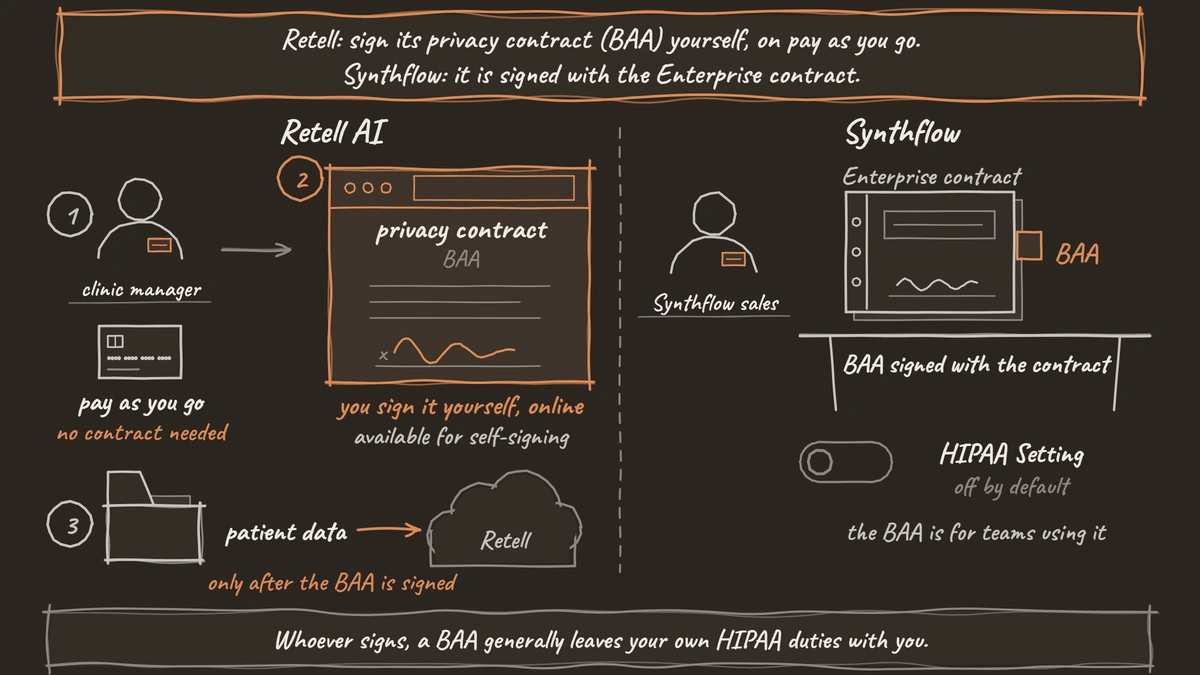
| HIPAA | A self-serve BAA on pay-as-you-go | A BAA signed with the contract for the HIPAA Setting, which is off by default |
| Where it runs | Retell's cloud; a dedicated stable server is an Enterprise add-on. Retell does not currently operate services in the EU | Synthflow's own cloud, with region-based hosting in the US and EU |
| Certificates listed | SOC 2 Type 1 and Type 2, HIPAA | SOC 2 Type 2, ISO/IEC 27001, PCI DSS v4.0.1, HIPAA, GDPR |
The Retell figures come from Retell's pricing page. Workspaces still on Retell's monthly billing moved to prepaid credits on 30 September 2026, while Enterprise stays on monthly invoices.
Where the call data is processed
For a buyer whose callers are in the EU, data location settles this comparison before price does. Retell's compliance page says "we do not currently operate services within the European Union." It handles the General Data Protection Regulation (GDPR) through Amazon Web Services and a data processing agreement, with standard contractual clauses for EU and UK residents' data.
Synthflow runs on its own cloud, with region-based hosting in the US and EU. Synthflow's region docs describe its EU cluster as having "all data and processing fully in the European Union," and its US cluster the same for the United States. It is retiring its older Global cluster during Q4 2026, and workspaces on it move to a US or EU cluster.
What each one costs to start
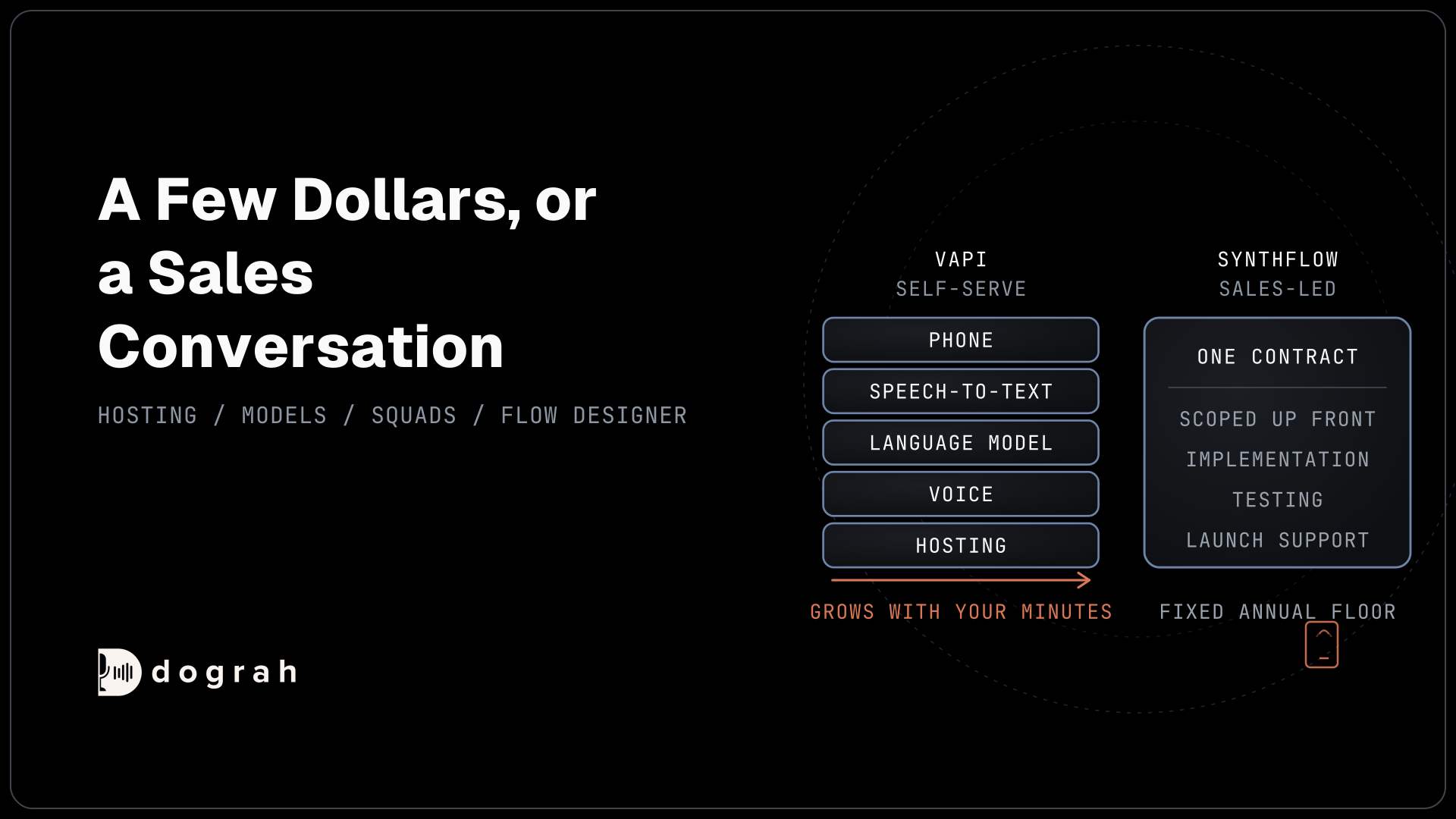
Retell's bill grows with your minutes and the model you pick, while Synthflow's starts at a fixed annual floor. Retell's headline range is a total per minute, and its cost estimator splits each minute into the language model, Retell's voice infrastructure, the voice and telephony. At 10,000 minutes a month, that works out to $700 to $3,100 by our arithmetic, before add-ons. A knowledge base, noise removal and safety guardrails each add $0.005 a minute, and PII removal adds $0.01. Past 20 calls at once, each extra line costs $8 a month. Our breakdown of Retell AI pricing prices every line.
On Synthflow, the pricing page says "Enterprise contracts start at $30,000 annually," with the final price "scoped around call volume, concurrency, telephony setup, integrations, security needs, and launch support." Usage is counted per second, with partial seconds rounded up. The contract also buys implementation, testing, training and launch support.
So a pilot costs a few dollars of credit on Retell, while on Synthflow it starts with a sales conversation. Our post on Synthflow pricing explains what the contract covers and how the floor works out each month.
Models and building an agent
Retell bills a long list of models by the minute, while Synthflow's model list depends on your plan. Retell prices each language model per minute, from small, cheap models to large ones, and sells OpenAI's realtime speech-to-speech models from $0.07 to $0.38 a minute. You can also connect your own LLM server: Retell runs the call and your server supplies the replies. Agents are built as a single prompt or as a Conversation Flow, where nodes handle each part of the call and edges decide when to move on.
Synthflow's model settings list OpenAI models from GPT-4o to GPT-6-Luna, plus Synthflow LLM and Advanced Synthflow LLM, and say "GPT and other third-party models are only available on Enterprise plans." Every plan on sale is Enterprise, so the line that Synthflow LLM is the only model below Enterprise applies to workspaces on the older Pro, Growth and Agency plans. Your own OpenAI key appears only when BYOK access is enabled for your account.
Synthflow agents use either Prompt Builder or the Flow Designer. A Trigger Subflow node hands the call to a sub-agent and returns to the main flow when it finishes. Both builders draw a call as nodes, so a flow moves across in shape, though each one is rebuilt by hand.

Open Source Alternative to Vapi / Retell
Self-hosted voice agent platform — no per-minute fees
dograh-hq/dograh
Star on GitHub
HIPAA and data controls
Retell lets any pay-as-you-go customer sign its BAA, while Synthflow writes its BAA into the Enterprise contract. Retell's business associate agreement is "available for self-signing" on pay-as-you-go. It must be signed before any patient data passes through Retell. Synthflow signs its BAA at contract signing for customers using the HIPAA Setting, which is off by default. Generally, whichever vendor signs, a BAA hands it obligations while your own HIPAA duties stay with you; confirm your position with counsel.
On data controls, Retell sells PII removal as a $0.01-a-minute add-on. Synthflow has PII redaction for transcripts, webhooks and logs on new calls, and an agent toggle that deletes transcripts, recordings and caller IDs after 30 days. For certificates, Retell lists SOC 2 Type 1 and Type 2, and Synthflow's trust center lists SOC 2 Type 2, ISO/IEC 27001 and PCI DSS v4.0.1.
Picking between them
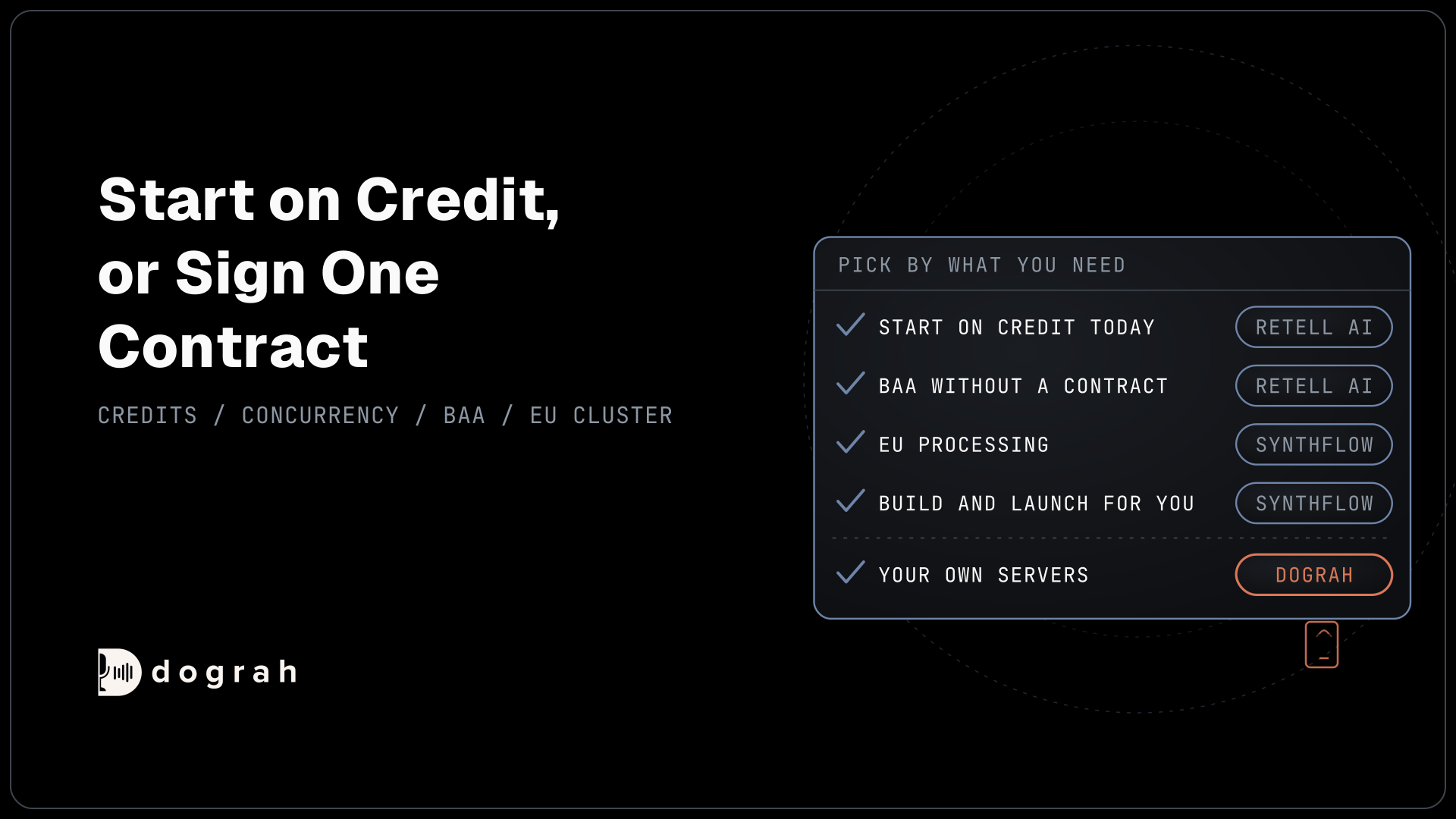
Pick Retell if you want to start on credit today, sign a BAA without a contract and choose the model per agent. Pick Synthflow if your callers are in the EU and you want them processed there, or if you want the vendor to build and launch the agent under one contract.
High-volume teams on Retell should price concurrency before the per-minute rate: burst calls pay the surcharge for their whole length. Teams weighing a third hosted option can read Vapi vs Synthflow and Bland AI vs Synthflow.
Run the same call script on both over a real phone line before you sign. Most phone calls still reach the agent as 8 kHz audio, while a browser demo runs at 16 kHz, so a demo that sounds sharp can mishear callers on the phone.
Where an open-source platform fits
Both are hosted and closed source, and each decides where your calls are processed: Retell outside the EU, Synthflow in the US or EU. If you need to choose the data centre yourself, that is where Dograh fits.
| Question | Retell AI | Synthflow | Dograh |
|---|---|---|---|
| Open source | No | No | Yes, BSD-2-Clause |
| Run it on your own servers | Runs on Retell's cloud | Runs on Synthflow's cloud, US or EU | Yes, self-host for free |
| Choose the models | Yes, from Retell's list or your own LLM server | GPT list on Enterprise | Yes, including open-weight models you host |
| BAA | Self-serve on pay-as-you-go | With the Enterprise contract | Self-hosted: none needed with Dograh |
Dograh is open source under BSD-2-Clause, and its GitHub repository, with more than 5,900 stars, holds the whole platform. Its visual workflow builder joins nodes with pathways, each with a written condition the AI reads, so a team used to Conversation Flow or the Flow Designer will find it familiar.
Self-hosted, Dograh runs where you install it, such as an EU data centre. Dograh is the orchestration layer: it runs the call flow, tools and telephony, and the speech and language models are a separate layer you choose. The call audio stays in-house only when the speech and language models run on your own servers too. With your own provider keys, the audio still reaches each provider. For patient calls, self-host Dograh. No BAA with Dograh is needed, because Dograh never sees the data. Your speech and language providers may need their own BAA, and your phone carrier may too.
Dograh starts every account on its own managed models. To keep call audio away from Dograh, open Models, switch the Organization default to BYOK with your own speech and language providers (or local models), and check that no agent has its own model override.
Your numbers stay with your carrier, such as Twilio, Vonage, Plivo or Telnyx. Transfer Call works on Twilio, Telnyx and Asterisk ARI. It passes no summary by default; on Twilio it can play a short spoken introduction to both people. Write the details to your system with an HTTP API tool before the transfer.
Self-hosted Dograh has no per-minute platform fee (servers, model keys and phone minutes still cost); Dograh Cloud has a 1¢-a-minute platform fee. Cloud includes 10 concurrent calls. Self-hosting puts uptime in your team's hands, and since there is no one-click import from Retell or Synthflow, each agent is rebuilt.
Dograh is the strongest fit when you want to pick the data centre and the models yourself, without a vendor contract, because the code is yours to run. To try it, self-host it with Docker Compose, or start on Dograh Cloud.
Join the Dograh Community
Dograh is an OSS alternative to Vapi. Join our Slack community for queries, releases, best practices & community interactions.
Glossary
- Conversation Flow
- Retell's visual builder, where a call is drawn as nodes, each with its own instructions or actions, joined by edges that decide when the agent moves on.
- Concurrency burst
- Retell's option to let calls run past your concurrent call limit, up to three times the limit or the limit plus 300, whichever is lower. Each burst call pays $0.10 a minute extra for its whole length.
- Data cluster
- The set of servers a hosted platform uses for your workspace. Synthflow's US and EU clusters keep all data and processing inside that region.
- Business associate agreement (BAA)
- The contract HIPAA requires before a vendor handles patient data. Retell offers one to sign yourself on pay-as-you-go; Synthflow signs it with the Enterprise contract.