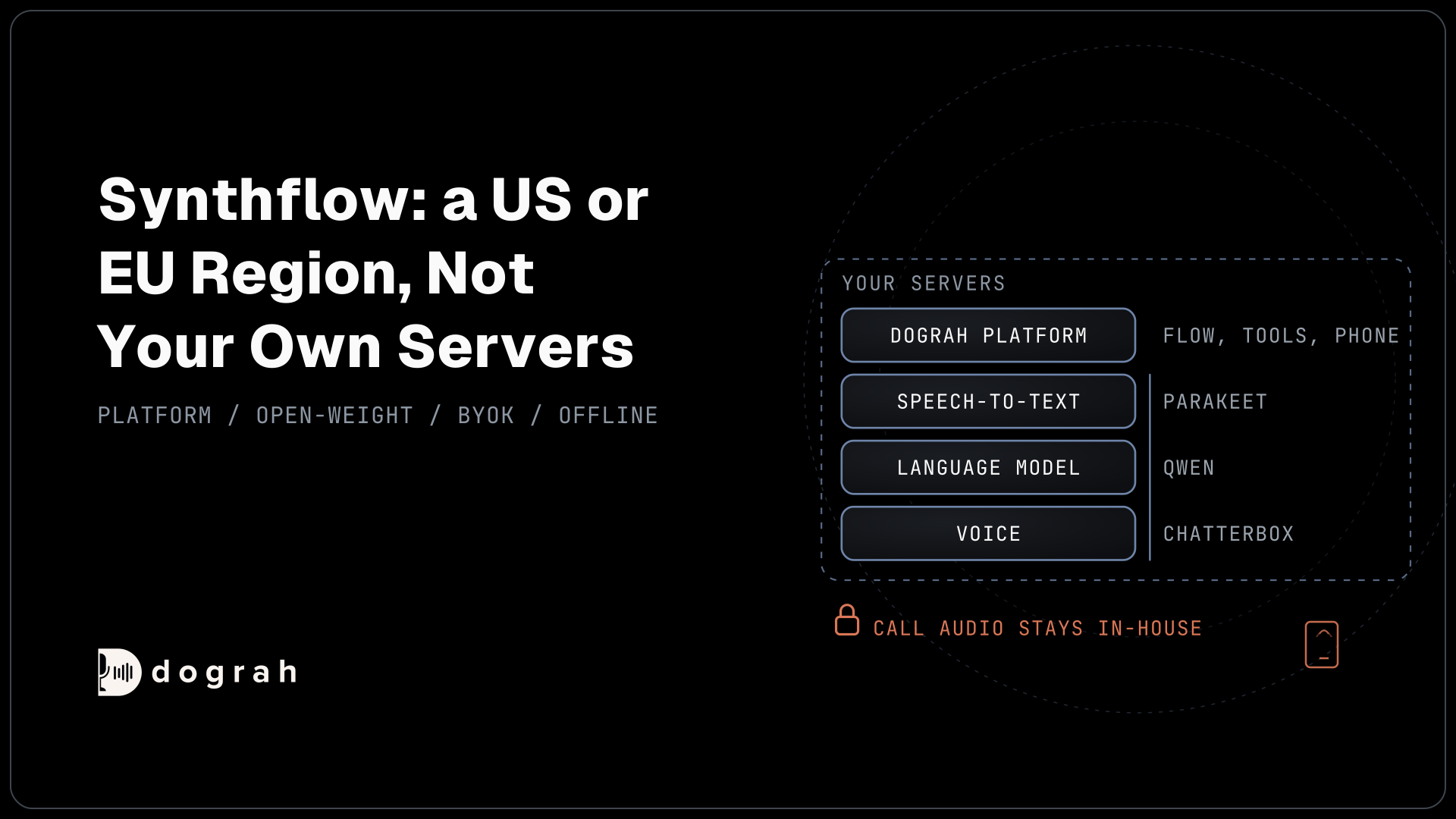

A full open-source alternative to Synthflow is Dograh, an open-source, self-hostable voice agent platform under BSD-2-Clause that anyone can run on their own servers for free. Synthflow runs on its own cloud, with region-based hosting in the US and EU. LiveKit Agents and Pipecat are open-source frameworks, and call audio stays in-house only with self-hosted models.
Key Takeaways
- Synthflow lets you pick a US or EU region, not your own servers.
- Dograh is a full open-source platform, while LiveKit Agents and Pipecat are frameworks.
- Self-host the speech and language models too, or call audio still leaves.
This post is part of our guide to Synthflow alternatives. The guide's section "Open-source routes: LiveKit Agents and Pipecat" notes that open source, on-prem and keeping the audio in-house often get mixed up. This post takes them apart, with what you gain and what you take on. The worked example is Dograh, an open-source, self-hostable voice agent platform.
Where Synthflow runs, and who picks its models
Synthflow is a hosted platform, so the honest comparison starts with where it runs and what it lets you choose.
Synthflow runs on its own cloud, with region-based hosting in the US and EU. Synthflow's region docs describe a US cluster with "all data and processing fully in the United States" and an EU cluster that keeps everything in the European Union. A legacy Global cluster is being retired during Q4 2026. So you choose a region, and Synthflow runs the servers in it.
The model layer is Synthflow's call too. Synthflow's model settings say "GPT and other third-party models are only available on Enterprise plans", and the older Pro, Growth and Agency workspaces get only Synthflow LLM. Your own OpenAI key appears only once BYOK access is enabled for your account. Synthflow sells one plan, Enterprise, with contracts from $30,000 a year.
What open source gives you that a contract does not
Open source changes who controls the platform, and a hosted region does not.
Dograh's code is on GitHub under BSD-2-Clause, one of the BSD licences, which lets you use, change and redistribute it, commercially too, as long as the copyright notice stays. The repository has more than 5,900 stars.
In practice that gives you four things a hosted contract keeps with the vendor. You can install it today, with no sales call. You can read the code your security team is asked to approve. You can change it, or pay someone to, when a feature is missing. And you can keep running the version you have if the vendor's pricing or direction changes, as Synthflow's did when it moved to a single Enterprise plan.
A full platform or a framework
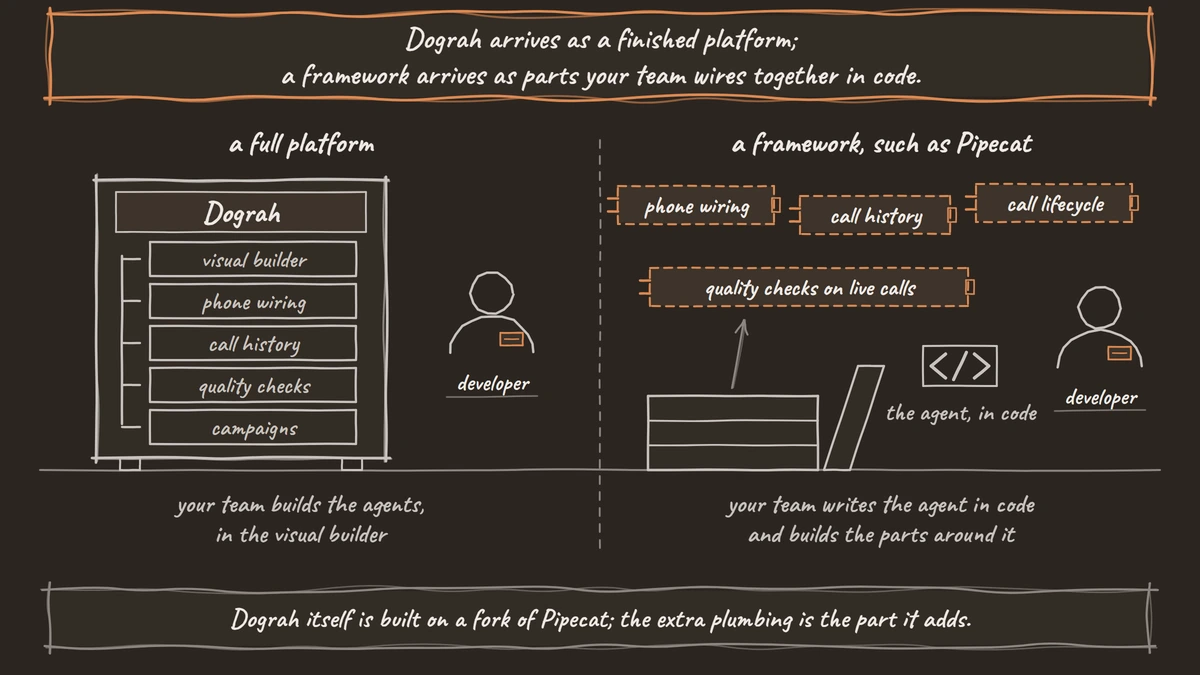
Three open-source options come up for a Synthflow team, and only one arrives as a finished platform.
| Option | Licence | Where it runs | What your team builds |
|---|---|---|---|
| Dograh | BSD-2-Clause | Your servers, Dograh Cloud, or on-prem and private cloud on Enterprise | The agents, in a visual builder; telephony, call history, QA and campaigns ship with it |
| LiveKit Agents | Apache-2.0 | Your servers with the LiveKit media server, or LiveKit Cloud | The agent in code, plus any builder, call history and QA you want |
| Pipecat | BSD-2-Clause | Your servers, or Pipecat Cloud | The agent in Python, plus phone wiring, call history, QA on live calls and the call lifecycle |
| Synthflow (for reference) | Closed source | Synthflow's own cloud, US or EU region | The agents, in the Flow Designer or a single prompt |
Pipecat is a Python framework from Daily, and Dograh itself is built on a fork of it. In our experience Pipecat is an excellent base, but production needs a lot of extra plumbing, which is the part Dograh adds. LiveKit Agents runs on the LiveKit media server. Both suit teams that want to write the agent in code.
A Synthflow team used to drawing calls will find Dograh closer to home, with nodes joined by pathways, each with a written condition the AI reads. Our Dograh vs Synthflow comparison sets the two builders side by side.

Open Source Alternative to Vapi / Retell
Self-hosted voice agent platform — no per-minute fees
dograh-hq/dograh
Star on GitHub
Keeping call audio in-house
Self-hosting the platform is half the job. The audio also goes wherever your models run.
Dograh is the orchestration layer: it runs the call flow, tools and telephony, and the speech and language models are a separate layer you choose. That layer can be Dograh's own models, your own keys for a supported provider, or open-weight models you host. Bringing your own key (BYOK) moves only the contract, so the audio still reaches each provider. That holds for Synthflow's BYOK too.
The call audio stays in-house only when the speech and language models run on your own servers too. One stack that fits a single 24GB graphics card is Qwen3.8 27B at 4-bit for the language model with Parakeet TDT 0.6B v2 for speech-to-text, at roughly 2GB. For the voice, Magpie TTS ships fixed voices as open weights under NVIDIA's own licence, and Chatterbox (MIT) can clone a voice. You point Dograh at them in its model configuration, and set up this way it can run offline.
Dograh starts every account on its own managed models. To keep call audio away from Dograh, open Models, switch the Organization default to BYOK with your own speech and language providers (or local models), and check that no agent has its own model override.
Our guide to running voice AI on local, self-hosted models explains the trade-offs, and the tutorial on building a voice agent on fully local open-source models walks through the setup.
What you take on when you run it yourself
Owning the platform moves the work that Synthflow's contract covers onto your own team.
Self-hosting uses Docker Compose, and you run the servers and their updates, plus the security around them. Self-hosted Dograh runs 10 calls at once by default, a limit you can raise. Your servers and phone carrier set the real ceiling. Synthflow's contract includes onboarding, testing and launch support, and self-hosted, that work is your team's.
Data controls are yours too. Synthflow offers PII redaction and a 30-day auto-delete toggle. With Dograh, keeping sensitive data out of the record is a call-design choice. Recordings and transcripts keep whatever is said, so the call never asks for a full account, card or Social Security number; use a short check such as the last four digits, and send payment links by text or email from your own system.
Telemetry is on by default (see the environment variables). Set ENABLE_TELEMETRY=false, and remove POSTHOG_API_KEY from the api service in docker-compose.yaml (or set it to an empty value).
Which route fits your team
The right route depends on who you want running the platform and how much you want to build.
Choose Dograh if you want a full platform on your own servers without an annual contract, with every model your choice. Choose LiveKit Agents or Pipecat if your developers would rather write the agent in code and build the product around it. Stay on Synthflow if you want the vendor to scope, build and launch the agent, and a US or EU region is enough.
Self-hosted Dograh has no per-minute platform fee (servers, model keys and phone minutes still cost); Dograh Cloud has a 1¢-a-minute platform fee. Dograh Cloud runs the same software for you. To start, run Dograh from GitHub with Docker Compose. When you are ready to move agents across, our guide on how to migrate from Synthflow to open-source voice AI goes step by step.
Join the Dograh Community
Dograh is an OSS alternative to Vapi. Join our Slack community for queries, releases, best practices & community interactions.
Glossary
- Open-weight model
- An AI model whose weights you can download and run on your own servers. Hosting one is the only way to keep call audio from reaching an outside model provider.
- Bring your own key (BYOK)
- Using your own account with a model provider instead of the platform's. You hold the contract and the bill, but the call audio still goes to that provider.
- Framework (voice AI)
- A code library for building a voice agent, such as LiveKit Agents or Pipecat. It handles audio and model calls; the builder, phone wiring, call history and QA are left to your developers.
- BSD-2-Clause
- A permissive open-source licence. You may use, change and redistribute the code, commercially too, as long as the copyright notice and licence text stay with it.