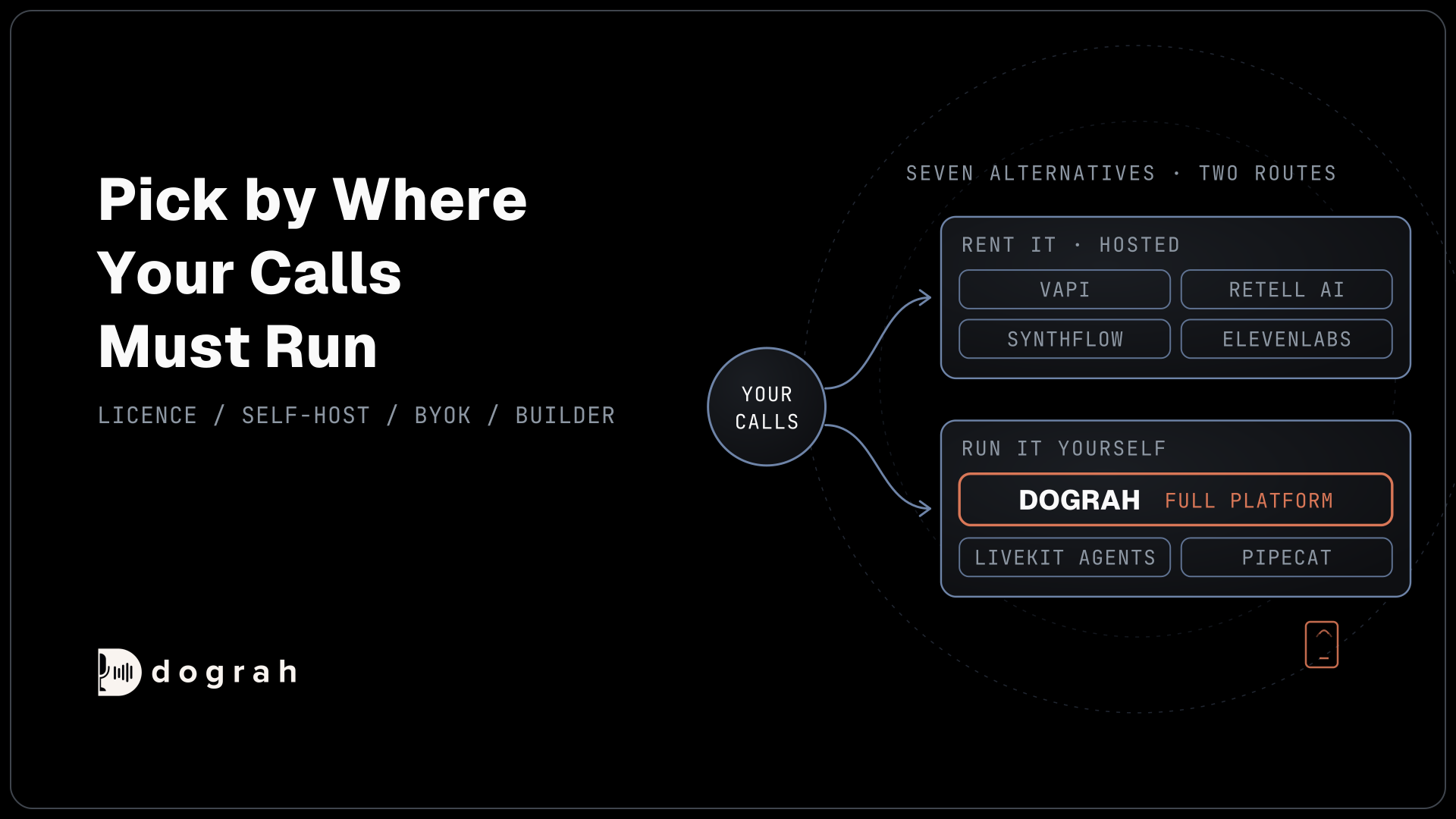

Bland AI alternatives split by who runs the platform. Vapi, Retell AI, Synthflow and ElevenLabs Agents are hosted and closed source, like Bland, and bill per minute or by contract. Dograh, an open-source, self-hostable voice agent platform, can run on your own servers with a visual builder. LiveKit Agents and Pipecat are open-source frameworks you build on.
Key Takeaways
- Bland's entry rate rose from $0.09 to $0.14 a minute in December 2025.
- If you need on-prem without an Enterprise contract, Dograh is open source and can be self-hosted.
- Rebuild one pathway, test it on a real phone line, then move numbers.
This guide sets seven Bland AI alternatives against Bland on cost, model choice, where each can run and what Bland keeps for Enterprise, and says when staying on Bland is the better call.
Why teams look beyond Bland AI
Most searches for an alternative to Bland AI start with a price change, a call cap, a feature locked behind Enterprise, the fact that Bland picks every model for you, or the move to Bland Agents.
Bland is a hosted platform for phone agents. In September 2026 it replaced Conversational Pathways with Bland Agents, where each call is still drawn as a pathway of nodes inside an agent, and every production agent must move to the new architecture by 15 November 2026. Bland says it is the only voice AI that runs entirely on its own models, all covered by one per-minute rate. It is a serious, growing vendor: Bland raised a $50 million Series C in June 2026 and reports more than 3.5 million calls a week.
The first trigger is price. On 5 December 2025, Bland's Start rate rose from $0.09 to $0.14 a minute, about 56% more, with Build at $0.12 and Scale at $0.11.
The second is volume. Start allows 100 calls a day and 10 at once. Build raises that to 2,000 a day and 50 at once, for $299 a month. Calls over a cap are rejected, so a busy day can hit a wall before the bill does.
The third is Bland's Enterprise column: the business associate agreement (BAA) that HIPAA requires before a vendor handles patient data, single sign-on (SSO), data residency and on-prem or virtual private cloud (VPC) deployment. Connecting your own carrier over SIP (Session Initiation Protocol) also needs an entitlement that Bland support switches on for Enterprise organisations.
The fourth is model choice. On Bland's self-serve plans you cannot move to a cheaper language model or another voice provider, and a voice cloned there stays there.
The fifth is the forced rebuild. Bland is moving every production pathway to Bland Agents by 15 November 2026, so teams have to migrate, re-test and promote each agent anyway, which makes it a natural point to compare where else that work could land. Our page on migrating from Bland AI to Dograh shows how to rebuild your agents and switch one number at a time.
What to compare before you switch
Six questions decide whether a Bland AI alternative fits, and price is only one.
The licence comes first, since it decides whether you can read the code and keep running it if the vendor changes course. Next is where it runs: your own servers without a sales contract, or the vendor's cloud only. Then billing: the list price, and how the total moves with the models you pick. Model choice covers whether you can bring your own key (BYOK) for a provider or host open-weight models yourself. The builder matters because teams leaving Bland are used to drawing calls as nodes. Last is compliance: which contract, certificate or hosting option your calls need, and which plan it sits on.
Latency is left out, because it depends on your models and carrier far more than on the platform. Measure it on your own calls.
The alternatives in one table
Here are seven Bland AI alternatives next to Bland, with each product's strengths and gaps in one cell.
| Product | Open source | Self-host or on-prem | List price | What you get, and what's missing |
|---|---|---|---|---|
| Bland AI (baseline) | No | Enterprise only: your VPC, on-prem GPU clusters or air-gapped, by contract. Start and Build run on Bland's cloud | Start $0.14/min with no platform fee; Build $0.12/min plus $299/mo; Enterprise custom. Phone billed separately | One rate covering Bland's own speech and language models, the Bland Agents builder (the successor to Pathways), and SOC 2, HIPAA, ISO 27001 and FedRAMP 20x Class A listed. But self-serve plans give no model choice, the BAA, SSO and data residency need Enterprise, and SIP needs an entitlement from Bland support |
| Dograh | Yes, BSD-2-Clause | Yes. Self-host the full platform for free with Docker; on-prem or private cloud on Enterprise; or managed Dograh Cloud | Self-hosted: no per-minute platform fee. Dograh Cloud: 1¢/min platform fee. Models and phone extra | Full platform with a visual workflow builder, your own phone carrier, call traces and automatic quality assurance (QA) that scores each step. Pick any model layer, including open-weight models you host. But self-hosting means you run the servers, and call transfer to a person works on Twilio only |
| Vapi | No | No. Runs on Vapi's cloud | $0.05/min hosting plus models at provider cost and phone. Core $29/mo, Pro $999/mo minimum. HIPAA add-on $2,000/mo | Model choice with your own keys or a custom large language model (LLM), plus OpenAI's realtime speech-to-speech models, with agents built as Assistants and Squads. But its visual Workflows builder stopped running in August 2026, and HIPAA costs extra every month |
| Retell AI | No | Runs on Retell's cloud; a dedicated server is an Enterprise add-on | $0.07 to $0.31/min, starting with $0.055/min voice infrastructure. 20 concurrent calls included, then $8/mo each | A choice of language models and a self-serve BAA on pay-as-you-go. But Retell bills the model per minute on top, and the code is closed |
| Synthflow | No | Runs on Synthflow's cloud | Enterprise contracts from $30,000 a year | Native telephony or SIP, with implementation and launch support in the contract. But every plan is an annual Enterprise contract |
| ElevenLabs Agents | No | Runs on ElevenLabs' cloud | Free plan with 15 min/month; paid plans $6 to $990/mo with included minutes; extra minutes $0.08. Language model billed on top | A workflow builder and a free plan, with BAAs for HIPAA on Enterprise. But the language model is billed separately, and the code is closed |
| LiveKit Agents | Yes, Apache-2.0 | Yes. Self-host the framework and the LiveKit media server. Managed option: LiveKit Cloud | Free to self-host. LiveKit Cloud: free Build plan, Ship from $50/mo, Scale from $500/mo; agent sessions $0.01/min | Open-source framework with telephony and any model you wire in. But it is a code framework, so your developers write the agent and the product around it |
| Pipecat | Yes, BSD-2-Clause | Yes. Self-host the framework. Managed option: Pipecat Cloud | Free to self-host. Pipecat Cloud from $0.01/min per active agent | Open-source Python framework from Daily with any model you wire in. But phone wiring, call history, QA on live calls and the call lifecycle are yours to build |
Five hosted products, Bland included, bill by the minute or by contract, and any private hosting sits behind a sales conversation. Of the three you can run yourself, only Dograh ships as a full platform; LiveKit Agents and Pipecat are frameworks.
Dograh: run the platform yourself
Bland offers VPC, on-prem and air-gapped setups on Enterprise contracts; the software stays closed. Dograh's code is open, so anyone can self-host it for free, read it and change it.
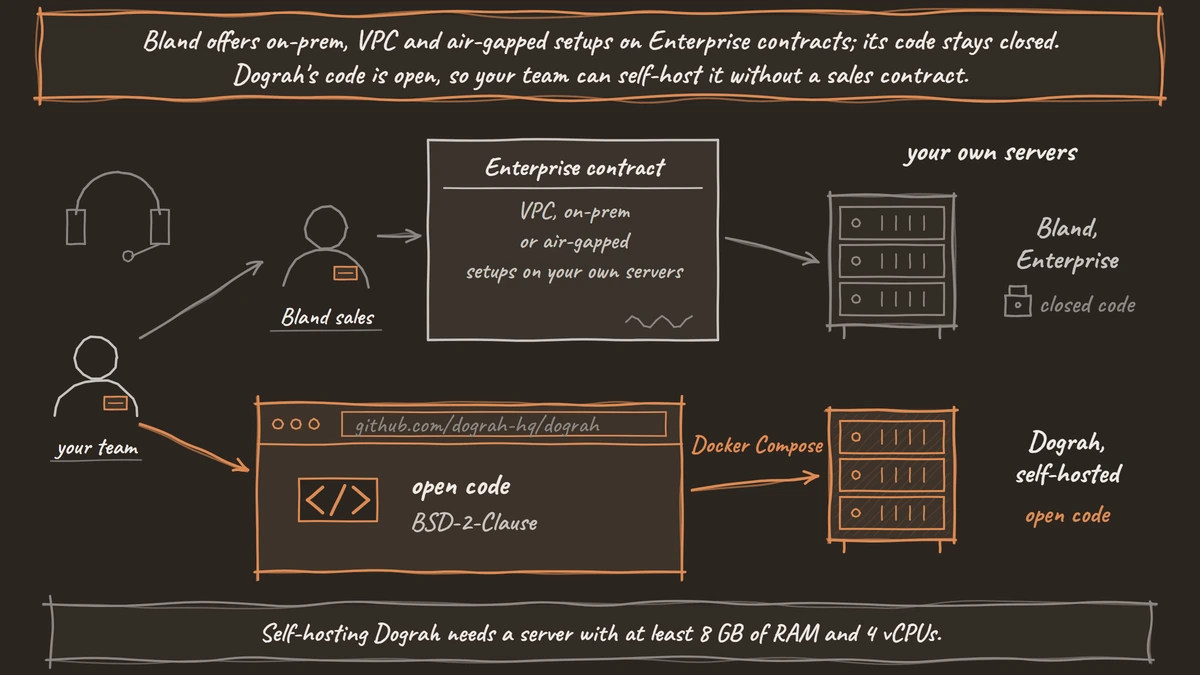
Dograh is licensed under BSD-2-Clause, and its GitHub repository, with more than 5,900 stars, holds the whole platform: the visual workflow builder, telephony, Transfer Call, Campaigns for outbound lists, call traces and automatic QA. A team used to Pathways will find the builder familiar: nodes joined by pathways, each with a condition the AI reads.
The biggest change from Bland is the model layer. Dograh is the orchestration layer: it runs the call flow, tools and telephony, while the speech and language models are a layer you choose, from Dograh's own models to any supported provider on your own key or open-weight models you host. Call data stays on your servers only when you self-host the models too; with your own keys, the audio still reaches each provider. Our guide to running voice AI on local, self-hosted models covers that stack.
Dograh runs on your own phone setup: Twilio, Vonage, Plivo, Telnyx, Cloudonix, Exotel, Vobiz or Asterisk ARI, with VICIdial through Asterisk ARI as an advanced option. On Dograh Cloud, Dograh Managed SIP connects your own SIP trunk or phone system (PBX). Dograh doesn't sell numbers, so yours stay with your carrier.
For HIPAA, Dograh's answer is self-hosting. No BAA with Dograh is needed, because Dograh never sees the data. Model providers that handle patient data may need their own BAA, as may the phone carrier, depending on what it stores, and a cloud host such as AWS needs one too.
Self-hosting uses Docker Compose on a server with at least 8 GB of RAM and 4 vCPUs, and runs 10 calls at once by default, a limit you can raise. Self-hosted Dograh has no per-minute platform fee (servers, model keys and phone minutes still cost); Dograh Cloud has a 1¢-a-minute platform fee and includes 10 concurrent calls, with more on request. Our Dograh vs Bland AI comparison goes through the two row by row.

Open Source Alternative to Vapi / Retell
Self-hosted voice agent platform — no per-minute fees
dograh-hq/dograh
Star on GitHub
Hosted alternatives to Bland AI
Four hosted products come up most often as Bland AI competitors, each taking a different line on model choice and compliance.
Vapi
Vapi assembles a stack from providers you pick, where Bland runs one it builds. Vapi charges $0.05 a minute for hosting and passes model costs through at the provider's price, or you bring your own keys or a custom LLM. You build with Assistants and Squads, and Vapi also runs OpenAI's realtime speech-to-speech models. Its visual Workflows builder was retired on 18 August 2026.
Vapi sells HIPAA handling as a $2,000 monthly add-on, so it does not need an Enterprise contract. Its published plans all run on Vapi's own cloud. Our Vapi vs Bland AI comparison sets the two against each other, and Vapi alternatives covers the field from Vapi's side.
Retell AI
Retell bills each part of a minute separately: a $0.055 voice infrastructure line, then the language model, the voice and a Retell phone line, for $0.07 to $0.31 a minute in total. Retell offers a choice of language models, including OpenAI's realtime speech-to-speech models, and has a visual Conversation Flow builder.
On compliance, pay-as-you-go customers can request and sign Retell's BAA from the dashboard, without an Enterprise contract. Its plans run on Retell's cloud, with a dedicated server as an Enterprise add-on. Our Retell AI vs Bland AI comparison goes through the two row by row, and Retell AI alternatives covers Retell's side of the field.
Synthflow and ElevenLabs Agents
Synthflow sells only Enterprise contracts, from $30,000 a year, and suits teams that want a vendor to build the agent for them.
ElevenLabs Agents has a free plan with 15 minutes a month and paid plans from $6 to $990 a month, with the language model billed on top. It has a workflow builder, and BAAs for HIPAA customers sit on its Enterprise plan.
Other open-source routes: LiveKit Agents and Pipecat
LiveKit Agents and Pipecat are solid open-source building blocks, and choosing one means your team builds the product around it.
On-prem and open source often get mixed up. Bland sells on-prem on Enterprise, but only open source lets you read, change and run the code without a contract. Neither alone keeps call audio in-house; that also needs self-hosted models.
Pipecat is a Python framework from Daily under BSD-2-Clause, and Dograh itself is built on a fork of it. In our experience Pipecat is an excellent base, but production needs a lot of extra plumbing: phone integrations, call history, QA on live calls and the call lifecycle.
LiveKit Agents runs on the LiveKit media server under Apache-2.0. Both have managed versions, Pipecat Cloud and LiveKit Cloud, priced in the table.
If open source is your main reason for leaving, our post on the open-source alternative to Bland AI covers what changes when you own the platform.
What Bland AI really costs
Bland's rate is simple to read, since one number covers the AI models. Phone time, outbound attempts, transfer minutes and texts each sit on top of that rate.
Bland bills call time to the second, and Scale, at $0.11 a minute, costs $499 a month. Your carrier bills phone time, or Bland passes Twilio's cost through. On Bland's own telephony, every outbound attempt and every failed call carries a $0.015 minimum charge. Time after a transfer to a person costs $0.05, $0.04 or $0.03 a minute by plan when the call uses a Bland number, and nothing on your own Twilio account.
By our arithmetic, 10,000 minutes a month comes to $1,499 on Build ($299 plus $0.12 a minute) and $1,599 on Scale. Start would come to $1,400, but at 100 calls a day, 10,000 minutes only fits if calls average more than three minutes. Phone time is extra on all three. On long lists with low answer rates, the attempt minimum adds up: if 10,000 dials go unanswered, the minimum alone comes to $150.
Our breakdown of Bland AI pricing prices every line, with the break-even points between plans.
When staying on Bland makes sense
Bland still fits some teams, and a switch only pays off if it fixes a real problem.
If you want one rate that covers the models and would rather make no model choices at all, Bland gives you that on Start with no monthly fee. Everyone else here asks you to pick a language model and a voice, or bring your own.
If you are buying Enterprise anyway, Bland bundles things that are hard to get elsewhere. It lists FedRAMP 20x Class A, achieved on 25 August 2026. Its Enterprise contracts also cover air-gapped deployment and EU data residency, and its forward deployed engineers build the first agent with your team. Self-hosted Dograh can run in your own EU data centre, and can run offline when set up for it, but the security and compliance work then sits with your own team.
How to move off Bland
Moving can happen one number at a time, so Bland keeps answering calls until each rebuilt agent passes its tests.
Plan for more work than it looks: in an April 2026 Zapier survey of 542 US executives, 58% of those who had tried to switch AI vendors said the move failed or took far more effort than expected.
Start by getting each call flow out. Bland's Get Single Pathway API returns each pathway's nodes and edges as JSON. Dograh has no one-click Bland import, so you rebuild the flow: by hand in the builder, or with an AI assistant that converts the JSON and builds the agent through Dograh's MCP (Model Context Protocol) server. A Bland Global Node, a step reachable from anywhere, needs a new design: Dograh's Global Node is a shared prompt, so you add pathways to that step instead.
Bland's own models do not come with you, so choose new ones. A voice cloned on Bland stays there, so re-create it at a provider Dograh supports, such as ElevenLabs or Cartesia, with the speaker's consent.
Numbers on your own Twilio account move easily: connect that account to Dograh and set each number's inbound workflow. For numbers bought through Bland, ask Bland support about porting them to another carrier, or to your own SIP trunk through Dograh Managed SIP. Test each rebuilt agent over a real phone line before any number moves. Our checklist for testing voice agents before you go live puts those checks in order, and the full walk-through is in how to migrate from Bland AI to open-source voice AI.
Join the Dograh Community
Dograh is an OSS alternative to Vapi. Join our Slack community for queries, releases, best practices & community interactions.
Picking your Bland AI alternative
The right pick depends on where your calls must run and who will run the platform.
If call data has to stay on your own servers, Dograh is a platform you can install today, with on-prem support on Enterprise if you want a contract. Teams that would rather write the agent in code can start with LiveKit Agents or Pipecat. For a hosted product, price Vapi, Retell AI, ElevenLabs Agents and Bland at your own call volume, and expect an annual contract with Synthflow.
Dograh answers the gaps that start most of these searches. It is open source under BSD-2-Clause, so you can self-host it today without a sales contract, and self-hosted it has no per-minute platform fee. You choose every model, from your own provider keys to open-weight models on your own servers, and your numbers stay with your carrier. A team used to Pathways gets the same nodes-and-pathways builder, with QA that scores each step. To try it, run it from GitHub with Docker Compose, or start on Dograh Cloud.
Whichever you shortlist, run the same call script on a real phone line, because most phone calls still reach the agent as 8 kHz audio, while a browser demo runs at 16 kHz.
Each part of this guide has its own deep dive:
- Dograh vs Bland AI
- Open-Source Alternative to Bland AI
- Bland AI Pricing Explained
- How to Migrate From Bland AI to Open-Source Voice AI
- Vapi vs Bland AI
Glossary
- Conversational Pathways
- Bland's original visual call builder, where each node handles one part of the call and labelled lines decide where it goes next. Since September 2026 a pathway sits inside a Bland Agent, and production pathways must move to Agents by 15 November 2026.
- Platform fee
- What a voice AI vendor charges for running the call itself, separate from the models and the phone line. Bland folds its models into its rate; self-hosted Dograh has no per-minute platform fee.
- Air-gapped deployment
- Running the platform on hardware with no outbound network connection, so no call data can leave over the internet. Bland sells it on Enterprise contracts.
- Bring your own key (BYOK)
- Using your own account with a model provider instead of the platform's. You hold the contract and the bill, but the call audio still goes to that provider.