
AI voice agents for utilities and energy answer and place routine customer calls: billing questions, start, stop and transfer orders, bill reminders and outage updates. They read the account from the customer information system during the call and write each change back. Gas leaks and downed lines get a fixed safety instruction and go straight to a person.
Key Takeaways
- A fixed safety line plays before any other part of the call.
- The agent reads the CIS during the call and writes each change back.
- Outage and pre-shutoff calls generally sit inside consent customers already gave.
This guide covers the calls a utility can hand to a voice agent, from billing questions and moves to outbound reminders and outage updates, plus the emergency line, and how each one runs in Dograh, an open-source voice agent platform that reads and writes your customer information system and outage data during the call. You can self-host it or run it on Dograh Cloud.
What utility customers call about
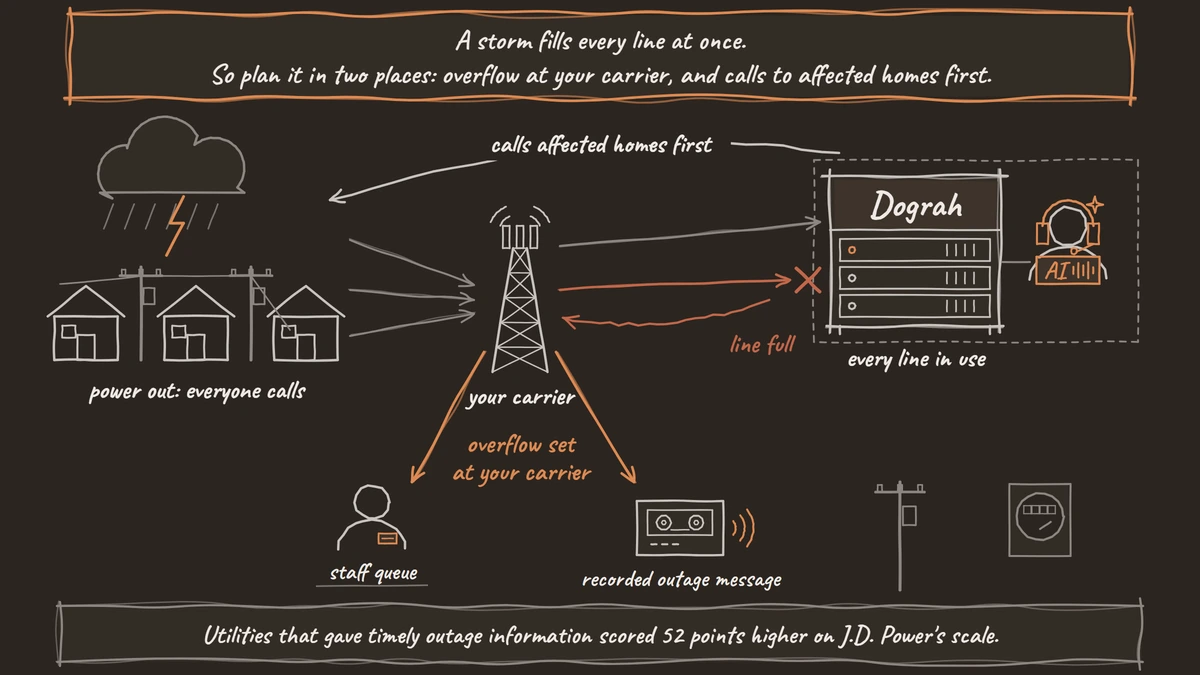
Utility calls gather around the bill and the power, and both rose in 2025. J.D. Power's Utilities Outlook 2026 found that 55% of US customers had a power outage in 2025, nearly half of them blamed on severe weather. In the same research, 22% of electric customers said they could not pay their full bill. Utilities that gave timely outage information scored 52 points higher on J.D. Power's 1,000-point scale. That is the case for outbound outage calls, and for an inbound line that can take the surge, both covered below.
Patience is thin. In J.D. Power's 2025 electric utility residential study, electric utility satisfaction fell to 499 out of 1,000, the lowest score across its residential utility studies, and the average monthly electric bill reached $189. In February 2026, the National Energy Assistance Directors Association (NEADA) reported that about 21.5 million households are behind on their energy bills. Those customers are the reason for the bill reminders below, which give the amount and due date and leave hardship and shutoff decisions to your staff.
Four kinds of call make up most of the work: questions about a bill or an account, moves that start, stop or transfer service, outbound reminders and outage updates, and emergencies. If your line sorts them with a keypad menu today, AI Voice Agent vs IVR shows what changes when the caller simply says what they need.
The agent works through your CIS and outage system
Every call in this guide reads from the utility's own systems and writes back to them, and the agent keeps no account data of its own. The customer information system (CIS) holds the account and the bill. The outage management system (OMS) knows which addresses are out and when crews expect power back.
Dograh runs each call as a flow drawn in its visual workflow builder. During the call, an HTTP API tool asks the CIS or OMS for what the caller needs, and the agent says only what came back. Once the caller agrees to a change, a second HTTP API tool writes it. After the call, a Webhook node sends the outcome and the transcript link onward, and it retries a temporary failure on its own.
Dograh has no built-in CIS or billing integration. Each connection is an HTTP API tool or an MCP tool pointed at your system's own API. Our guide to Integrating Voice Agents With Your Stack covers those routes.
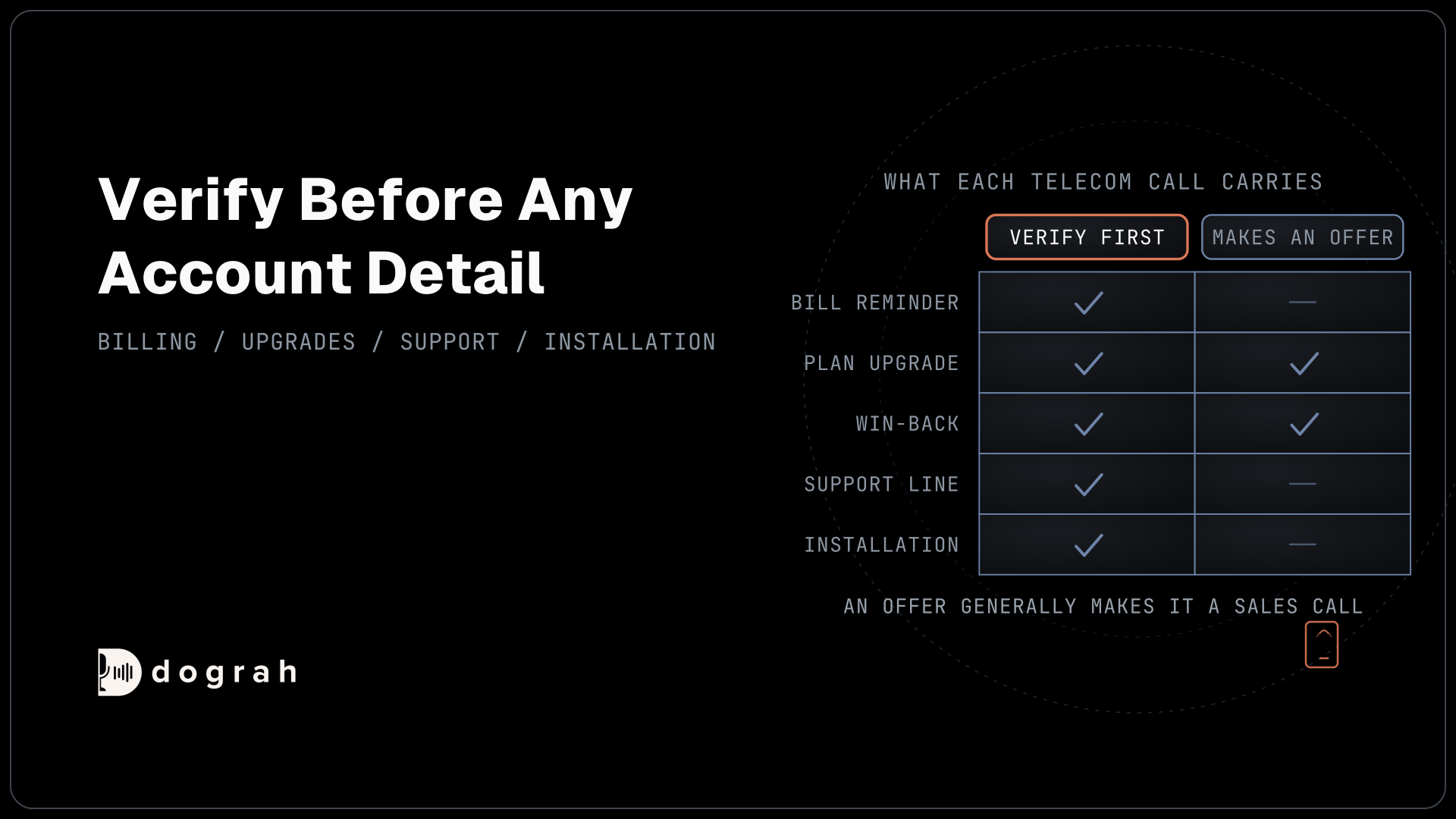
Pre-Call Data Fetch, at the bottom of the Start Call node, can look up the account by the caller's number as the call connects. A phone number finds an account, but it does not prove who is calling. So every call runs greet, verify, then disclose: before the agent names a balance or a due date, it asks for an approved check, such as the last digits of the account number.
Transfer Call hands the caller to a person. It works on Twilio only and passes no summary, so the agent first writes the details to your system with an HTTP API tool. If nobody answers within the 30-second default, the caller stays with the agent; tell it in the prompt to offer a callback and write the request through an HTTP API tool.
Safety comes first on every utility call
A caller who smells gas or sees a downed power line must hear a fixed instruction before anything else, then reach a person. The US Pipeline and Hazardous Materials Safety Administration (PHMSA) tells anyone who suspects a gas leak not to "Use a telephone or cell phone (these can ignite airborne gases)" and to "Telephone 911 from a neighbor's house or other location well away from the gas leak." The caller is already on a phone, so the agent's job is to get them off it and outside.
Exact words hold only where Dograh speaks fixed text: the Greeting Text on the Start Call node, a pathway's Transition Speech, the Transfer Call tool's Pre-Transfer Message, or a recorded clip. Inside a node, the language model writes its own words. Choosing the emergency pathway is also the model reading a written condition, never a hard rule.
So the safety line goes in the Greeting Text that every caller hears, for example: "If you smell gas or see a downed power line, hang up now, leave the area, and call 911 from a safe place." Your safety team writes the real wording. In a service area that speaks two languages, write the line in both, because Greeting Text plays before Dograh can hear the caller's language. If a caller mentions gas or a fallen wire anyway, the emergency pathway repeats the instruction as fixed text and transfers to the 24/7 emergency line, with no intake questions first.
If that transfer goes unanswered, Dograh hands the failure back to the model, which writes its own reply. That is why the fixed instruction plays before the transfer. Each Agent node can carry its own Transfer Call tool, so gas calls and electric calls can reach different emergency numbers. AI voice agents for emergency intake in utilities walks through the full design.

Open Source Alternative to Vapi / Retell
Self-hosted voice agent platform — no per-minute fees
dograh-hq/dograh
Star on GitHub
Inbound calls: bills, accounts and moves
Most inbound calls are about a bill or a move, and both run on the account the CIS returns after verification.
Billing and account questions
The support call answers a bill from the account's own numbers. After verification, an HTTP API tool returns the usage, the rate, the number of billing days and whether the bill used an estimated meter read, and the agent explains the bill from those. Tariff documents and policies can sit in the Knowledge Base for general questions, but account figures always come from the CIS. For callers in other languages, open the agent's Model tab, set speech-to-text to Multilingual (Auto-detect) and tick the languages you serve under Language hints (available with Dograh's own models or Deepgram Flux).
Payment arrangements are offered only within limits the utility's system returns. Dograh takes no payments on a call, so an HTTP API tool asks the utility's own system to send its secure payment link by text or email. Shutoff decisions, disputes, hardship cases and assistance-program eligibility go to a person. AI voice agents for utility customer support sets out the full call order, including the "is there an outage at my address?" question.
Start, stop and transfer service
A move is two orders that are hard to undo, because a stop on the wrong address cuts off someone else's power. For a stop, the agent verifies the account holder, collects the service address and the stop date, reads both back and writes the order only after a clear yes. For a start, it collects the name, service address, start date and contact number, and the utility's own system runs its address validation and its credit and deposit rules. The agent reads the result and never decides it.
Signatures and ID documents go out from the utility's own system, never through the call. If a write could be sent twice, a Preset Parameter carrying the call's workflow_run_id lets the CIS ignore the duplicate. AI voice agents for start, stop and transfer service in utilities covers both orders and the transfer call that combines them.
Outbound calls and the FCC consent line
Outbound utility calls are judged by what they say, and most service calls sit inside consent the customer has already given. This is general information, not legal advice.
The FCC's 2016 declaratory ruling, FCC 16-88, says customers who give a utility their wireless number "have given prior express consent to be contacted by their utility company at that number with messages that are closely related to the utility service". It lists calls that "warn about planned or unplanned service outages; provide updates about service outages or service restoration; ask for confirmation of service restoration or information about lack of service". Before termination, it also covers "calls to warn about the likelihood that failure to make payment will result in service curtailment."
The ruling draws two limits. "After a customer's utility service has been terminated, however, routine debt collection calls by utilities to those customers will continue to be governed by existing rules and requirements." It also calls these service calls not telemarketing, so an upgrade or product offer generally moves the call outside that consent. Customers "may revoke consent in any reasonable manner". Dograh keeps no do-not-call list of its own, so the agent writes a spoken opt-out to your system with an HTTP API tool, and those numbers come off the list before the next campaign upload.
Bill and shutoff reminders
A reminder states facts and points to the utility's own payment channels. After verification, the agent gives the amount, the due date and, before a shutoff, the date in the written notice. It never takes a payment and never threatens beyond what the notice says. A voicemail names only the utility and a number to call back. Hardship and assistance questions go to a person. Once service is cut off, the call is a collection call under other rules, which our post on AI voice agents for debt collection covers. AI voice agents for utility bill reminders has the full call.
Outage and restoration calls
An outage call goes only to the addresses the OMS lists as affected, and it states a restoration time only if the OMS has one. The OMS starts each call through the API Trigger, or your system uploads the affected list as a Campaigns list through Dograh's API. When the OMS has no estimated time of restoration (ETR), the agent says so and never guesses. Campaign calling hours are set by weekday in one time zone per campaign. Restoration checks wait for those hours, and the utility's own texts cover the night. AI voice agents for outage notifications covers the call list and the "is your power back?" check.
Rules differ by state and outside the US. Confirm your own position with counsel before the first outbound campaign.
Join the Dograh Community
Dograh is an OSS alternative to Vapi. Join our Slack community for queries, releases, best practices & community interactions.
Storm surges, concurrency and where the data lives
An outage fills the phone line at the moment the agent is most useful, so capacity needs a plan before storm season. Self-hosted Dograh runs 10 concurrent calls by default, adjustable with DEFAULT_ORG_CONCURRENCY_LIMIT; servers and the phone provider set the practical ceiling. Dograh Cloud's Pay as you go plan includes 10 concurrent calls, and you contact Dograh for more.
When the limit is full, Dograh rejects a new inbound call at once instead of queueing it. On Twilio, the caller hears a fixed message that the account has reached its concurrent call limit, and the call ends. Set the limit for the outage peak and add an overflow at the carrier, so turned-away calls reach a human queue or a recorded outage message. Calling affected customers first also means fewer of them need to call in. Then load-test it, as How to Test, Monitor, and Scale AI Voice Agents in Production describes.
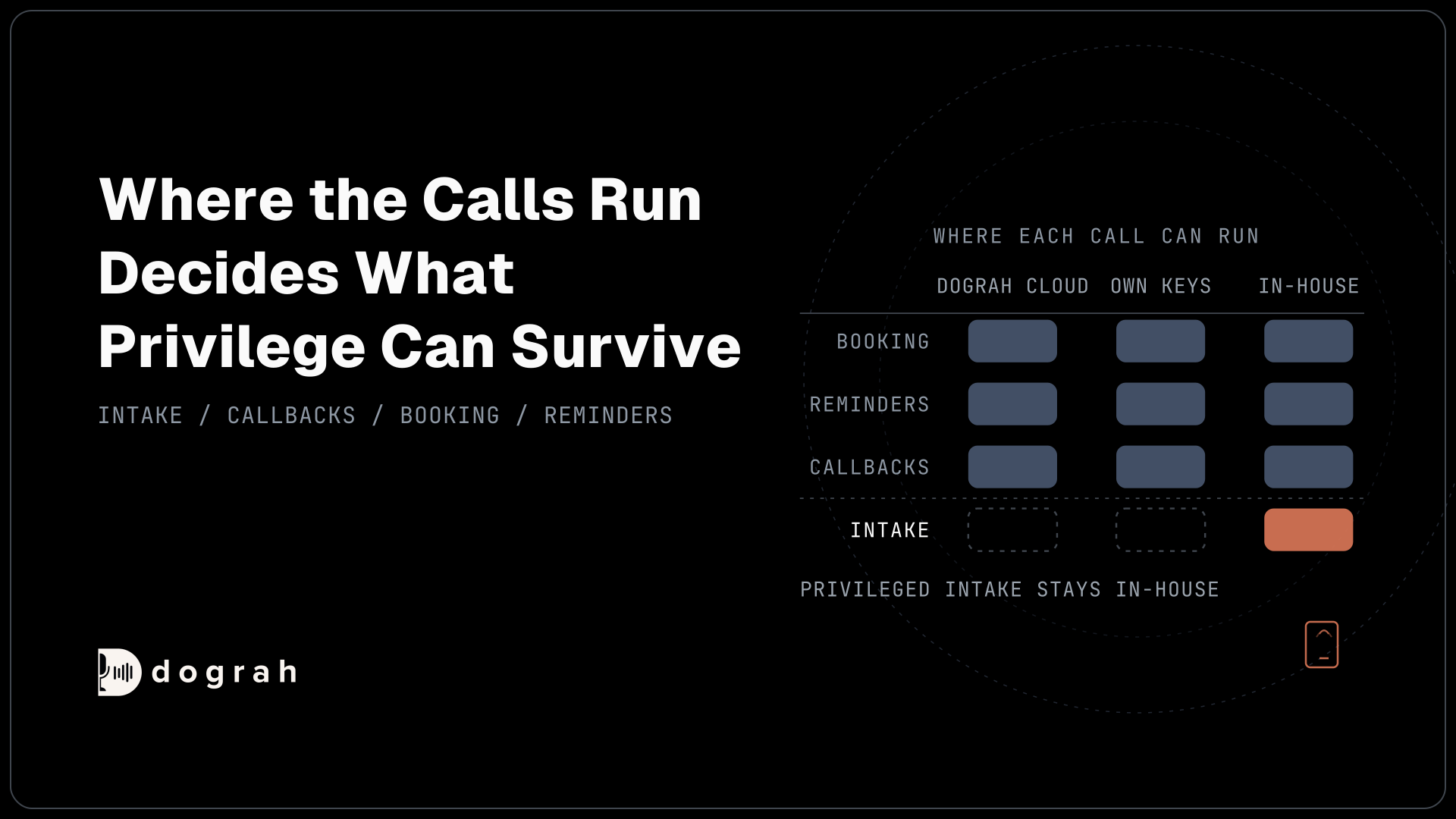
Dograh is the orchestration layer: it runs the call flow, tool calls, telephony and the call lifecycle, and the speech and language models are a separate layer you choose. Self-hosting keeps recordings and transcripts on the utility's own servers. The call audio stays in-house only when the speech and language models run there too. Transcripts keep everything said, so the agent never asks for a password, a PIN or a card number. Our page on self-hosted voice AI for utilities shows the safety line, the account check and the write-back to your customer system on your own servers.
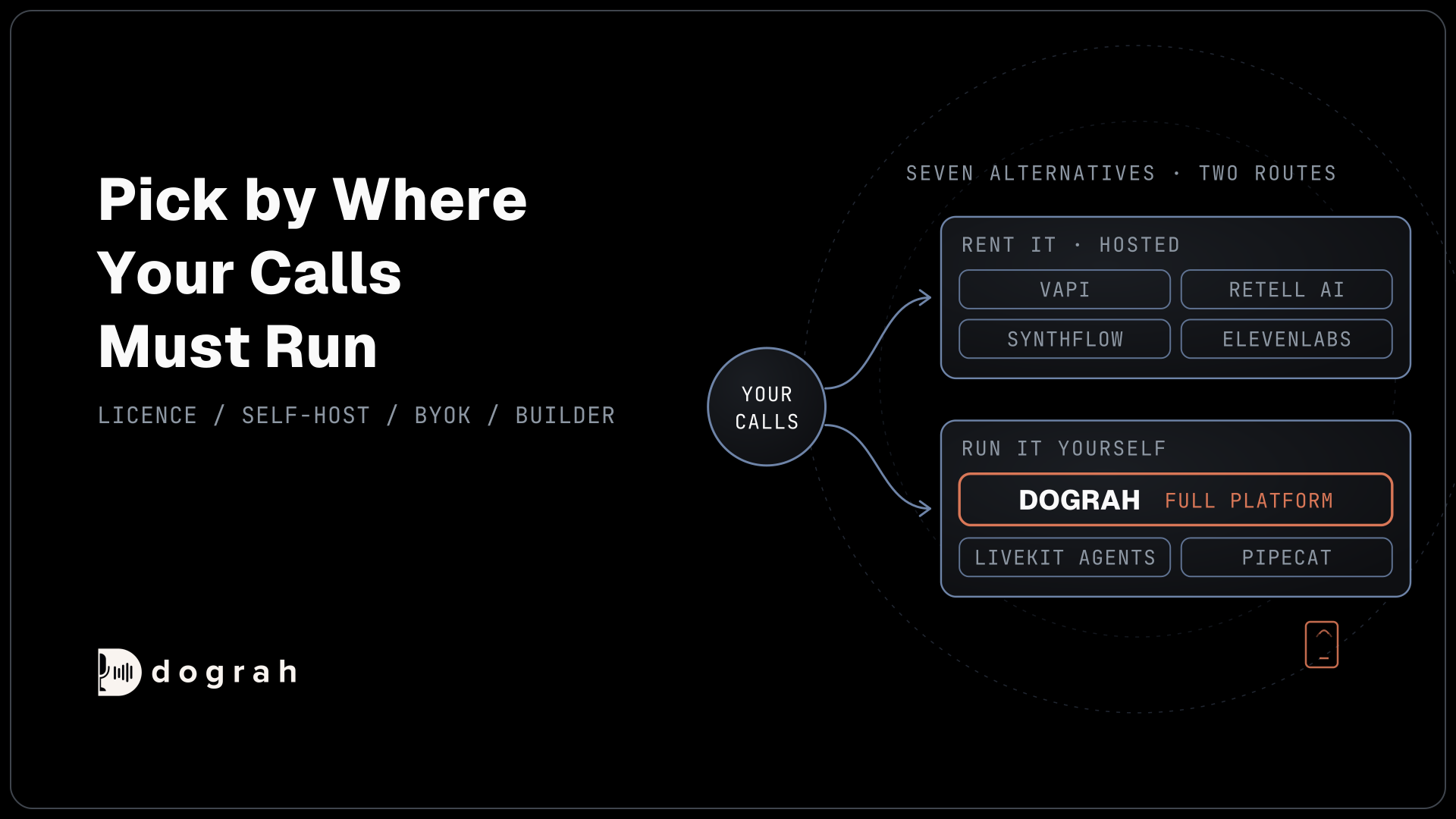
Choosing a platform for utility calls
A utility platform has to pass checks a buyer can verify in a trial. It should run self-hosted or on-premise, with the tier that allows it stated up front. The safety line should be fixed text, and the agent should read and write the CIS and OMS during the call. Opt-outs and calling hours should be enforceable, and concurrency should rise for a storm. The price should be published.
Best AI voice agents for utilities compares Dograh with hosted platforms and enterprise vendors on those checks, prices included.
Which utility call to hand over first
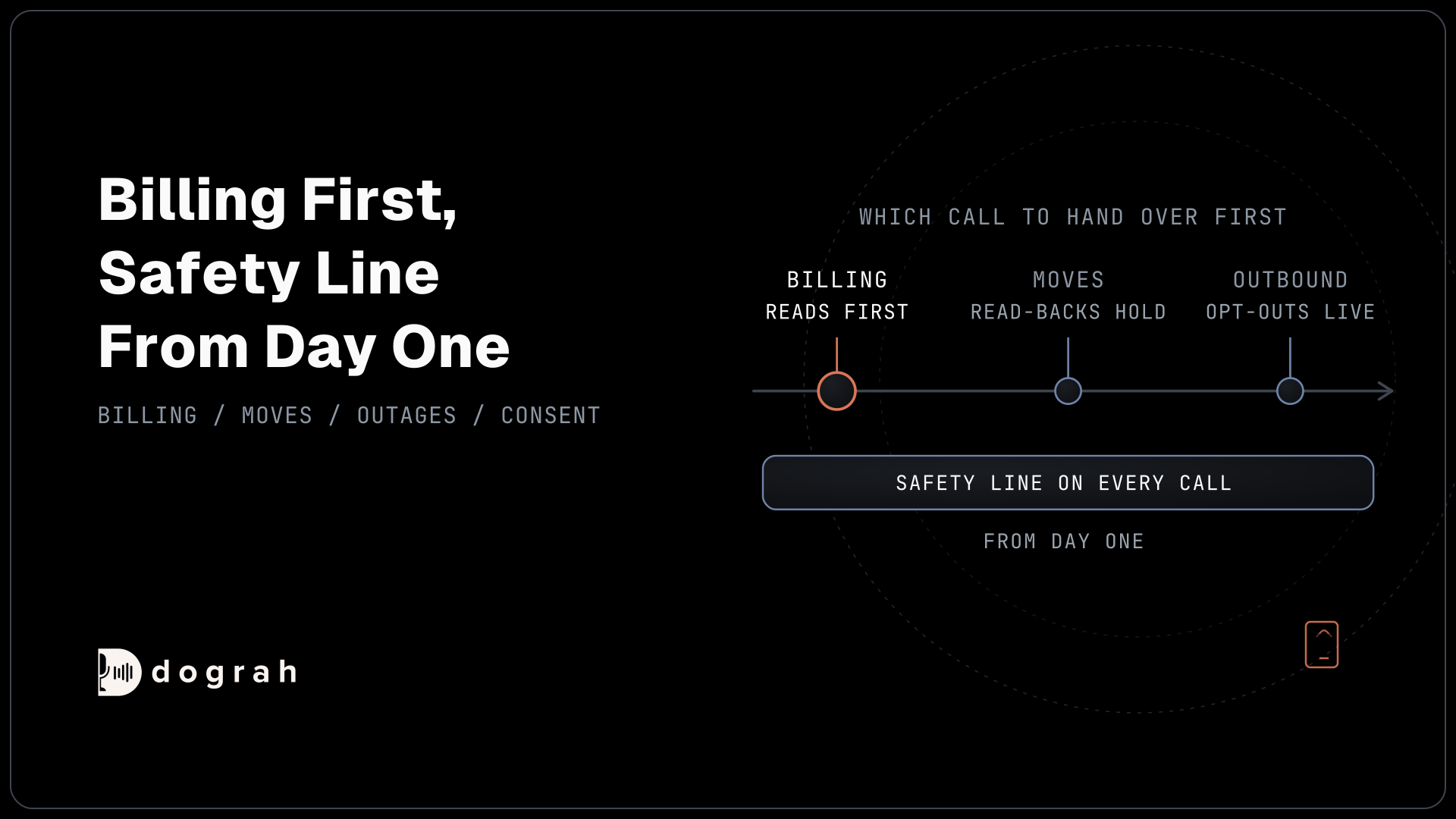
Start with inbound billing and account questions, because the agent reads before it writes and raises no outbound consent questions. The safety line goes in from day one. Add start, stop and transfer orders once read-backs hold, then outbound outage and reminder campaigns once opt-outs live in your own system.
Put the agent on a real phone number before any customer hears it. Most phone calls reach the agent as 8 kHz audio, while a browser test runs at 16 kHz, and browser test calls cannot run Transfer Call, so test the emergency transfer over a real call. Once live, run QA on a random 5 to 10% sample of calls and check that every gas mention took the emergency pathway.
Self-hosted Dograh has no per-minute platform fee (servers, model keys and phone minutes still cost); Dograh Cloud has a 1¢-a-minute platform fee.
Each utility call above has its own deep dive:
- AI Voice Agents for Emergency Intake in Utilities
- AI Voice Agents for Utility Customer Support
- AI Voice Agents for Start, Stop and Transfer Service in Utilities
- AI Voice Agents for Utility Bill Reminders
- AI Voice Agents for Outage Notifications
- Best AI Voice Agents for Utilities
Glossary
- Estimated meter read
- A bill based on the utility's estimate of usage when the meter was not read, corrected later by an actual read. The agent tells the caller a read was estimated only when the CIS returns that flag.
- Outage management system (OMS)
- The system that tracks which addresses are without power or service and when crews expect to restore it. Outage calls take their call list and their restoration time from it.
- Estimated time of restoration (ETR)
- The time the utility expects service back at an address. A voice agent states it only when the OMS returns one and says plainly when there is no estimate yet.
- Prior express consent
- Under the TCPA, permission to receive autodialed or prerecorded calls. The FCC treats a wireless number given to a utility as consent to calls closely related to the service, such as outage updates.