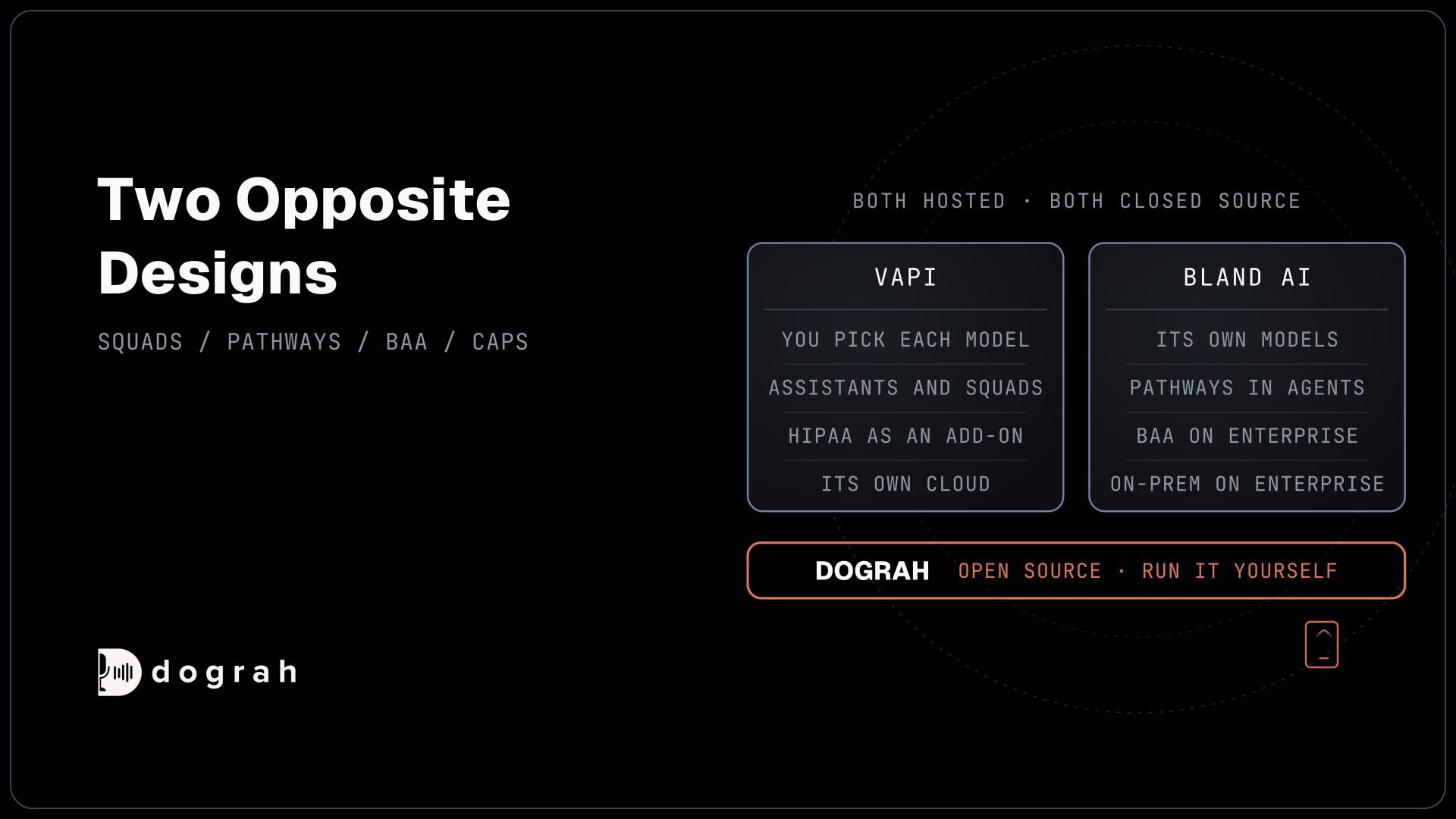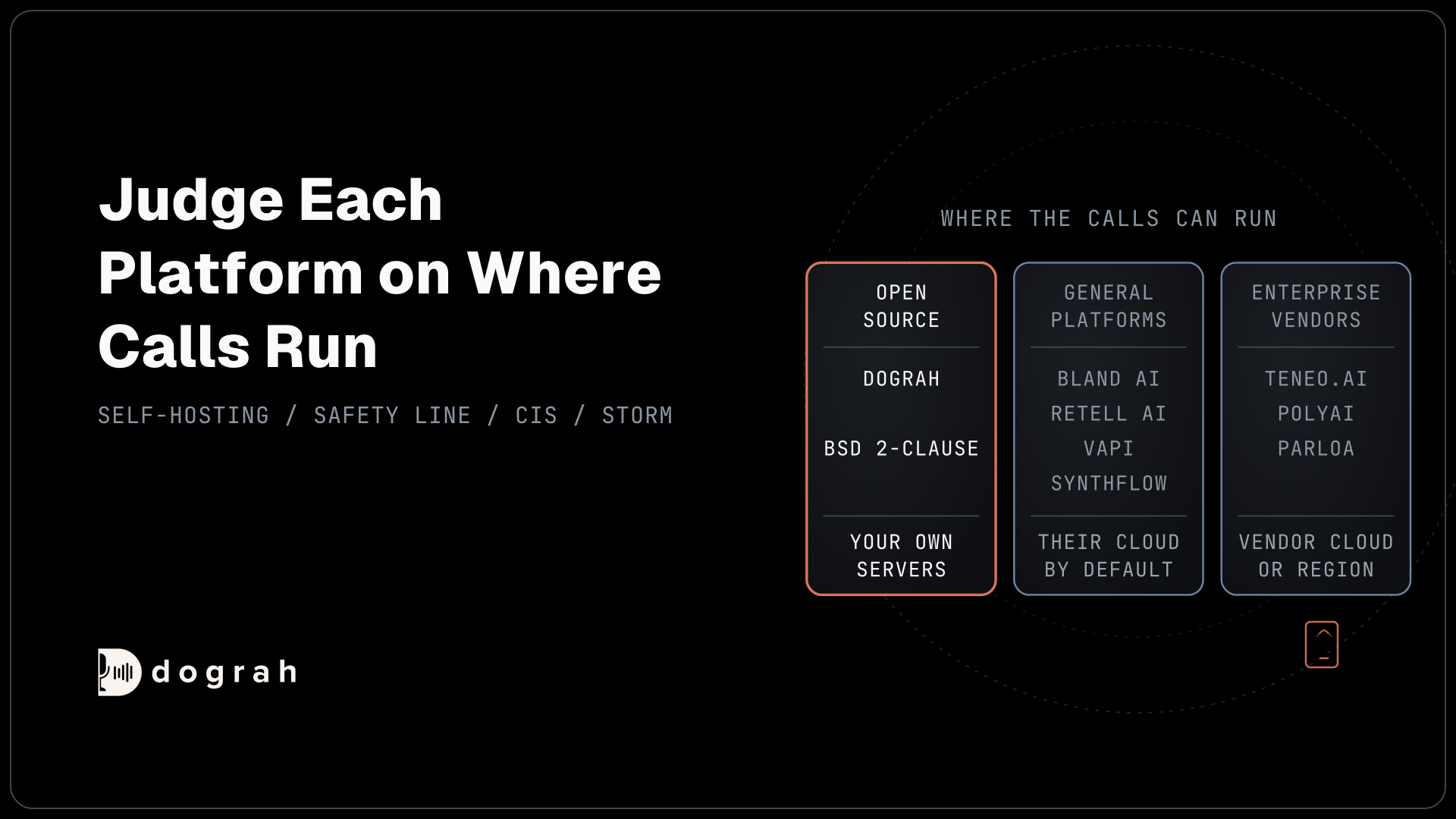

The best AI voice agents for utilities come down to where calls run. Dograh, an open-source platform, can run on the utility's own servers, read and write customer accounts mid-call and play the gas safety line as fixed words. The others are hosted platforms such as Bland AI and Vapi, or enterprise vendors such as Teneo.ai and PolyAI.
Key Takeaways
- Judge each platform first on where its calls and recordings can run.
- If calls must stay on your own servers, Dograh can run there, self-hosted with no per-minute platform fee.
- Make every vendor prove the gas safety line on a real phone call.
This post is part of our guide to AI voice agents for utilities and energy. The guide's section "Choosing a platform for utility calls" says a utility platform has to pass checks a buyer can verify in a trial. Here are eight platforms, starting with Dograh, judged on six tests that matter to an electric, gas or water utility.
The six tests a utility buyer should run
Utility calls come in waves, so the tests lean toward control and capacity. J.D. Power's Utilities Outlook 2026 found that 55% of US customers had a power outage in 2025.
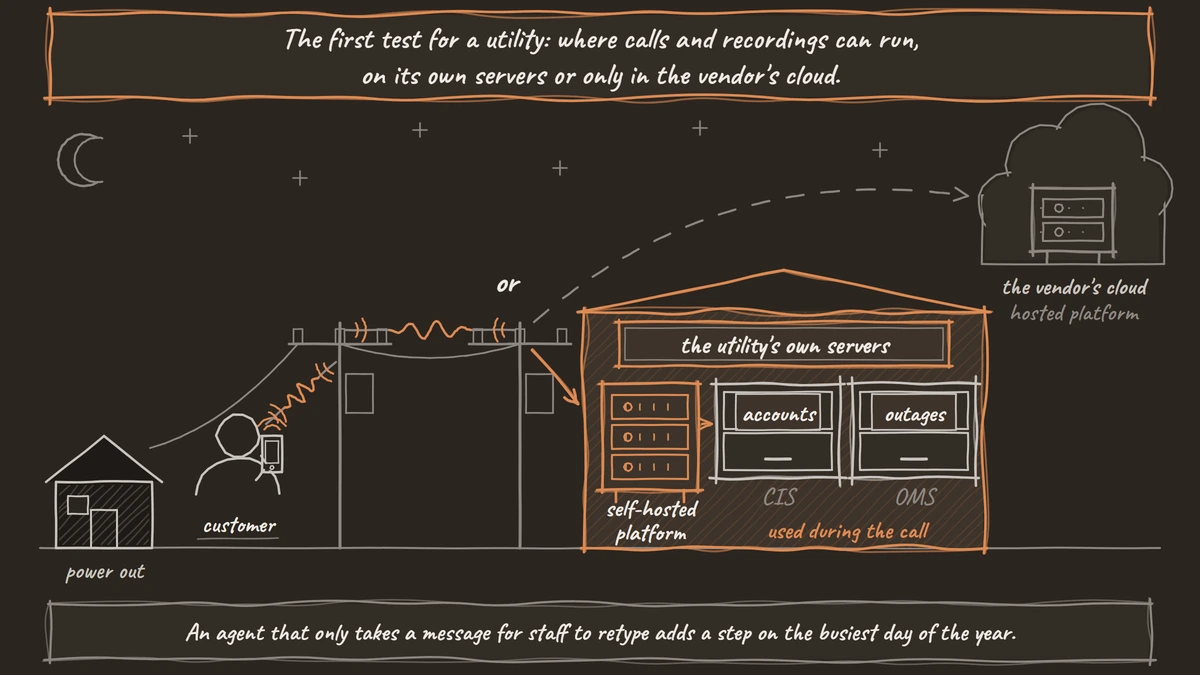
The first test is where calls and recordings can run: on the utility's own servers, in a private cloud, or only in the vendor's cloud, and which plan allows each.
The second is open code. A utility's security team usually reviews any software that touches customer accounts, and open code lets that review happen before a contract is signed. It also lets the utility keep running the agent if a vendor changes its terms or its prices.
The third is the safety line. On a call about a gas smell or a downed wire, the instruction to leave the area and call 911 should play as fixed words, before the model decides anything.
The fourth is whether the agent reads and writes your customer information system (CIS) and outage management system (OMS) during the call. An agent that only takes a message for staff to retype adds a step on the busiest day of the year.
The fifth is storm capacity: how many calls run at once, and what the next caller hears when the limit is full. Ask each vendor how many concurrent calls your plan includes, and check whether your carrier can send the overflow to a person or a recorded outage message.
The sixth is price: what a minute or a seat costs at your call volume, and what sits on top of it, such as models, phone minutes and add-ons.
How the eight platforms compare
The table starts with Dograh, then orders the rest by how much control they give over where calls run.
| Platform | Where calls can run | Open source | Stated concurrency | Price | What you get, and what's missing |
|---|---|---|---|---|---|
| Dograh | Your own servers; Dograh Cloud; Enterprise adds on-premise or private cloud | Yes, BSD 2-Clause | 10 by default, raised self-hosted or by contacting Dograh on Cloud; a call over the limit is rejected at once | Self-hosted: no per-minute platform fee. Dograh Cloud: 1¢/min platform fee | Fixed Greeting Text, Transition Speech and Pre-Transfer Message for the safety line, a Transfer Call tool per Agent node, HTTP API tools to your CIS and OMS, campaigns by API. But no prebuilt CIS connector, and Transfer Call works on Twilio only |
| Bland AI | Bland's platform; on-prem or virtual private cloud (VPC) deployment on Enterprise | No | Start 10, Build 50, Enterprise sized to your volume | Start $0.14/min; Build $0.12/min plus $299/month; telephony billed separately | One per-minute price covers the model and both speech layers. On-prem or VPC comes with an Enterprise contract |
| Teneo.ai | Cloud, private cloud, or entirely within your own country | No | Through sales | Through a demo and sales | Utility agents for start, stop and transfer, outages and billing, launched in 2026. Closed code, priced through sales |
| Parloa | Parloa's platform, with regional zones that keep customer data in a chosen legal region | No | Through sales | Per minute for voice, custom plans through sales | Its technology runs E.ON One's voicebot for energy suppliers. Closed code, priced through sales |
| Synthflow | Synthflow's platform, with EU and US hosting | No | Planned per contract | Enterprise contracts from $30,000 a year | Native telephony, SIP trunking or approved enterprise telephony. One plan, Enterprise, scoped to volume and integrations |
| PolyAI | PolyAI's platform; your own carrier over Session Initiation Protocol (SIP) | No | 10 on its model API once a card is added | Platform per minute through sales; Dialog-RSN-1 model API 2¢ per connected minute, telephony extra | Managed enterprise agents, with outage reporting and billing named in its utilities guide. Platform price through sales |
| Retell AI | Retell's cloud; Enterprise terms by contract | No | 20 free, then $8 per extra call a month | $0.07 to $0.31/min | Developer platform with speech-to-speech models. Closed code, running in its cloud |
| Vapi | Vapi's platform | No | 4 on the base tier, 10 on Core, 30 on Pro; $10 per extra line a month | $0.05/min hosting, before models and phone | Wide model choice for developers. The hosting fee sits on top of every model and phone cost |
Dograh: open source you can run on utility servers
Against the six tests above, Dograh's case is straightforward. It can run on the utility's own servers from open code, plays the safety line as fixed words, reads and writes the CIS and OMS during the call through HTTP API tools, states its concurrency limit and what happens when it is full, and publishes its price. None of that needs a sales contract.
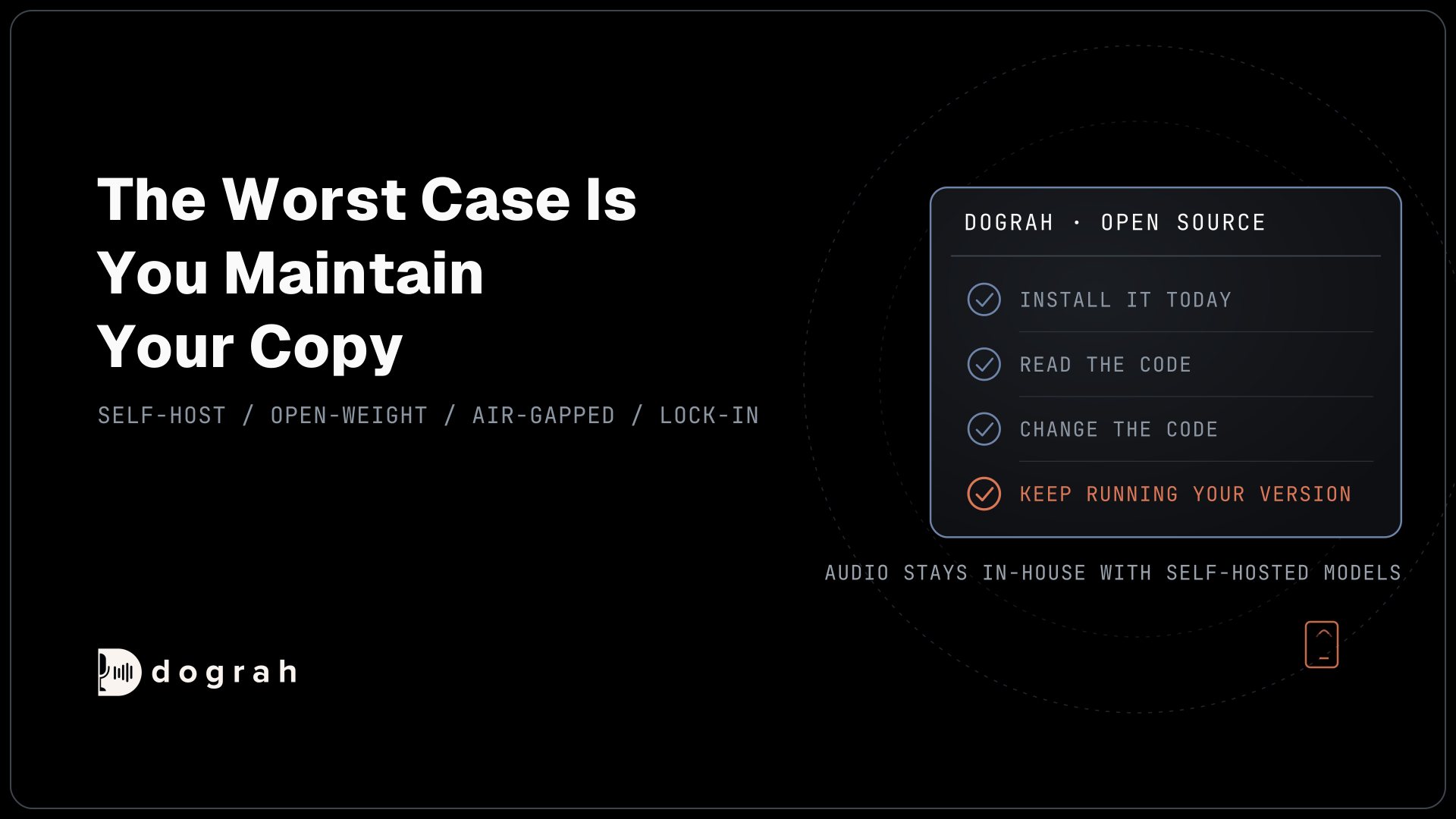
Dograh is released under the BSD 2-Clause licence and has more than 5,800 stars on GitHub. It is the orchestration layer: it runs the call flow, tools and telephony, and the speech and language models are a separate layer you choose. With self-hosting and open-weight models on the utility's own servers, call audio and transcripts stay in-house. With a hosted model used through your own API key, the audio still reaches that provider, so the key moves the contract but not the data.
The safety line is fixed text, not generated. The Greeting Text and a pathway's Transition Speech play set words, and the Transfer Call tool's Pre-Transfer Message plays before the transfer starts, so the caller hears "leave the area and call 911" even if nobody picks up. Each Agent node can carry its own Transfer Call tool, so a gas call and a downed-line call reach different desks.
For the account, Pre-Call Data Fetch sends the caller's number to your endpoint as the call connects, so a known outage at that address can be the first thing the agent says. HTTP API tools read and write the CIS and OMS during the call, and the API Trigger and campaigns created through the API start outage and reminder calls from your own systems.
Capacity is set in plain terms. Self-hosted Dograh runs 10 concurrent calls by default, raised with DEFAULT_ORG_CONCURRENCY_LIMIT, and your servers and carrier set the real ceiling. Dograh Cloud Pay as you go includes 10, with more by contacting Dograh. When the limit is full, Dograh rejects the next inbound call at once, with no queue, so set the limit for your storm peak and plan an overflow at your carrier.
Self-hosted Dograh has no per-minute platform fee (servers, model keys and phone minutes still cost); Dograh Cloud has a 1¢-a-minute platform fee. Dograh's pricing page lists Enterprise on-premise or private-cloud deployment with data residency.
The limits are worth stating. Dograh ships no prebuilt connector for a CIS such as SAP or Oracle Utilities, so your team connects each system's API. Transfer Call works on Twilio only and passes no summary, so write the call details to your system before the transfer. Dograh sends no texts, takes no payments and keeps no do-not-call list of its own; the utility's own systems do all three.

Open Source Alternative to Vapi / Retell
Self-hosted voice agent platform — no per-minute fees
dograh-hq/dograh
Star on GitHub
Bland AI, Retell AI, Vapi and Synthflow: general voice platforms
These four are general voice platforms, and none is built for utilities. They appear on most shortlists because a developer team can build on them without a utility-specific project.
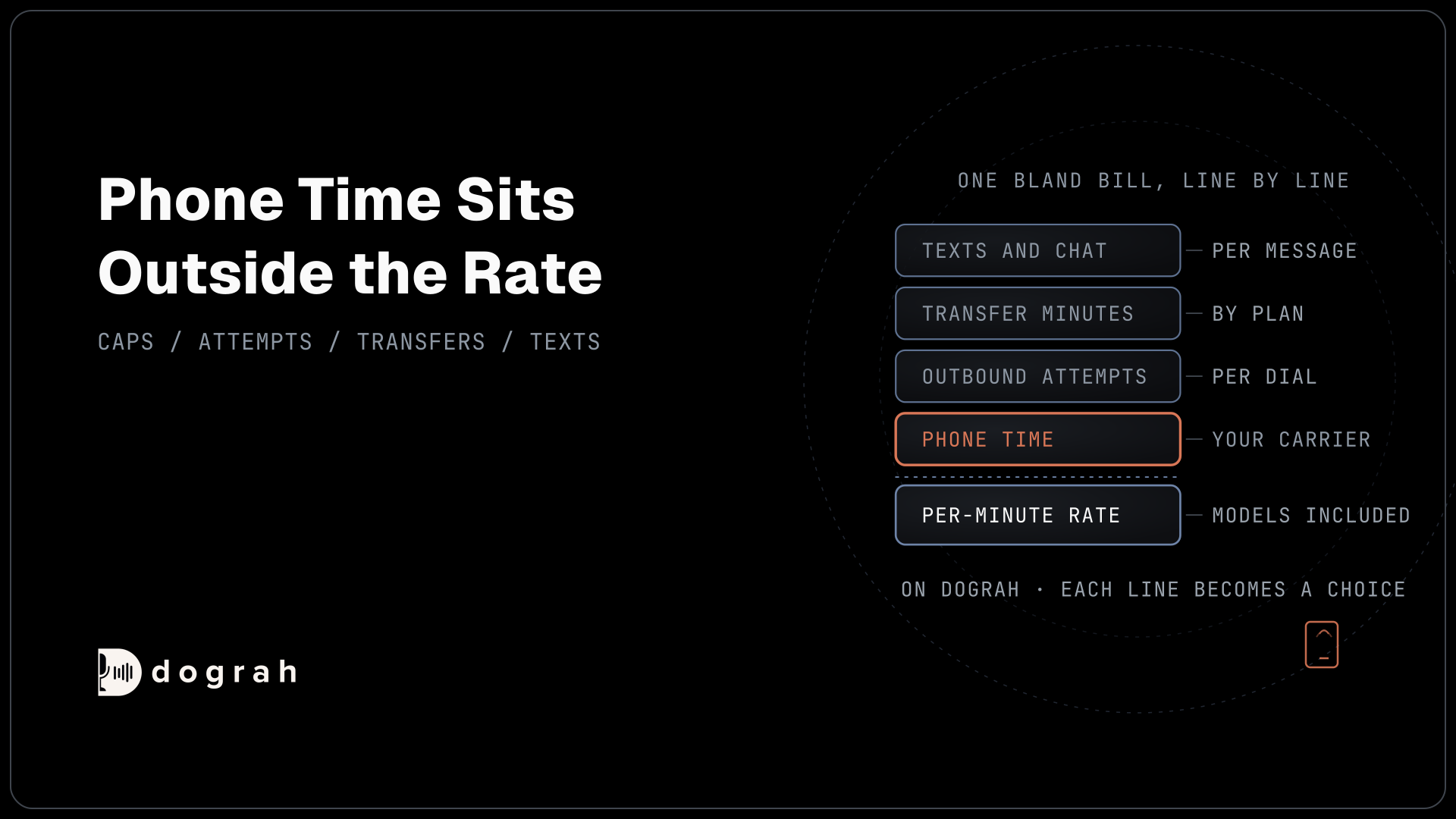
Bland AI sells Start at $0.14 a minute with 10 concurrent calls, and Build at $0.12 a minute plus $299 a month with 50. The per-minute rate covers the model and both speech layers, and telephony is billed separately. Its Enterprise plan offers on-prem or VPC deployment, with concurrency sized to your volume.
Retell AI charges $0.07 to $0.31 a minute for voice agents, and every account includes 20 concurrent calls free, with more at $8 per call a month. It also lists speech-to-speech models from OpenAI's GPT Realtime family, priced separately. Our breakdown of Retell AI pricing covers the parts.
Vapi charges $0.05 a minute for hosting on its base tier, with models passed through at cost and phone transport billed by the provider. That tier includes 4 concurrent calls, Core at $29 a month includes 10 and Pro includes 30, and extra lines cost $10 a month each. Vapi pricing explained adds up a full call.
Synthflow lists one plan, Enterprise, with contracts from $30,000 a year, scoped around call volume, concurrency, telephony, integrations and security needs. It runs on its own telephony, SIP trunking or approved enterprise telephony, and offers EU and US hosting.
All four leave the safety line and the CIS connections to your team, the same as Dograh. The difference is where the result runs: on their cloud, unless an Enterprise contract with Bland AI says otherwise.
Teneo.ai, PolyAI and Parloa: enterprise vendors with utility work
These three sell through sales teams and bring the most utility-specific work. Teneo.ai launched utility agents in February 2026, covering start, stop and transfer requests with address checks and identity verification, outage surges with restoration estimates, hazard reports, and billing and payment plans. It offers deployment in the cloud, in a private cloud, or entirely within your own country, and buyers start with a demo.
PolyAI's utilities guide names outage reporting and billing among the first areas to automate. PolyAI prices its platform per minute through its sales team, and its Dialog-RSN-1 model API at 2¢ per connected minute, with telephony not included. Your own carrier connects over SIP at no charge.
Parloa's technology runs OneVoice, the voicebot E.ON One built for energy suppliers and municipal utilities, announced in 2023. Parloa prices voice per minute on custom plans. In September 2026 it described Parloa Zones, which keep customer data such as transcripts and logs, and the services that process them, within a chosen legal region.
For a utility, the questions for all three are the same: which deployment your contract covers, and how many calls run at once in a storm. A managed project also raises a question the self-serve platforms do not: who writes the safety wording and who signs it off. On a gas call, that should be the utility's own safety team, in writing, before launch.
Consent and opt-outs stay with the utility on every platform
No platform choice changes the consent rules, so the utility keeps the records whichever product it picks. The FCC's 2016 ruling, FCC 16-88, generally treats a wireless number given to a utility as consent to calls closely related to the service, such as outage updates and payment warnings before a shutoff. An offer generally falls outside that, and so do routine collection calls after service is cut off. This is general information, not legal advice; confirm your position with counsel.
That puts two jobs in the utility's own systems: the record of who gave which number and when, and the opt-out list. A customer can generally revoke consent in any reasonable manner, including by saying so on the call. In Dograh, an HTTP API tool writes the opt-out to your list during the call, and you remove those numbers before the next campaign upload. Ask every other vendor on this list how its product does the same, and confirm your position with counsel.
What every platform must prove in a trial
Whatever you shortlist, run the same five tests before signing. Put a test call through that mentions gas and check that the fixed safety words play before anything else, then that the transfer reaches the emergency desk over a real phone line. AI voice agents for emergency intake in utilities sets out what that call should do.
Next, have the agent read a real test account from your CIS and write a change back, and confirm it states a restoration time only when your OMS returns one. Ask a test caller to say "stop calling me" and check the opt-out lands in your own list. Finally, load-test for your storm peak and listen to what the next caller hears when every line is busy.
Join the Dograh Community
Dograh is an OSS alternative to Vapi. Join our Slack community for queries, releases, best practices & community interactions.
Which platform fits which utility
The right choice depends on where your calls must run and who will build the agent. Four situations cover most utilities.
A utility that needs call audio, recordings and transcripts on its own servers should start with Dograh self-hosted. It is the strongest fit for that need, because the code is open, the platform fee is zero when self-hosted, and the safety line, the CIS lookups and the storm limit all sit in a call flow your own team controls. Call audio stays in-house only when the speech and language models run there too.
A utility that wants a vendor to bring utility templates and run the project will look at Teneo.ai and PolyAI, with Parloa close behind for energy suppliers, and accept that calls run in the vendor's cloud or region. A developer team that wants a hosted platform this week can start on Bland AI, Retell AI or Vapi and watch the per-minute fee as volume grows, and a utility ready for an annual contract can add Synthflow.
Many utilities will shortlist two: one platform they can host themselves and one managed vendor. Run the same five trial tests on both, on the same test accounts, and compare what each one did on the gas call first.
Dograh's strengths line up with the tests a utility weighs most: open code its security team can read, servers it controls, fixed safety wording, live CIS and OMS reads and writes, and a concurrency limit stated up front. To try it, self-host Dograh from GitHub with Docker Compose, or start on Dograh Cloud with its 1¢-a-minute platform fee, and point one test number at a gas-leak test call.
Glossary
- Self-hosting
- Running the voice agent platform on servers the utility controls. With open-weight models on the same servers, call audio and transcripts stay in-house.
- Concurrency limit
- How many calls a platform runs at once. During an outage it decides whether the next caller reaches the agent or is turned away, so plan for the storm peak.
- Data residency
- Keeping customer data, such as transcripts and logs, inside a chosen country or legal region. Vendors offer it through regional cloud deployments, or the utility gets it by self-hosting.
- Open-weight model
- A speech or language model whose weights can be downloaded and run on your own servers. It is what lets a self-hosted voice agent keep call audio away from outside providers.