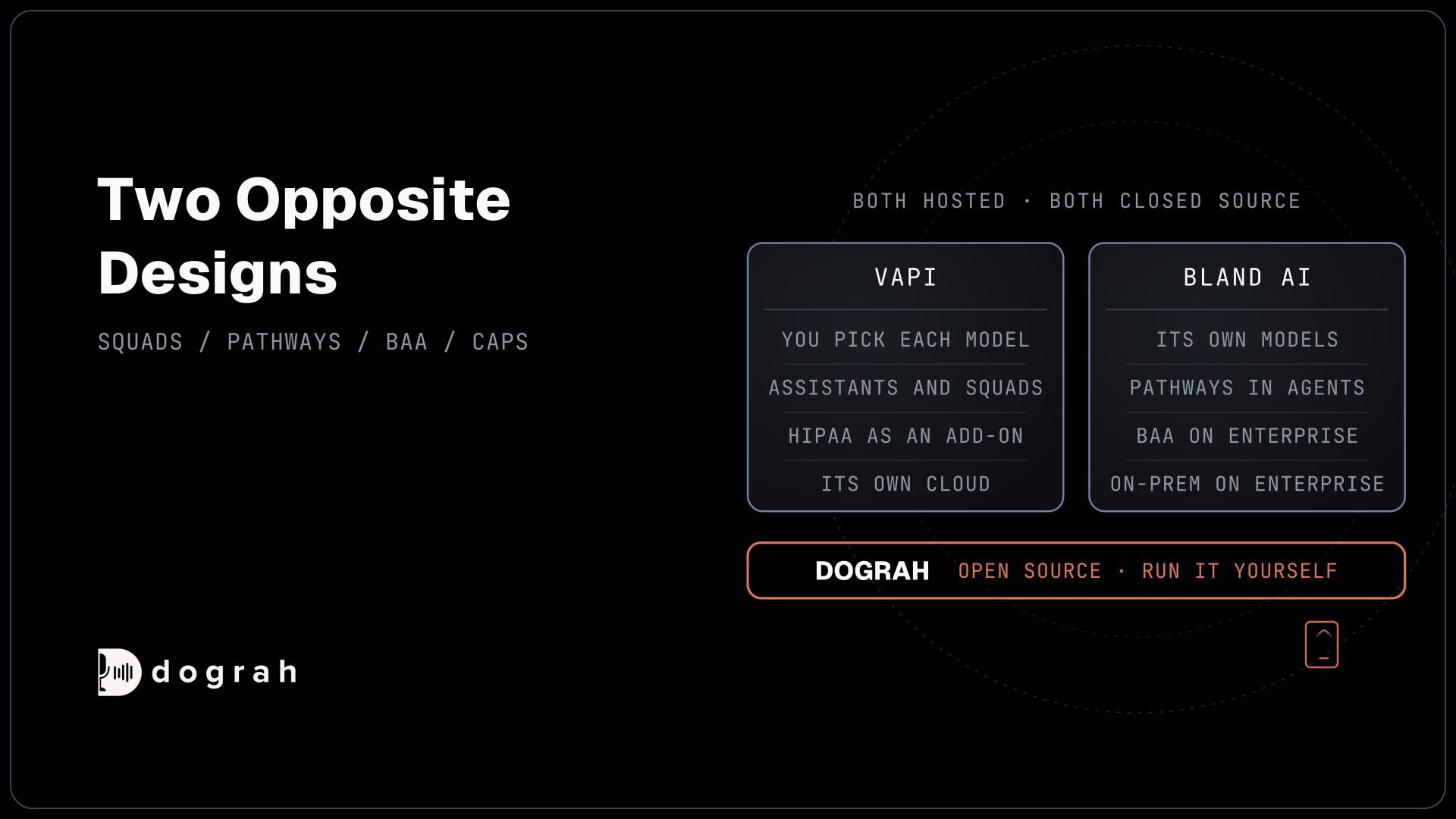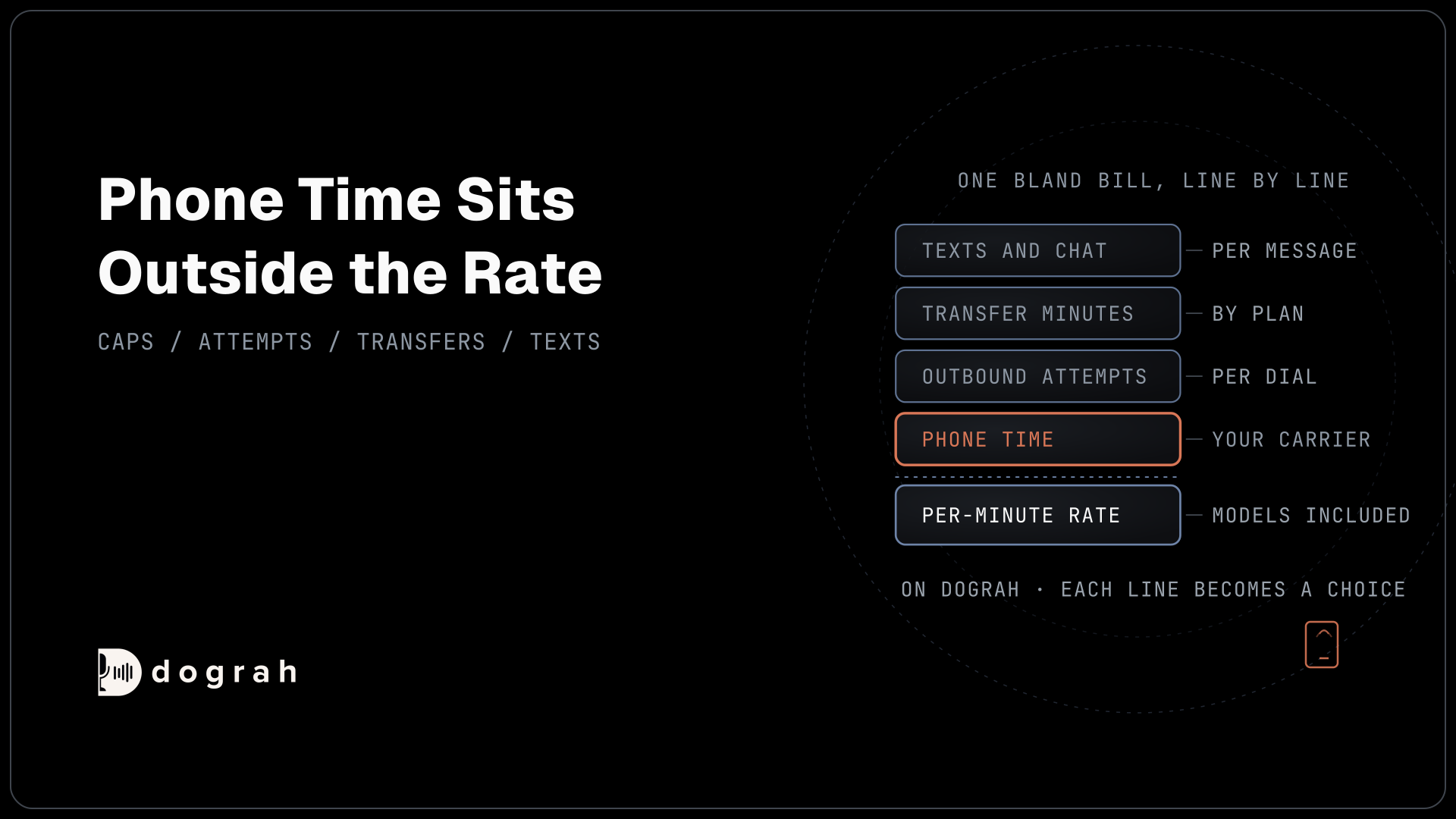

A full open-source alternative to Bland AI is Dograh, an open-source, self-hostable voice agent platform under BSD-2-Clause that anyone can run on their own servers for free. Bland sells virtual private cloud, on-prem and air-gapped setups on Enterprise contracts, but its code stays closed. Call audio stays in-house only when the models are self-hosted too.
Key Takeaways
- Bland's on-prem and air-gapped setups are Enterprise contracts for closed code.
- If you want the code without a sales contract, self-host Dograh under BSD-2-Clause.
- Full data sovereignty needs self-hosted models as well as a self-hosted platform.
This post is part of our guide to Bland AI alternatives. The guide's section "Other open-source routes: LiveKit Agents and Pipecat" separates on-prem from open source in a short paragraph; this post takes that apart properly, with what you gain and what you take on.
What Bland sells for private hosting
Bland does let you run its platform outside its own cloud, so the honest comparison starts there.
Bland's trust page lists four ways to deploy: Bland's managed cloud, your own virtual private cloud (VPC) on AWS, Google Cloud or Azure, dedicated GPU clusters in your own data centre, and an air-gapped install with no outbound network. It can also pin every leg of a call to one region, so EU calls stay on EU GPUs. Bland says it runs entirely on its own speech and language models, so its calls never reach an outside model provider. It lists FedRAMP 20x Class A, SOC 2 Type II, ISO 27001 and PCI DSS too.
All of that sits in the Enterprise column of Bland's pricing page, next to the BAA for HIPAA, single sign-on and data residency. Start and Build run on Bland's cloud. And in every setup the software stays closed: Bland's on-prem is a way to run Bland's software on your hardware; it does not give you the software.
What open source adds that on-prem does not
Open source changes who controls the platform, and on-prem alone does not.
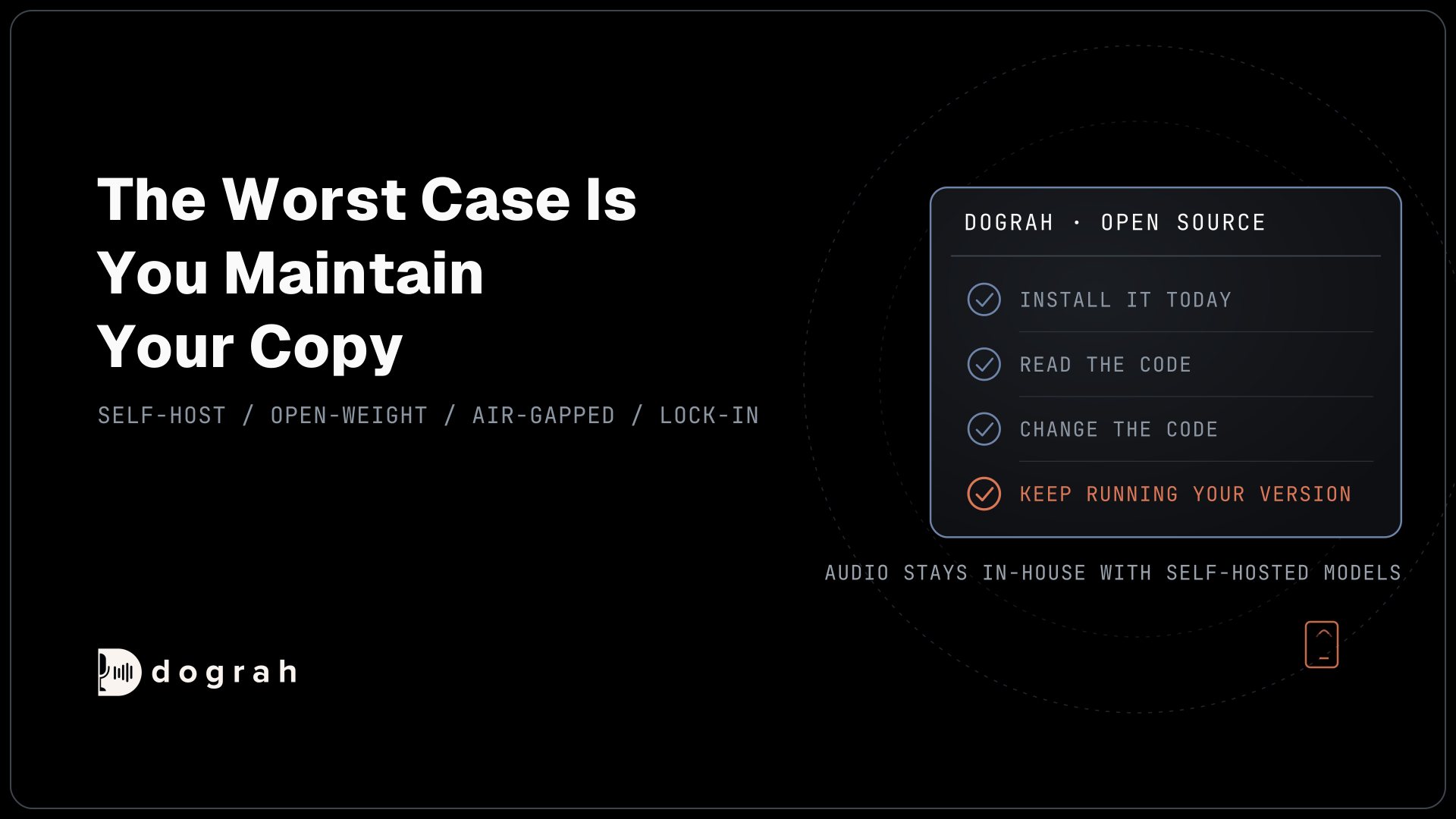
Dograh's code is on GitHub under BSD-2-Clause, one of the BSD licences, which lets you use, change and redistribute it, commercially too, as long as the copyright notice stays. In practice that means four things a closed on-prem contract leaves with the vendor. You can install it today, with no sales call. You can read the code your security team is asked to approve. You can change it, or pay someone to, when a feature is missing. And you can keep running the version you have if the vendor's pricing or direction changes.
That last point is the lock-in question. With a closed platform, an on-prem install still depends on the vendor's licence, updates and support contract. With open source, the worst case is that you maintain your copy yourself.
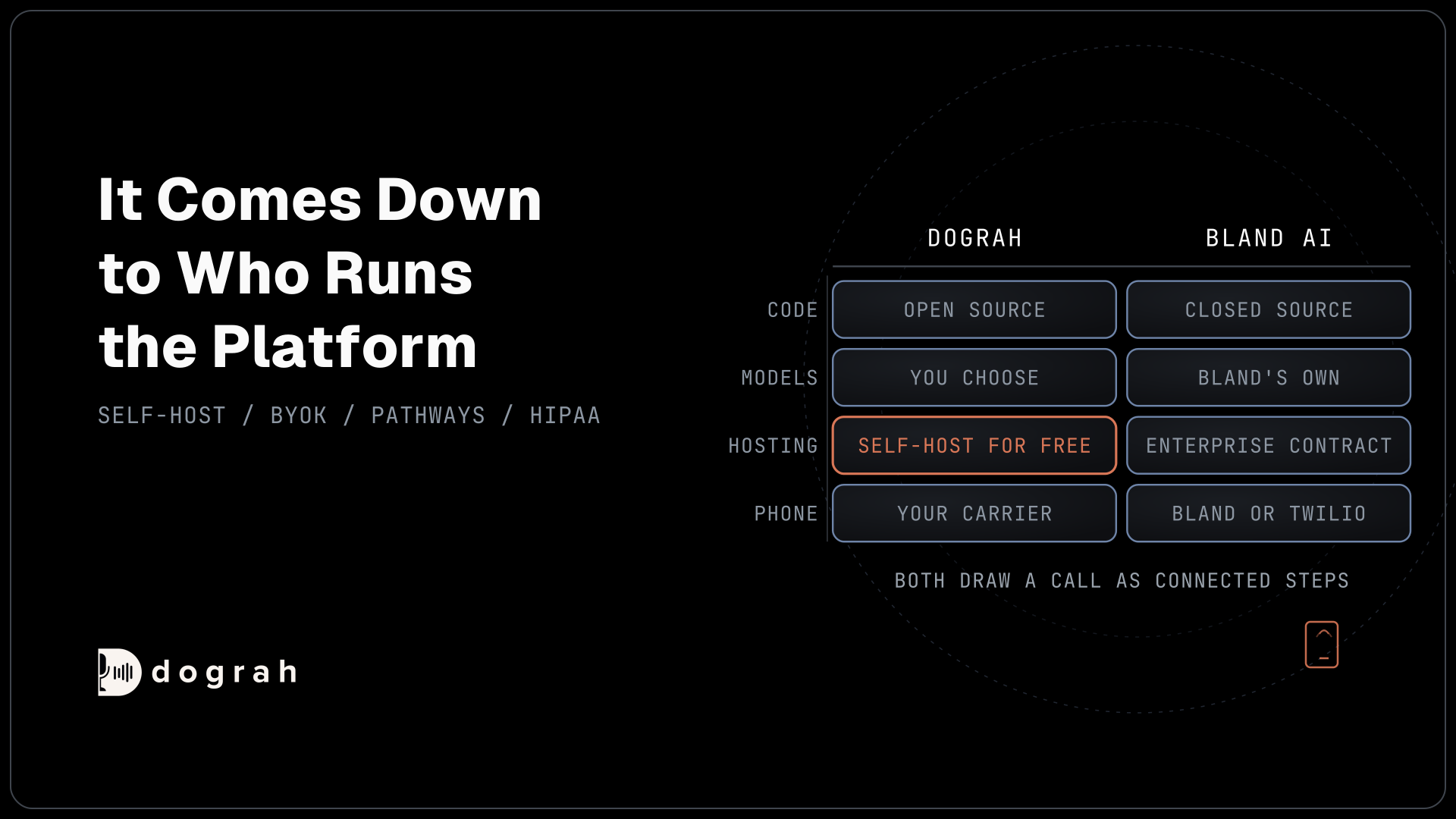
The table sets the three private routes against each other, with no prices, since Bland's private installs are quoted per contract.
| Question | Bland on Enterprise (VPC, on-prem, air-gapped) | Dograh, self-hosted | LiveKit Agents or Pipecat |
|---|---|---|---|
| Can you read and change the code? | No, the software is closed | Yes, BSD-2-Clause | Yes, Apache-2.0 or BSD-2-Clause |
| How do you get it? | An Enterprise contract with Bland | Install it today with Docker Compose | Install the framework and write the agent in code |
| What comes with it? | Bland's own models, the Bland Agents builder (the successor to Pathways) and forward deployed engineers. But the models are Bland's own | Builder, telephony, Transfer Call, Campaigns, QA and traces. But you choose and run the model layer | Code building blocks for a voice pipeline, with any model you wire in; managed hosting on LiveKit Cloud or Pipecat Cloud. But your developers write the agent and the product around it |
| Does call audio stay in-house? | Yes, since Bland's models run inside the install | Only when you also host open-weight models | Only when you also host open-weight models |
| Who runs it? | Your hardware or cloud account, with Bland's software and support under contract | Your team, with optional Enterprise support | Your team |
A full platform or a framework
Open source alone does not get you a product. With a framework, your developers build the product; with a full platform, they build the agent.
LiveKit Agents and Pipecat are good open-source frameworks, and Dograh itself is built on a fork of Pipecat. In our experience Pipecat is an excellent base, but a production deployment needs a lot of extra plumbing: phone integrations, call history, quality assurance (QA) on live calls and the call lifecycle.
Dograh ships that plumbing in the same repository. A visual workflow builder draws the call as nodes joined by pathways, each with a written condition the AI reads to pick its route, so a team used to Bland's Pathways will find it familiar. Telephony connects to your own carrier, such as Twilio, Vonage, Plivo, Telnyx, Cloudonix, Exotel, Vobiz or Asterisk ARI, and your numbers stay with that carrier. Transfer Call hands the caller to a person, Campaigns dial outbound lists with retries and calling hours, and a QA node scores each step of a call after it ends. Every call keeps its transcript and recording, and View Trace opens the call's trace in Langfuse. Our Dograh vs Bland AI comparison goes through each feature row by row.

Open Source Alternative to Vapi / Retell
Self-hosted voice agent platform — no per-minute fees
dograh-hq/dograh
Star on GitHub
Keeping call audio in-house
Self-hosting the platform keeps call records on your servers. Keeping the audio there too takes one more step.
Dograh is the orchestration layer: it runs the call flow, tools and telephony, and the speech and language models are a separate layer you choose. If that layer is a provider on your own key, the audio still goes to that provider, because bringing your own key (BYOK) moves the contract, not the data. Full data sovereignty needs open-weight models on your own hardware as well. That is Bland's real advantage on a private install: its models come with it.
The language and speech-to-text models we recommend fit together on one 24 GB GPU: Qwen3.8 27B, quantized to 4-bit, with Parakeet TDT 0.6B v2 beside it at roughly 2 GB. For the voice, Magpie TTS gives fixed voices, and Chatterbox can clone one. Dograh connects to local language models through OpenAI-compatible servers such as Ollama or vLLM, and to local speech models through Speaches.
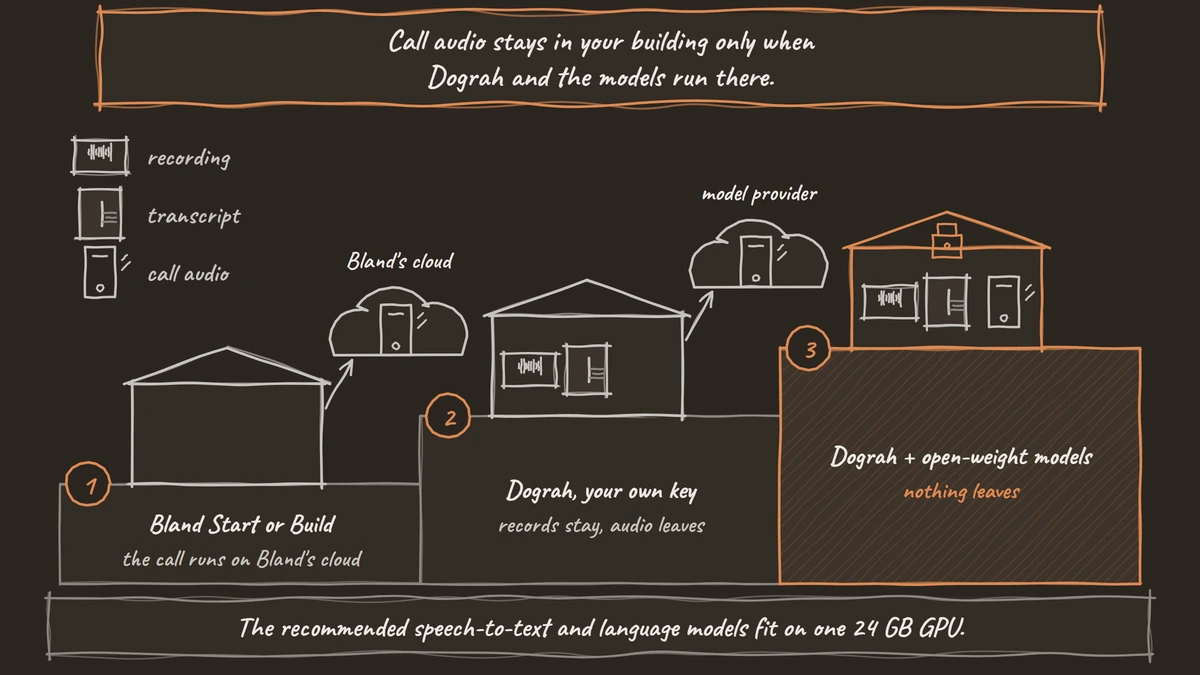
Self-hosted Dograh can also run offline when set up this way: local models, calls through your own phone system over Asterisk ARI or through the browser, and telemetry turned off with ENABLE_TELEMETRY=false. Installing and updating still need internet access or a private image registry. On region, the rule is plain: claim EU or UK data location only when Dograh and the models both run in a data centre there. Our tutorial on building a voice agent on fully local open-source models walks through that setup, and why voice data needs to stay local covers the risk it avoids.
What you take on when you run it yourself
Owning the platform moves operations work to your team, and that is the fair objection to open source.
A self-hosted install needs a server with at least 8 GB of RAM and 4 vCPUs, with no GPU when your models run through API keys. It runs 10 calls at once by default, a limit you can raise, and your servers and phone carrier set the real ceiling. Your team owns updates, monitoring, backups and incident response. Recordings and transcripts have no retention setting, so deleting old calls is a job for your own storage, and recording can be switched off only server-wide. Transfer Call works on Twilio only and passes no summary to the person who picks up.
For patient calls, run Dograh self-hosted. Generally, no BAA with Dograh is needed for a self-hosted install, because Dograh never sees the data. Model providers may need their own BAA when they handle patient data, the phone carrier may need one depending on what it stores, and a cloud account such as AWS needs one too. Confirm your position with counsel.
Self-hosted Dograh has no per-minute platform fee (servers, model keys and phone minutes still cost); Dograh Cloud has a 1¢-a-minute platform fee with 10 concurrent calls included, if you would rather not run servers. Dograh Enterprise adds on-prem or private-cloud deployment with custom service-level agreements (SLAs) when you want a contract behind the install.
Which route fits your team
The choice turns on whether you want a vendor to run a closed install or your own team to hold the code.
If your team cannot run servers and needs a vendor-backed air-gapped install or FedRAMP 20x Class A, Bland Enterprise is built for that. If you want to write the whole agent in code, LiveKit Agents and Pipecat are solid open-source frameworks to build on.
Dograh is the strongest fit when you want the platform itself, because it is open source under BSD-2-Clause and you can self-host it today without a sales contract. Self-hosted, it has no per-minute platform fee. You choose every model, from your own provider keys to open-weight models on your own servers, and your numbers stay with your carrier. A team used to Pathways gets the same nodes-and-pathways builder, with QA that scores each step. To try it, self-host it from GitHub with Docker Compose, or start on Dograh Cloud.
Join the Dograh Community
Dograh is an OSS alternative to Vapi. Join our Slack community for queries, releases, best practices & community interactions.
Glossary
- Air-gapped
- Running a system on hardware with no outbound network connection, so no data can leave over the internet. Installs and updates then arrive through a private registry or physical media.
- BSD-2-Clause
- A permissive open-source licence. It allows use, change and redistribution, commercial use included, as long as the copyright notice and disclaimer are kept.
- Data sovereignty
- Keeping call data, audio included, inside infrastructure you control. For a voice agent it needs a self-hosted platform and self-hosted models.
- Open-weight model
- An AI model whose weights you can download and run on your own hardware, such as Qwen3.8 27B or Parakeet TDT 0.6B v2.