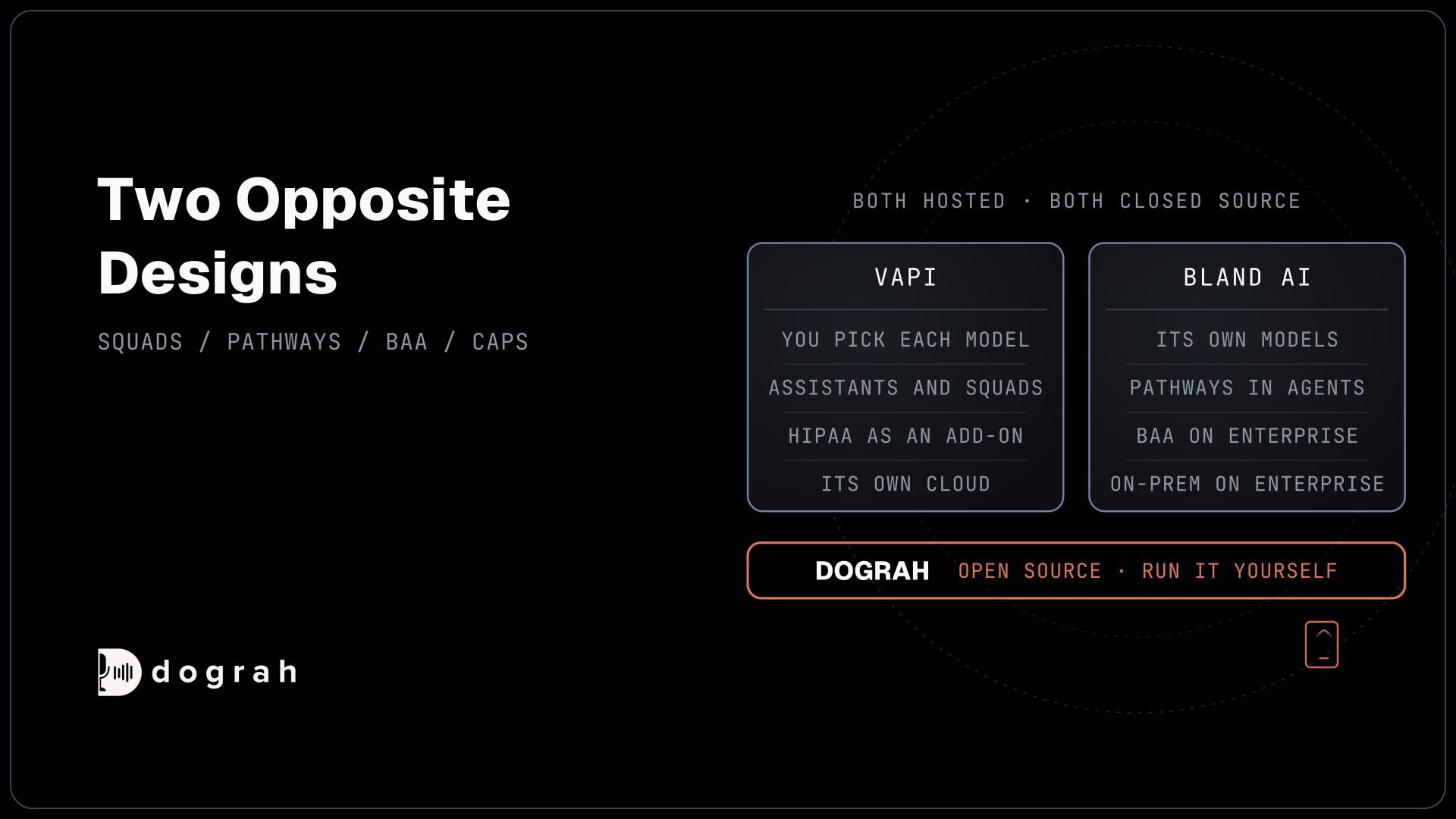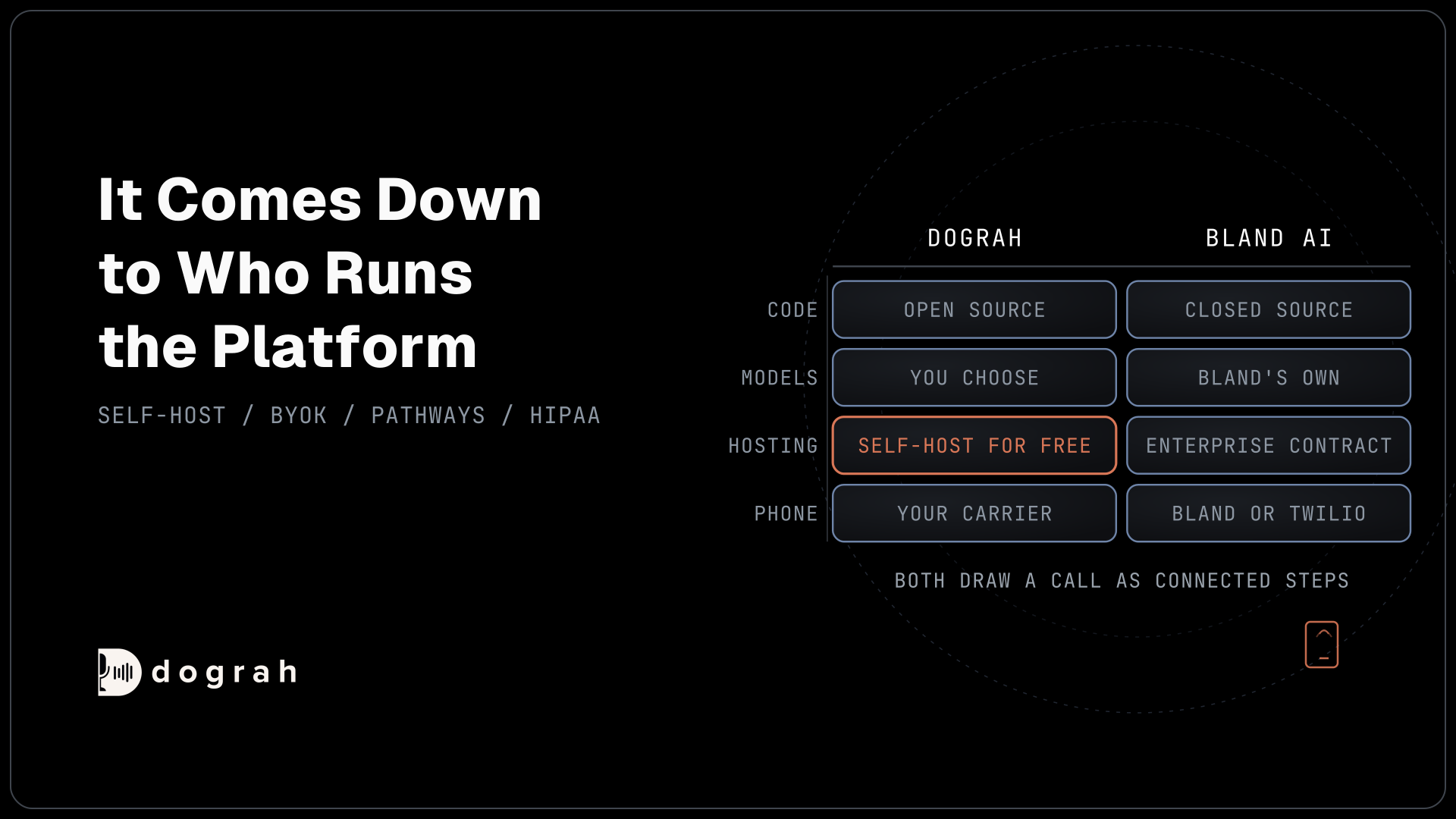

Dograh vs Bland AI comes down to who runs the platform. Bland is closed source and hosted, with one per-minute rate covering its own models; private hosting and its HIPAA agreement (BAA) need Enterprise. Dograh, an open-source, self-hostable voice agent platform, runs on your servers for free or on Dograh Cloud, with any model layer you choose.
Key Takeaways
- Price Bland's bundled rate against Dograh plus the models you choose.
- If you need private hosting without an Enterprise contract, self-host Dograh from GitHub.
- For HIPAA calls, run Dograh self-hosted, so no BAA with Dograh is needed.
This post is part of our guide to Bland AI alternatives. The guide's section "Dograh: run the platform yourself" gives Dograh one place among seven options; this post puts the two platforms against each other, row by row, and ends with who should stay on Bland.
The two platforms, row by row
Bland sells a hosted stack it builds itself, while Dograh is open-source software you can run anywhere. Each cell says what you get, then the gap.
| Row | Bland AI | Dograh |
|---|---|---|
| Licence | Closed source | Open source under BSD-2-Clause, with the code on GitHub |
| How you pay | One rate that includes Bland's models: $0.14/min on Start with no platform fee, $0.12/min plus $299/mo on Build, $0.11/min plus $499/mo on Scale. But phone time, outbound attempts and transfer minutes are billed on top | Self-hosted: no per-minute platform fee. Dograh Cloud: a per-minute platform fee (see below). But you pay the model providers and phone carrier yourself, and your servers when self-hosting |
| Models | Bland's own speech, language and voice models, included in the rate. But on Bland's self-serve plans you cannot pick another provider | Dograh's models or your own keys for supported providers, plus open-weight models you host. But choosing and tuning that layer is your job |
| Builder | Bland Agents, the successor to Conversational Pathways, where each call is still drawn as a pathway of nodes, plus Norm, which builds from plain-language instructions. But Norm is billed separately, by tokens, and every production agent must move to Bland Agents by 15 November 2026 | A visual workflow builder of nodes and pathways, QA that scores each step, and an MCP (Model Context Protocol) server that lets an AI assistant create and edit agents. But the AI picks each pathway by reading its condition, never by a fixed rule |
| Calls at once | 10 on Start, 50 on Build and 100 on Scale, with daily caps of 100, 2,000 and 5,000 calls; Enterprise is sized to your volume. But calls over a cap are rejected | Self-hosted: 10 by default and adjustable, with your servers and carrier setting the ceiling. Dograh Cloud: 10 included, more on request |
| Phone | Bland numbers at $15/mo in the US and Canada, or your own Twilio account. But connecting another carrier over SIP (Session Initiation Protocol) needs an entitlement that Bland support switches on for Enterprise organisations | Your own carrier, from Twilio and Telnyx to Exotel and Asterisk ARI, or Dograh Managed SIP for your own trunk on Dograh Cloud, so your numbers stay with your carrier. But Dograh doesn't sell numbers |
| Transfer to a person | Transfer time at $0.05, $0.04 or $0.03 a minute by plan on Bland numbers, and free on your own Twilio account. But its advanced transfer options are Enterprise only | Transfer Call, which waits 30 seconds for an answer by default. But it works on Twilio only and passes no call summary |
| HIPAA | SOC 2 Type II, HIPAA, ISO 27001 and FedRAMP 20x Class A listed. But the BAA is Enterprise only | For patient calls, run Dograh self-hosted. No BAA with Dograh is needed, because Dograh never sees the data |
| Private hosting | Your virtual private cloud (VPC), on-prem GPU clusters or air-gapped, on Enterprise contracts. But the software stays closed | Self-host for free on your own servers without a sales contract, with on-prem or private-cloud support on Enterprise. But your team runs and updates it |
How you pay for a minute
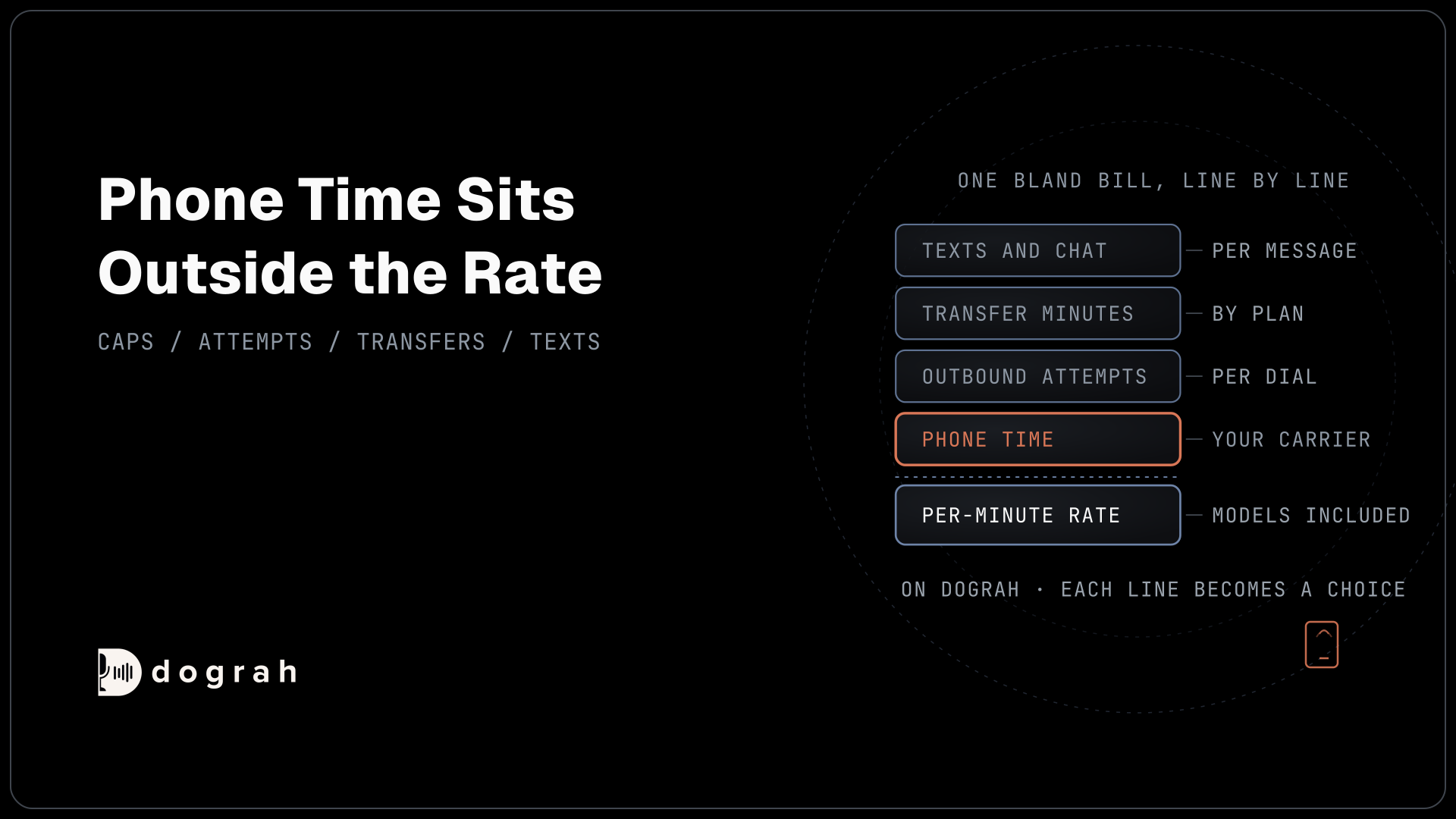
Bland charges one rate that already includes the AI models, while Dograh charges for the platform only, if at all.
Bland's self-serve rates became plan-based on 5 December 2025. A minute on Start went from the previous standard rate of $0.09 to $0.14, with no platform fee. Build costs $0.12 a minute plus $299 a month, and Scale $0.11 plus $499 a month. The rate covers Bland's speech, language and voice models, with no token charges. Phone time sits on top, on your own carrier or on Bland's Twilio at cost. On Bland's telephony, each outbound attempt and each failed call has a $0.015 minimum charge, and time after a transfer to a person is billed at the plan's transfer rate when the call uses a Bland number. Those lines matter most for outbound teams dialling long lists.
Self-hosted Dograh has no per-minute platform fee (servers, model keys and phone minutes still cost); Dograh Cloud has a 1¢-a-minute platform fee with 10 concurrent calls included. The model bill is whatever your chosen providers charge, or only the GPU time if you host open-weight models. So the total follows your choices: a smaller model keeps simple calls cheap, and a stronger one costs more only where the call needs it.
By our arithmetic from Bland's list prices, 10,000 minutes a month costs $1,499 on Build before phone time. Our post on Bland AI pricing works through every line, with the break-even points between plans.
Who picks the models
Bland runs its own models; on Dograh, you pick them.
Bland says it is the only voice AI that runs entirely on its own models, with speech-to-text, the language model and the voice built by one team. That has real benefits: one contract and a single team to call when something breaks. The trade is control. On Bland's self-serve plans you cannot move to a cheaper language model or a different voice provider, and a voice cloned on Bland stays on Bland.
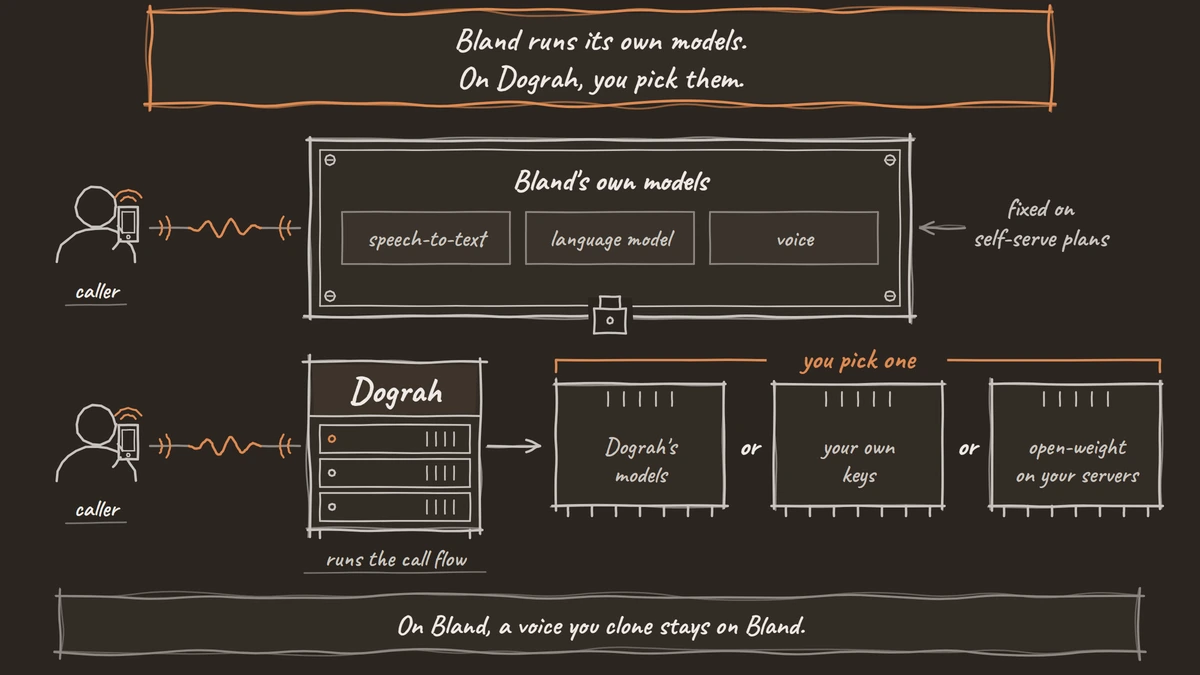
Dograh is the orchestration layer: it runs the call flow, tools and telephony, and the speech and language models are a separate layer you choose. That layer can be Dograh's own models or your own keys for a supported provider. You can also host open-weight models on your own servers. Dograh also runs speech-to-speech models, though handing a call to another agent and the spoken transfer introduction need a cascade agent, with separate speech-to-text, language model and voice.
Where the audio goes depends on that choice. With your own keys, the audio still reaches each provider, because bringing your own key (BYOK) moves the contract, not the data. Call data stays on your servers only when you self-host Dograh and the models too. Our guide to running voice AI on local, self-hosted models covers that setup.
Building the call: Pathways and Dograh's workflow builder
Both platforms draw a call as connected steps, so a team used to one will recognise the other.
Conversational Pathways was Bland's original builder: a node editor with nodes for webhooks, knowledge bases and transfers, where each edge carries a label the agent checks. In a pathway, a Global Node is a step the call can jump to from anywhere, then return. In September 2026 Bland replaced Pathways with Bland Agents, where a pathway's nodes sit inside an agent with versioned snapshots and development, staging and production environments, so live calls keep the production version. Norm builds an agent from plain-language instructions, billed by tokens.
Every production agent must move to Bland Agents by 15 November 2026, so Bland teams are migrating, re-testing and promoting each agent anyway. That makes it a natural point to compare where else the work could land.
Dograh's visual workflow builder uses a Start Call node, Agent nodes and an End Call node, joined by pathways that each carry a written condition the AI reads. Its Global Node is a shared prompt added to each step, not a step of its own, so a "reachable from anywhere" step becomes extra pathways. Mid-call lookups and writes run through HTTP API tools, and a Webhook node sends the results after the call. Dograh's MCP server lets an assistant such as Claude Code create and edit agents; a new agent publishes as version 1 at once, while edits to an existing one save as drafts.
For outbound lists, Bland runs batch calls and Dograh runs Campaigns, with retry settings, calling hours and a contacts file your system can upload through the API.

Open Source Alternative to Vapi / Retell
Self-hosted voice agent platform — no per-minute fees
dograh-hq/dograh
Star on GitHub
Phone carriers, HIPAA and private hosting
Phone setup and hosting decide which deals each platform can sign. Bland keeps most of them for Enterprise; Dograh puts them in your hands.
Bland sells numbers in the US and Canada at $15 a month and accepts your own Twilio account. Connecting another carrier over SIP needs an entitlement that Bland support switches on for Enterprise organisations. Dograh connects to your own carrier, including Twilio, Vonage, Plivo, Telnyx, Cloudonix, Exotel, Vobiz and Asterisk ARI, with VICIdial through Asterisk ARI as an advanced option. On Dograh Cloud, Dograh Managed SIP connects your own SIP trunk or phone system (PBX), in the Global, India or UAE region. Dograh doesn't sell numbers, so yours stay with your carrier. Transfer Call hands the caller to a person on Twilio.
Bland lists a signed business associate agreement (BAA) for HIPAA, but only in its Enterprise column, together with single sign-on and data residency. For patient calls, run Dograh self-hosted. Generally, no BAA with Dograh is needed then, because Dograh never sees the data. Model providers may need their own BAA when they handle patient data, and the phone carrier may need one, depending on what it stores. If the servers run in a cloud account such as AWS, that provider generally needs a BAA too; confirm your position with counsel. Our post on HIPAA-compliant voice AI for hospitals counts every vendor that hears the call.
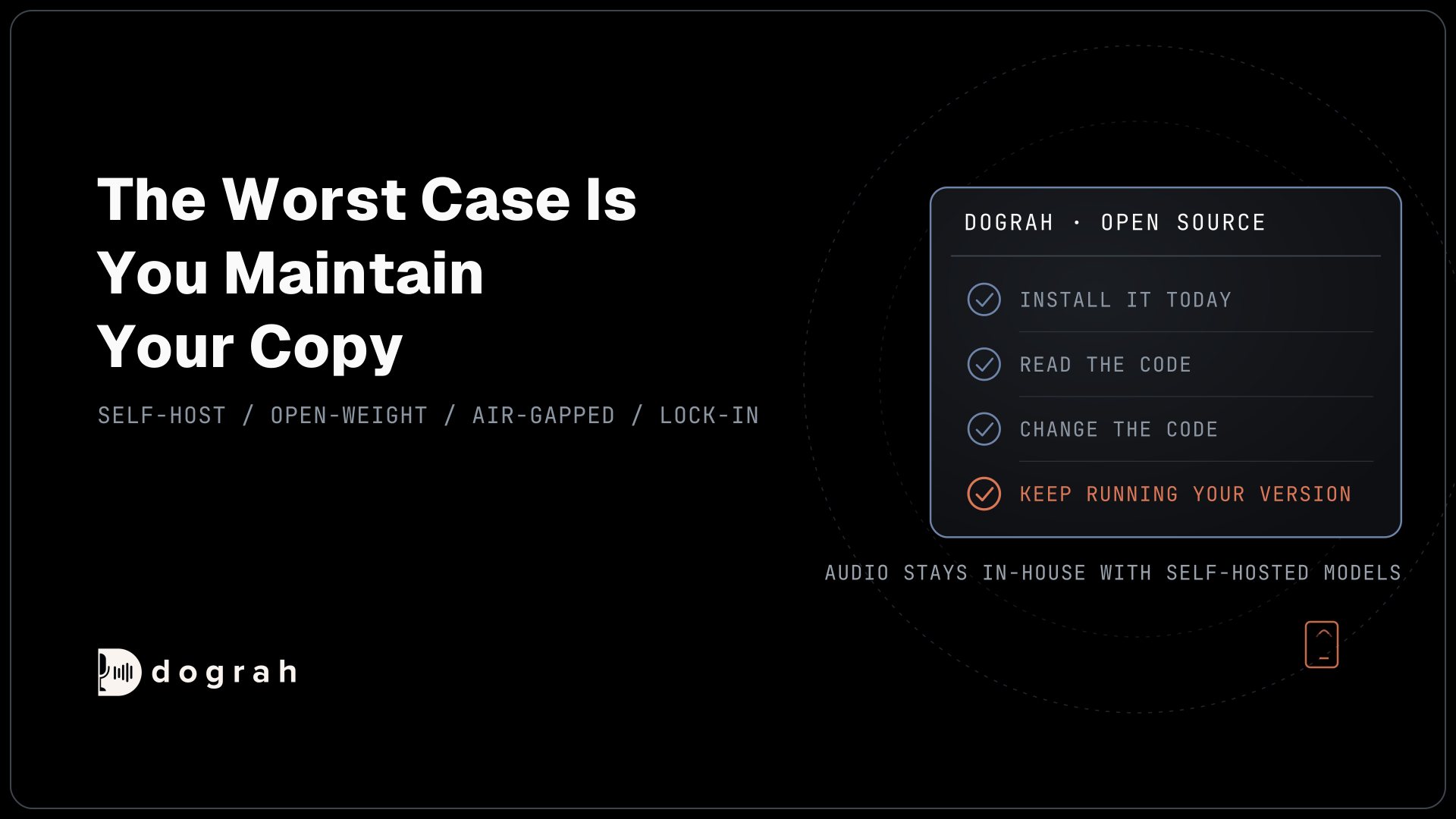
On private hosting, Bland offers VPC, on-prem and air-gapped setups on Enterprise contracts for closed software. Dograh is open source: anyone can self-host it for free, read the code and change it. That matters for lock-in. In an April 2026 Zapier survey of 542 US executives, only 6% said they could stop using their main AI vendor without disruption. Code you can run yourself keeps working whatever the vendor decides.
Who should stay on Bland
Bland is the better fit for some teams, and the reasons are concrete.
Stay on Bland if you want one rate that covers the models and would rather run no servers or choose no models. Stay too if you are buying Enterprise anyway and need what Bland writes into that contract: FedRAMP 20x Class A, an air-gapped install backed by the vendor, EU data residency where every leg of a call stays in one region, or forward deployed engineers who build the first agent with you. Self-hosted Dograh can run in your own EU data centre, and can run offline when set up for it, but the security and compliance work then sits with your own team.
When Dograh is the stronger fit
Dograh is the strongest fit for teams that want to own the platform, because it answers the gaps that start most searches away from Bland. It is open source under BSD-2-Clause, so you can self-host it today without a sales contract, and self-hosted it has no per-minute platform fee. You choose every model, from your own provider keys to open-weight models on your own servers, and your numbers stay with your carrier. A team used to Pathways gets the same nodes-and-pathways builder, with QA that scores each step.
The limits sit with the setup. Self-hosting means your team runs the servers and the updates, and Transfer Call works on Twilio only. Teams weighing other hosted platforms will find the same trade in our Dograh vs Retell AI comparison.
Run your real call script on both over a phone line, since most phone calls still reach the agent as 8 kHz audio while a browser demo runs at 16 kHz. To try Dograh, self-host it from GitHub with Docker Compose, or start on Dograh Cloud.
Join the Dograh Community
Dograh is an OSS alternative to Vapi. Join our Slack community for queries, releases, best practices & community interactions.
Glossary
- Orchestration layer
- The part of a voice agent platform that runs the call flow, tools, telephony and turn-taking. Dograh is an orchestration layer; the speech and language models are a separate layer you choose.
- Business associate agreement (BAA)
- The contract HIPAA requires before a vendor handles patient data on a covered entity's behalf. It hands the vendor obligations, but the covered entity's own duties remain.
- Conversational Pathways
- Bland's original visual call builder, where each node handles one part of the call and labelled lines decide where it goes next. Since September 2026 a pathway sits inside a Bland Agent, and production pathways must move to Agents by 15 November 2026.
- Open-weight model
- An AI model whose weights you can download and run on your own servers. Hosting one is the only way to keep call audio from reaching an outside model provider.