
HIPAA-compliant voice AI for hospitals means every vendor that handles a call's protected health information signs a business associate agreement, the agent collects only what the call needs, and access to recordings and transcripts is controlled and logged. Self-hosting on a platform like Dograh removes one vendor from that chain. Models leave it only when they run on your servers.
Key Takeaways
- A single patient call leaves PHI in at least six places.
- Self-hosting on a platform like Dograh removes one vendor; hosted models need BAAs.
- No product is HIPAA compliant by itself. Your deployment decides it.
This post is part of our guide to AI voice agents for hospitals and health systems. The guide's section on compliance, language and country points here for the HIPAA detail. This post maps what the Health Insurance Portability and Accountability Act (HIPAA) asks of a hospital voice agent, and what changes when you run Dograh, an open-source, self-hostable voice agent platform, on your own servers. It is general information, not legal advice.
Where PHI lands on a voice agent call
A voice agent call puts protected health information (PHI) in more places than the recording. The live audio carries it as the patient speaks. The transcript keeps every word, and so does the recording. Extracted fields, such as the reason for the visit, hold a summary of it. The webhook payload carries those fields to your systems, and the call trace keeps each turn for debugging.
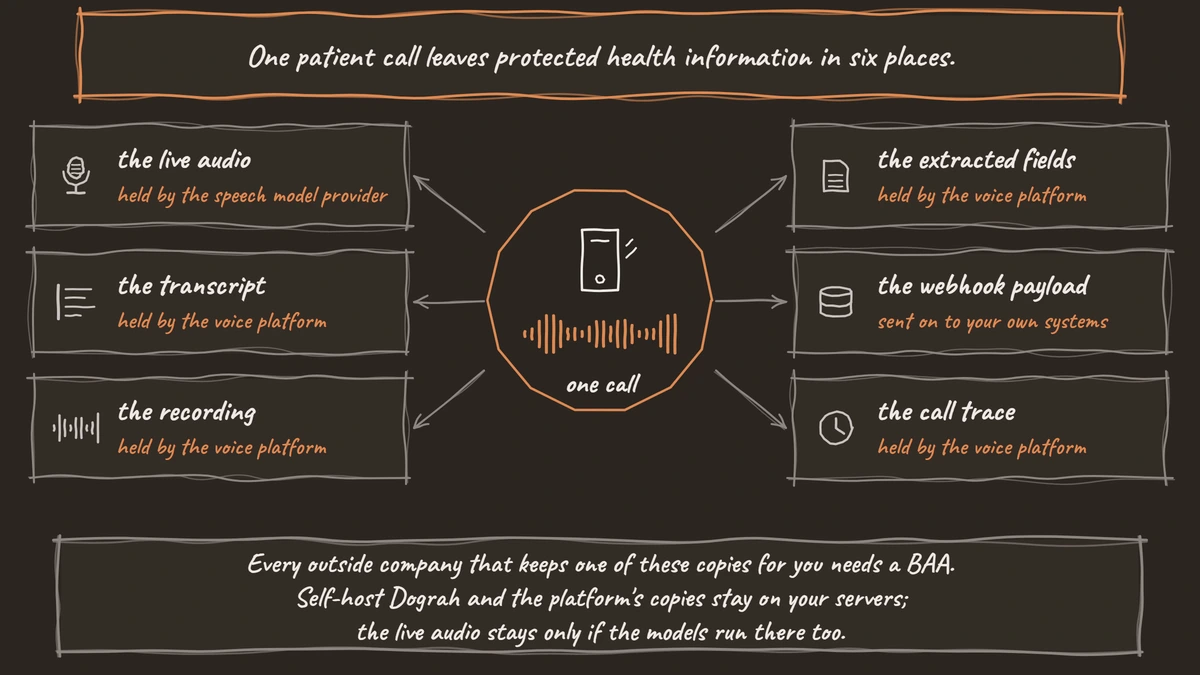
Every outside company that holds one of those copies for you is a business associate. Under 45 CFR 160.103, that is a person who "creates, receives, maintains, or transmits protected health information" on behalf of a covered entity. Those companies are where much of the risk sits. In May 2026, HIPAA Journal's review of the federal breach portal found that business associates reported 10 of the 61 large healthcare breaches, but 22 of the 61 actually occurred at a business associate.
So the first design question is who holds each copy, before any question about the voice. The broader case for keeping enterprise voice systems inside your own walls is in Why On-Prem Will Win Enterprise Voice AI.
Every vendor that stores or processes the call needs a BAA
The rule is simple to state. Under 45 CFR 164.502(e), a covered entity may let a business associate "create, receive, maintain, or transmit protected health information on its behalf, if the covered entity obtains satisfactory assurance that the business associate will appropriately safeguard the information". In practice, that assurance is the business associate agreement (BAA).
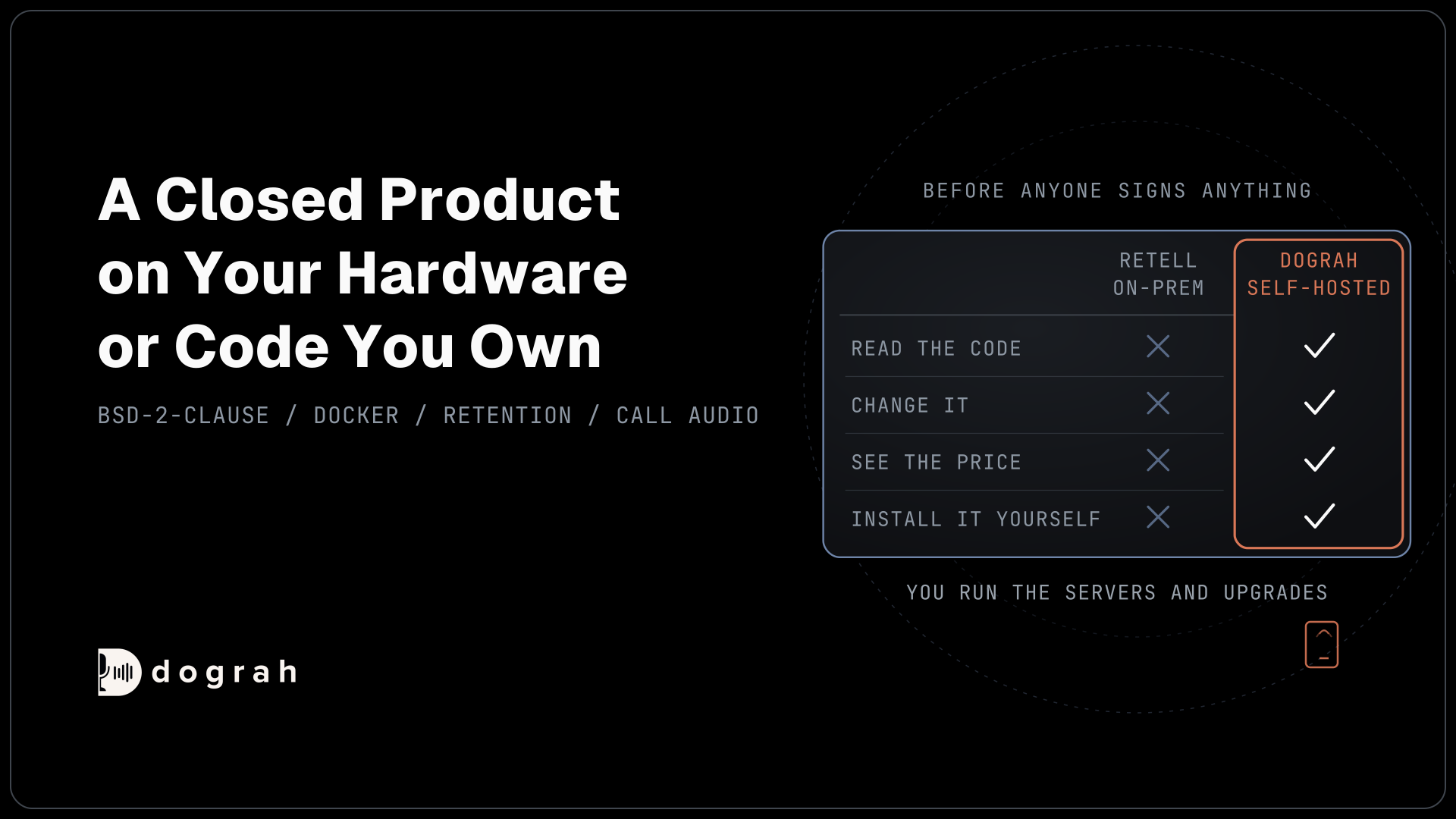
A BAA delegates obligations to the vendor and adds a duty for you to monitor them. It never transfers your liability. A hosted voice platform that signs a BAA is a legitimate route, and HIPAA does not require self-hosting. What self-hosting changes is how many vendors you contract with and watch.
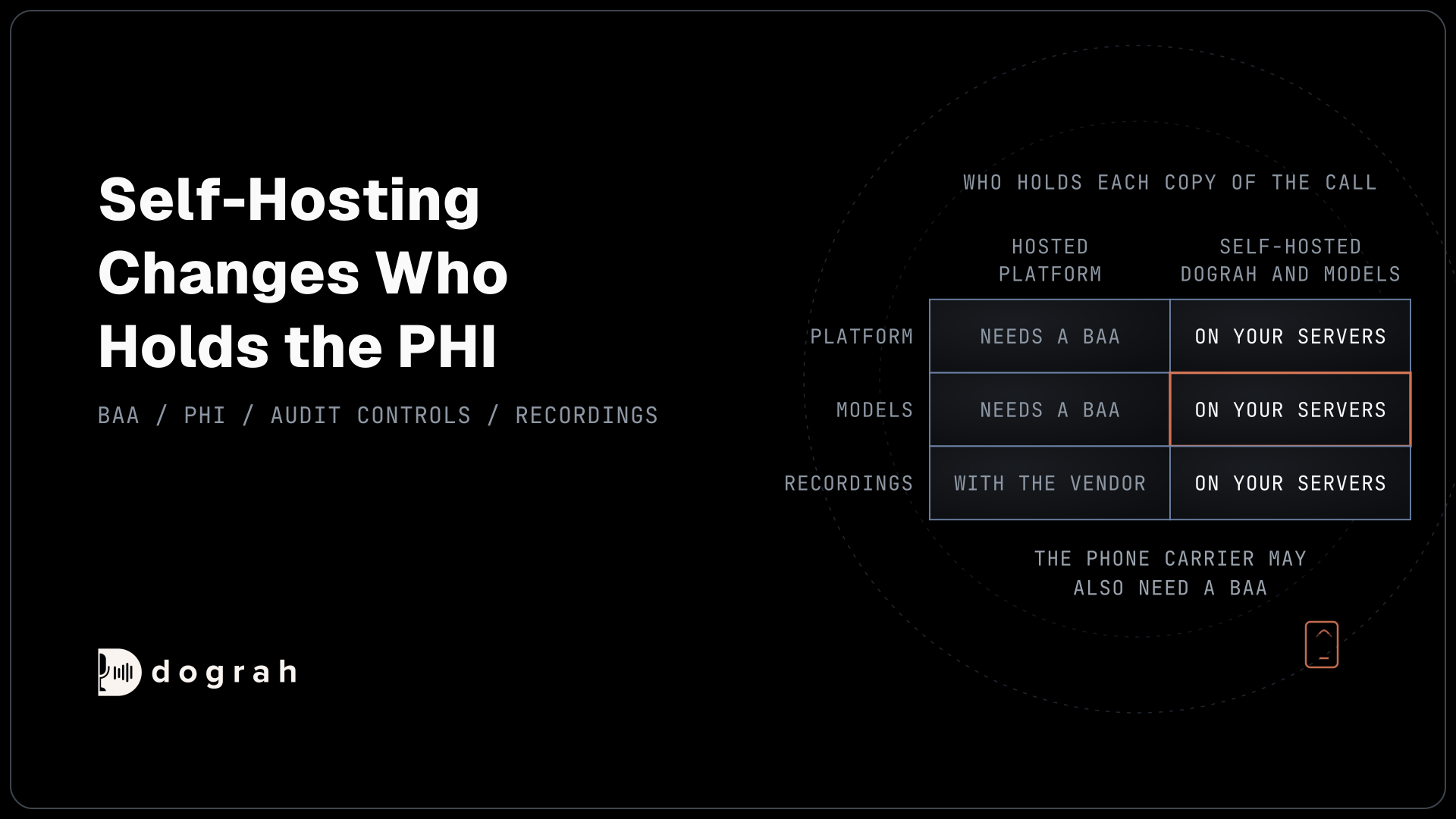
| Layer of the call | Hosted voice platform | Self-hosted Dograh, hosted models | Self-hosted Dograh and open-weight models |
|---|---|---|---|
| Phone carrier | Depends on what the carrier stores; many (e.g. Twilio) offer a BAA. Check the carrier's terms. | Depends on what the carrier stores; many (e.g. Twilio) offer a BAA. Check the carrier's terms. | Depends on what the carrier stores; many (e.g. Twilio) offer a BAA. Check the carrier's terms. |
| Voice platform | BAA needed | On your servers, no BAA with Dograh | On your servers, no BAA with Dograh |
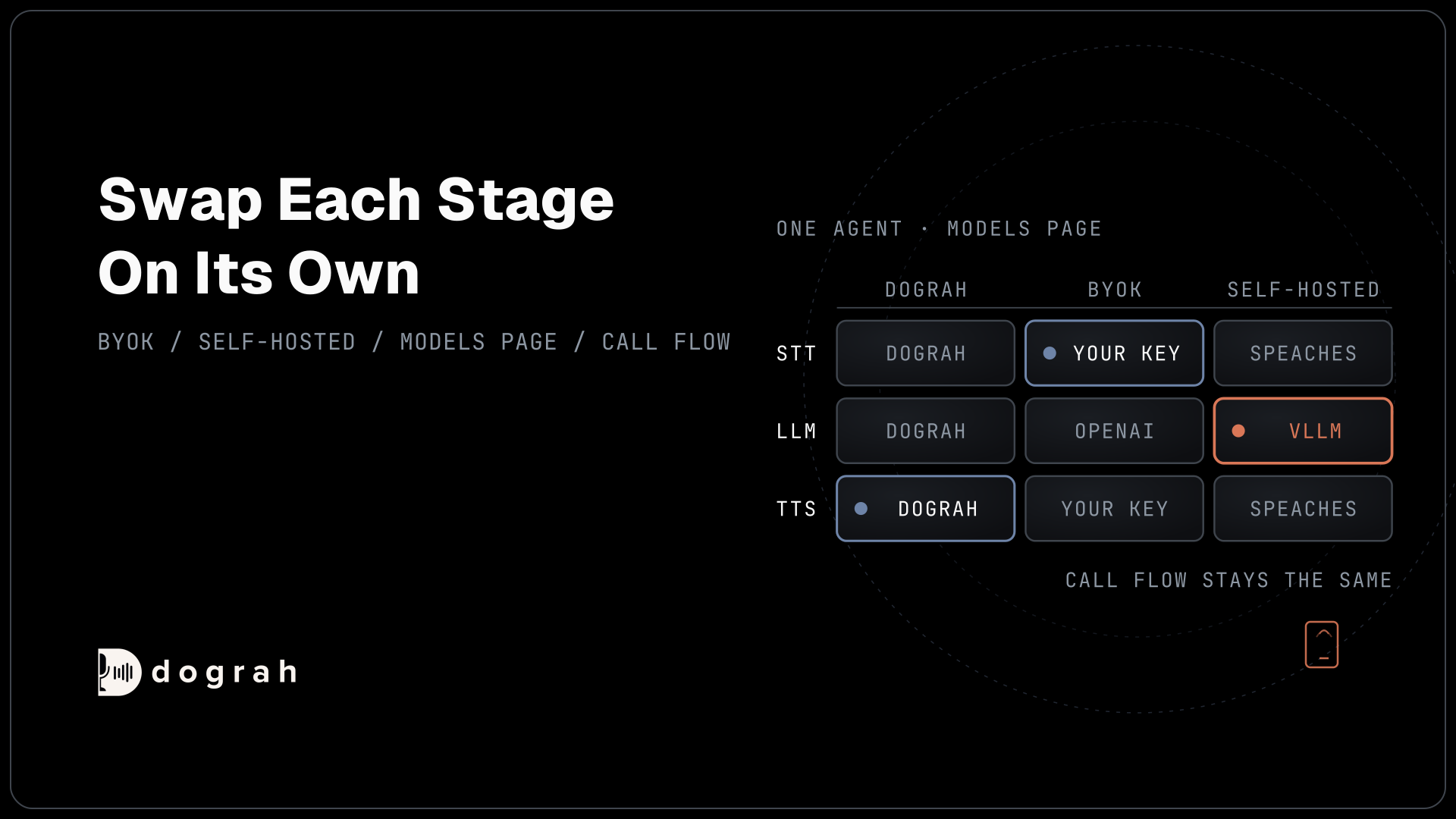
| Speech-to-text, language model, text-to-speech | BAA needed, usually through the platform's own vendors | BAA needed with each provider you call by API key | On your servers |
| Recordings, transcripts, traces | Wherever the platform stores them | On your servers | On your servers |
If your servers run in a cloud account (AWS, Google Cloud, Azure), you need a BAA with that cloud provider. In your own data centre, you don't.
The carrier stays in every row. It carries the audio whichever way you build, so check its terms. As one example, Twilio's HIPAA page says customers who want a BAA "must have our Security Edition or Enterprise Edition". Model providers vary by provider and plan, so ask each one which plan its BAA covers. The roundup of the best AI voice agents for healthcare compares what the hosted platforms state about BAAs, and Running Voice AI on Local, Self-Hosted Models covers the last column.

Open Source Alternative to Vapi / Retell
Self-hosted voice agent platform — no per-minute fees
dograh-hq/dograh
Star on GitHub
Ask only for what the call needs
HIPAA asks you to use as little PHI as the task needs, and a voice agent makes that a design choice. Under 45 CFR 164.502(b), a covered entity "must make reasonable efforts to limit protected health information to the minimum necessary to accomplish the intended purpose".
On a call, the minimum necessary standard turns into two habits. Ask only for what the call needs: a scheduling agent needs a date of birth and a reference, never a Social Security number or a diagnosis. And hold nothing the agent could read out too early: the lookup that runs when the call connects returns only a record reference, and the greeting, which plays before verification, carries no PHI. The verification step itself follows 45 CFR 164.514(h), and our tutorial on how to build a voice agent for healthcare shows each habit in Dograh's screens.
Then test for leaks the way an attacker would. Call the agent and ask for an appointment before giving a date of birth, give a wrong date of birth twice, say you are calling for a family member, and ask it to repeat what it already knows. None of those calls should hear a single health detail. Once the agent is live, a QA node that scores a sample of real calls step by step keeps checking the same thing.
Who can open call recordings, and for how long
The Security Rule's technical safeguards apply to every system that stores call data. 45 CFR 164.312 requires access controls that "allow access only to those persons or software programs that have been granted access rights", and audit controls that "record and examine activity in information systems that contain or use electronic protected health information".
Those systems belong in your risk analysis too. 45 CFR 164.308 requires "an accurate and thorough assessment of the potential risks and vulnerabilities" to electronic PHI. A 2026 analysis by Medcurity, a compliance vendor, found that every recent Department of Health and Human Services (HHS) resolution agreement citing a Security Rule violation named a failure to conduct one. List the voice platform, the recordings store, the trace store and each model provider in it by name.
Be exact about what the platform does. Dograh has no retention setting, and nothing deletes recordings or transcripts automatically. On a self-hosted server, recording can be switched off only for the whole server, not per agent, and transcripts are still saved. So on a self-hosted server, retention is your policy, carried out by your own deletion job on your own storage.
One rule often gets stretched here. The six-year period in 45 CFR 164.316 applies to your Security Rule documentation, such as policies and risk analyses. It is not a rule to keep call recordings for six years. How long you keep recordings is set by your records policy and the other laws that apply to you, so confirm it with counsel.
Join the Dograh Community
Dograh is an OSS alternative to Vapi. Join our Slack community for queries, releases, best practices & community interactions.
What changed in HIPAA in the last 90 days
The proposed overhaul of the Security Rule has not become law, and it is no longer close. The rule was proposed in January 2025. The federal regulatory agenda on reginfo.gov now lists it under "Long-Term Actions", with final action set for July 2027.
So build to the current rule. Access controls, audit controls and a risk analysis that names every part of the voice agent are required today, whatever the final text says.
What self-hosting changes, and what it does not
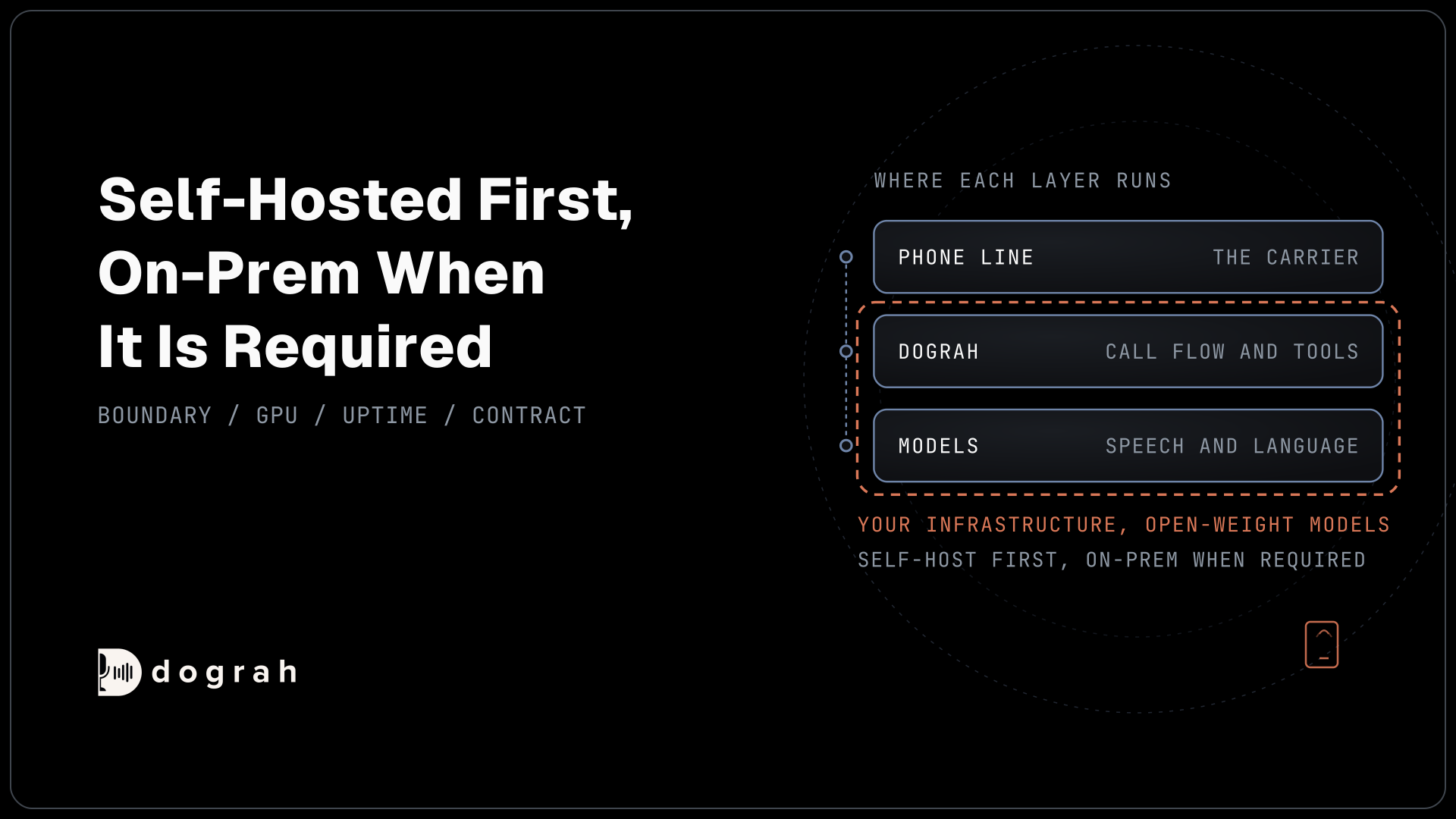
Self-hosting changes who holds the PHI. It does not make a deployment compliant by itself. A self-hosted Dograh install keeps the call flow, recordings, transcripts and traces on your servers, so no BAA with Dograh is needed. If those servers run in a cloud account such as AWS, Google Cloud or Azure, that cloud provider needs a BAA. Patient audio stays inside your network only when the speech and language models run there as well. The phone carrier may also need a BAA, depending on what it stores; many, such as Twilio, offer one.
Generally, the shorter the chain, the fewer contracts there are to monitor and the fewer outside systems hold a copy of the call. Self-hosted Dograh has no per-minute platform fee, though servers, paid model keys and phone minutes still cost money. Dograh Cloud has a 1¢-a-minute platform fee. The privacy case beyond HIPAA, including voiceprints, is in Why Voice Data Needs to Stay Local: Privacy, PII, and Biometric Risk.
None of this replaces your own review. HIPAA compliance depends on how a deployment is set up, contracted and run. Confirm your position with counsel before any patient call goes live.
Glossary
- Business associate
- A company that creates, receives, stores or sends patient health information for a hospital or clinic, such as a hosted voice platform or a model provider. HIPAA requires a BAA with each one before it handles that data.
- Minimum necessary
- The HIPAA standard at 45 CFR 164.502(b) that limits the PHI used or disclosed to what the task needs. For a voice agent, it means asking only for the details the call requires.
- Audit controls
- The Security Rule requirement at 45 CFR 164.312(b) to record and examine activity in systems that hold electronic PHI. For a voice agent, that covers who opened which recording, transcript or trace.
- Risk analysis
- The Security Rule's required assessment of risks to electronic PHI under 45 CFR 164.308. For a voice agent, it should name the platform, every model provider, the carrier and each store of call data.