
AI voice agents for telecom, cable and broadband are phone agents that handle routine customer calls: bill reminders, plan upgrades, win-back offers, support and fault calls, and installation scheduling. They verify the caller before naming any account detail, and they read and write the customer's account in the billing and order systems during the call.
Key Takeaways
- Verify the caller before naming any balance, plan, address or visit.
- Call detail is never read on the call; offer a callback instead.
- An offer turns a service call into a sales call with stricter consent.
This guide covers the calls a phone, cable or broadband provider can hand to a voice agent, from billing and account growth to support and installation, plus the rules that run through all of them and how each one runs in Dograh, an open-source voice agent platform that reads and writes your billing and support systems during the call. You can self-host it or run it on Dograh Cloud.
Telecom calls are account calls
Almost every telecom call ends in the customer's account, so an agent that cannot read and change it is only a slower menu.
The numbers show what happens when the agent only answers. In J.D. Power's 2026 wireless carrier study of more than 57,000 customers, 45% of phone-support interactions involved an AI assistant, and it resolved the issue 48% of the time. Satisfaction was 20 points higher when customers spoke to a person instead. That gap is the strongest case against a telecom voice agent, and it is fair.
Home internet has further to go. J.D. Power's 2026 internet provider study scored wired internet providers 560 out of 1,000 against 645 for wireless internet. A cable or fiber provider starts each call with less goodwill to spend, so its agent has to verify fast, fix the problem or book the engineer, and hand over cleanly, as the service section below shows.
Our reading is simple. An agent earns its place when it finishes the job inside the account: it confirms the balance, changes the plan, books the visit and writes the result back.
The billing and network systems hold every answer
Every call in this guide reads from the provider's own systems and writes back to them, and the agent keeps no copy of the account. The billing system (BSS) holds balances and plans, and the order and field service systems (OSS) hold new lines and engineer visits. A network status feed shows outages by area.
Pre-Call Data Fetch, at the bottom of the Start Call node, sends the caller and called numbers to your endpoint once the call connects, so the agent can know about an outage at the caller's address before it says hello. During the call, an HTTP API tool reads the account or writes a change. After the call, a Webhook node sends the outcome and transcript link onward and retries a temporary failure automatically. HTTP API tools do not retry by themselves, so the prompt says what to do when a lookup fails.
Dograh has no built-in billing or CRM integration. Every connection is an HTTP API tool, an MCP tool, a webhook or the API Trigger pointed at the API your BSS or OSS already offers. Integrating Voice Agents With Your Stack covers those routes in detail.
A plan change or a booking must never land twice. Add the call's workflow_run_id to the HTTP API tool as a preset parameter, and your system uses it to ignore a repeat.
Two handovers cover the rest. Transfer Call passes the customer to a person; it works on Twilio only and passes no summary, so the agent writes the details to your system first. If nobody answers within the 30-second default, the customer stays with the agent; tell it in the prompt to offer a callback and write the request through an HTTP API tool. Transfer to Agent hands a live call from a billing agent to a support agent with the full conversation, so the customer never repeats anything. It works on cascade agents only, not speech-to-speech.
Verify before any account detail
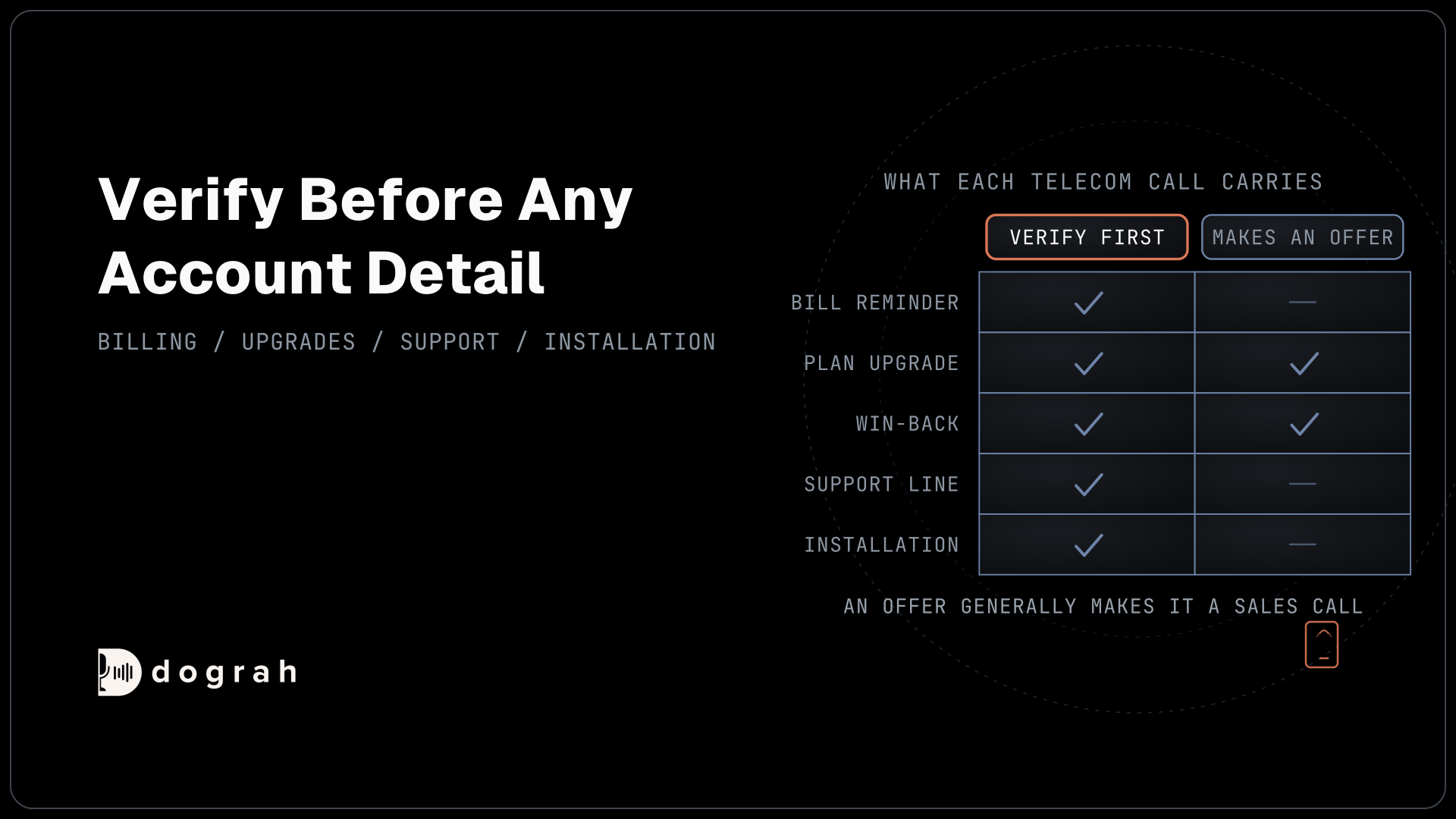
For a phone carrier, greet, verify, disclose is a federal rule as well as good practice. A phone number finds an account but does not prove who is calling, so the agent asks for an approved check, such as the last digits of the account number, before it names a balance, a plan, an address or a visit.
The rule text at 47 CFR 64.2010 says carriers "must properly authenticate a customer prior to disclosing CPNI based on customer-initiated telephone contact". Customer proprietary network information (CPNI) covers what a carrier knows from providing the service, such as the plan and how it is used. Call detail information, meaning the numbers called and the time or length of calls, gets a stricter test: it can be disclosed on an inbound call only after a password "that is not prompted by the carrier asking for readily available biographical information, or account information". The definitions count a date of birth as readily available biographical information.
A voice agent should not collect that password at all. Dograh keeps everything said in the transcript and recording, with no redaction, so a spoken password or PIN would sit there for anyone with access. The rule offers the other route: without a password, call detail goes "to the customer's address of record" or by "calling the customer at the telephone number of record". Your system starts that callback through the API Trigger. Our post on fraud-alert callbacks uses the same call-back-the-number-on-file pattern.
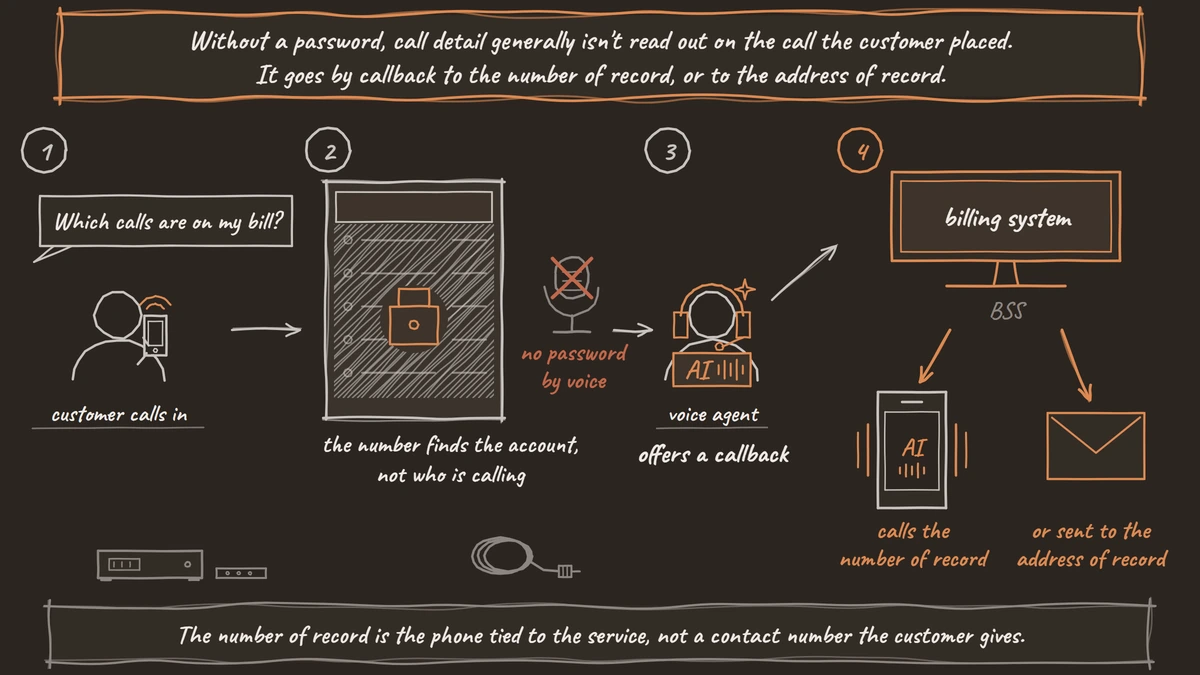
These rules are written for phone and mobile carriers, including interconnected VoIP. Broadband-only providers are not named in them, but the same pattern is good practice. This is general information, not legal advice; check with counsel.
Billing calls: reminders before the due date
The bill reminder is a service call that tells a verified customer what is due and when, and it carries no offer. Your billing system starts it through a campaign or the API Trigger, and Pre-Call Data Fetch checks the balance as the call connects, so a customer who paid this morning hears thanks instead of a demand.
After verification, the agent states the amount and due date exactly as the billing system returns them. Dograh has no feature for taking payments on a call and no keypad tool, so an HTTP API tool asks the provider's own system to send its secure payment link by text or email. Payment plans and disputes go to a person. AI voice agents for telecom bill reminders covers timing, prepaid recharge reminders and the line between a reminder and collections.

Open Source Alternative to Vapi / Retell
Self-hosted voice agent platform — no per-minute fees
dograh-hq/dograh
Star on GitHub
Growing the account: upgrades and win-back
Upgrade and win-back calls make offers, so they follow the rules for sales calls.
Plan upgrades and cross-sell
An upgrade call makes one offer, read from the plan record, to a customer who has agreed to hear it. The agent reads the offer and its full monthly price from the billing system through an HTTP API tool, never from its prompt. If the customer accepts, a second tool writes the change back. Contract terms go to a person.
The CPNI rules matter here too. They generally let a carrier market within the categories of service a customer already buys, while offering a new category, such as home internet to a mobile-only customer, generally needs the customer's approval. AI voice agents for plan upgrades and cross-sell in telecom covers both.
Win-back
A win-back call asks a former customer why they left, then makes one offer that answers that reason. The list must come from your own records of customers who left. Section 222(b) of the Communications Act bars a carrier from using information another carrier gives it to provide service, such as a porting request, "for its own marketing efforts", so a pending port is generally off limits as a win-back trigger.
Former customers may have given up the number they had, so check it against the Federal Communications Commission's (FCC) Reassigned Numbers Database before dialling. One no ends the calls, and the opt-out is written to your system straight away. AI voice agents for win-back in telecom explains where win-back fits and where an earlier retention call works better.
Service calls: support lines and installation
Service calls fix or set up the line, and they work best when the agent knows the network's state before it starts troubleshooting.
Support lines
The support line resolves the fault or hands it over fast, and it never loops. Pre-Call Data Fetch looks up the area by the calling number, so a customer in a known outage hears that in the first sentence instead of being walked through a router restart. Otherwise the agent verifies the caller and runs a line test through an HTTP API tool. If the line looks fine, it works through a short troubleshooting path from your own Knowledge Base files.
When the test shows the fault is on your side, the agent books an engineer or transfers the call. AI voice agents for telecom support lines covers the full flow, and our comparison of AI voice agents and IVR explains why open conversation beats a keypad menu here.
Installation scheduling
The installation call books an engineer visit from live slots and confirms the window, the address, access and who will be home. An HTTP API tool reads open slots from the field service system, and the agent offers only those and reads the booking back before writing it. A day-before confirmation call gives the customer a chance to move the visit while there is still notice to give.
In the UK, Ofcom's automatic compensation scheme treats an appointment cancelled with less than 24 hours' notice as missed. If a link from your own system is enough, send that; Dograh sends no texts itself. AI voice agents for installation scheduling in telecom covers access questions and failed visits in full.
Join the Dograh Community
Dograh is an OSS alternative to Vapi. Join our Slack community for queries, releases, best practices & community interactions.
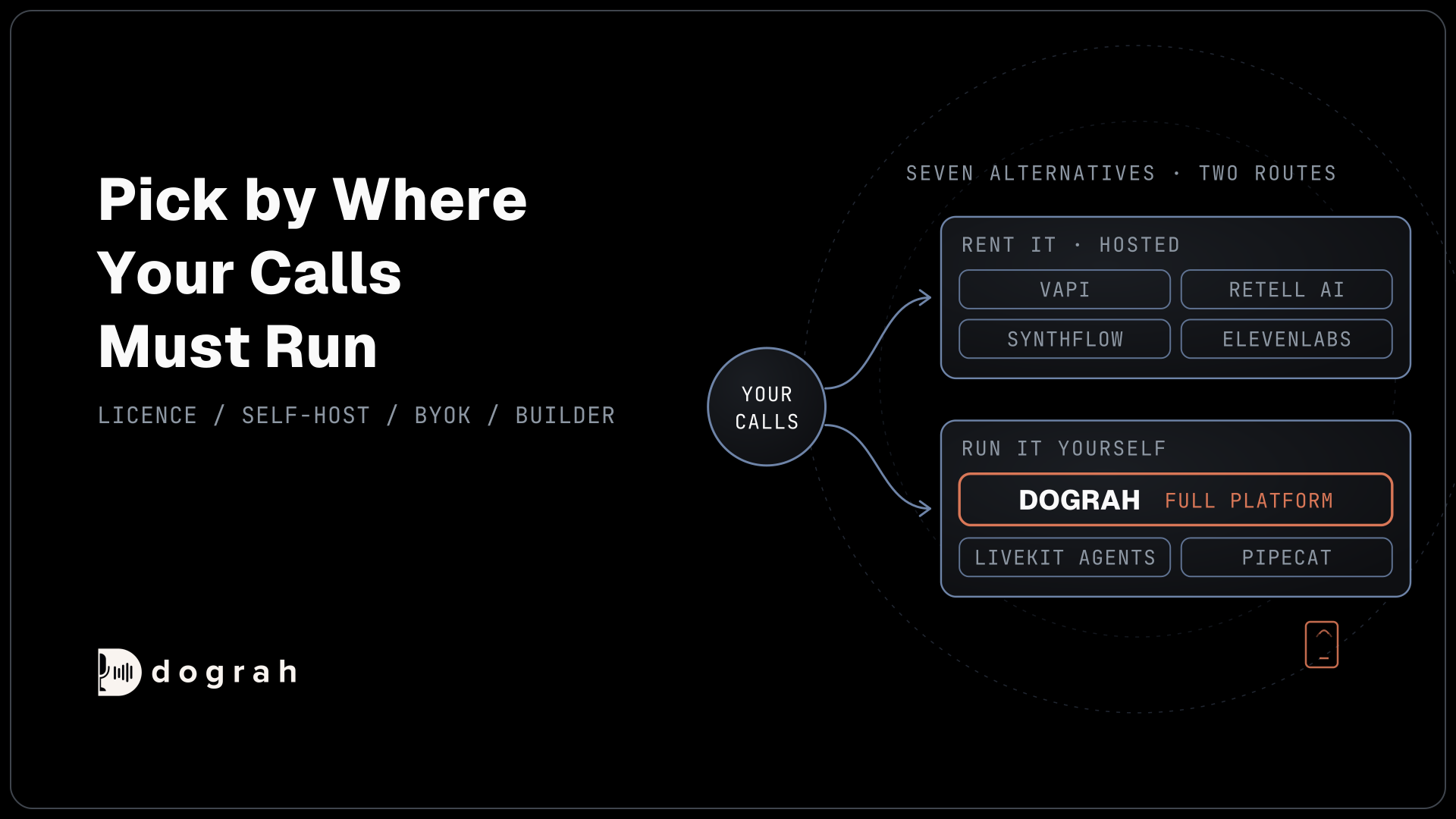
Choosing a platform and running it on your own network
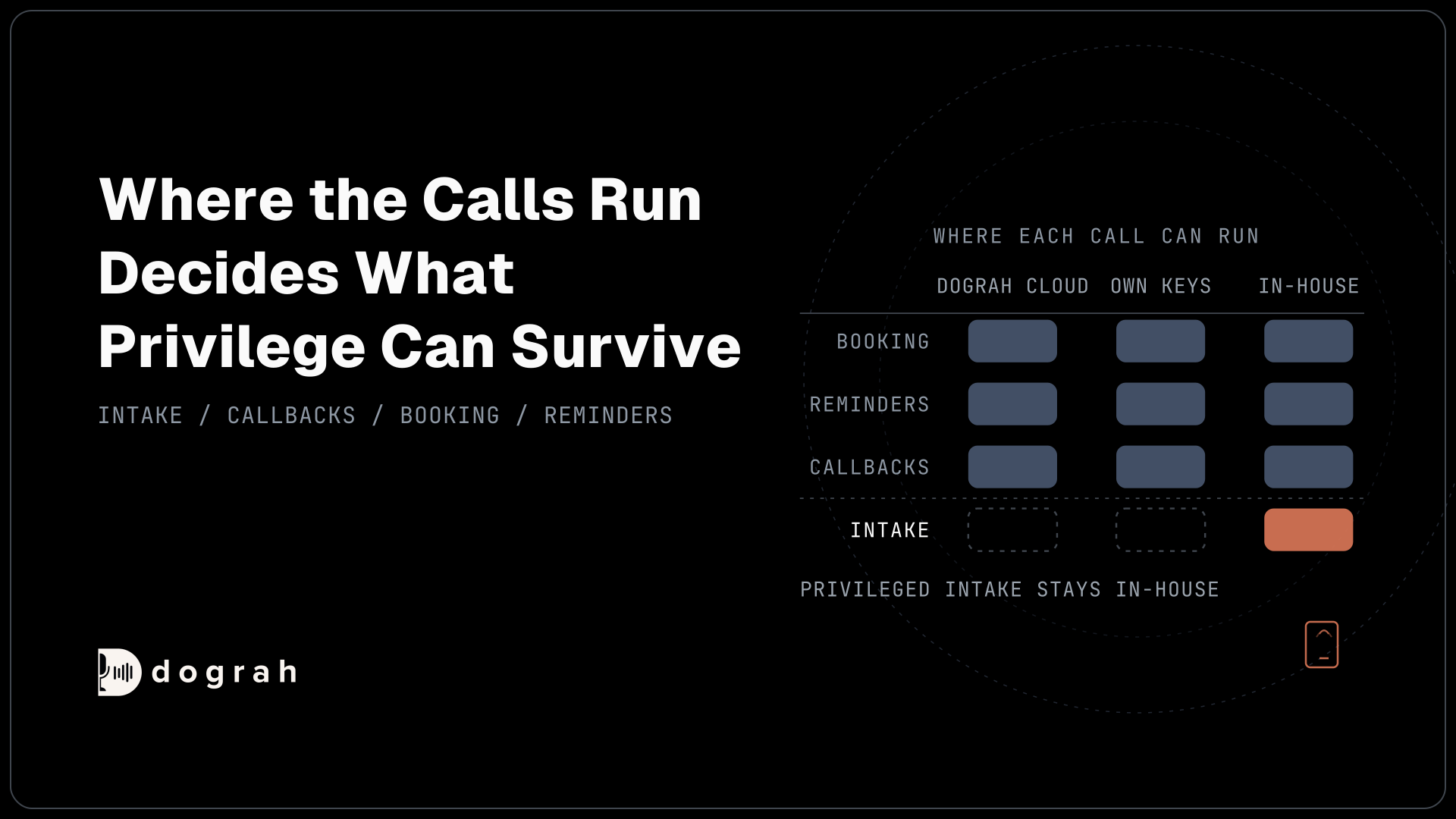
Telecom providers own phone networks, so where the agent connects matters as much as how it sounds. A hosted platform usually means your calls leave your network for theirs.
Dograh connects to several telephony providers, including Twilio, Vonage, Plivo, Telnyx, Exotel and Vobiz. Dograh Managed SIP brings your own SIP trunk or PBX to Dograh Cloud, in the Global, India or UAE regions; Dograh does not sell numbers. Self-hosted, Asterisk ARI connects the agent to your own Asterisk, and a VICIdial integration through Asterisk ARI is available as an advanced feature that is not on by default.
Outage days test capacity. Dograh runs 10 concurrent calls by default, self-hosted or on Dograh Cloud Pay as you go, raised with DEFAULT_ORG_CONCURRENCY_LIMIT or by contacting Dograh. When the limit is full, Dograh rejects the next inbound call at once, with no queue, so set the limit for your outage peak and add an overflow at your carrier.
Dograh is the orchestration layer: it runs the call flow, tools and telephony, and the speech and language models are a separate layer you choose. Recordings and transcripts stay on your servers when you self-host; the call audio stays in-house only when those models run there too. Best AI voice agents for telecom compares contact-center suites, managed vendors, developer platforms and Dograh, prices included. Our page on self-hosted voice agents for telecom operators covers account and fault calls on servers you run.
Consent, broadband labels and recordings
The rules depend on whether the call sells something. This is general information, not legal advice.
In the US, the Telephone Consumer Protection Act (TCPA) covers calls made with an artificial or prerecorded voice, and the FCC's February 2024 ruling, FCC 24-17, confirmed that AI-generated voices count. The rule text at 47 CFR 64.1200 covers "any telephone call that includes or introduces an advertisement or constitutes telemarketing" and allows it with "the prior express written consent of the called party". Sales calls to residential subscribers are barred before 8 a.m. or after 9 p.m., "local time at the called party's location". Dograh campaigns use one time zone per campaign, so split your lists by time zone.
Read together, a reminder or support call with no offer is generally informational, while an upgrade or win-back offer generally makes the call telemarketing. Keep offers out of service calls, and keep the consent flag in your own system.
Broadband sales by phone now carry a disclosure rule. The FCC's July 2026 broadband label order says "Provider phone sales representatives must orally summarize" the label, covering fields such as the monthly price with fees and any early termination fee. "Verbatim recitation of the label is not required". The phone rule takes effect once the Office of Management and Budget completes its review, so read those fields from the plan record once it does.
Recordings need a plan too. Dograh Cloud records every call; self-hosted, recording can be switched off only server-wide, and transcripts are still saved. A single call's recording or transcript cannot be deleted in the app, though self-hosted teams can delete it from their own storage. If you record, say so in the Greeting Text, and hand anyone who objects to a person or end the call. Confirm your own position with counsel before the first outbound campaign.
Which telecom call to hand over first
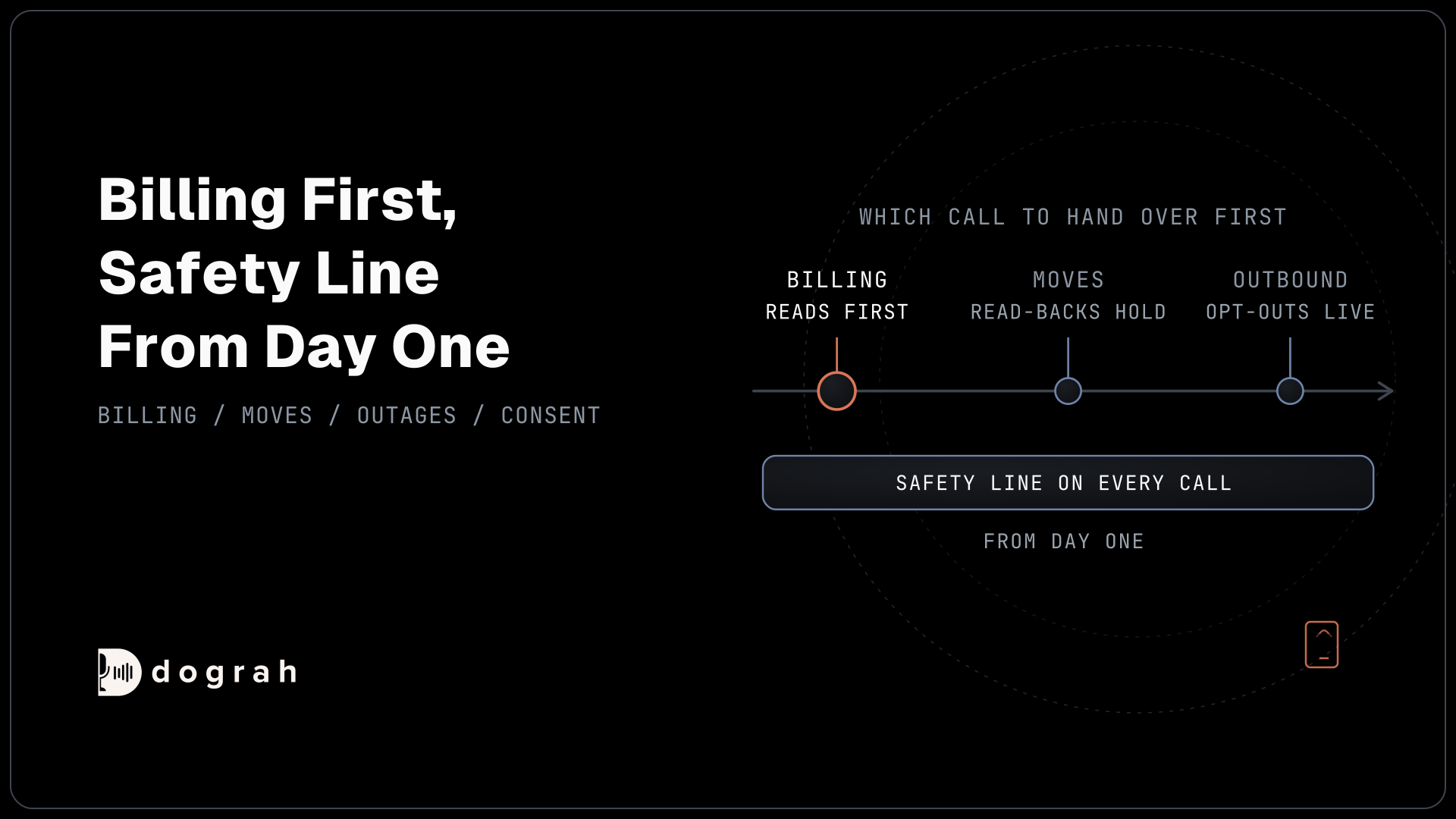
Start with the inbound support line, because the outage check alone takes pressure off your team on the worst days and raises no outbound consent questions. Add bill reminders next, then installation confirmations, and leave upgrade and win-back offers for last, once written consent sits in your own system.
Put the agent on a real phone number before any customer hears it: most phone calls still reach the agent as 8 kHz audio, while a browser test runs at 16 kHz. Once live, run QA on a random 5 to 10% sample of calls and fix what the transcripts show. Self-hosted Dograh has no per-minute platform fee (servers, model keys and phone minutes still cost); Dograh Cloud has a 1¢-a-minute platform fee.
Each call above has its own deep dive:
- AI Voice Agents for Telecom Bill Reminders
- AI Voice Agents for Plan Upgrades and Cross-sell in Telecom
- AI Voice Agents for Win-Back in Telecom
- AI Voice Agents for Telecom Support Lines
- AI Voice Agents for Installation Scheduling in Telecom
- Best AI Voice Agents for Telecom
Glossary
- Customer proprietary network information (CPNI)
- What a phone carrier knows about a customer from providing the service, such as the plan and the calls made. FCC rules require carriers to authenticate a caller before disclosing it on a customer-initiated call.
- Call detail information
- Information about specific calls, such as the number called and the time, location or length of a call. A carrier may disclose it on an inbound call only after a password, or by calling back the telephone number of record.
- Telephone number of record
- The phone number tied to the underlying service on the account, not a contact number the customer supplied. A callback to it is the safe route for call detail when no password is given.
- Prior express written consent
- Under the TCPA, a signed written agreement that lets a business deliver advertisements or telemarketing using an artificial or prerecorded voice. An outbound upgrade or win-back call from an AI voice agent generally needs it.