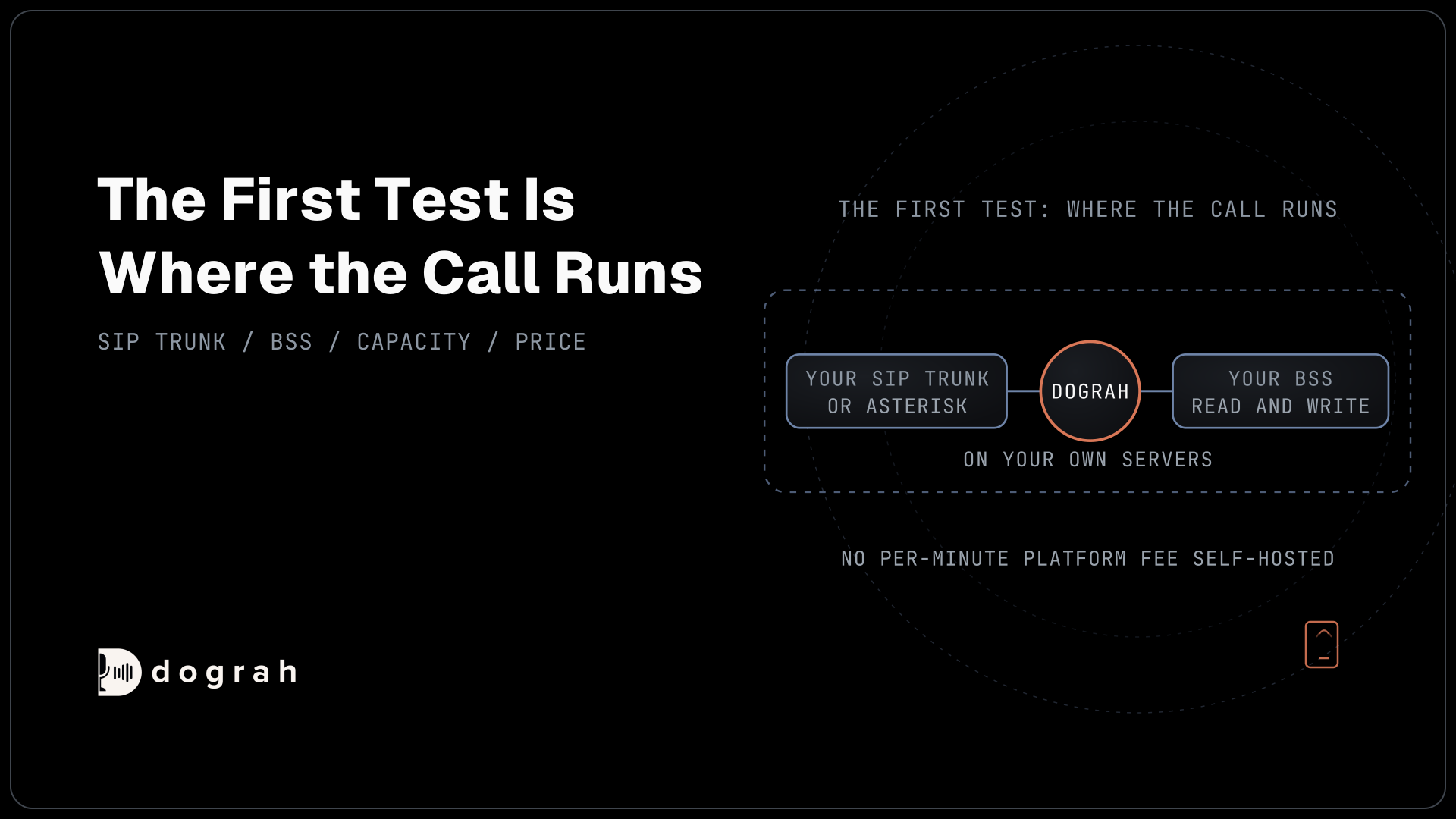

The best AI voice agents for telecom come down to where the calls run. Dograh, an open-source platform, runs on your own SIP trunk or Asterisk and reads and writes your billing system during the call. The rest are contact-center suites such as Genesys, managed vendors such as PolyAI, and developer platforms such as Vapi and Retell AI.
Key Takeaways
- Judge each platform on whether it runs on your own phone network.
- Dograh can run self-hosted on your own network, with no per-minute platform fee.
- The agent must resolve in your billing system, or satisfaction drops.
This post is part of our guide to AI voice agents for telecom, cable and broadband. The guide's section on choosing a platform starts from one line: "Telecom providers own phone networks, so where the agent connects matters as much as how it sounds." Here are eleven platforms, starting with Dograh and then grouped by the kind of purchase they are, judged on five tests that matter to a phone, cable or broadband provider.
The five tests a telecom buyer should run
A telecom voice agent is judged by whether it fixes the customer's problem inside your systems, so the tests start there. Voice quality is close enough across these products that it rarely decides the purchase.
The reason is in the data. In J.D. Power's 2026 wireless carrier study of more than 57,000 customers, 45% of phone-support interactions involved an AI assistant, and it resolved the issue 48% of the time. Customer satisfaction was 20 points higher when customers spoke to a person. A platform earns its place only if it closes that gap.
The first test is where the call runs. An operator already owns numbers, SIP trunks and often an Asterisk or contact-center platform, so check whether the agent can sit on that network or needs the call carried to the vendor's cloud.
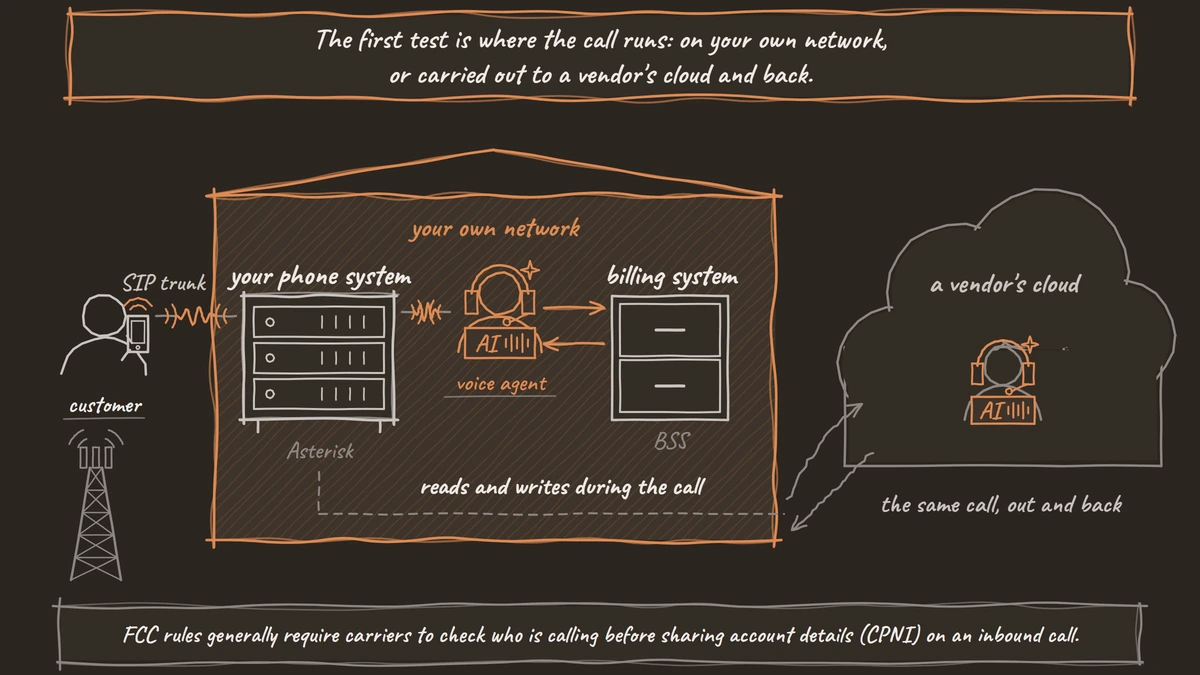
The second is whether the agent can read and write your billing system (BSS) and order and field service systems (OSS) during the call. An agent that only takes a message for staff to retype adds a step.
The third is whether the call flow can enforce the rules. Under 47 CFR 64.2010, phone carriers "must properly authenticate a customer prior to disclosing CPNI" (customer proprietary network information), and the FCC's July 2026 broadband label order says provider phone sales representatives "must orally summarize" the label fields once the phone rule takes effect. What matters is a verify step the flow cannot skip, with fixed wording and prices read from your plan record where you need them. A certificate on a vendor's page does not do that for you. This is general information, not legal advice; confirm your position with counsel.
The fourth is outage capacity: how many calls run at once, and what a caller hears when the limit is full. Outage days bring the biggest spikes a support line sees. Ask each vendor how many concurrent calls your plan includes and what happens to the next caller once they are all in use. Then check whether your carrier can send that overflow to a person or a recorded outage message.
The fifth is price: what a minute or a seat costs at your call volume, and what sits on top of it, such as models, phone minutes and add-ons.
How the eleven platforms compare
The table groups the platforms by type, then shows each one's phone network options and list price.
| Platform | Type | Your own phone network | Price on its own site | Watch for |
|---|---|---|---|---|
| Dograh | Open source (BSD 2-Clause), self-hostable | Your own SIP trunk or PBX on Dograh Cloud through Dograh Managed SIP; your own Asterisk through Asterisk ARI when self-hosted; Twilio, Vonage, Plivo, Telnyx and more | Self-hosted: no per-minute platform fee. Dograh Cloud: 1¢/min platform fee | No prebuilt billing connector; HTTP API tools reach your BSS. Transfer Call works on Twilio only |
| Genesys Cloud CX | Contact-center suite | Bring your own carrier (BYOC), with a monthly allotment of BYOC minutes included | CX 1 $75 to CX 4 $240 per user a month, billed annually | Virtual agents draw on AI Experience tokens |
| NICE Cognigy | Contact-center suite | Voice Gateway connects to your contact center and telephony system | Ask NICE for a quote | On-premises installs are no longer offered to new customers |
| Five9 | Contact-center suite | Runs inside Five9's cloud platform | Ask Five9 for a quote | The IVA is one part of the wider contact-center suite |
| Talkdesk | Contact-center suite | Voice comes with Voice Essentials and above | $105 to $225 per user a month | Add-ons and recommendations go through sales |
| PolyAI | Managed voice vendor | Your own carrier connects over SIP at no charge | Platform per minute through sales; API 2¢ per connected minute | The API plan excludes telephony and orchestration |
| Parloa | Managed voice vendor | Ask Parloa | Consumption-based: per minute for voice | Volume packages agreed with sales |
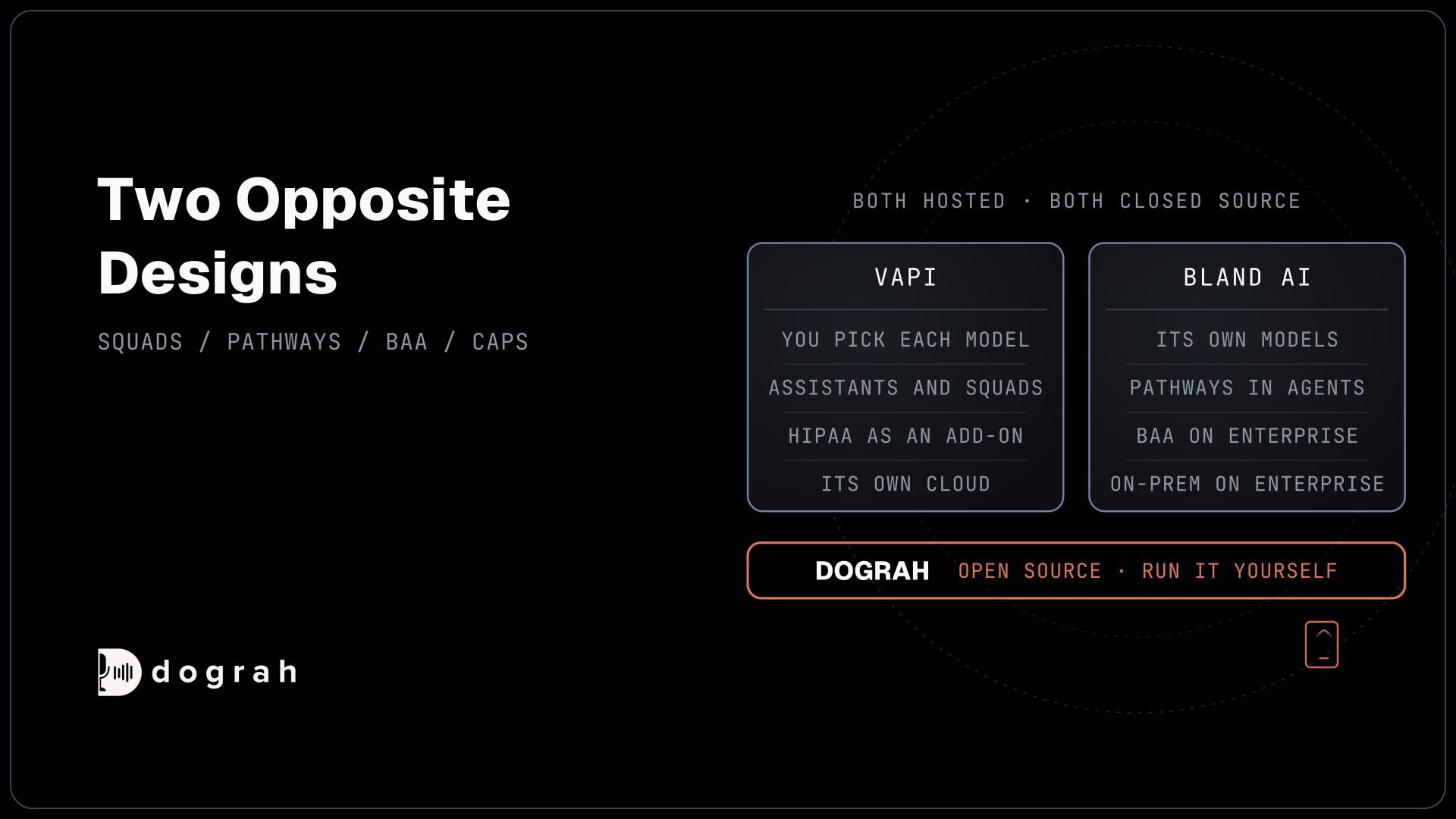
| Vapi | Developer platform | Vapi's SIP transport is free; carrier fees pass through | $0.05/min hosting before models and phone; Core $29/month | HIPAA handling is a $2,000/month add-on |
| Retell AI | Developer platform | No charge for SIP trunking or custom telephony | $0.07 to $0.31/min | The per-minute total depends on the models and voice you choose |
| Bland AI | Developer platform | Your own Twilio account or SIP trunks from any provider | Per-minute talk-time plans | On-prem or VPC on Enterprise only |
| Synthflow | Developer platform | Native telephony, SIP trunking or approved enterprise telephony | Enterprise contracts from $30,000 a year | Enterprise is the only plan listed |
Dograh: open source on your own phone network
Against the five tests above, Dograh's case is straightforward. It runs on your own SIP trunk or Asterisk, reads and writes your billing system during the call through HTTP API tools, keeps the verify step and fixed wording in the call flow, states its concurrency limit and what happens when it is full, and publishes its price. None of that needs a sales contract.
Dograh is the open-source option in this list, released under the BSD 2-Clause licence, and it can run where the operator's calls already run. It is the orchestration layer: it runs the call flow, tools and telephony, and the speech and language models are a separate layer you choose.
On telephony, Dograh connects to Twilio, Vonage, Plivo, Telnyx, Cloudonix, Exotel and Vobiz. Dograh Managed SIP brings your own SIP trunk or PBX to Dograh Cloud, in the Global, India and UAE regions; Dograh does not sell numbers. Self-hosted, Asterisk ARI connects the agent to your own Asterisk, and a VICIdial integration through Asterisk ARI is available as an advanced feature, not on by default.
For the account, Pre-Call Data Fetch sends the caller and called numbers to your endpoint as the call connects, so an outage check can come first. An HTTP API tool reads or writes the BSS during the call, and a Webhook node sends the outcome afterwards, retrying a temporary failure automatically. The flow puts the verify step in its own node, before the agent reaches any account detail.
Capacity is set in plain terms. Self-hosted Dograh runs 10 concurrent calls by default, raised with DEFAULT_ORG_CONCURRENCY_LIMIT, and your servers and carrier set the real ceiling. Dograh Cloud Pay as you go includes 10, with more by contacting Dograh. When the limit is full, Dograh rejects the next inbound call at once, with no queue, so plan an overflow at your carrier for outage days.
The gaps are worth stating. There is no prebuilt BSS or CRM connector, so your team points HTTP API tools at your own APIs. Transfer Call works on Twilio only and passes no summary. Self-hosted Dograh has no per-minute platform fee (servers, model keys and phone minutes still cost); Dograh Cloud has a 1¢-a-minute platform fee. Dograh's pricing page lists Enterprise on-prem or private-cloud deployment within your data perimeter, with SSO and audit logs.
Contact-center suites: Genesys, NICE Cognigy, Five9 and Talkdesk
A suite fits an operator that wants its AI agent inside the same platform as its human agents, priced by the seat. You buy routing and reporting for your human team, and the voice agent comes with them.
Genesys Cloud CX lists four editions, from CX 1 at $75 to CX 4 at $240 per user a month, billed annually. Virtual agents use Genesys Cloud AI Experience tokens, and each organization gets 250 named or 350 concurrent tokens a month, so heavy agent use means buying more. Genesys lets customers bring their own carrier (BYOC), which suits an operator with its own trunks.
NICE Cognigy sells Cognigy.AI with a Voice Gateway that connects to an existing contact center and telephony system. Cognigy now states that "On-premises installations are no longer offered to new customers", so a new buyer gets the managed SaaS. That matters for an operator that wanted call audio on its own servers.
Five9 calls its voice agent an Intelligent Virtual Agent (IVA), built on Five9's cloud, no-code platform, and the IVA passes details of the interaction to the human agent who takes over. Talkdesk lists Voice Essentials at $105, Elite at $165 and Industry Experience Clouds at $225 per user a month, with add-ons and recommendations through its sales team.
The trade-off is the same across the four. The suite owns the platform and its upgrade timetable, and the agent's reach into your BSS depends on the suite's connectors or your own integration work.

Open Source Alternative to Vapi / Retell
Self-hosted voice agent platform — no per-minute fees
dograh-hq/dograh
Star on GitHub
Voice-first managed vendors: PolyAI and Parloa
A managed vendor designs and runs the voice agent for you, which suits an operator with no engineering team for it. You agree volume and price with sales, and the vendor's team builds the flows.
PolyAI prices its platform per minute through its sales team. It says customers can use "your numbers or ours", and that "your own carrier connects over SIP at no charge", which is a good fit for an operator keeping its own trunks. PolyAI also sells an API at 2¢ per connected minute that gives model-only access for custom voice stacks; telephony and orchestration are not included on that plan, so you would build the rest.
Parloa uses consumption-based pricing, per minute for voice, with volume packages agreed with its team. Both are closed platforms running in the vendor's cloud, so the call audio and transcripts sit there. For an operator that wants the agent on its own servers, that is the deciding point.
Developer platforms: Vapi, Retell AI, Bland AI and Synthflow
Developer platforms give an engineering team the building blocks and charge by the minute or by contract. They are quick to start, and the operator still writes the integrations.
Vapi charges $0.05 a minute for hosting before models and phone minutes, with Core at $29 a month and Pro from $999 a month. Its SIP transport is free, carrier fees pass through, and HIPAA handling is a $2,000 a month add-on. Plans include 4, 10 or 30 concurrent calls, with extra lines at $10 a month each, so an outage-day peak needs planning in advance. Our breakdown of Vapi pricing goes through each fee.
Retell AI lists $0.07 to $0.31 a minute for voice agents, includes 20 concurrent calls free, and charges nothing for SIP trunking or custom telephony. It also lists speech-to-speech models from OpenAI's GPT Realtime family. Retell AI pricing explained breaks the per-minute rate down by layer.
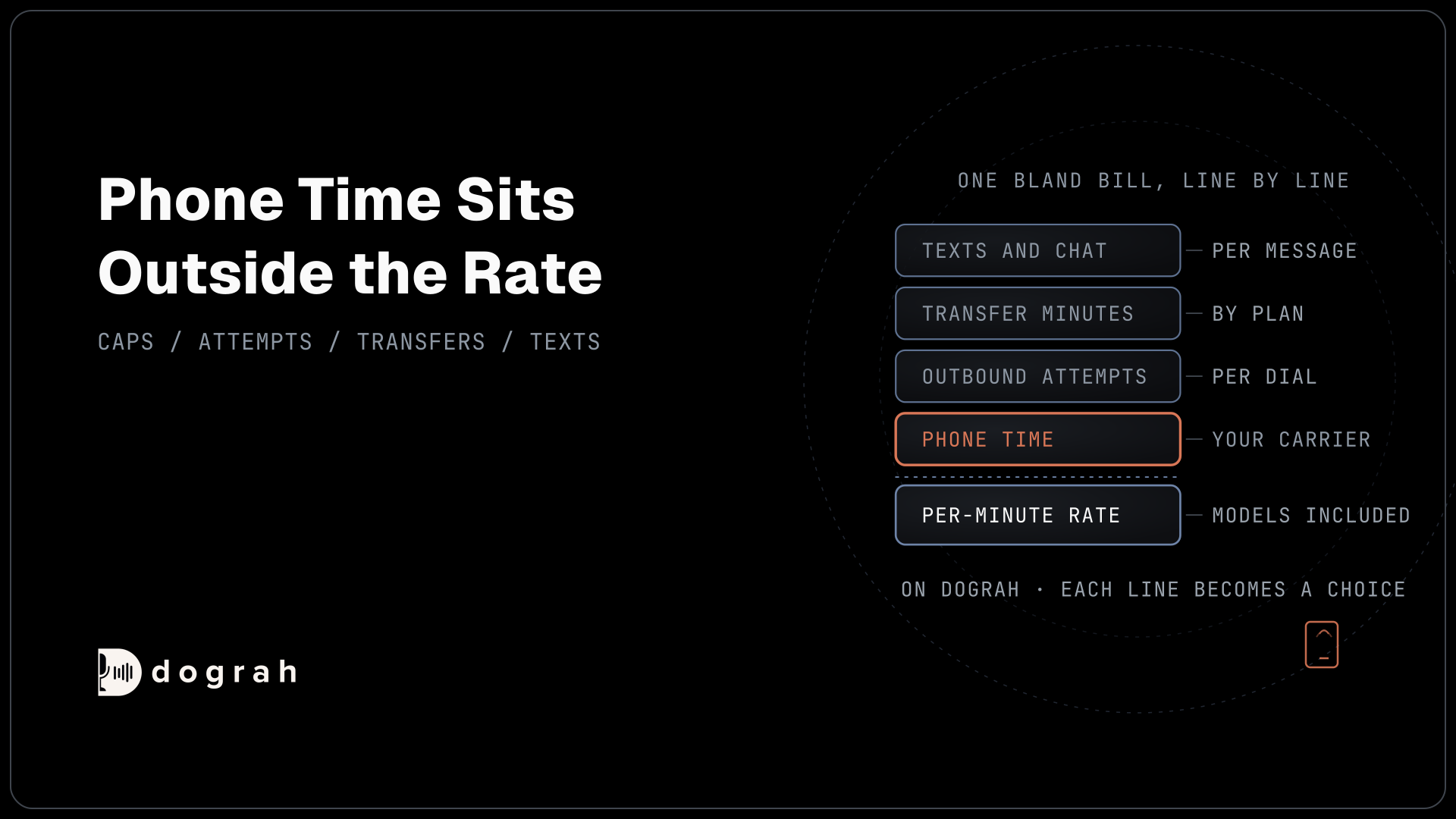
Bland AI sells per-minute talk-time plans and works with your existing Twilio account or SIP trunks from any provider; on-prem or VPC deployment comes with its Enterprise plan. Our post on Bland AI pricing covers the plans, and Retell AI vs Bland AI compares the two directly. Synthflow lists one plan, Enterprise, with contracts from $30,000 a year, and supports its own telephony, SIP trunking or approved enterprise telephony.
All four are closed platforms. The usage fee or contract sits on top of every call for as long as you run them, which adds up on a support line that takes calls all day.
Join the Dograh Community
Dograh is an OSS alternative to Vapi. Join our Slack community for queries, releases, best practices & community interactions.
Which platform fits which operator
The right choice depends on who will run the agent and where your calls already live. Four situations cover most operators.
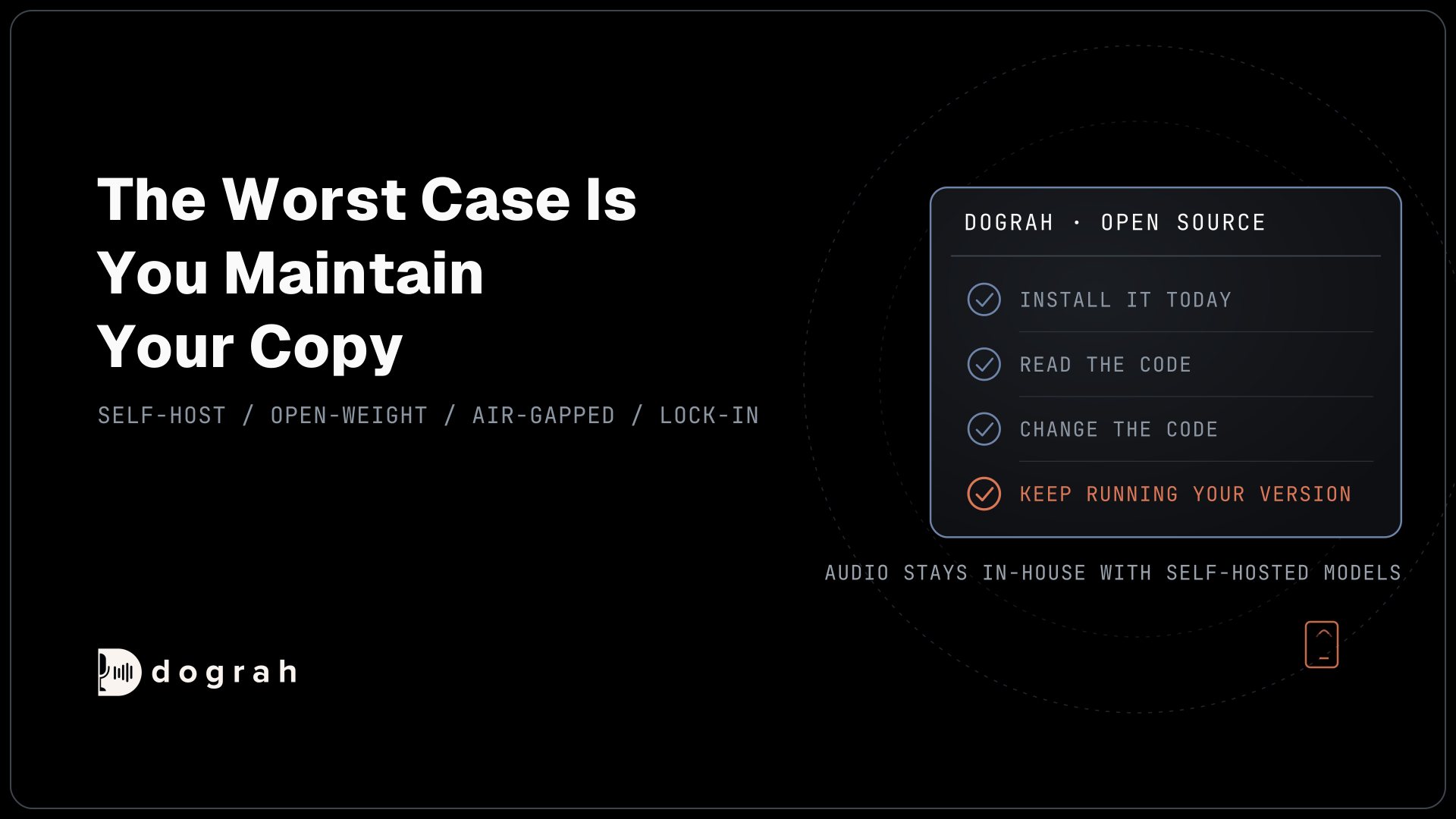
An operator that wants the agent on its own SIP trunk or Asterisk, with recordings and transcripts on its own servers, should start with Dograh self-hosted; call audio stays in-house only when the speech and language models run there too. A large carrier already running Genesys or another suite for its human agents will often add the suite's own AI agent, since routing and reporting stay in one place. An operator with no engineering team for voice will look at a managed vendor such as PolyAI or Parloa and accept that calls run in the vendor's cloud.
A regional cable or fiber provider with a small engineering team can start on a developer platform, then watch the per-minute fee as volume grows, or start on Dograh Cloud at a 1¢-a-minute platform fee and move to self-hosting later.
Whichever you pick, run the pilot on your real phone network with your real billing API, and judge it on calls resolved, not calls answered. Most phone calls still reach the agent as 8 kHz audio, while a browser demo runs at 16 kHz, so a demo that sounds perfect can still mishear plan names on the phone. Put the pilot on a real number before any customer hears it. To try Dograh, self-host it from GitHub with Docker Compose or start on Dograh Cloud, and point one test number on your own trunk at it. Our comparison of the best AI voice agents for healthcare applies the same own-or-rent test to a different industry.
Glossary
- Bring your own carrier (BYOC)
- Connecting your existing phone carrier or SIP trunks to a voice platform instead of buying phone service from the platform. For a telecom operator it keeps numbers and routing on its own network.
- Asterisk ARI
- The Asterisk REST Interface, which lets an outside application control calls on an Asterisk phone system. Self-hosted Dograh uses it to run the voice agent on an operator's own Asterisk.
- Concurrency limit
- The number of calls a voice agent platform runs at the same time. On an outage day it decides how many customers reach the agent before the rest need an overflow route.
- Customer proprietary network information (CPNI)
- What a phone carrier knows about a customer from providing the service, such as the plan and the calls made. FCC rules require carriers to authenticate a caller before disclosing it on an inbound call.