
AI voice agents for law firms are phone agents that answer and place a firm's routine calls: new-client intake, callbacks to missed callers, consultation booking and reminders, and document-collection reminders to existing clients. They read and write the practice management system during the call and hand anything needing a lawyer's judgment to a person. They never give legal advice.
Key Takeaways
- A caller is owed confidentiality from the first sentence, before any engagement.
- Privileged intake runs on servers the firm controls, with the models there too.
- The agent never says "you have a case"; a lawyer decides that.
This guide follows a matter from the first call to the document chase, then covers where those calls should run, the rules for every call and how each one runs in Dograh, an open-source voice agent platform that reads and writes your practice management system during the call. You can self-host it or run it on Dograh Cloud.
The calls a law firm can hand to a voice agent
A voice agent can take the calls that collect information or book a time, and it leaves every judgment to a lawyer. The phone is still a main way new clients arrive. In CallRail's 2026 marketing outlook for law firms, a survey of 100 legal professionals in October 2025, firms said clients are as likely to make first contact by phone as by email, 69% each. Of clients who first reach out by phone, 84% prefer to keep using the phone. The phone line is where many new matters start, and the agent's first job is to answer it every time, as the intake and missed-call sections below show.
AI is already inside most firms. The 8am 2026 Legal Industry Report, from more than 1,300 responses gathered in September and October 2025, found nearly 70% of legal professionals use general-purpose AI tools for work, up from 31% a year earlier. Privilege was a top concern for 39% of them. That concern is why a later section covers where the calls run.
Four calls fit well: new-client intake, missed-call callbacks, consultation booking and document-collection reminders. The first three come before anyone is a client. Each one ends in the firm's own system, and none of them decides anything about the case.
There is one sentence the agent never says, in any form: "you have a case." A prompt cannot guarantee that. Models avoid a banned phrase and still deliver its meaning ("that sounds like exactly the kind of matter we take"). Exact wording holds only where Dograh plays fixed text: the Greeting Text at the start of the call, a pathway's Transition Speech (text or a pre-recorded clip) and the Transfer Call tool's Pre-Transfer Message. Our post on prompt and flow design patterns for reliable voice agents shows how to split a flow so the risky turns lead into a fixed line and a handoff.
The practice management system holds the matter, and the agent works through it
Every call here reads from the firm's practice management system and writes back to it, so the agent keeps no copy of its own.
During the call, an HTTP API tool asks the firm's system for open consultation slots or a client's open document list, and the agent uses only what comes back. A second tool writes the booking or the intake answers back. After the call, a Webhook node sends the outcome and the transcript link to the same system, and retries automatically on a temporary failure.
Dograh has no built-in Clio, calendar or CRM integration. Each connection is an HTTP API tool pointed at your system's own API; MCP tools, the Webhook node, Pre-Call Data Fetch and the API Trigger are the other routes, and n8n connects through them. Our guide to Integrating Voice Agents With Your Stack covers those mechanics.
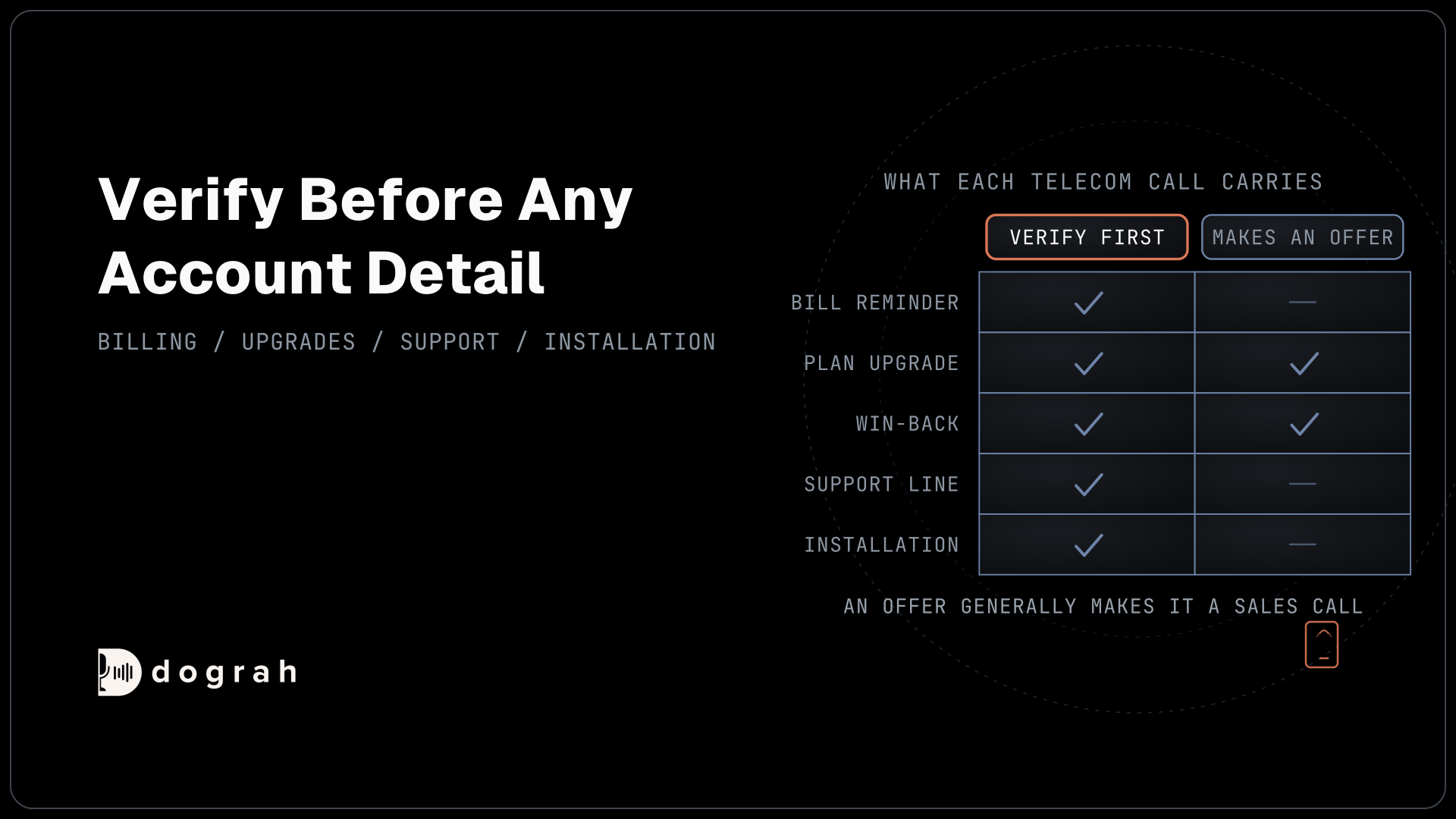
Every call runs greet, verify, then disclose. A phone number can find a client record, but it does not prove who is holding the phone, and in legal work a spouse or an employer answering is a real risk. Before the agent names a matter or a missing document, it confirms identity with a check the firm approves, such as date of birth plus a reference the firm gave the client.
Transfer Call, which hands the caller to a person, works on Twilio only and passes no summary, so the agent writes the details to the firm's system first. If nobody answers within the 30-second default, the caller stays with the agent; tell it in the prompt to offer a callback and write the request through an HTTP API tool.
Before the client: intake, missed calls and consultations
Three calls come before anyone signs an engagement letter, and the person on the line is already owed confidentiality in all of them.
New-client intake
Intake gathers what a lawyer needs to decide whether to take the matter, and it starts with names. Under Model Rule 1.18 (quoted here from Pennsylvania's adopted text), "A person who consults with a lawyer about the possibility of forming a client-lawyer relationship with respect to a matter is a prospective client." So the agent asks for the caller's name and the other side's names first, for the conflict check, before it asks what happened.
Callers rarely wait for that order, and many describe the accident in their first sentence, so who else hears the call matters. In United States v. Heppner, a federal court in New York held in February 2026 that a defendant's own exchanges with a public AI tool were not privileged; Venable's reading of the ruling is that attorney-directed tools under real confidentiality terms "may present a materially different analysis". Our post on AI Voice Agents for Law Firm Intake makes the full privilege argument.
Missed-call recovery
Missed-call recovery calls back a person whose call nobody answered, fast, once. Dograh can only see calls that reach it, so the firm's own phone system spots the missed call and starts the callback through the API Trigger, from the firm's own number. The agent says which firm is returning the call and confirms it reached the person who called before asking how it can help.
A callback to someone who called the firm generally answers their request rather than soliciting them under Rule 7.3, while calling numbers that never contacted the firm is a different matter. Whether a missed call is consent to an AI-voice callback is a question for counsel. AI voice agents for missed-call recovery in law firms sets out the callback and its voicemail rule.
Consultation scheduling
The scheduling call books a consultation from the attorney's live calendar and writes it to the firm's system. An HTTP API tool reads the open slots, and the agent offers only what came back. It collects the caller's name, contact details, matter type, the other party's names and a preferred time, and reads the booking back before writing it once.
The booking is tentative until the conflict check clears. Staff or the firm's conflict software check the names before the consult, and on a hit staff cancel and refer the caller elsewhere. Any consultation fee goes through the firm's own payment link, sent by its own system, never a card read out on the call. AI voice agents for legal appointment scheduling covers the reminder and reschedule calls too.

Open Source Alternative to Vapi / Retell
Self-hosted voice agent platform — no per-minute fees
dograh-hq/dograh
Star on GitHub
During the matter: document-collection reminders
Once the firm is engaged, chasing a missing document is part of the duty to keep the client informed. In its July 2026 annual report, Minnesota's lawyer discipline office named communication as the top area for private discipline, with complaints up to 1,572 in 2025 from 1,278 in 2024. Rule 1.4 asks a lawyer to "keep the client reasonably informed about the status of the matter".
The reminder call does what an email cannot. After verifying the client, the agent names the document and why the case needs it by a given date, then asks what is holding it up. An HTTP API tool then asks the firm's own system to send its secure upload link by text or email, since Dograh sends no texts itself and no document is taken on the call.
Keep the cadence gentle: no more than one call per document per week, stopping when the document arrives. Dograh's Campaigns have no per-contact call cap, so the firm's own call list enforces that. A voicemail gives only the firm's name and a callback number, because anyone at that number may hear it. AI voice agents for document-collection reminders covers consent and the full call.
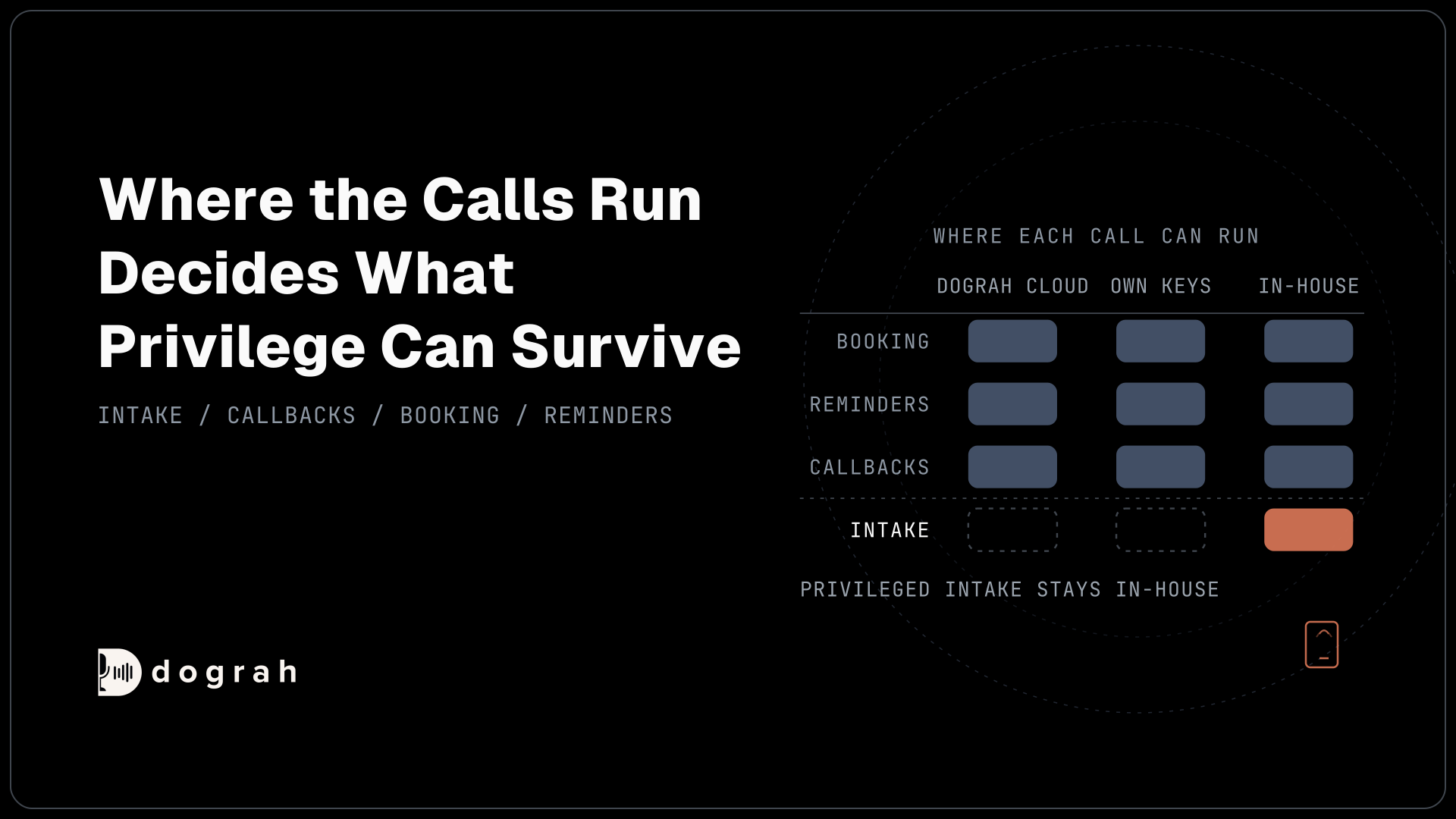
Where the calls run decides what privilege can survive
The deciding test is whether the duty attached to the information can be handed to someone else by contract, and for privilege it generally cannot.
Health data has a contract built for this: a business associate agreement delegates HIPAA obligations to each vendor. Privilege has no equivalent, and a privilege waiver cannot be taken back once the information has reached the wrong party. Texas Professional Ethics Committee Opinion 705 says a lawyer may share confidential information with a service provider only if "reasonably confident" that "the confidential character of the information will be respected and protected by the service provider." For an intake call, that service provider generally includes every company whose model hears the audio.
Scoring and monitoring find a problem after the audio has already reached someone else. They are worth running, and they cannot undo a disclosure, so privileged intake runs where no outside party hears it.
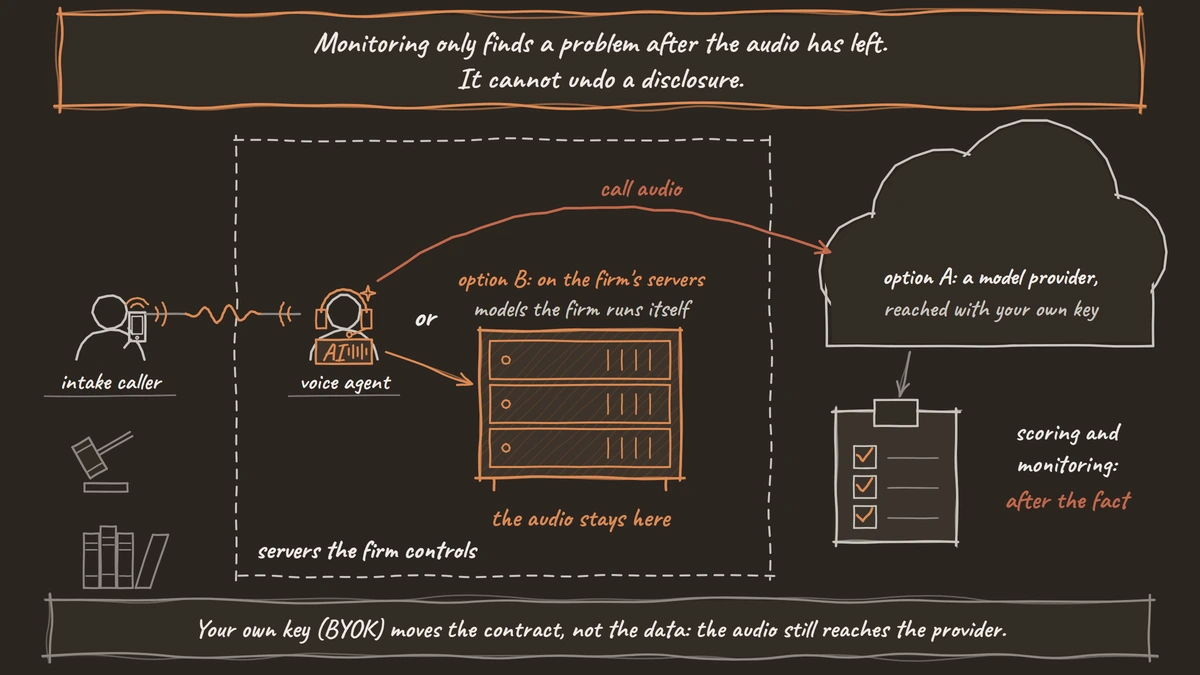
Dograh is the orchestration layer: it runs the call flow, tools and telephony, and the speech and language models are a separate layer you choose. Whether the models sit with a provider you reach through your own key (BYOK) or run as open-weight models on your own servers decides where the audio goes. BYOK moves the contract, not the data, because the audio still reaches the provider. Full data sovereignty needs both halves: self-hosted Dograh and self-hosted open-weight models. Our guide to running voice AI on local, self-hosted models covers the model side, and On-Prem Voice AI for Law Firms covers the servers and the phone path for a firm.
Dograh has no retention setting and deletes nothing automatically, so a firm that runs it in-house deletes recordings and transcripts from its own storage under its own policy. Not every call needs the top tier: a reminder that carries no case facts can run on Dograh Cloud or with your own keys.
Join the Dograh Community
Dograh is an OSS alternative to Vapi. Join our Slack community for queries, releases, best practices & community interactions.
Choosing a platform and building the agent
One post compares the options a firm meets, and one builds the agent.
Answering services bill per answered call, and hosted voice platforms bill per minute. Before comparing price, sort every option by where the call audio and transcripts go, because that is the question a privilege review asks first. Best AI Voice Agents for Law Firms compares them on that basis, prices included.
Our tutorial on how to build a voice agent for law firms builds an intake and booking agent in Dograh, with a conflict lookup, a booking tool that cannot double-book and a test over a real phone call.
Self-hosted Dograh has no per-minute platform fee (servers, model keys and phone minutes still cost); Dograh Cloud has a 1¢-a-minute platform fee. Our open-source legal intake voice agent page sets out the intake call, from names first to the conflict lookup, on your own servers.
Rules that apply to every call
A few rules hold on every call above. This section is general information, not legal advice.
Recording consent depends on the state. Some states, such as California, Florida, Illinois and Pennsylvania, require every party's consent to record a call, so the Greeting Text can say the call is recorded, and a caller who objects can be handed to a person or the call ended. Recording cannot wait for the caller's consent, and on a self-hosted install it can be switched off only for the whole server. Transcripts keep everything said, so the agent never asks a caller to speak a password or a card number.
If you want to tell callers they're speaking with an automated assistant, or your location requires it by law, write it in the Greeting Text along with the firm's name.
Outbound calls need consent. In its February 2024 ruling, FCC 24-17, the Federal Communications Commission confirmed that the Telephone Consumer Protection Act (TCPA) limits on calls using an "artificial or prerecorded voice" cover "current AI technologies that generate human voices". Such calls generally need the called party's prior express consent, and written consent when the call carries an advertisement or telemarketing. For clients, the engagement letter is the natural place to ask for it, recorded in the firm's system. Dograh keeps no do-not-call list: it can tag a call as do_not_call, but it does not block later calls, so opt-outs live in the firm's own system and those numbers come off each campaign list before upload.
Confirm your own position on recording and consent with counsel in each state where you call.
Which call to hand over first
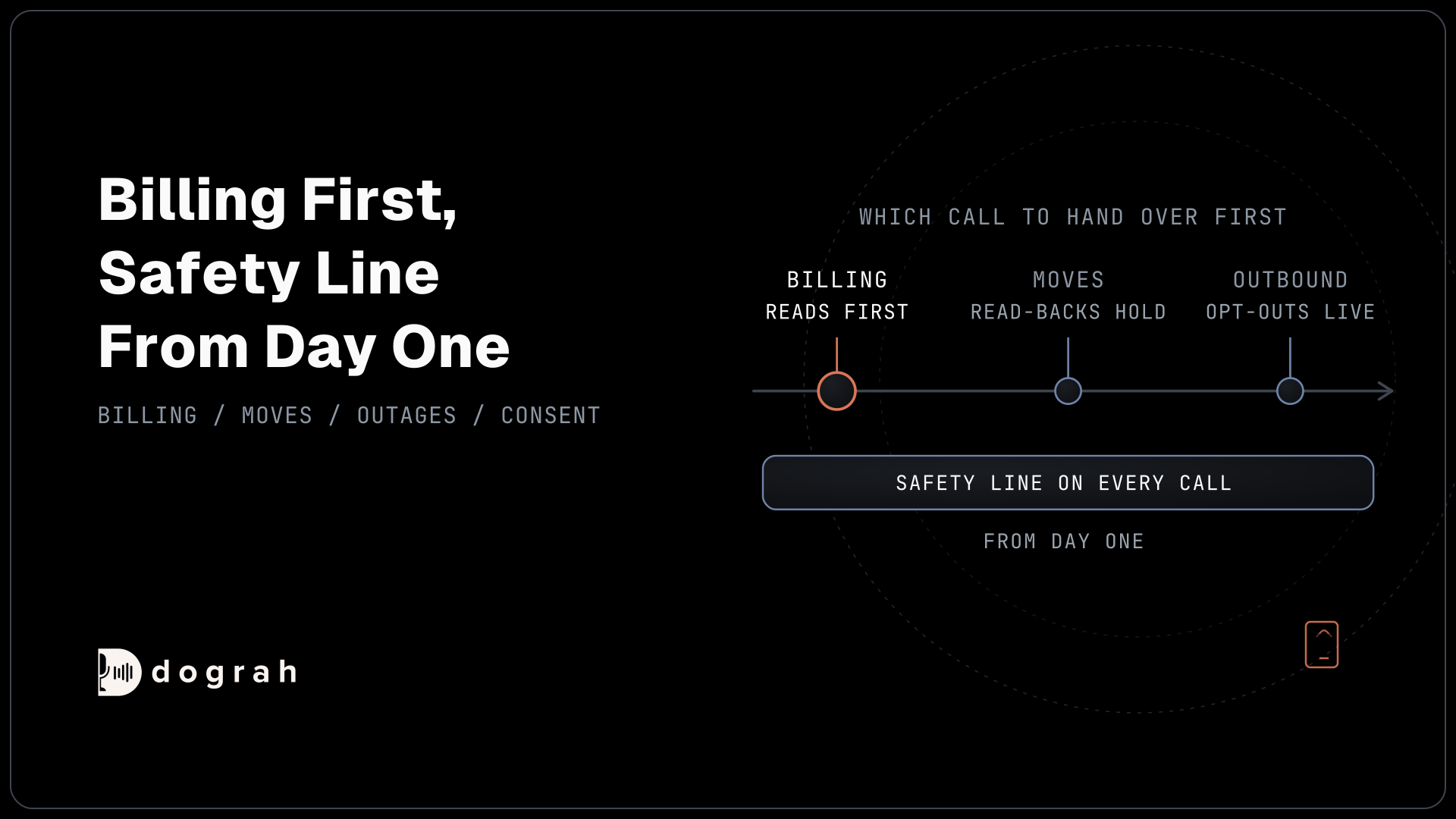
Start with the calls that carry no case facts, then move intake once the in-house setup is ready.
Consultation booking and its reminders are the easiest first step. They read a calendar and write a booking, so they can run on Dograh Cloud while the firm decides on hosting. Missed-call callbacks come next, booking a consultation rather than taking case facts, and AI voice agents for after-hours coverage covers the night-time handover. Privileged intake comes once Dograh and the models run on servers the firm controls.
Put every agent on a real phone number before a client hears it, following the order in Testing Voice Agents Before You Go Live. Once live, run QA on a random 5 to 10% sample of calls and read every call that ended in a transfer. Each transcript turn is saved with the node it was spoken in, so a stray sentence traces back to its step.
Each call above has its own deep dive:
- AI Voice Agents for Law Firm Intake
- AI Voice Agents for Missed-Call Recovery in Law Firms
- AI Voice Agents for Legal Appointment Scheduling
- AI Voice Agents for Document-Collection Reminders
- On-Prem Voice AI for Law Firms
- Best AI Voice Agents for Law Firms
- How to Build a Voice Agent for Law Firms
Glossary
- Prospective client
- Under Model Rule 1.18, a person who consults a lawyer about possibly forming a client-lawyer relationship. The duty of confidentiality starts there, so a caller is owed it from the first sentence of an intake call.
- Privilege waiver
- Losing attorney-client privilege over information because it reached someone outside the privilege, such as an outside company whose model heard the call. A waiver generally cannot be undone, which is why privileged intake runs on servers the firm controls.
- Conflict check
- Matching the caller and every other party against the firm's existing clients before taking on a matter. The agent collects the names; staff or the firm's conflict software clear them before the consult.
- Prior express consent
- Under the TCPA, the called party's permission before a call using an artificial or prerecorded voice. FCC 24-17 confirmed this covers AI-generated voices, so outbound reminder calls generally need it.