
AI voice agents for missed-call recovery in law firms call back people whose calls nobody answered. The firm's phone system reports the miss, and the agent calls once from the firm's own number, confirms it reached the person who called, then takes intake details or books a consultation. Anything urgent goes to a person.
Key Takeaways
- The firm's phone system reports the miss and starts the callback.
- Confirm it reached the person who called before saying why.
- Call back once, from the firm's number, then stop.
This post is part of our guide to AI voice agents for law firms. The guide's section "Before the client: intake, missed calls and consultations" describes this one as calling back a person whose call nobody answered, fast and once, started by the firm's own phone system. Here is that callback in full, built on Dograh, an open-source, self-hostable voice agent platform.
Slow answers cost firms clients
Firms say themselves that slow responses lose them business. In CallRail's 2026 marketing outlook for law firms, a survey of 100 legal professionals in October 2025, 81% said they lose business because of "slow responses to inbound calls, texts or webforms". 35% said they lose "significant business", which they estimated at 11 to 25% of annual revenue, because they could not respond fast enough.
CallRail sells call tracking, the sample is small and these are firms' own estimates. Still, the direction matches what any intake manager sees: a person with a new legal problem often calls more than one firm, and the first useful conversation tends to win.
Miss fewer calls first, then recover the rest
A callback fixes a call that already went wrong, so the first job is to miss fewer calls. Route overflow and after-hours calls to a voice agent that answers, and the callback list shrinks to the calls that still slip through, such as a caller who hung up during the greeting or a burst of calls at once. Our post on AI voice agents for after-hours coverage covers the night-time handover.
Some firms start with a text-back instead: an automatic message after the missed call that says sorry, we missed you, and how can we help. It is cheap and quick to set up, and it comes from the firm's own phone system or messaging provider, since Dograh sends no texts itself. In legal work it needs care. A text sits on a shared phone for anyone to read, and in Pennsylvania a text to a prospective client can count as live contact under the solicitation rule (more below). A voice callback earns its place when the person needs to talk now, and it can confirm who answered before saying anything.
How the callback starts
Dograh only sees calls that reach it, so the missed call has to be reported by the system that missed it. There is no missed-call event for a call that never arrived at Dograh. The firm's own phone system or call-tracking tool spots the missed or abandoned call and calls the API Trigger with the caller's number and the time of the call. Our post on API Triggers shows what that request carries.
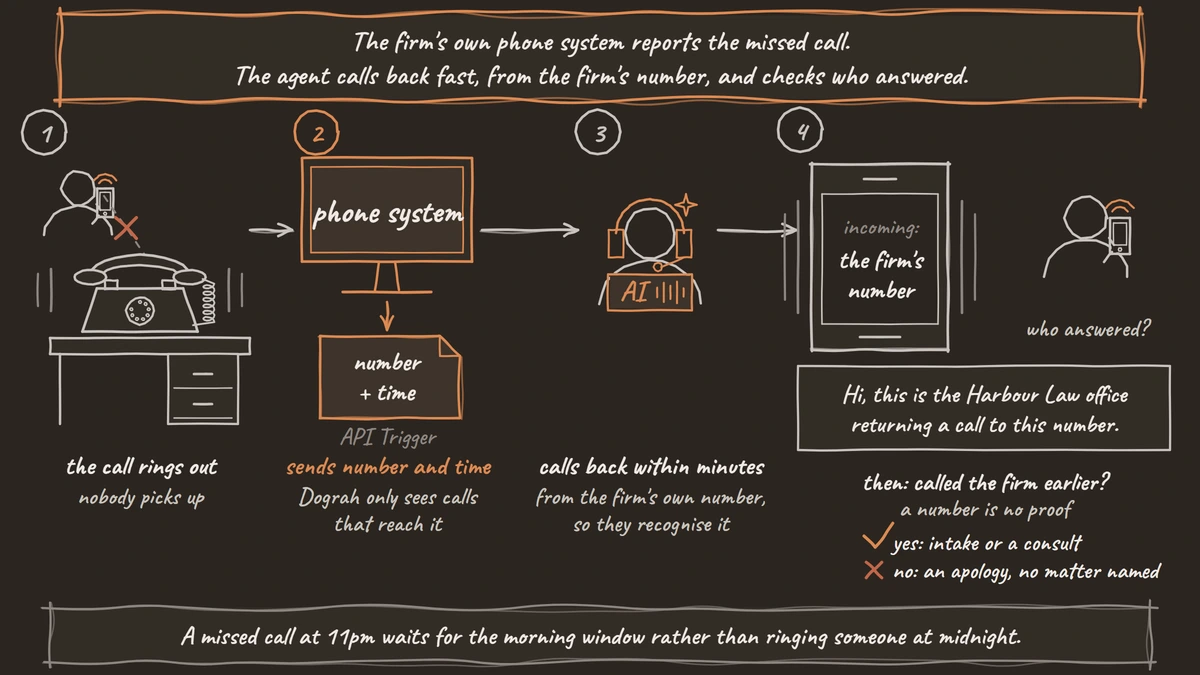
Two settings matter most. The callback should come from the firm's own published number, the one the person just dialled, so they recognise it. And it should come fast, within minutes during the firm's calling hours. A missed call at 11pm waits for the morning window rather than ringing someone at midnight.
If the caller left a voicemail, the firm's system can pass a short reason with the trigger, such as "car accident" or "family law". The agent uses it only to choose its questions, and it does not repeat it until it knows who answered.
What the callback says
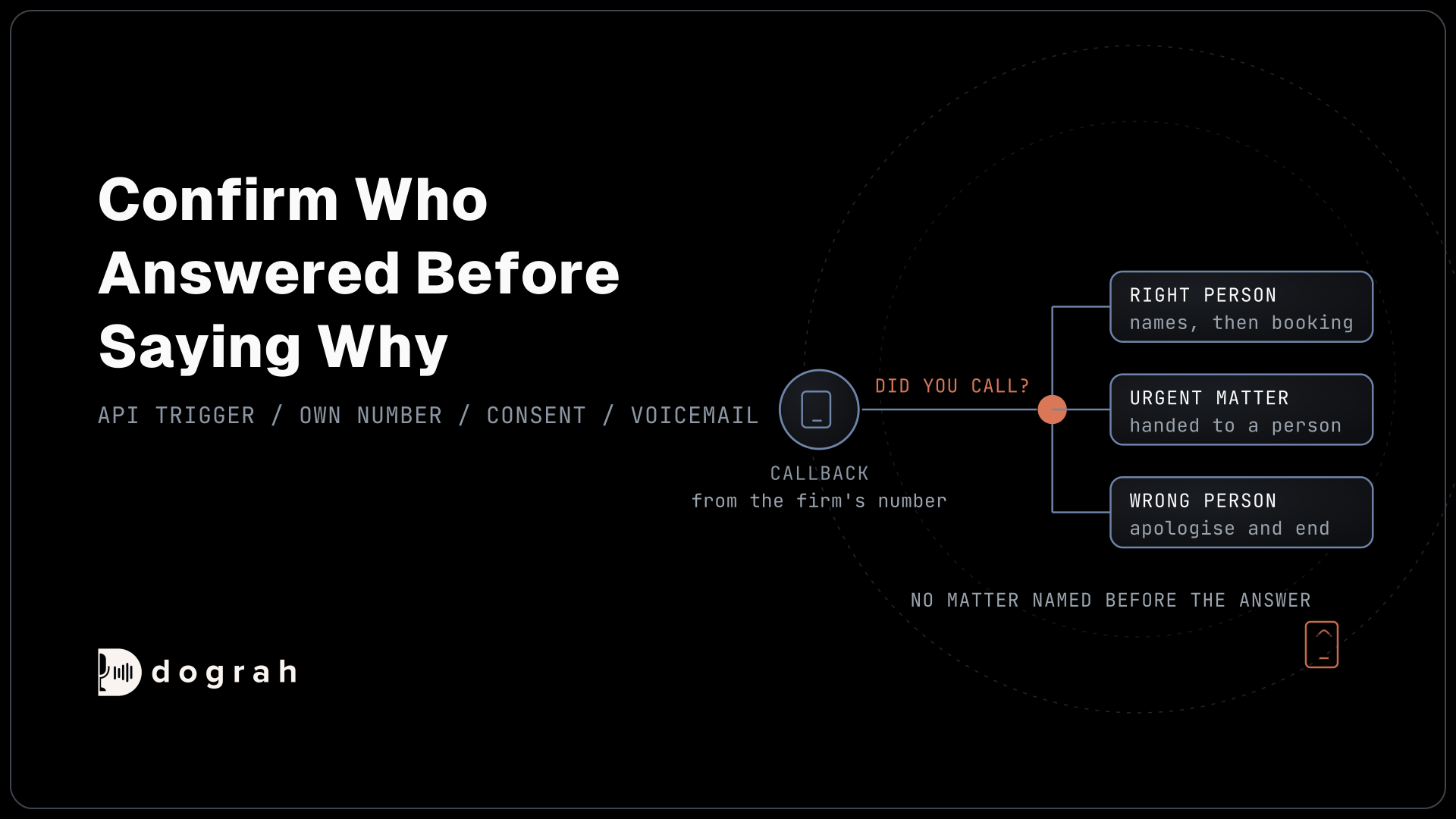
The callback names the firm and confirms who answered before it says why it is calling. The Greeting Text, fixed words Dograh plays exactly as written, carries the opening: "Hi, this is the Harbour Law office returning a call to this number." Variables can fill in per call, such as {{caller_name | there}}, but a missing name needs that fallback or the raw placeholder is read aloud. If you want to tell people they're speaking with an automated assistant, or your location requires it by law, say that in the greeting as well.
Next, the agent asks whether the person called the firm earlier. A phone number is not proof of who is holding the phone, and a callback about a divorce or an arrest that reaches a spouse or an employer does real harm. If the answer is no, the agent apologises and ends the call without mentioning a matter.
If it is the right person, the call turns into intake or booking. The agent asks for names first, for the firm's conflict check, and the practice area, then offers a consultation from the attorney's live calendar. AI Voice Agents for Law Firm Intake covers what intake must ask and why, and AI voice agents for legal appointment scheduling covers the booking. Urgent matters go to a person with Transfer Call, which works on Twilio only and passes no summary, so the agent writes the details to the firm's system first.

Open Source Alternative to Vapi / Retell
Self-hosted voice agent platform — no per-minute fees
dograh-hq/dograh
Star on GitHub
Rule 7.3 and consent for the callback
The callback is safest when it answers the person's own request. This section is general information, not legal advice.
Model Rule 7.3, quoted from Pennsylvania's adopted text, defines solicitation as "a communication initiated by or on behalf of a lawyer or law firm that is directed to a specific person the lawyer knows or reasonably should know needs legal services in a particular matter". Its first comment says a communication is not a solicitation "if it is in response to a request for information". A callback to someone who called the firm generally answers their request rather than soliciting them; calling numbers that never contacted the firm is a different matter. States differ. Pennsylvania, for one, now counts text messages as live person-to-person contact, a change that took effect on 14 November 2024, as Marshall Dennehey explains.
The phone rules are separate. In its February 2024 ruling, FCC 24-17, the Federal Communications Commission confirmed that the Telephone Consumer Protection Act (TCPA) limits on "artificial or prerecorded voice" calls cover "current AI technologies that generate human voices", and such calls generally need the called party's prior express consent. Whether a missed inbound call counts as that consent is a question for counsel; this post does not say it does. Placing the call from the firm's own number, to someone who just called it, is the starting point. Confirm your state's version of Rule 7.3 and your consent position with counsel.
Join the Dograh Community
Dograh is an OSS alternative to Vapi. Join our Slack community for queries, releases, best practices & community interactions.
One callback, then stop
The callback is one fast attempt, and the firm decides whether there is a second. When the firm's phone system starts calls through the API Trigger, it sets that rule itself. If the firm batches the day's misses into a campaign instead, set the campaign's retries to the firm's rule; they run from 0 to 10, and the default is 2.
How many times to try is a business decision. The system's job is to tell a retryable failure, such as a busy line, from an outcome that ends it, such as a wrong number or a request not to be called again. Every attempt is recorded: a Webhook node writes the outcome to the firm's system when each call ends. Dograh keeps no do-not-call list, so a request to stop is written to the firm's own system and that number is left off future calls.
Voicemail gives only the firm's name and a callback number. Set it under Settings, "Enable voicemail and screening handling", "When voicemail is detected", "Leave a message".
A callback carries little case detail until the person starts describing the matter, so many firms start on Dograh Cloud and move intake in-house later. Self-hosted Dograh has no per-minute platform fee (servers, model keys and phone minutes still cost); Dograh Cloud has a 1¢-a-minute platform fee.
Glossary
- Solicitation
- Under Rule 7.3, a lawyer-initiated communication to a specific person known to need legal services in a particular matter. A response to that person's own request for information generally falls outside it.
- Live person-to-person contact
- Rule 7.3's term for in-person or live phone contact with no time for reflection. Pennsylvania's comment also counts text messages, so a missed-call text there needs care.
- Text-back
- An automatic text sent after a missed call. It comes from the firm's own phone system or messaging provider, since Dograh sends no texts itself.
- API Trigger
- A Dograh endpoint another system calls to start one outbound call. For missed-call recovery, the firm's phone system calls it with the caller's number and the time of the missed call.