
AI voice agents for utility customer support answer inbound calls about bills and accounts. They verify the caller, explain the bill from the account's own numbers and offer payment arrangements only within the utility's limits. Shutoff decisions, disputes, hardship cases and assistance eligibility go to a person, and gas leaks get a fixed safety line first.
Key Takeaways
- The fixed safety line plays before the agent asks anything.
- Explain a bill from the account's own numbers, never from a document.
- Shutoffs, disputes, hardship and assistance eligibility always go to a person.
This post is part of our guide to AI voice agents for utilities and energy. In the guide's section "Inbound calls: bills, accounts and moves", the billing part comes down to one line: the support call answers a bill from the account's own numbers. Here is that call in order, built on Dograh, an open-source, self-hostable voice agent platform, with the customer information system (CIS) read and written during the call.
Why most support calls start with the bill
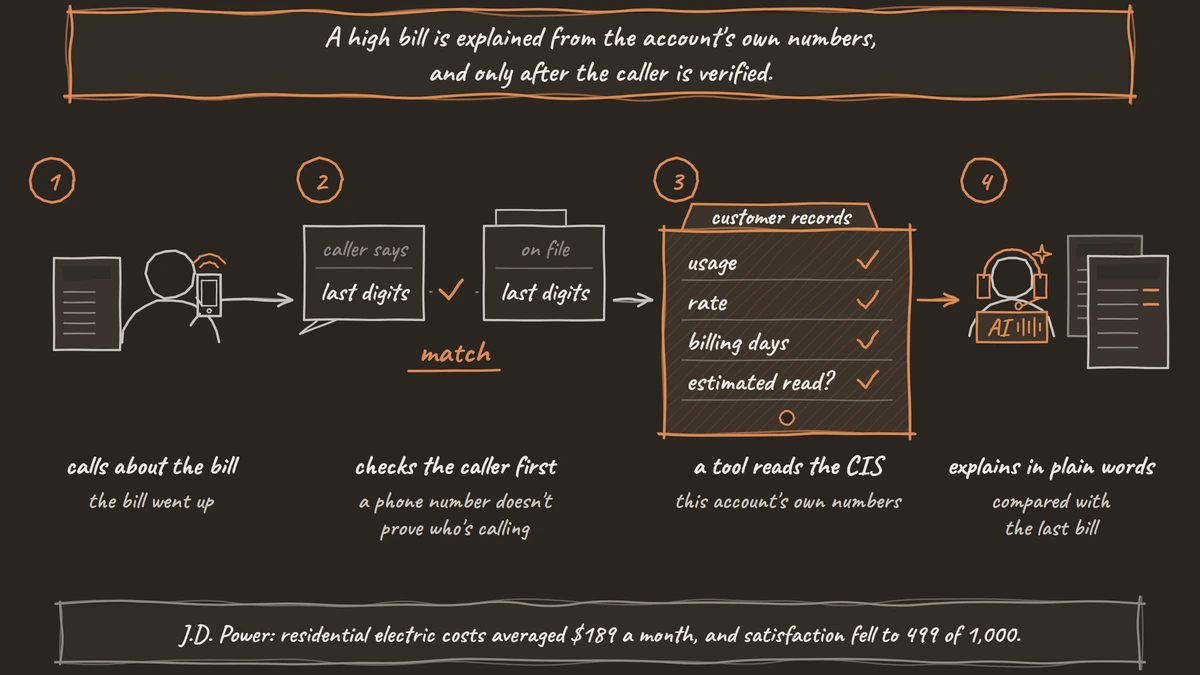
Bills went up in 2025, and satisfaction went down with them. In J.D. Power's 2025 residential study, electric utility satisfaction fell to 499 out of 1,000, the lowest across its residential utility studies, with average monthly residential electric costs at $189. In J.D. Power's Utilities Outlook 2026, 22% of electric customers said they could not pay their full bill.
For water utilities, the phone is where satisfaction is lowest. In the same outlook, water utility customers who used digital channels scored 43 points higher than those who relied on phone support. That makes the phone call the place where a better answer shows first.
The call in order, from safety line to verification
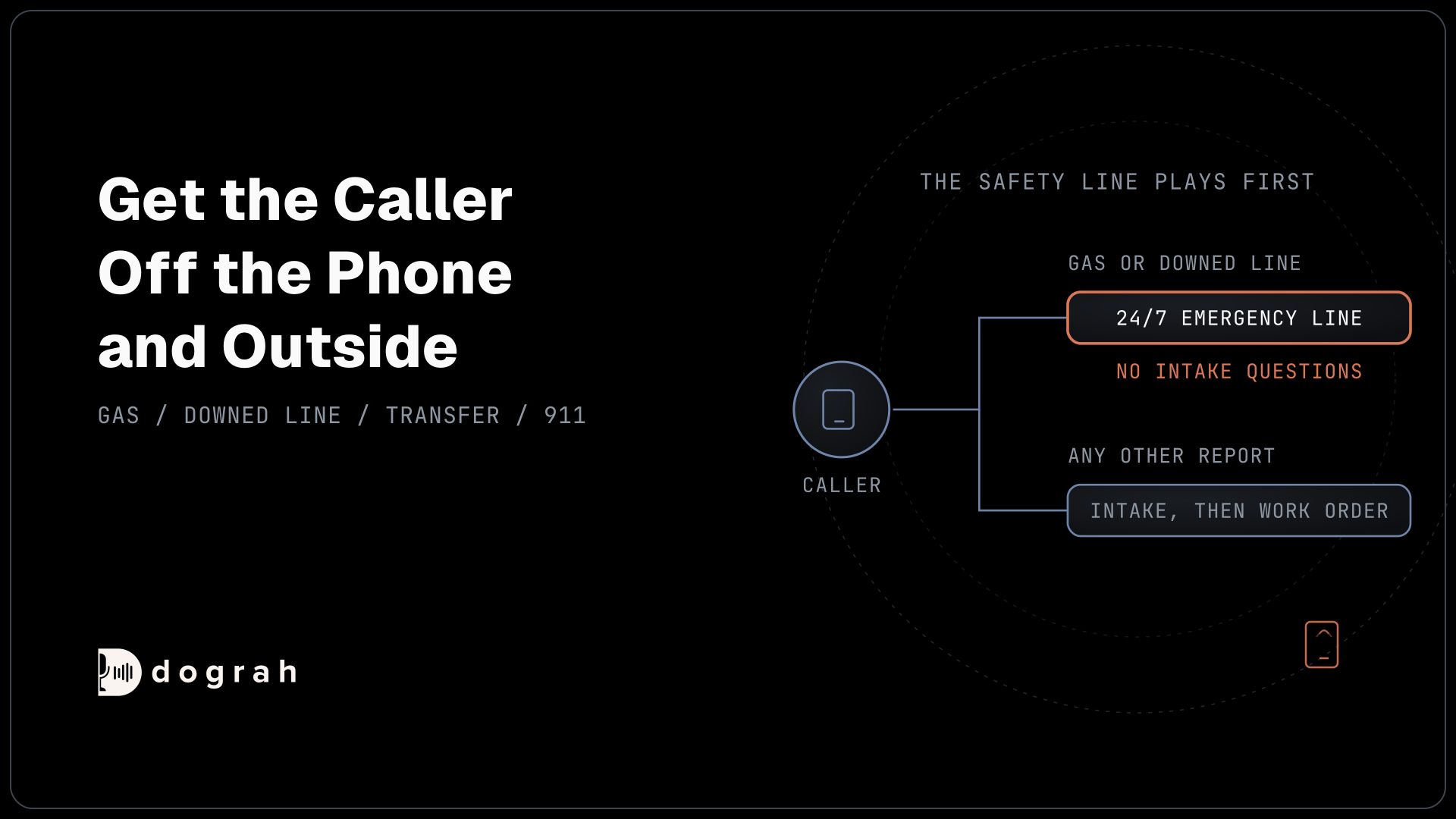
The first seconds of a support call carry two jobs: the safety line and finding the account. Every utility number can receive a gas call, so the Greeting Text on the Start Call node carries a fixed instruction for anyone who smells gas or sees a downed line: leave the area and call 911 from a safe place. AI voice agents for emergency intake in utilities covers that path. The same greeting names the utility. If you want to tell callers they're speaking with an automated assistant, or your location requires it by law, write it there too.
Pre-Call Data Fetch, at the bottom of the Start Call node, set to Inbound calls only, sends the caller's number to your CIS as the call connects. The greeting waits for it while the caller hears ringing. A phone number finds an account, but it does not prove who is calling, so write the prompt so the agent names no balance or payment history from that lookup until the caller is verified.
Before it discloses anything, the agent asks for an approved check, such as the last digits of the account number. It never asks for a password or a PIN, because transcripts keep everything said and there is no redaction. Greeting Text plays before Dograh can hear the caller's language, so in a bilingual area, write it in both, for example "Hola, hello".
Explaining the bill from the account
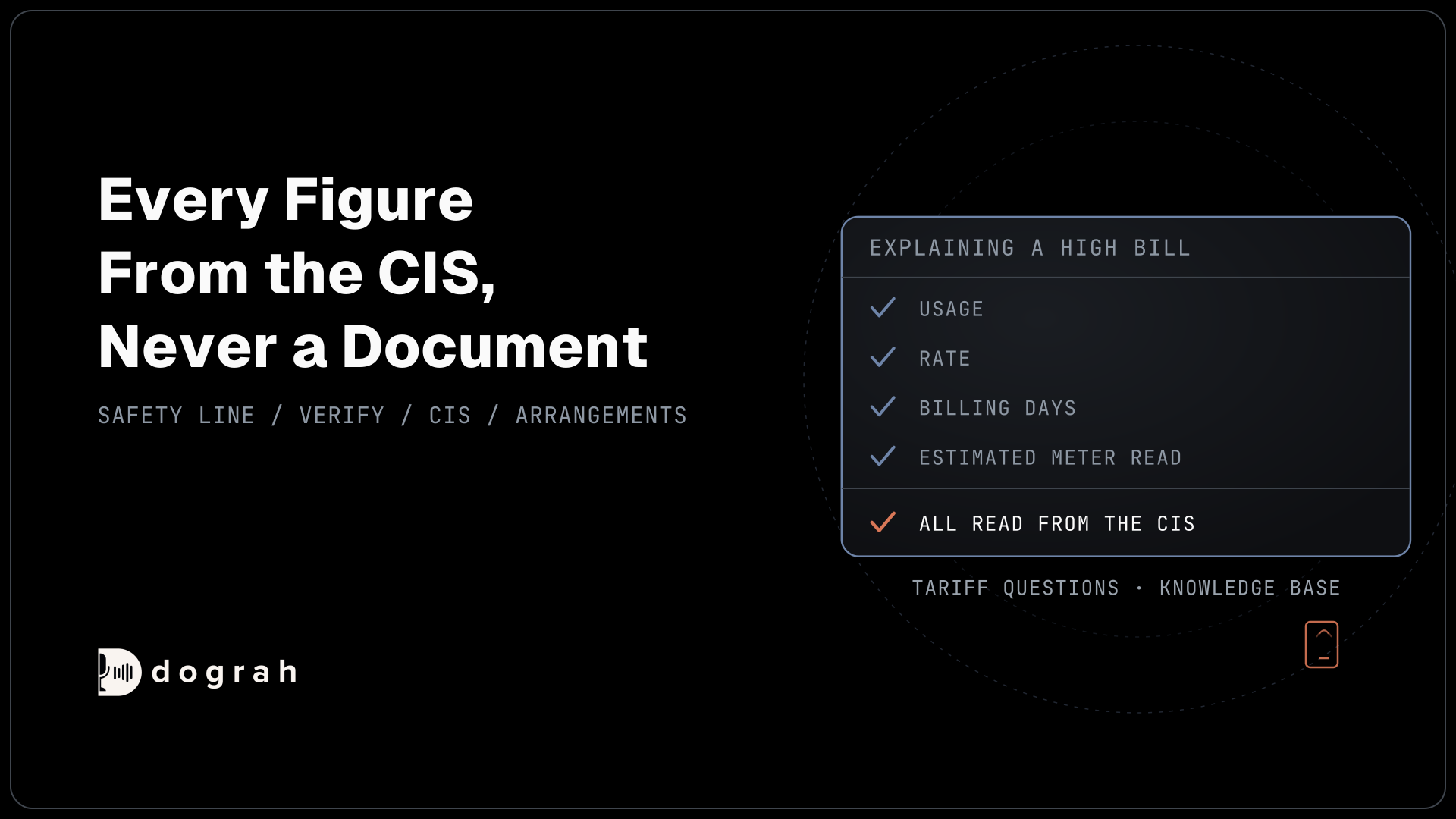
A high-bill call is answered with the account's own numbers. After verification, an HTTP API tool returns what drives the bill: the usage, the rate, the number of billing days and whether the bill used an estimated meter read. The agent compares them with the last bill in plain words, for example a longer billing period or an estimated read that a real read will correct.
General questions about tariffs and fee policies can come from the Knowledge Base, which takes PDF, DOCX, DOC, TXT and JSON files up to 5 MB each. Account figures never come from those documents. A tariff sheet cannot know this customer's usage, so the number the agent states is always the one the CIS returned during the call.
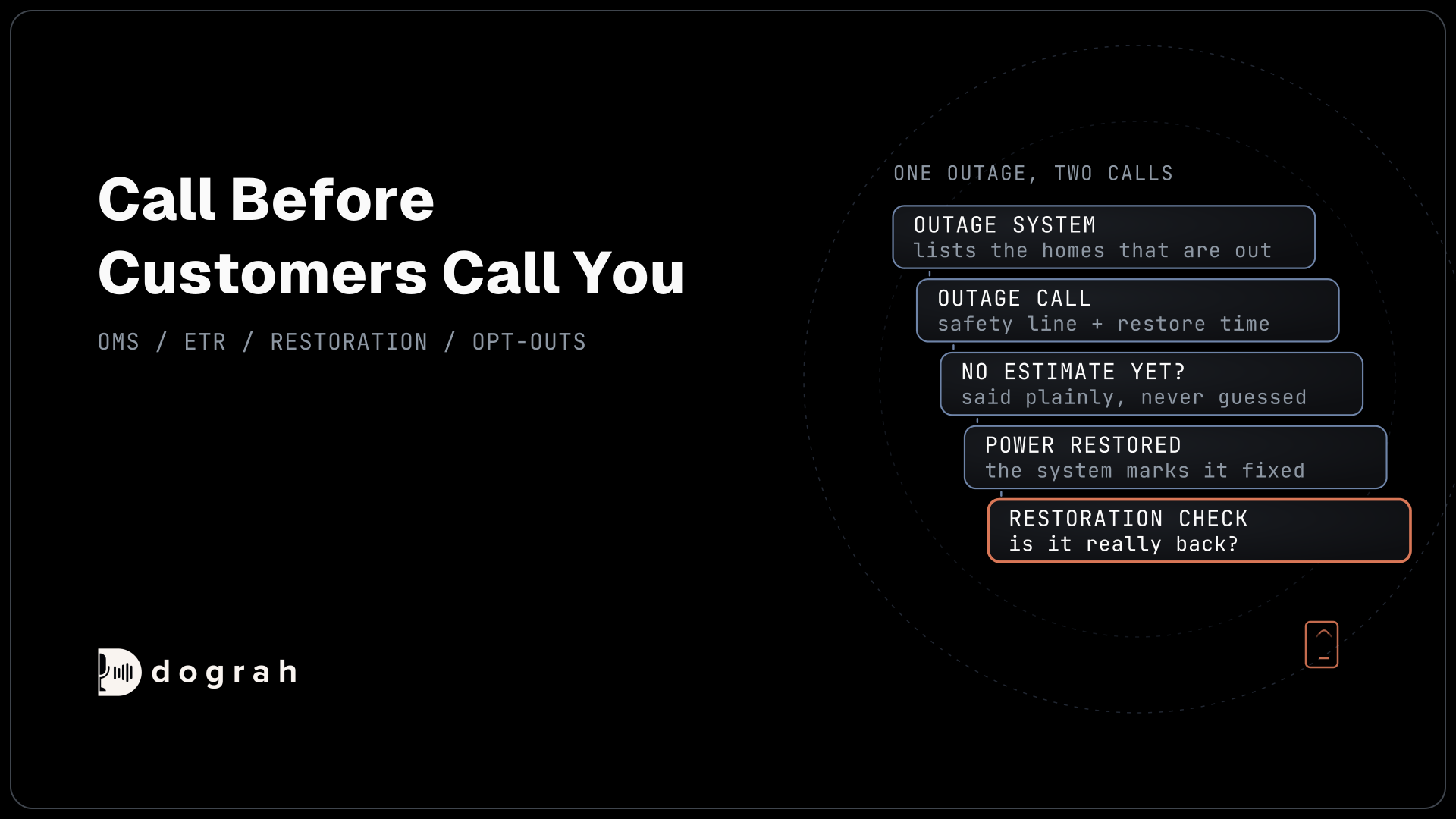
Some callers ask whether there is an outage at their address. A second HTTP API tool can ask the outage management system and read back what it returns, including a restoration time only if one exists. Outbound outage calls are a separate job, set out in AI voice agents for outage notifications.

Open Source Alternative to Vapi / Retell
Self-hosted voice agent platform — no per-minute fees
dograh-hq/dograh
Star on GitHub
Payments and payment arrangements
The agent explains how to pay, but the payment itself never happens on the call. Dograh has no feature for taking customer payments and no keypad (DTMF) tool. When a customer wants to pay, an HTTP API tool asks the utility's own system or payment provider to send its secure payment link by text or email.
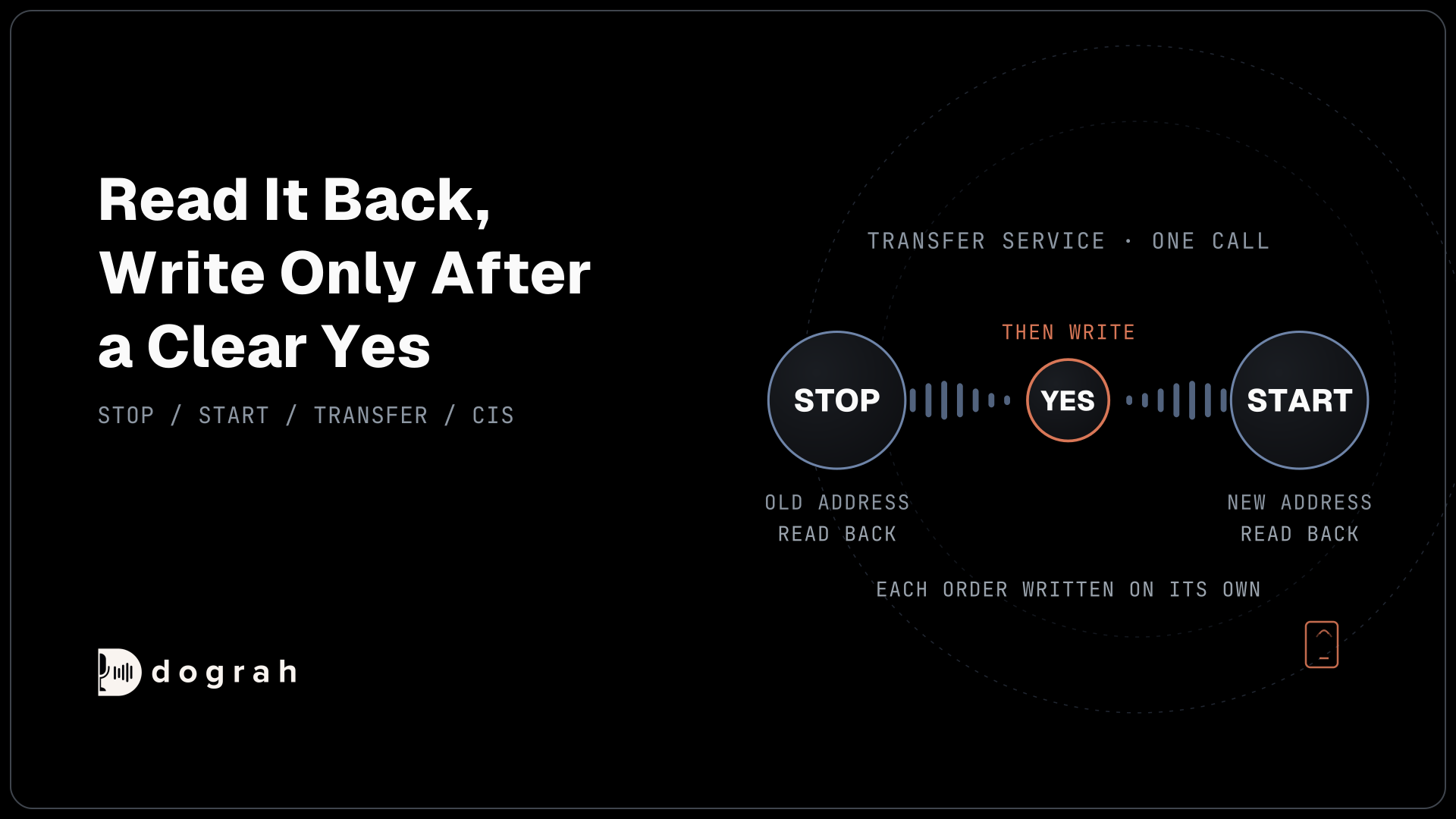
Payment arrangements follow the utility's rules. An HTTP API tool asks the CIS which plans this account qualifies for, and the agent offers only those. Once the customer picks one, the agent reads back the amounts and dates, gets a clear yes, and a second tool writes the arrangement. If the system returns nothing, the request goes to a person.
Calls about moving house are service orders, with their own read-back rules. AI voice agents for start, stop and transfer service in utilities covers them.
What goes to a person
Decisions that can cost a household its service stay with staff. Shutoff decisions, billing disputes, hardship cases and assistance-program eligibility all go to a person, along with deposit waivers and anything outside policy. The agent can say that energy assistance programs exist and transfer the caller to someone who can check eligibility.
A disputed meter read is a dispute too, so the agent does not argue the number. It records what the customer says is wrong, as they stated it, writes a review request to the CIS through an HTTP API tool, and tells the customer the billing team will follow up. A person decides whether a re-read or a corrected bill follows.
Transfer Call works on Twilio only and passes no summary. So the agent first writes the reason and the account to the CIS with an HTTP API tool, and the person who picks up sees it there. If nobody answers within the 30-second default, the caller stays with the agent; tell it in the prompt to offer a callback and write the request to the same system through an HTTP API tool. Out of hours, AI voice agents for after-hours coverage covers what the agent does when nobody is on duty.
Join the Dograh Community
Dograh is an OSS alternative to Vapi. Join our Slack community for queries, releases, best practices & community interactions.
Where to start
Start with billing questions, because they read from the CIS before anything is written. Put the agent on a real phone number before any customer hears it, since most phone calls reach it as 8 kHz audio while a browser test runs at 16 kHz. Once live, run QA on a random 5 to 10% sample of calls, as Automated QA for Voice Agents describes, and look for any figure the agent did not get from the CIS.
Self-hosted Dograh has no per-minute platform fee (servers, model keys and phone minutes still cost); Dograh Cloud has a 1¢-a-minute platform fee.
Glossary
- Estimated meter read
- A meter reading the utility calculates instead of reading the meter. A bill built on one can be corrected later by a real read, which is a common reason for a high-bill call.
- Payment arrangement
- A plan that splits an overdue balance into instalments under the utility's own rules. The voice agent offers only the plans the CIS returns for that account and writes the one the customer accepts.
- Pre-Call Data Fetch
- A Dograh setting on the Start Call node that sends the caller's number to your system as the call connects. It finds the account; the agent still verifies the caller before naming any account detail.
- Energy assistance program
- Public or utility help with energy bills for households that qualify, such as the Low-Income Home Energy Assistance Program (LIHEAP) in the US. Eligibility is checked by a person, never decided by the voice agent.