
The best AI voice agents for law firms are judged by where call audio and transcripts go. Dograh, an open-source voice agent platform, can run with its models on the firm's own servers and write to the firm's systems during the call. Smith.ai bills per answered call, and Vapi, Retell AI, Bland AI, PolyAI and Synthflow are hosted platforms.
Key Takeaways
- Sort every option by where the intake call's audio and transcripts go, then compare price.
- If privileged intake must stay in-house, Dograh can run there, self-hosted with open-weight models.
- Pilot the agent on real intake calls and check that it asks names before facts.
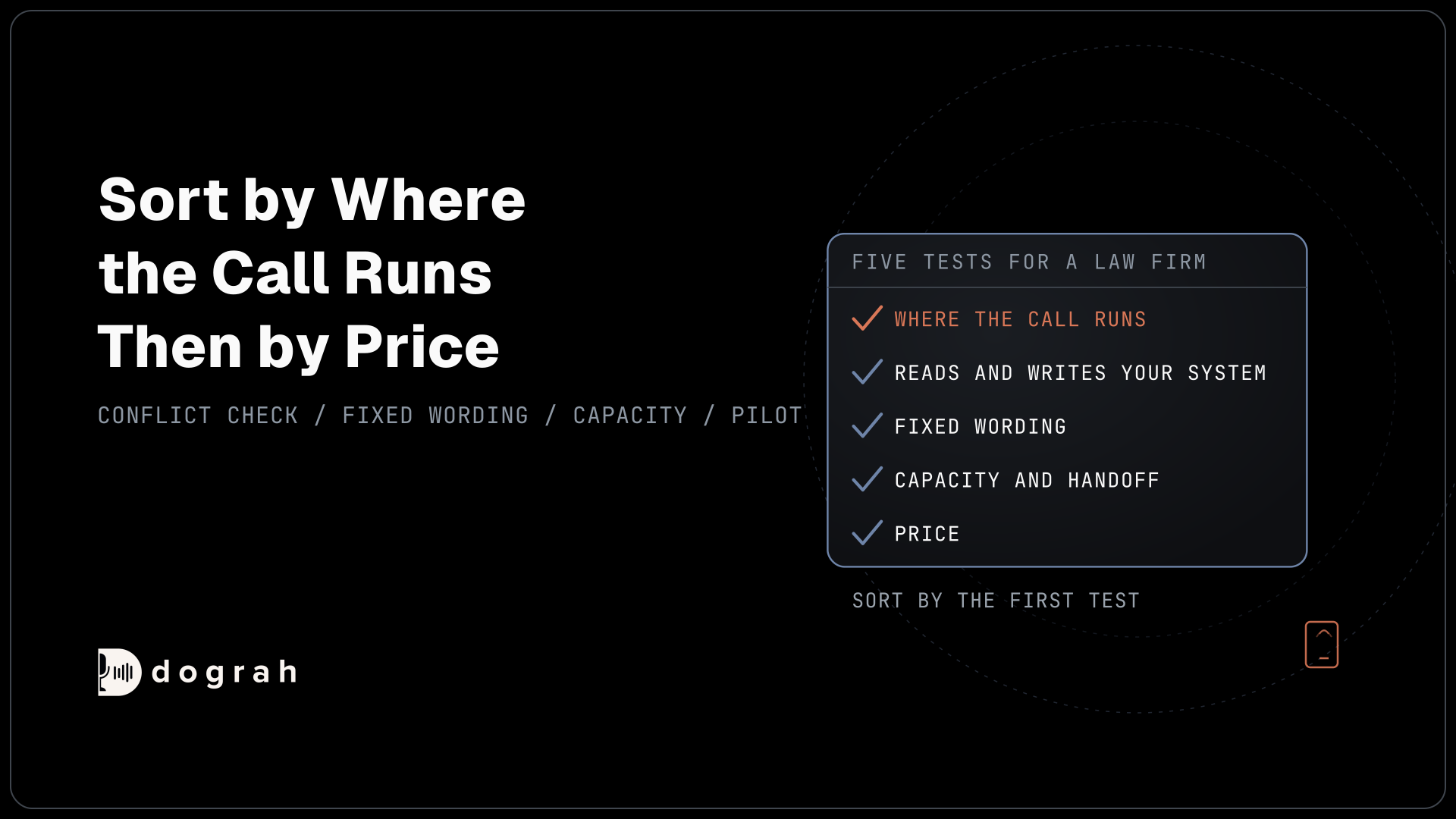
This post is part of our guide to AI voice agents for law firms. The guide's section "Choosing a platform and building the agent" says to sort every option by where the call audio and transcripts go before comparing price. Here are seven options, starting with Dograh and then grouped by the kind of purchase they are, judged on five tests that matter to a law firm.
The five tests a law firm should run
A law firm's voice agent is judged by who hears the caller's words and whether the call lands in the firm's own systems, so the tests start there. Voice quality is close enough across these products that it rarely decides the purchase.
The first test is where the call runs. Every company whose systems hear an intake call is one more party the firm has to trust with a prospective client's confidences. Ethics rules generally ask a lawyer to be reasonably confident in any provider that handles confidential information; Texas ethics Opinion 705, for example, allows sharing only if the lawyer is "reasonably confident that the confidential character of the information will be respected and protected by the service provider." Lawyers already weigh this: in the 8am 2026 Legal Industry Report, from more than 1,300 responses gathered in September and October 2025, 39% named privilege as an AI concern. This is general information, not legal advice; confirm your position with counsel.
The second is whether the agent can read and write the firm's practice management system during the call. A caller about a new matter is a prospective client from the first sentence, so the agent asks for names before facts, runs them through the firm's conflict check and stops asking about the case on a possible match. An agent that only takes a message for staff to retype adds a step and leaves case facts in one more place.
The third is whether the call flow can hold the lines that must not change. The agent never says any version of "you have a case", and a prompt instruction cannot guarantee that, because models avoid a banned phrase and still deliver its meaning. Wording holds only where the platform plays fixed text, so ask where fixed wording lives in each product. Before naming a matter, the agent checks something the firm approves, such as a date of birth plus a reference the firm gave the client, because a phone number does not prove who is holding the phone. Some states generally require every party's consent to record a call, so the greeting says the call is recorded. This is general information, not legal advice; confirm your position with counsel.
The fourth is capacity and handoff: how many calls run at once, what a caller hears when the limit is full, and how a call reaches a person. A TV campaign or a busy Monday morning can bring a burst of calls, so ask each vendor how many concurrent calls your plan includes and where the next caller goes once they are all in use.
The fifth is price: what a call or a minute costs at your volume, and what sits on top of it, such as models, phone minutes and add-ons.
How the seven options compare
The table starts with Dograh, then groups the rest by type and shows where each one's calls run and its list price.
| Platform | Type | Where calls and transcripts run | How it writes to your practice system | Price on its own site | Watch for |
|---|---|---|---|---|---|
| Dograh | Open source (BSD 2-Clause), self-hostable | Your own servers, with open-weight models there too; or Dograh Cloud; Enterprise adds on-premise or private cloud | HTTP API tools read and write your system's API during the call | Self-hosted: no per-minute platform fee. Dograh Cloud: 1¢/min platform fee | No prebuilt Clio connector; Transfer Call works on Twilio only |
| Smith.ai | AI receptionist service | Smith.ai's service, month-to-month | Native integrations, including Clio, from the Free plan | Pro from $150/month for 75 calls; $2.50 per extra call | Every answered call counts toward the quota |
| PolyAI | Managed voice vendor | PolyAI's platform; your own carrier connects over SIP at no charge | Built and run with PolyAI's team | Platform per minute through sales; API 2¢ per connected minute | The API plan excludes telephony and orchestration |
| Synthflow | Managed enterprise platform | Synthflow's platform, with EU and US hosting | Integrations scoped in the Enterprise contract | Enterprise contracts from $30,000 a year | Enterprise is the only plan listed |
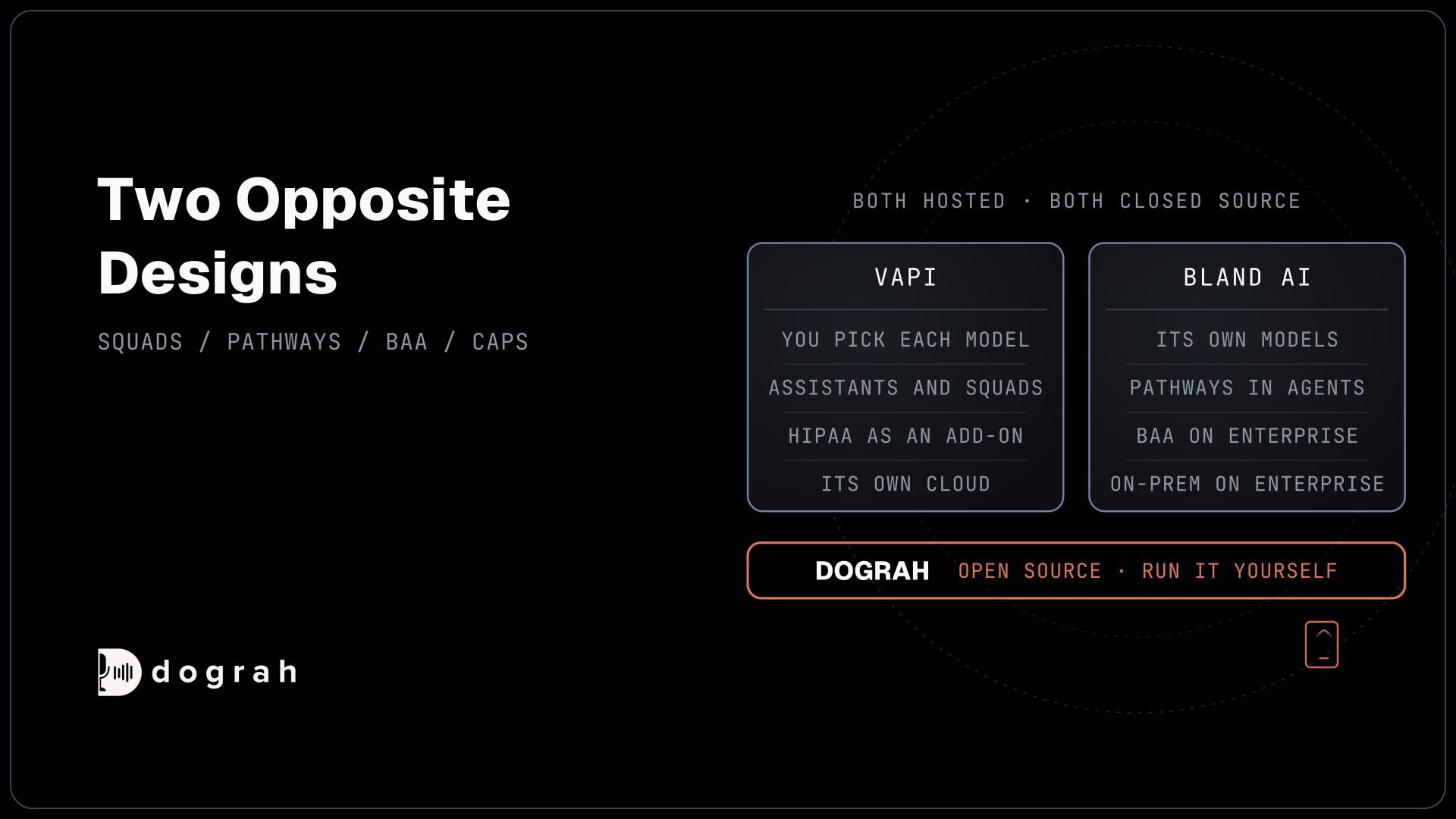
| Vapi | Developer platform | Vapi's managed platform; dedicated SIP on Premier | Tool calls to your system's API | $0.05/min hosting before models and phone; Core $29/month | HIPAA add-on, with a BAA, is $2,000/month |
| Retell AI | Developer platform | Retell's cloud; dedicated server add-on on Enterprise | Tool calls to your system's API | $0.07 to $0.31/min | 20 concurrent calls included, $8/month per extra |
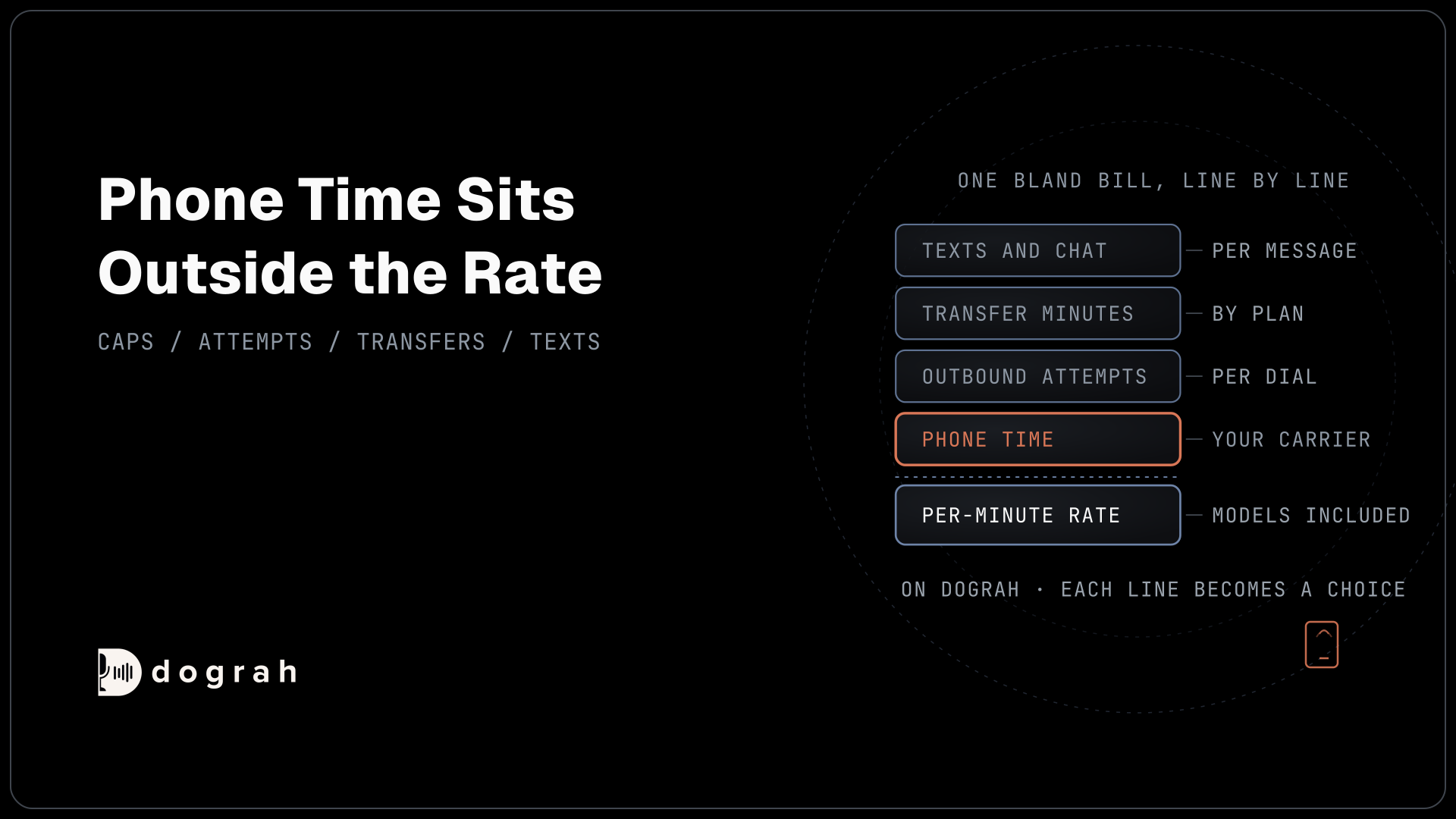
| Bland AI | Developer platform | Bland's platform; on-prem or VPC on Enterprise | Tool calls to your system's API | Start $0.14/min; Build $0.12/min plus $299/month | Transfers billed per transfer minute unless you bring your own telephony |
Dograh: run the platform and the models on the firm's servers
Against the five tests above, Dograh's case is straightforward. It can run on the firm's own servers with the speech and language models there too, reads and writes the firm's systems during the call through HTTP API tools, plays the lines that must not change as fixed text, states its concurrency limit and what happens when it is full, and publishes its price. None of that needs a sales contract.
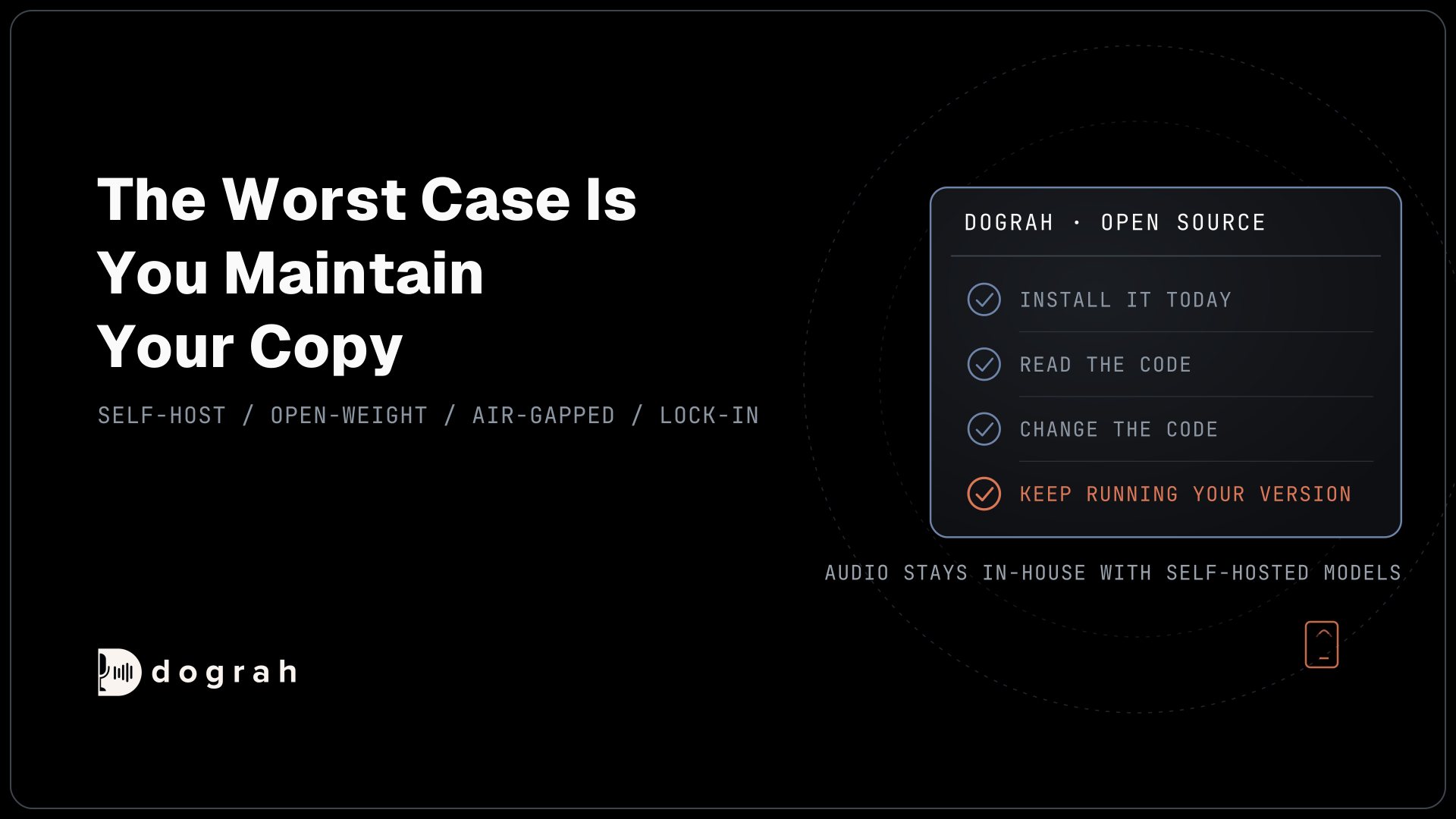
Dograh is the open-source option in this list, released under the BSD 2-Clause licence, and the self-hosted version is "Free forever" with the full platform, per Dograh's pricing page. It is the orchestration layer: it runs the call flow, tools and telephony, and the speech and language models are a separate layer you choose. That choice decides the privilege question. If you bring your own key (BYOK) for a hosted model, the contract is yours but the audio still reaches the provider. With self-hosted Dograh and open-weight models on the firm's servers, no outside AI provider hears the call. On-Prem Voice AI for Law Firms covers the servers and the phone path.
It works with the phone setup a firm already has. Dograh connects to Twilio, Vonage, Plivo, Telnyx and more. Dograh Managed SIP brings the firm's own SIP trunk or PBX to Dograh Cloud, and self-hosted, Asterisk ARI connects the agent to the firm's own Asterisk; Dograh does not sell numbers.
For intake, an HTTP API tool runs the firm's own conflict lookup and reads open consultation slots during the call. Pre-Call Data Fetch sends the caller's number to the firm's endpoint as the call connects, so a returning client's record is ready, though the caller is still verified before anything about a matter is said. The recording notice goes in the Greeting Text and the no-advice line in a pathway's Transition Speech, so both play word for word, and a Pre-Transfer Message plays fixed text before a call goes to a person. A Webhook node sends the intake record to the firm's system after the call, retrying a temporary failure automatically.
Capacity is set in plain terms. Self-hosted Dograh runs 10 concurrent calls by default, raised with DEFAULT_ORG_CONCURRENCY_LIMIT, and Dograh Cloud includes 10, with more by contacting Dograh. When the limit is full, Dograh rejects the next inbound call at once, with no queue, so set an overflow at the carrier to the front desk or voicemail.
On price, self-hosted Dograh has no per-minute platform fee (servers, model keys and phone minutes still cost), and Dograh Cloud has a 1¢-a-minute platform fee. The Enterprise plan adds on-premise or private-cloud deployment, "data residency & data perimeter", single sign-on and audit logs.
The limits come after that. Dograh has no prebuilt Clio or other practice management connector, so the firm's team points HTTP API tools at its system's API. Transfer Call works on Twilio only and passes no summary, so the agent writes the intake details to the firm's system before the transfer. There is no retention setting, so the firm's own policy decides when recordings and transcripts are deleted from its storage, and transcripts keep everything the caller said.

Open Source Alternative to Vapi / Retell
Self-hosted voice agent platform — no per-minute fees
dograh-hq/dograh
Star on GitHub
Smith.ai: an AI receptionist billed per answered call
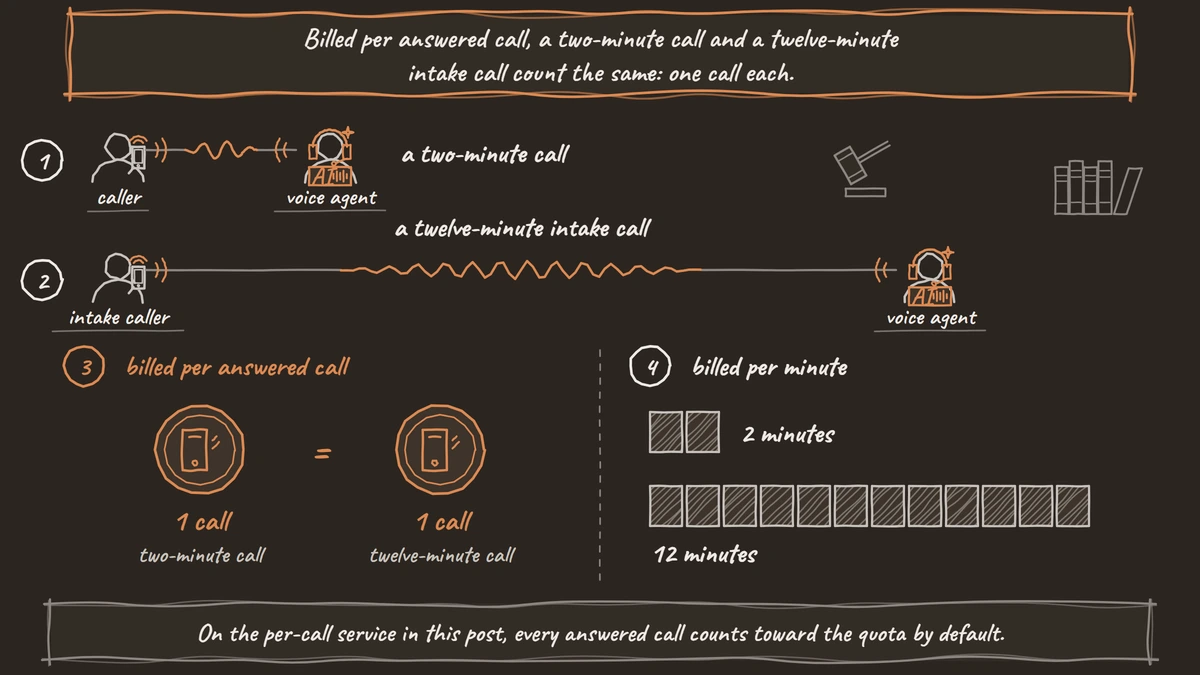
Smith.ai sells an answering service, not a platform, and it bills by the call. Its pricing page lists a Free plan with 25 calls and $3.00 per extra call, a Pro plan from $150 a month for 75 calls with $2.50 per extra call, and an Enterprise plan from $500 a month for 300 calls. It says: "Every call answered by your AI Receptionist counts toward your call quota by default."
The service is month-to-month, and native integrations, including Clio, come with the Free plan. A call the AI cannot handle can go to a live receptionist based in North America. Every call runs through Smith.ai's service, and per-call pricing treats a two-minute call and a twelve-minute intake call the same. Our wider comparison, Best AI Receptionist Software, covers answering services beyond law.
Managed vendors: PolyAI and Synthflow
A managed vendor suits a larger firm that wants the vendor's team to build and run the agent, with volume and price agreed in a contract.
PolyAI prices its platform per minute through its sales team. It offers "your numbers or ours", and says "your own carrier connects over SIP at no charge". It also sells an API at 2¢ per connected minute that gives model-only access for custom voice stacks; telephony and orchestration are not included on that plan. Its pricing page lists SOC 2 and ISO 27001 certified infrastructure.
Synthflow lists one plan, Enterprise, with contracts from $30,000 a year; final pricing depends on call volume, concurrency, telephony, integrations and security needs. It supports its own telephony, SIP trunking or approved enterprise telephony, and its pricing page shows EU and US hosting and MSA and DPA support.
Both run in the vendor's cloud, so the call audio and transcripts sit with the vendor. For privileged intake, that brings the firm back to the first test.
Developer platforms: Vapi, Retell AI and Bland AI
These three sell programmable phone agents to every industry, billed per minute, so a firm's developer builds the legal flow on top.
Vapi charges $0.05 a minute for hosting, with models and phone minutes on top, and lists Core at $29 a month and Pro from $999 a month. Core includes 10 concurrent calls and Pro 30, with extra lines at $10 a month each. Its HIPAA add-on costs $2,000 a month and includes a business associate agreement (BAA), and Premier lists dedicated SIP. The arithmetic is in Vapi Pricing Explained.
Retell AI lists $0.07 to $0.31 a minute for voice agents, with its voice infrastructure at $0.055 a minute. Every account includes 20 concurrent calls, with more at $8 a month each, and there is no charge for SIP trunking or custom telephony. Retell says HIPAA is available on pay-as-you-go, with a self-serve BAA requested from the dashboard. PII removal is $0.01 a minute extra, and Enterprise offers a dedicated server as an add-on. Retell AI Pricing Explained has the full breakdown.
Bland AI lists Start at $0.14 a minute with no platform fee and 10 concurrent calls, and Build at $0.12 a minute plus a $299 monthly platform fee with 50. Transfers cost $0.05 and $0.04 per transfer minute on those plans, and customers who bring their own telephony pay no transfer fees; Bland works with your existing Twilio account or SIP trunks from any provider. Enterprise is custom-priced and lists "On-prem / VPC available", with BAA, SSO and data residency.
Generally, a BAA is a HIPAA contract for health data. It is useful where a firm also handles medical records, as personal injury firms do, but privilege has no equivalent agreement, so a signed BAA does not settle the privilege question. This is general information, not legal advice; confirm your position with counsel.
Join the Dograh Community
Dograh is an OSS alternative to Vapi. Join our Slack community for queries, releases, best practices & community interactions.
Which one fits your firm
The right choice depends on which calls you hand over first and who will run the agent.
For privileged intake, start with Dograh self-hosted. With open-weight models on the firm's servers, no outside AI provider hears the call, and HTTP API tools run the conflict check against the firm's own system while the caller is on the line. It is the strongest fit for that call, because the firm keeps the platform, the models and the recordings without a sales contract. Bland's Enterprise on-prem offer is the closed route to a similar place. AI Voice Agents for Law Firm Intake sets out why that call is the hardest one to place with a vendor.
For consultation booking and reminders, which carry names and dates rather than case facts, a hosted option is easier to defend. Smith.ai suits a firm that wants a service with a Clio connection and no build. PolyAI and Synthflow suit a larger firm that wants a vendor's team to run it under contract. Vapi, Retell AI and Bland AI suit a firm with a developer who wants per-minute pricing. Outbound reminder calls with an AI voice generally need the called party's prior express consent under the Telephone Consumer Protection Act (TCPA), which the engagement letter can ask for; confirm your position with counsel.
Dograh covers both kinds of call on one platform. It is open source, runs on the firm's own servers and phone setup, writes to the firm's systems during the call, plays fixed wording where it matters and publishes its price. To try it, self-host Dograh from GitHub with Docker Compose, or start on Dograh Cloud at a 1¢-a-minute platform fee and move intake in-house later. Either way, run the pilot on a test number with the firm's real conflict check before any client hears it.
Glossary
- Business associate agreement (BAA)
- A HIPAA contract that delegates health-data obligations to a vendor. Useful for firms that handle medical records, but privilege has no equivalent agreement.
- Bring your own key (BYOK)
- Using your own account with a model provider through a voice platform. The contract is yours, but the call audio still reaches that provider.
- Platform fee
- The per-minute charge for running the agent itself, before speech models, language model and phone minutes. Self-hosted Dograh has none.
- Per-call pricing
- Billing by each answered call regardless of length, as Smith.ai's AI receptionist does. Short and long calls cost the same.