
The best AI receptionist software depends on whether you want to rent a receptionist or own one. With one location and no technical staff, a ready-made product or Dograh Cloud's visual builder is the fastest start. Teams that want to own the agent can self-host open-source Dograh for free. With local open-weight models, no AI vendor receives the call audio.
Key Takeaways
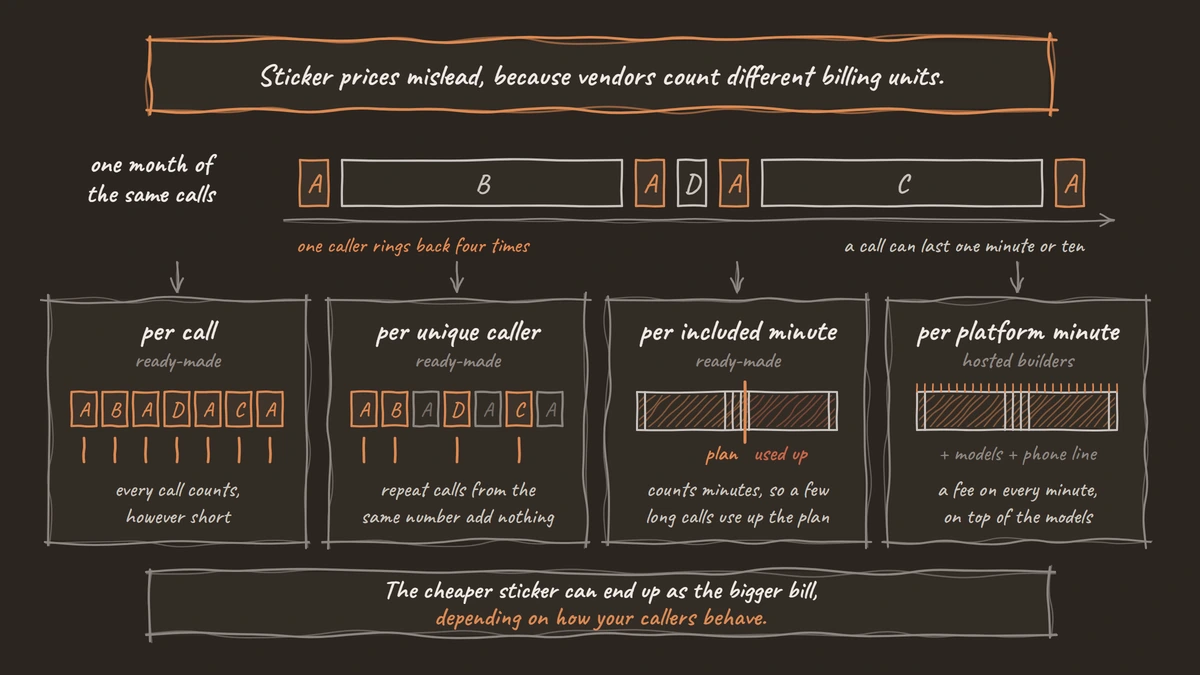
- Sticker prices mislead, because vendors count different billing units.
- On hosted platforms, a HIPAA business associate agreement (BAA) usually sits on a paid or top tier.
- Self-hosted Dograh with local models keeps AI vendors out of your call data, though your phone carrier still carries the call.
Which type fits you
| If you… | Pick |
|---|---|
| Run one location, with nobody technical | A ready-made product (Smith.ai, Rosie, Goodcall…) |
| Want to design your own call flow, without running servers | A hosted builder: Dograh Cloud, Vapi, Retell |
| Need call data to stay on your own servers, or want no per-minute platform fee | Self-hosted Dograh with open-weight models |
| Have engineers who want to write the agent in code | Pipecat or LiveKit Agents |
This post is part of our guide to AI receptionists. The guide explains what an AI receptionist does and what it costs to run, and this post narrows that to one decision: which software to pick. We build Dograh. To keep the comparison fair, every product is checked against the same columns, using each vendor's own pricing page.
How we compared the tools
We compared list prices and plan details from each vendor's own pricing page.
We did not run test calls on other vendors' products, so nothing here is a review score. Each price is the list price on the vendor's page, in the vendor's own unit. We did not convert prices into one per-minute rate, because the units do not convert cleanly. A call can last one minute or ten, and one caller can ring back four times in a month.
The table adds two columns that matter once real customer data is on the line. One says whether you can run the software on your own servers. The other says on which plan a business associate agreement (BAA) appears. A BAA is the contract the Health Insurance Portability and Accountability Act (HIPAA) requires before a vendor handles patient information for a healthcare provider.
Where a pricing page says nothing, the table says "not stated". That tells you only that the page is silent on it.
AI receptionist software compared side by side
Every product named in this post is in this table, with the same columns, so you can compare like with like.
| Product | Group | List price | Billing unit | Self-host | Licence | HIPAA BAA |
|---|---|---|---|---|---|---|
| Dograh (open source) | Build your own | Free, no per-minute platform fee | None (you pay model and phone providers) | Yes | BSD-2-Clause | None published; self-host to keep vendors out of the data path |
| Dograh Cloud | Build your own | 1¢/min platform fee | Per platform minute | Managed; on-prem on Enterprise | Hosted service | None published |
| Vapi | Build your own | $0.05/min hosting, models and phone extra | Per platform minute | No | Proprietary | $2,000/month add-on |
| Retell AI | Build your own | $0.055/min voice infrastructure, plus models and phone | Per minute | No | Proprietary | Enterprise ("Custom BAA") |
| Bland | Build your own | $0.14/min on Start, models included | Per minute | Enterprise only (on-prem or VPC) | Proprietary | Enterprise only |
| Synthflow | Build your own | Enterprise contracts from $30,000 a year | Annual contract | No | Proprietary | Not stated |
| Pipecat + Pipecat Cloud | Open-source framework | Framework free; Cloud $0.01/min active agent (agent-1x), phone $0.018/min extra | Per agent minute | Yes | BSD-2-Clause | Not stated |
| LiveKit Agents + LiveKit Cloud | Open-source framework | Framework free; Cloud $50/mo for 5,000 agent session minutes, then $0.01/min | Monthly plus per minute | Yes | Apache-2.0 | Scale ($500/mo) and Enterprise |
| Smith.ai AI Receptionist | Ready-made | $150/mo for 75 calls ($2.00 a call) on Pro | Per call | No | Proprietary | Not stated |
| Goodcall | Ready-made | $79/mo per agent for 100 unique callers, then $0.50 each | Per unique caller | No | Proprietary | Not stated |
| Rosie | Ready-made | $49/mo for 250 minutes | Per included minute | No | Proprietary | Not stated |
| Dialzara | Ready-made | $29/mo for 60 minutes, then $0.48/min | Per included minute | No | Proprietary | Not stated |
| Upfirst | Ready-made | $24.95/mo for 30 calls, then $1.50 a call | Per call | No | Proprietary | Custom plan |
| Frontdesk (formerly My AI Front Desk) | Ready-made | $99/mo for 200 voice minutes | Per included minute, plus credits | No | Proprietary | Not stated |
| Reception (ElevenLabs) | Ready-made | $29/mo for 75 credits (1 credit = 1 phone minute) | Per included minute | No | Proprietary | "does not currently support HIPAA compliance" |
| Ruby (human reference) | Human service | $720/mo for 200 minutes | Per included minute | No | Not software | "HIPAA-compliant services available" |
| Smith.ai live receptionists (human reference) | Human service | $300/mo for 30 calls, then $11.50 a call | Per call | No | Not software | Not stated |
Prices are as listed on each vendor's site. Every build-your-own price leaves out the speech and language models and the phone line, except Bland's, which includes the models.
Read the billing unit column before the price column. Goodcall's $79 counts distinct callers, however long they talk. Dialzara's $29 counts minutes, so a few long calls use up the plan. The cheaper sticker can end up as the bigger bill, depending on how your callers behave.
Ready-made AI receptionists suit a single location
If you run one location and nobody on staff is technical, a ready-made product is the quickest start.
Setup means filling in a form about your business and forwarding your phone number. There are no servers to run and no call flows to design. Building your own only starts to pay off when your calls or your data need control that a rented product cannot give. All prices below are list prices.
Smith.ai's AI Receptionist can hand calls to its North America-based human receptionists, which suits businesses that want a person as backup.
Goodcall charges per unique caller with unlimited minutes, so it suits businesses with long calls.
Rosie texts callers a booking link on its entry plan. Calendar booking and live transfer need its higher Scale plan.
Dialzara has a low-priced entry plan in English and Spanish, but minutes run out fast on long calls.
Upfirst charges per call and offers BAAs only on its Custom plan.
Frontdesk, formerly My AI Front Desk, bundles chat, text messages and a CRM with the phone agent.
Reception, from ElevenLabs: its product page says it "does not currently support HIPAA compliance", so it is not for patient calls.
For scale, human answering costs more per minute. Ruby charges $720 a month for 200 minutes of human receptionists, and Smith.ai's live human receptionists start at $300 a month for 30 calls, then $11.50 a call. An in-house receptionist earned a median $38,010 a year in May 2025, according to the Bureau of Labor Statistics.
Build-your-own platforms, and where Dograh fits
Build-your-own tools hand you the agent itself, and you take on setting it up and running it.
Dograh: own the agent and run it yourself
Dograh is an open-source, self-hostable voice agent platform under the BSD-2-Clause licence. You draw the call as steps and pathways in a visual builder and attach a knowledge base with your FAQ documents. HTTP API tools and MCP (Model Context Protocol) let it look things up or write to your systems mid-call. Call transfer to a person works on Twilio, Telnyx, Plivo, Cloudonix and Asterisk ARI.
Dograh is the orchestration layer, and you choose the models. It supports its own models and supported providers through your own key. It also runs open-weight models on your own servers, and only that option keeps call audio inside your infrastructure. Bringing your own key moves the contract to you, but the audio still reaches that provider. Your phone carrier carries the audio in every setup.
You can self-host it or use the managed cloud. The open-source platform has no per-minute platform fee, so self-hosted costs are your servers plus the providers you choose. Mixing pre-recorded audio with text-to-speech (TTS) lowers the voice part of that bill.
Two honest gaps. Dograh has no built-in calendar connector, so booking goes through an HTTP API tool to your scheduling system, as in our post on booking meetings mid-call with Calendly. Calendly's booking API needs a paid plan and caps hosts below Enterprise at 100 bookings a day. Dograh also publishes no BAA. For a step-by-step build, see How to Build an AI Receptionist.
Hosted platforms you build on
Vapi, Retell AI, Bland and Synthflow let you build the agent while they run it on their servers.
Vapi charges $0.05 a minute for hosting, with models and phone billed on top, and sells HIPAA as a $2,000-a-month add-on. Retell AI charges $0.055 a minute for voice infrastructure, plus models and phone, with a BAA on Enterprise. Bland charges $0.14 a minute on Start with models included, and keeps its BAA and on-prem or VPC (virtual private cloud) option for Enterprise. Synthflow lists enterprise contracts from $30,000 a year and no self-serve price. Outside Bland's Enterprise on-prem option, the agent lives on the vendor's servers, so leaving means rebuilding it somewhere else. Teams looking for a Vapi alternative for an AI receptionist that they can run themselves are the gap Dograh fills.
Open-source frameworks you write code on
Pipecat (BSD-2-Clause) and LiveKit Agents (Apache-2.0) are code frameworks. They give you the real-time voice pipeline in Python, and the receptionist itself is yours to write.
Both are free to self-host, and both sell hosting. Pipecat Cloud charges $0.01 per active agent minute on agent-1x, plus $0.018 a minute for phone calls. LiveKit Cloud charges $50 a month for 5,000 agent session minutes on Ship, then $0.01 a minute, and offers a signed BAA from its $500-a-month Scale plan. Dograh is built on a fork of Pipecat, and adds a visual builder and the phone plumbing on top.

Open Source Alternative to Vapi / Retell
Self-hosted voice agent platform — no per-minute fees
dograh-hq/dograh
Star on GitHub
When owning the agent is worth it
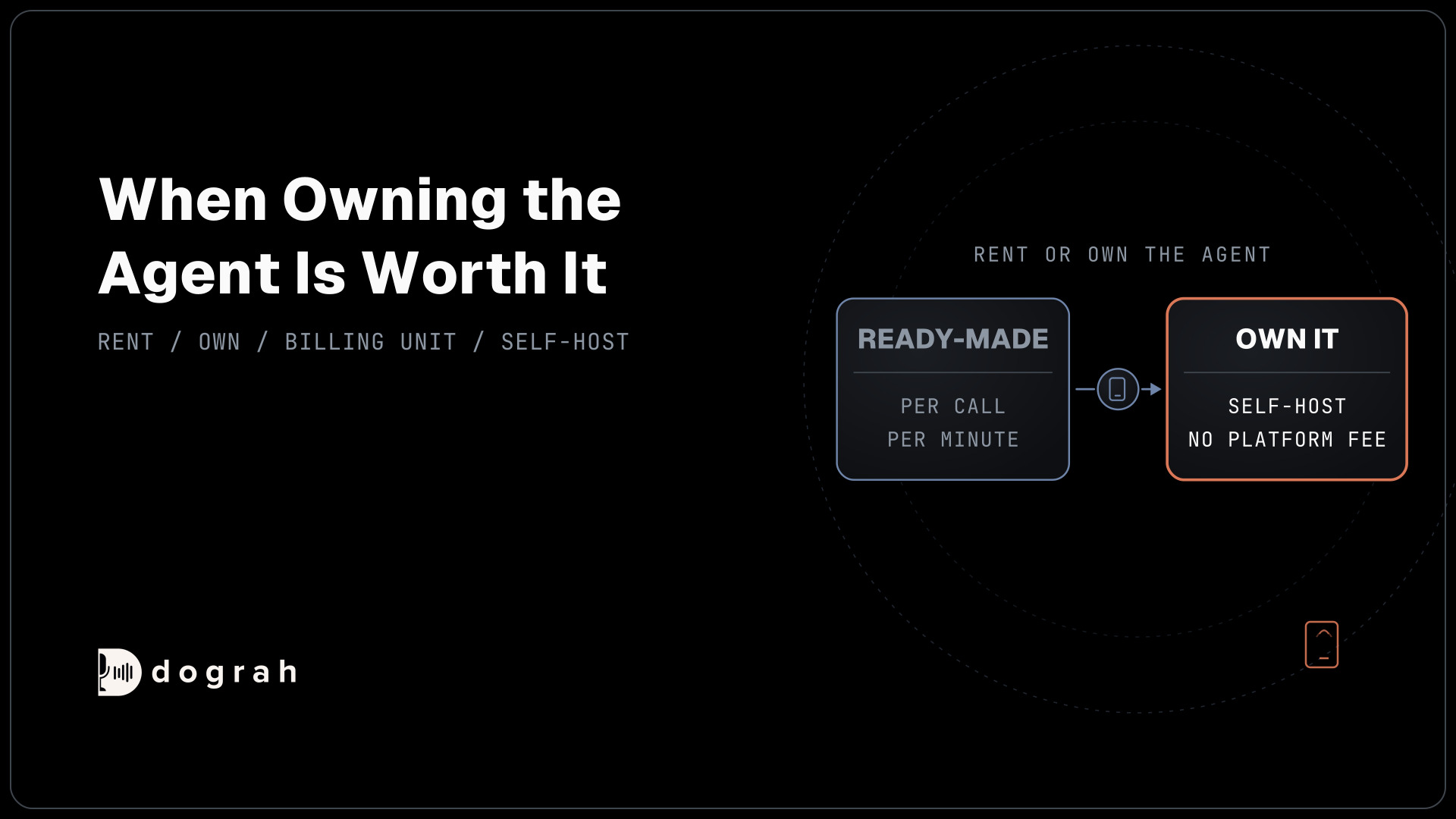
Owning the agent makes sense when you want control over the call flow, the costs and where call data goes.
Start with cost. Ready-made bills grow with every call or caller. Hosted platforms add a platform fee to every minute on top of the models. Dograh Cloud charges the per-minute platform fee in the table, with 10 concurrent calls included and credits from $5. Self-hosted, the platform fee line is gone, and the rest of the bill is your own servers plus the providers you pick.
Then the data path. HIPAA allows a hosted vendor under a BAA, so self-hosting is a choice the law leaves to you. A BAA delegates obligations to the vendor, but it does not move your own liability. The BAA also tends to cost extra: Vapi's $2,000-a-month add-on, Enterprise plans at Retell AI and Bland, LiveKit's Scale plan and the Custom plan at Upfirst. Self-hosted Dograh with local open-weight models takes the vendor out of the data path, though your phone carrier still carries the call. Our post on why voice data needs to stay local covers what a recording reveals about a caller.
Building pays off in a few cases. One is call data that must not reach a third party. Another is when the voice agent is part of the product you sell, or you run many locations from one setup. If none of those apply to you, rent a ready-made product and revisit the choice when your call volume grows.
Join the Dograh Community
Dograh is an OSS alternative to Vapi. Join our Slack community for queries, releases, best practices & community interactions.
What to test in your free trial
Run the same short script on every product you try, over a real phone call, before you compare prices.
Make the route to a person short. In a survey by AnswerConnect, which sells human answering, 85% of 6,000 consumers in the US, UK and Canada said they would rather speak to a real person, and 31% said they would hang up if connected to an AI agent, in its April 2026 survey wave. That is a reason to test the transfer first.
| Test | What to do | Pass rule |
|---|---|---|
| Greeting | Call and listen to the first sentence | It names the business and says what it can help with |
| Interruption | Talk over the agent mid-sentence | It stops and answers the new question |
| After-hours call | Call outside opening hours | It gives the right hours and takes a message or books |
| Wrong department | Ask for something the business does not do | It says so and takes a message or transfers |
| Reschedule | Move an existing booking | The booking moves in your real calendar, with no duplicate |
| Transfer to a person | Ask for a human on a real phone call | Someone answers, or the agent comes back with a set fallback |
| Your monthly bill | Price last month's calls in the vendor's unit | You know the number before you sign |
Exact wording only holds where the platform speaks fixed text. In Dograh, that is the greeting, a pathway's transition speech or a pre-recorded clip. Inside a step the AI generates the words, so put any line that must be said exactly, such as the business name, in the greeting.
Test the transfer over a real phone call, because browser web calls cannot transfer a caller to a phone number. In Dograh, call transfer waits 30 seconds by default, adjustable from 5 to 120. If nobody answers in time, the transfer fails and the caller comes back to the agent. You choose what happens next. The agent can resume the conversation to take a message, page someone or promise a callback. It can also end the call, or play a voicemail screening message.
If you run one location, pick the ready-made product whose billing unit matches how your callers behave. If you want to own the agent, start with the open-source repository and the build guide linked above.
Glossary
- Billing unit
- The thing a vendor counts to charge you: a call, a unique caller, an included minute or a platform minute. Two plans with the same monthly price can cost very different amounts at your call volume if they count different units.
- Platform fee
- The per-minute charge a voice platform makes for running the agent, separate from the speech and language models and the phone line. Self-hosted Dograh has none, while hosted platforms charge one on every minute.
- Business associate agreement (BAA)
- The HIPAA contract a vendor signs before handling patient information for a healthcare provider. It delegates obligations to the vendor, but the provider keeps its own liability.
- BYOK (bring your own key)
- Using your own account with a model provider inside a voice platform. It moves the contract to you, but the call audio still reaches that provider, so it is not the same as keeping data in-house.