
Open-source Kore.ai alternatives are divided into a full platform you run and frameworks you build on. For teams that want to own the whole platform, Dograh is the open-source option that runs on their own servers, with phone lines, transfers and QA already built. LiveKit Agents and Pipecat are the frameworks your developers build a product on.
Key Takeaways
- Kore.ai already offers on-prem, so the real difference is whose code runs there.
- Self-hosted Dograh keeps recordings and transcripts in your own database and storage.
- A Kore.ai project export opens only in Kore.ai, so moving means a rebuild.
Kore.ai sells SaaS, a dedicated VPC and on-prem, and each one runs its closed code. For teams that want code they can read, we compare the open options and show where call data sits, then talk about rebuilding a Kore.ai voice agent in Dograh and what self-hosting takes.
Open-source Kore.ai alternatives in one table
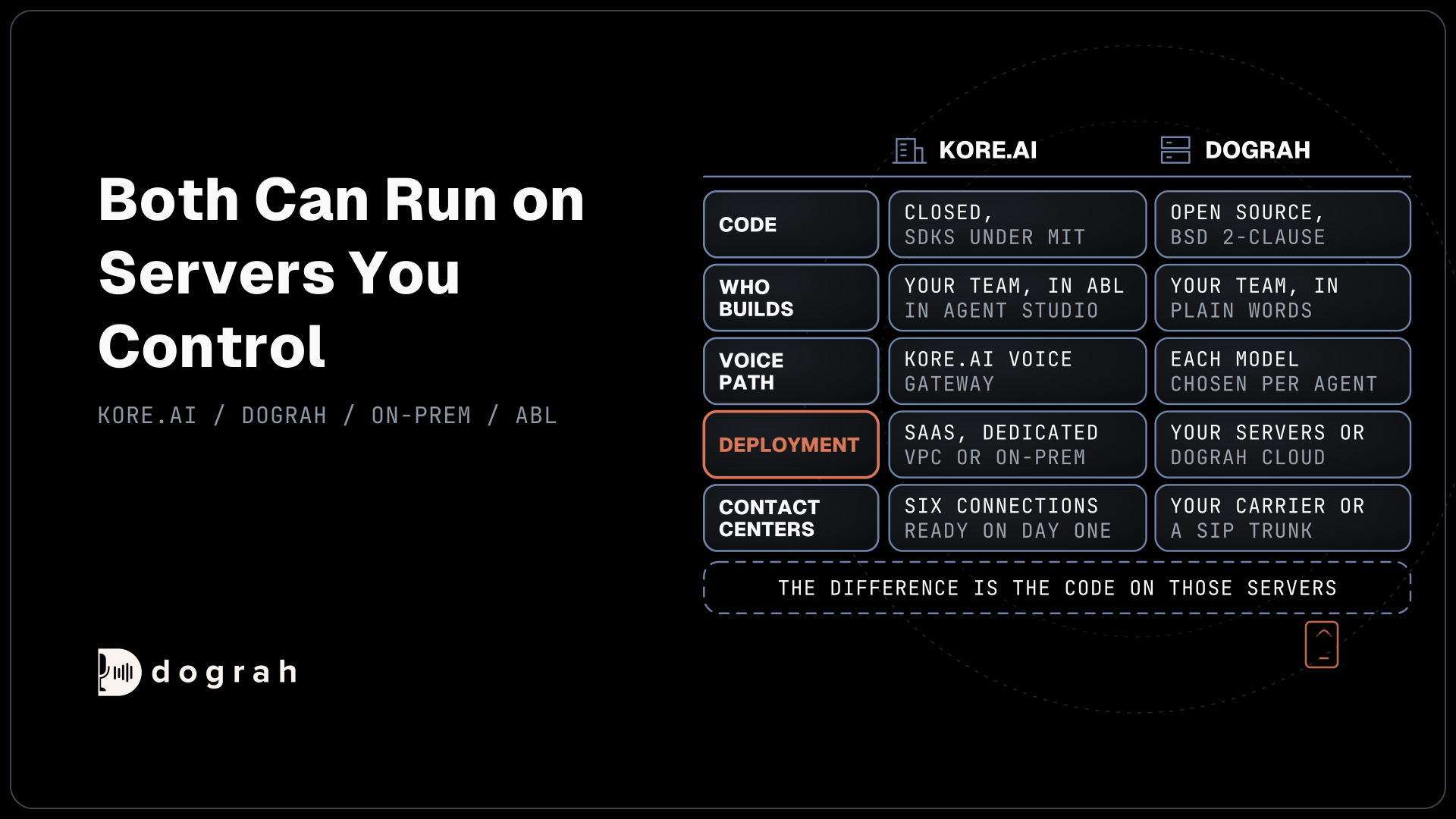
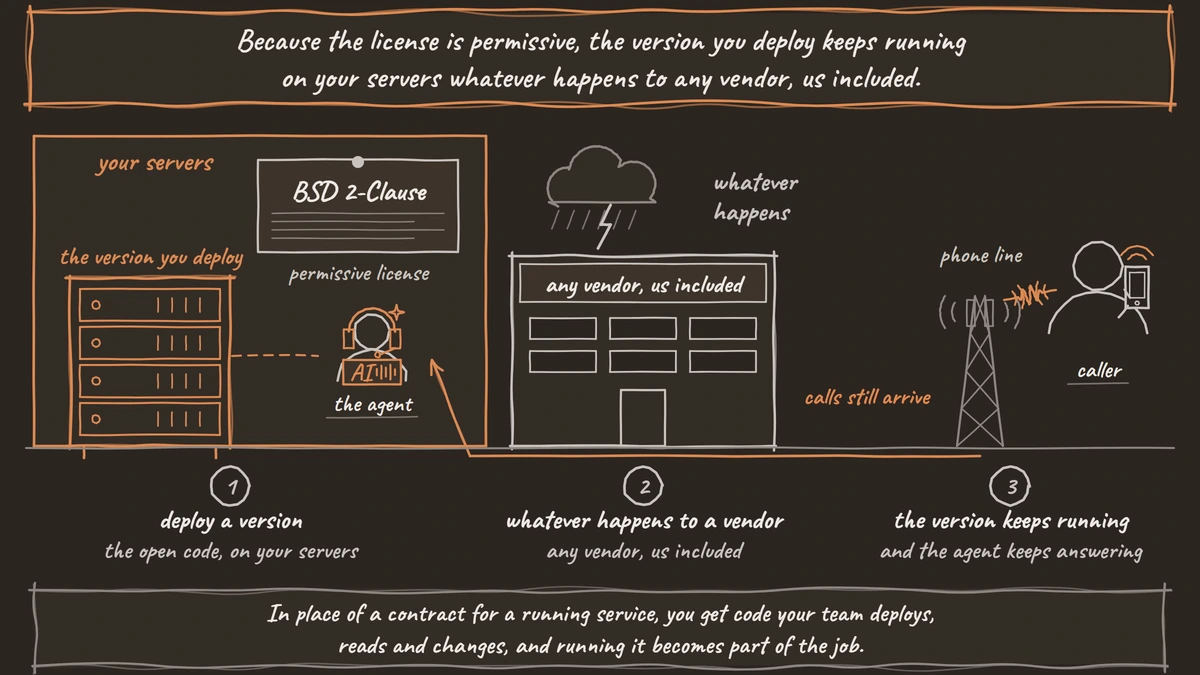
Moving to open source changes what you buy. In place of a contract for a running service, you get code your team deploys, reads and changes, and running it becomes part of the job. Kore.ai already offers multi-tenant SaaS, a dedicated single-tenant VPC and on-premises deployment, so the rows below look at whose code runs on the servers as well as where they sit.
| Option | License | Where calls run | What you pay | Ready on day one | Call data |
|---|---|---|---|---|---|
| Kore.ai (baseline) | Closed. SDKs and tools under MIT | Multi-tenant SaaS, a dedicated VPC or on-prem | By quote, modules metered per session on a 12-month contract | Yes, a full suite | Where you deploy it. Projects export as a Kore.ai archive, messages and recordings by API |
| Dograh | BSD 2-Clause | Your own servers, on-prem on Enterprise, or Dograh Cloud | Self-hosted, no per-minute platform fee. Dograh Cloud, 1¢/min platform fee. Models and phone at their own rates | Yes, with the builder, transfers, Campaigns, QA and traces | In your own Postgres and storage when self-hosted |
| LiveKit Agents | Apache-2.0, turn detector under the LiveKit Model License | Your own servers, or LiveKit Cloud | Free to self-host | No, your team builds the product | Wherever your team sends it |
| Pipecat | BSD-2-Clause | Your own servers, or Pipecat Cloud | Free to self-host | No, your team builds the product | Wherever your team sends it |
| Rasa | Licensed platform. Rasa Open Source, Apache-2.0, is in maintenance mode | Self-managed, or Rasa's managed service | Free Developer Edition with limits. Enterprise by quote | Chat-led, with a voice connector bought separately | On your servers when self-managed |
Kore.ai's open pieces are client SDKs, a bot kit and test tools on GitHub under MIT, and none of them runs a call. Of the open rows, only one arrives ready to answer a phone line. The frameworks need a product built on top before a caller hears anything.
Dograh: open code and a platform you own
Dograh is open source under BSD 2-Clause, and its GitHub repository holds the whole platform, from the agent builder to the phone connections. A single Docker Compose file brings up the API, the UI, Postgres for runs and transcripts, MinIO for recordings and the supporting services, and a Helm chart covers Kubernetes. Because the license is permissive, the version you deploy keeps running on your servers whatever happens to any vendor, us included.
Agents are described in plain words, with no vendor language to learn. On the "Create an agent" page of the Agent Builder you describe the call, check the "Your agent requirements" card and choose "Approve & build", then edit on the canvas whenever you want a hand change. A self-hosted install runs the builder with a Dograh Service Key, and the canvas works without one. The Dograh MCP server lets an AI assistant create and edit agents, which suits teams used to building Kore.ai agents from coding tools.
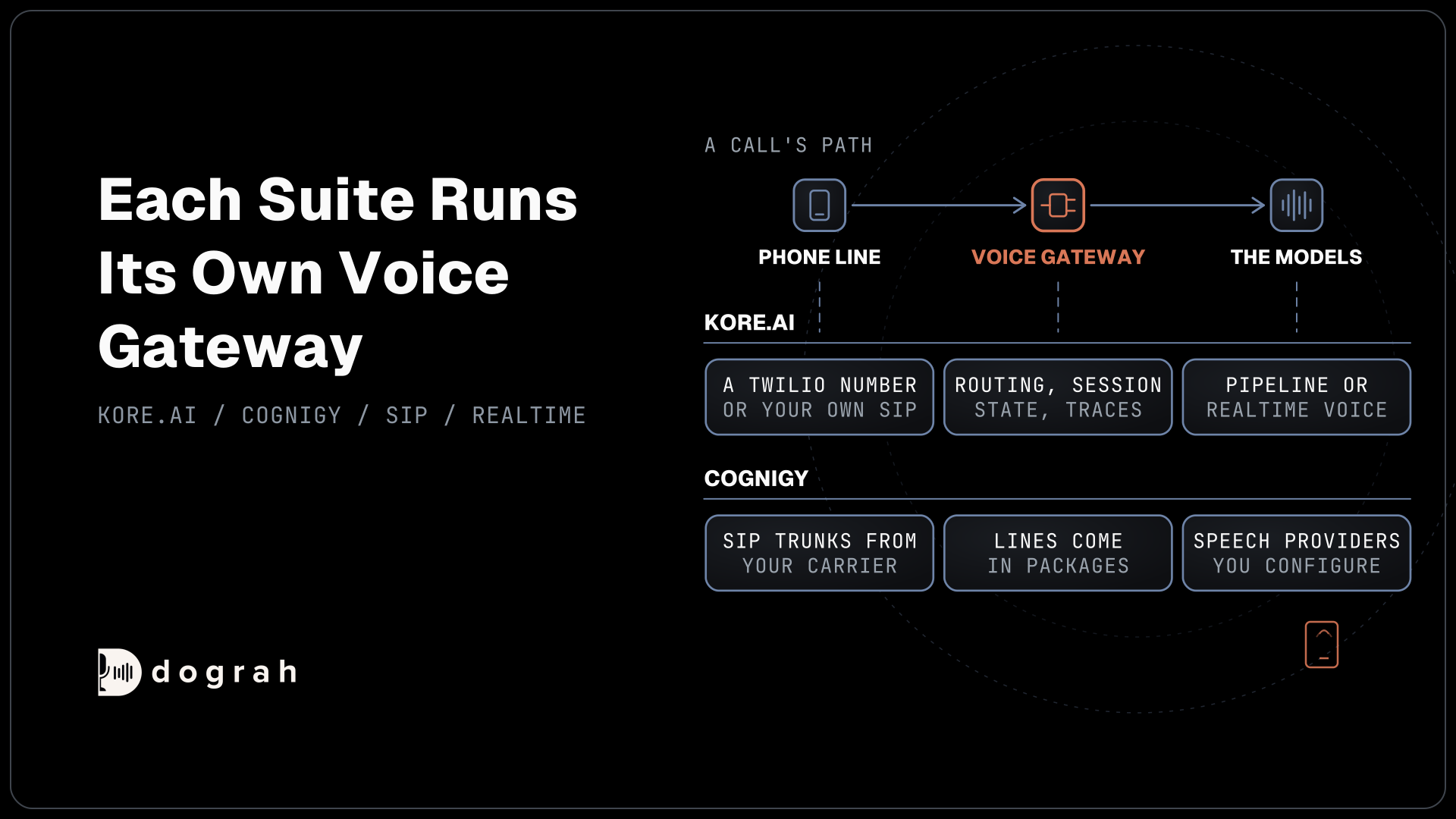
As the orchestration layer, the platform runs the call flow, tools and telephony, and you choose the speech-to-text, LLM and voice for each agent. That can be Dograh's own models, your provider keys or open-weight models on your own machines, and the built-in speech-to-speech options are OpenAI Realtime, Gemini Live, AWS Nova Sonic, Grok, Ultravox and Azure Realtime. Calls arrive over Twilio, Telnyx, Plivo, Vonage, Exotel, Vobiz, Cloudonix or Asterisk ARI, and because the code is open, a team can add its own carrier as a custom telephony provider package.
Where it runs sets both the bill and the workload. Self-hosted Dograh has no per-minute platform fee, though servers, model keys and phone minutes still cost money. A self-hosted install needs a server with at least 8 GB of RAM and 4 vCPUs and runs 10 calls at once by default, a limit you can raise, and the server, the database and the upgrades become your team's job. Support comes through the open-source community, with custom SLAs on Enterprise, and the Enterprise plan adds on-prem and private-cloud deployment with data residency. Dograh Cloud handles the hosting for a 1¢-a-minute platform fee and includes 10 concurrent calls, with more on request.

Open Source Alternative to Vapi / Retell
Self-hosted voice agent platform — no per-minute fees
dograh-hq/dograh
Star on GitHub
Where call data lives in each setup
Kore.ai's three deployment models already answer part of the residency question. Rasa's comparison of Rasa and Kore.ai makes that point fairly, while warning that on-prem leaves security patches, scaling and high availability to your own operations team. What changes between the setups is who can read the code and where the audio goes.
On Kore.ai's multi-tenant SaaS, conversations sit in Kore.ai's shared cloud. A dedicated VPC or an on-prem install keeps them in space reserved for you, but the runtime is still Kore.ai's closed code under its license. In every Kore.ai setup the audio also reaches the speech providers your admins configure, and in realtime mode with parallel transcription it goes to a speech-to-text provider and a speech-to-speech provider at the same time.
Self-hosted Dograh on your own provider keys keeps the platform, recordings and transcripts on your servers, while the audio still travels to each model provider. Bring your own key (BYOK) moves the contract to you, and the audio still leaves. With open-weight models running on your own machines as well, the audio stays inside your network for the whole call, and recordings stay until your team deletes them.
Getting results out belongs to the same picture. Completed calls download as a CSV report, each agent saves as a JSON file that another install loads through Upload Agent Definition, and the run details API returns each call's results to your own systems.
Rebuilding a Kore.ai voice agent in Dograh
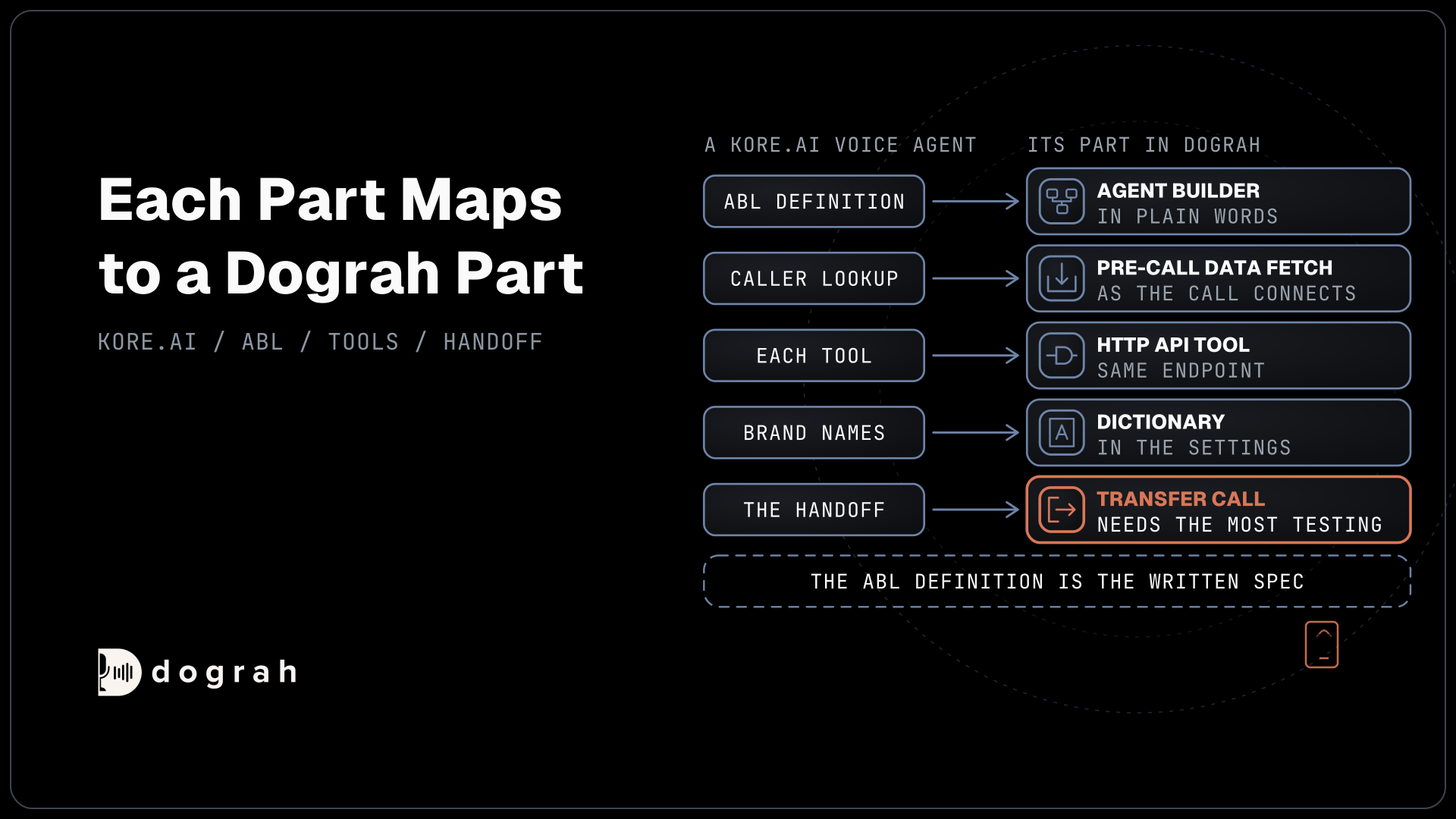
A Kore.ai voice agent usually looks a caller up, answers or acts through tools, and hands off to a person when it needs to. Each of those parts maps to a Dograh part, and the Agent Blueprint Language (ABL) definition you export is the written spec for the rebuild.
Start with the agent itself. Take its purpose, rules and outcomes from the ABL definition, describe them in plain words in the Agent Builder, answer its questions and approve the requirements card. "Test agent" saves the result and publishes version 1, and later changes made in the Builder tab save as a draft until you publish them.
The lookup moves to Pre-Call Data Fetch, which sends the caller and called numbers to your CRM once the call connects, so the greeting can use the record. Each tool the Kore.ai agent called becomes an HTTP API tool pointed at the same endpoint, and brand names or product terms go into the Dictionary in the agent's Settings.
The handoff needs the most testing. Transfer Call works on Twilio, Telnyx, Plivo, Cloudonix and Asterisk ARI, where Dograh calls the destination first and connects the caller only when someone answers. A busy, unanswered or failed attempt comes back to the agent and the call continues, and on Twilio a short spoken introduction to both people can play first, close to Kore.ai's pre-transfer announcement. On Exotel, Vobiz or Vonage numbers, the agent books a callback request through an HTTP API tool when the caller needs a person. The QA step then scores each step of test and live calls, so the rebuilt agent can be checked against the old one.
LiveKit Agents and Pipecat for teams that build
Developers who want to own every layer can start from a framework instead. LiveKit Agents is Apache-2.0, with its turn detector under a separate LiveKit Model License, and Pipecat is the BSD-2-Clause Python framework Dograh is built on. Both are actively maintained, and both leave the phone setup, the builder, call history and QA to your team. Our comparison of open-source voice AI frameworks covers what each one asks of you.
Rasa: a licensed platform with open-source roots
Rasa often comes up as the open answer to Kore.ai, and it needs a careful label. Rasa Open Source is Apache-2.0, but its README says the project is in maintenance mode, and the product Rasa sells today is a licensed platform. The free Developer Edition covers one bot with up to 1,000 external conversations a month, Enterprise is quoted, and voice comes through an AudioCodes IVR connector sold as an additional purchase. It suits a chat-led team that wants a self-managed platform under a commercial license.
Join the Dograh Community
Dograh is an OSS alternative to Vapi. Join our Slack community for queries, releases, best practices & community interactions.
When staying on Kore.ai makes sense
Kore.ai does a lot that an open voice platform leaves to other tools. If your teams use AI for Work for HR and IT requests, or its process automation for jobs such as accounts payable, replacing only the voice agent leaves you with two vendors. Its contact center list runs from NICE CXone, Five9, Genesys and Talkdesk to Amazon Connect and Microsoft Dynamics 365, so a team already wired into one of those keeps its routing.
On-prem under one commercial contract also matters to some regulated buyers, who want a vendor answerable for the install as well as the software. If that is your situation, our Kore.ai review covers who it fits.
What moving off Kore.ai takes
Plan the move as a rebuild in stages. Kore.ai's project import and export API produces a portable project archive with a manifest and a lockfile, and that archive imports into another Kore.ai project. Keep it, with the ABL agents inside, as the spec for each Dograh agent.
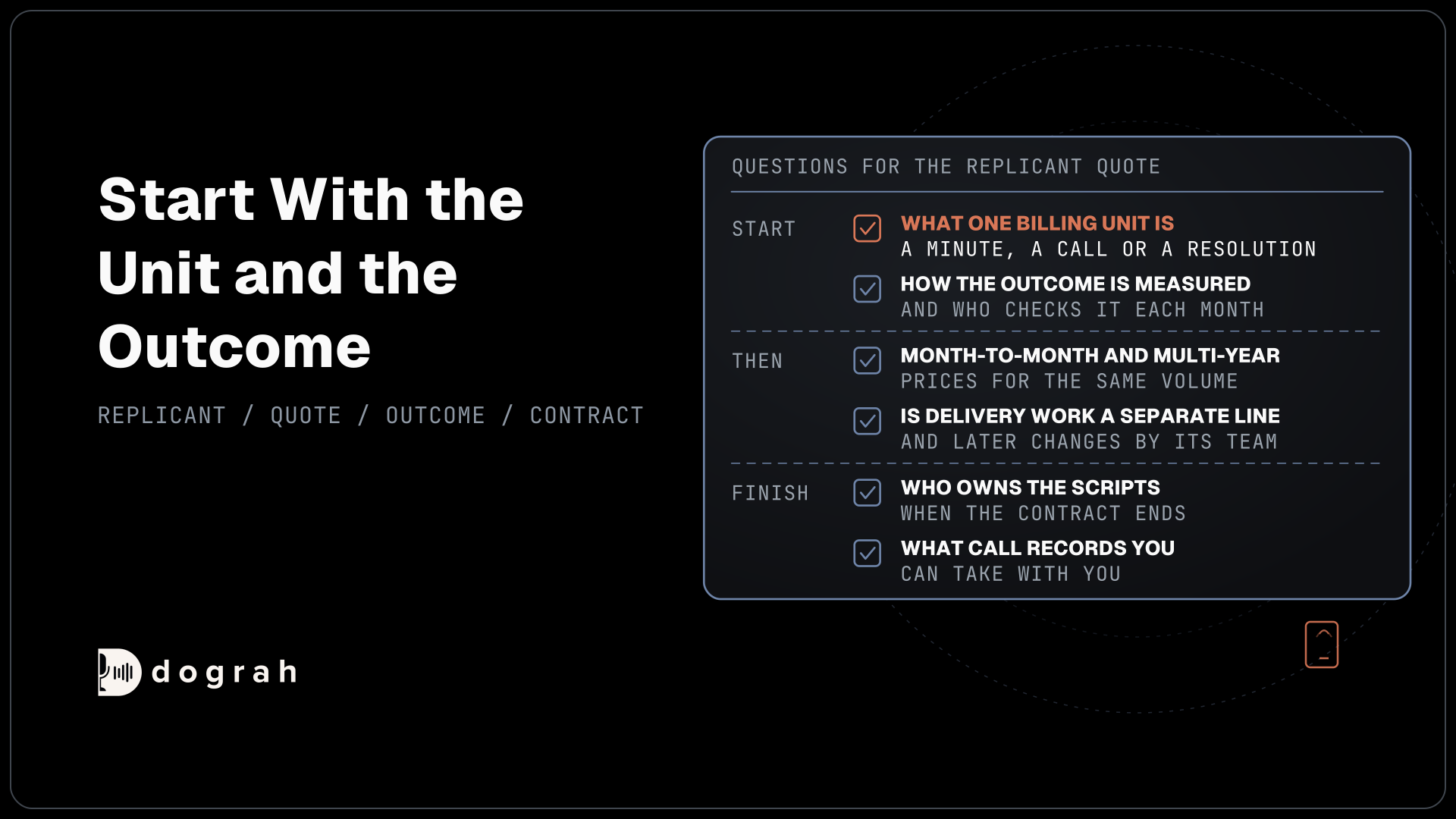
Pull call history before the contract ends. Kore.ai's analytics API returns session summaries, conversation messages, trace events and LLM calls, and recordings come per session, so collect what you need for testing and audits. Numbers bought through Twilio inside Kore.ai raise a porting question, while a SIP trunk you brought yourself can point at the new install. Our post on Kore.ai pricing covers the contract terms to time this against.
Then write down the jobs that become yours. Give the install its own domain with TLS, back up the Postgres database and the recording storage, watch the call traces, and apply each update to a newer image on a schedule. Finally, move one queue or one after-hours line to the new agent and test every transfer over a real phone call, since browser test calls cannot transfer. Move the next line once the first holds up.
Picking your open-source Kore.ai alternative
If open code and your own servers are the reason you are looking, start with Dograh, the open option that answers calls on day one, and add the Enterprise plan when you want on-prem support under contract. If your developers want to build every layer themselves, LiveKit Agents or Pipecat is the base. If you want a self-managed chat platform under a commercial license, Rasa fits that. And if a hosted rate would do, our guide to Kore.ai alternatives covers the hosted platforms.
Before you commit, rebuild your busiest Kore.ai agent and run it on a test number for a week. The server load, the model bill and the call records are then real numbers before anything moves.
Glossary
- Agent Blueprint Language (ABL)
- Kore.ai's typed, schema-driven language for defining an agent's behavior, tools, guardrails and handoffs. Agents written in it run only on Kore.ai, so a move treats them as a spec.
- Project archive
- The portable file Kore.ai's export API produces, with a manifest and a lockfile. It imports into another Kore.ai project, so it carries configuration and not a running agent.
- Orchestration layer
- The voice agent layer that runs the call flow, turn-taking, tool calls and the phone connection. The speech and language models sit in a separate layer you choose.
- Bring your own key (BYOK)
- Using your own model provider account inside the platform. You hold the contract and the bill, while the call audio still goes out to that provider.