
Kore.ai is an enterprise conversational and agentic AI platform for customer service, employee support and process automation. It fits large teams that want one vendor on SaaS, a dedicated VPC or on-prem, under a quote-led contract, and its code is closed. To own the platform yourself, choose Dograh, which is open source and runs self-hosted or on Dograh Cloud.
Key Takeaways
- Kore.ai covers service, employee and process automation on one agent platform.
- It runs as multi-tenant SaaS, in a dedicated VPC or on-prem.
- Each deal is priced by quote, with modules metered per session.
Kore.ai sells far more than a voice agent, so a fair review has to look at each part. We cover its pros and cons, the platform and products, voice, deployment and compliance, how a deal is priced, what to ask, who it fits, and where open-source Dograh fits instead.
Kore.ai pros and cons at a glance
Kore.ai is a wide platform for large enterprises, and its weak spots mostly come from that size. The table gives the short version, and each part then gets its own section.
| Strengths | Watch-outs |
|---|---|
| Service, employee and process automation on one platform | Closed source, with agents written in Kore.ai's own language |
| Multi-tenant SaaS, a dedicated VPC or on-prem | Priced by quote, so no rate to check before a sales call |
| Its own voice gateway, with pipeline and realtime voice modes | Realtime mode with parallel speech-to-text sends caller audio to two providers |
| A long list of model providers | HIPAA is not on the trust center list, so a BAA needs asking |
| Connects to Genesys, Five9, NiCE CXone, Amazon Connect and Talkdesk | Many modules to scope, each priced on its own |
What Kore.ai sells on its Agent Platform
Kore.ai calls itself an enterprise conversational and agentic AI platform, and it sells three product lines. AI for Service covers AI agents, agent assist, contact-center AI, voice AI agents, quality AI and outbound campaigns. AI for Work covers employee tasks in HR, IT, sales and finance, and AI for Process covers back-office work such as accounts payable.
All three run on the Agent Platform, which Kore.ai calls Artemis. Agents are written in its Agent Blueprint Language (ABL), a typed, schema-driven format, with Autoloop for tuning, StateTrace for tracing each step and ARCH as a built-in solution architect. Teams can author visually or in code, including from Claude Code, Cursor and Codex, and Kore.ai offers Forward Deployed Engineers to take a project from proof to production.
Kore.ai says it was named a Leader in The Forrester Wave for conversational AI platforms for customer service, Q2 2026, one of 14 platforms evaluated. It names Glean, Moveworks, Decagon, Sierra and Cognigy as its own competitors, which shows how far its scope reaches past the phone.
Voice through the Kore.ai Voice Gateway
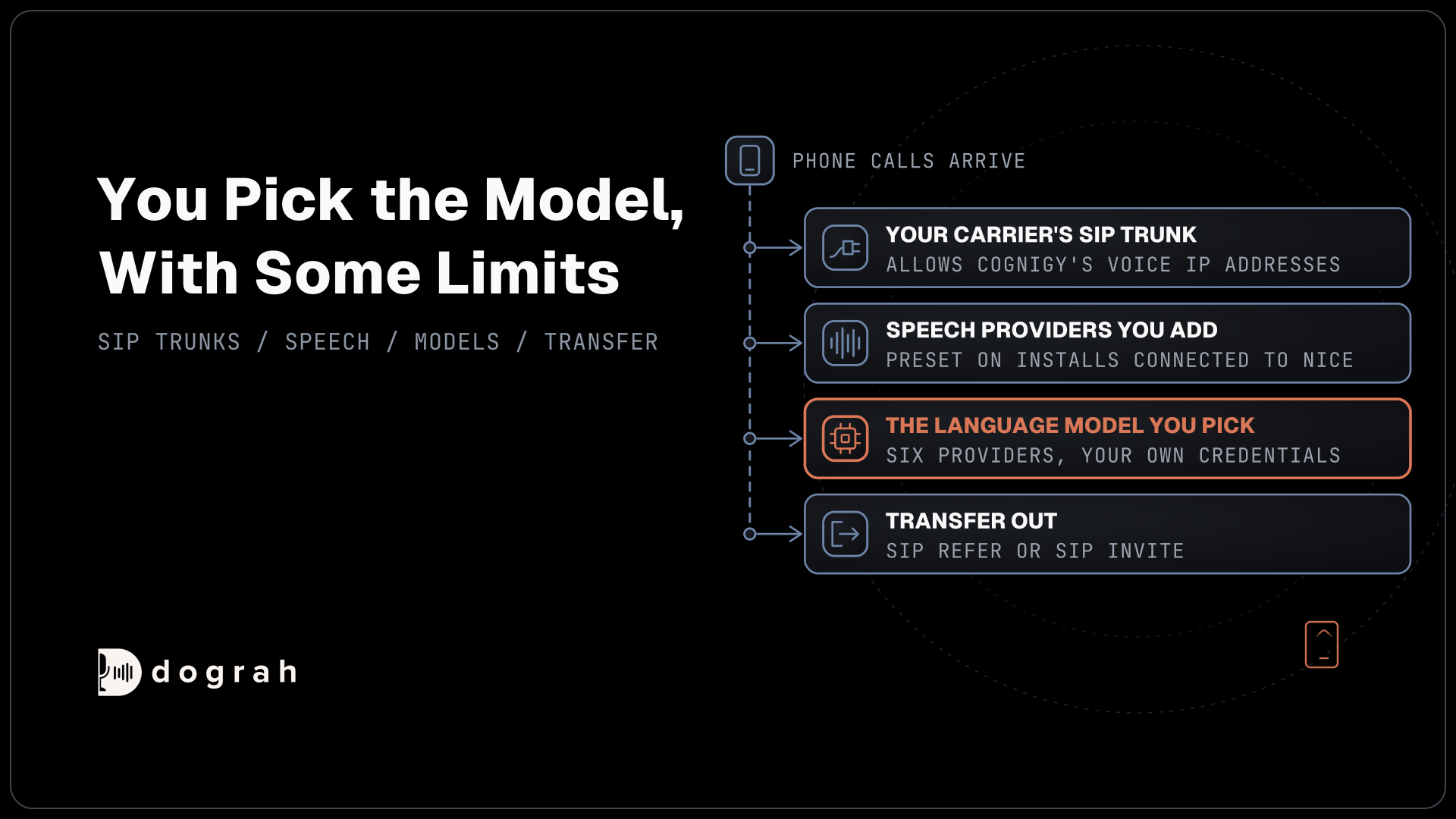
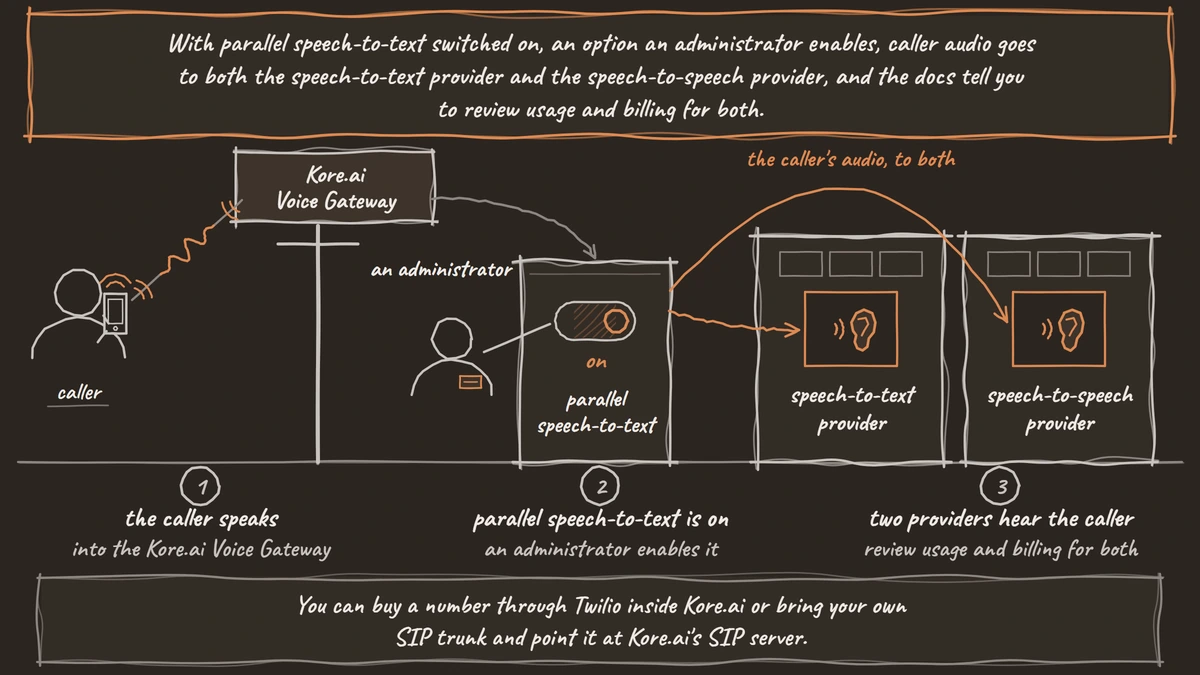
Voice runs through Kore.ai's own gateway, the Kore.ai Voice Gateway (KoreVG), which handles telephony, connection routing, session state, traces and the call lifecycle. You can buy a number through Twilio inside Kore.ai or bring your own SIP trunk and point it at Kore.ai's SIP server.
There are two ways to run the voice itself. Pipeline voice uses separate speech-to-text, LLM and text-to-speech steps, with speech from providers such as Deepgram, Microsoft Speech, Emotech and ElevenLabs. Realtime voice uses a speech-to-speech model from Amazon Nova Sonic, Azure OpenAI Realtime, Grok, Google Gemini Live or OpenAI Realtime.
Realtime mode has one detail worth reading twice. With parallel speech-to-text switched on, an option an administrator enables, caller audio goes to both the speech-to-text provider and the speech-to-speech provider, and the docs tell you to review usage and billing for both. Transfers go to a person over SIP or to a phone number on the public network, with announcements before the transfer and recovery if it fails. Kore.ai also lists Genesys, Five9, NiCE CXone, Amazon Connect and Talkdesk among the contact centers it works with.
Deployment, compliance and where data sits
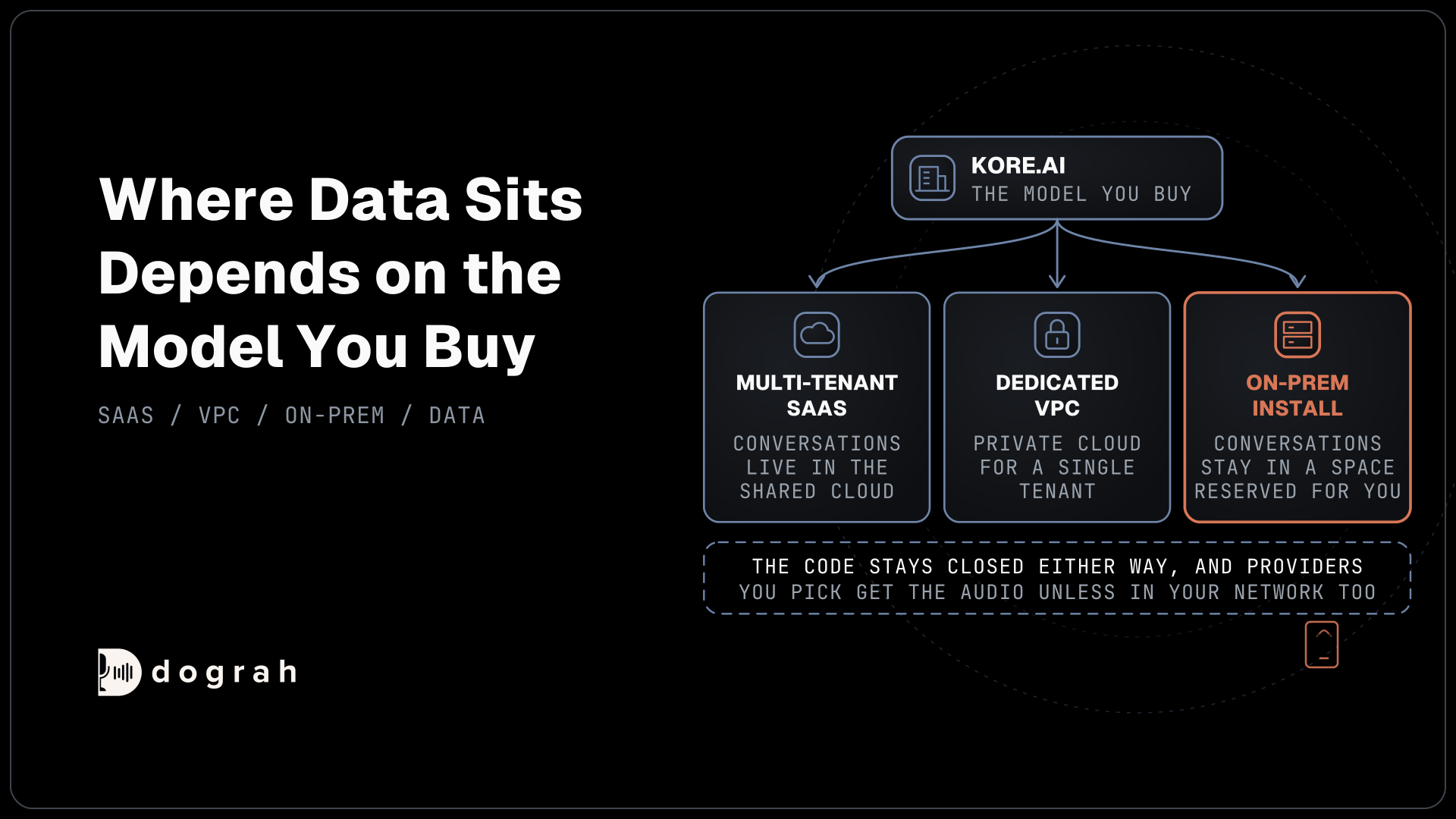
Kore.ai still offers every deployment model a large buyer asks for. Kore.ai offers public cloud multi-tenant SaaS, a private cloud dedicated VPC for a single tenant, and on-premises deployment. That sets it apart from Cognigy, which no longer sells on-prem installs to new customers.
Its trust center lists SOC 2 Type 1 and Type 2, PCI DSS, ISO/IEC 27001:2022, GDPR, CCPA, the EU AI Act and DESC Cloud Service Provider. HIPAA appears as a logo on the homepage but not in that list, so ask Kore.ai for its business associate agreement (BAA) in writing before patient calls go through it.
Where data sits depends on the model you buy. On multi-tenant SaaS, conversations live in Kore.ai's shared cloud. On a dedicated VPC or on-prem, they stay in a space reserved for you, though the platform's code stays closed either way, and the speech and language providers you pick still receive the audio unless they run inside your network too.

Open Source Alternative to Vapi / Retell
Self-hosted voice agent platform — no per-minute fees
dograh-hq/dograh
Star on GitHub
How Kore.ai prices a deal
Kore.ai prices each deal by quote, and its AWS listing shows the shape of the bill. The AWS Marketplace listing for AI for Service is a 12-month contract with session-based metering, each module counted per session. The modules include the AI for Service base, Agent AI, Contact Center AI, Quality AI and the Interaction Gateway, with or without speech. The listed unit price is a placeholder for a private offer, so the real rate arrives in your quote. Our post on Kore.ai pricing covers what drives that number and what to ask.
Models and the closed-code gap
Kore.ai offers a wide model list. Its supported models come from OpenAI, Anthropic, Azure OpenAI, Microsoft Foundry, Google, AWS Bedrock, Vertex AI, Groq, Cohere, Mistral AI, Fireworks, Together AI, Perplexity, DeepSeek and xAI, with Ultravox among the speech-to-speech options.
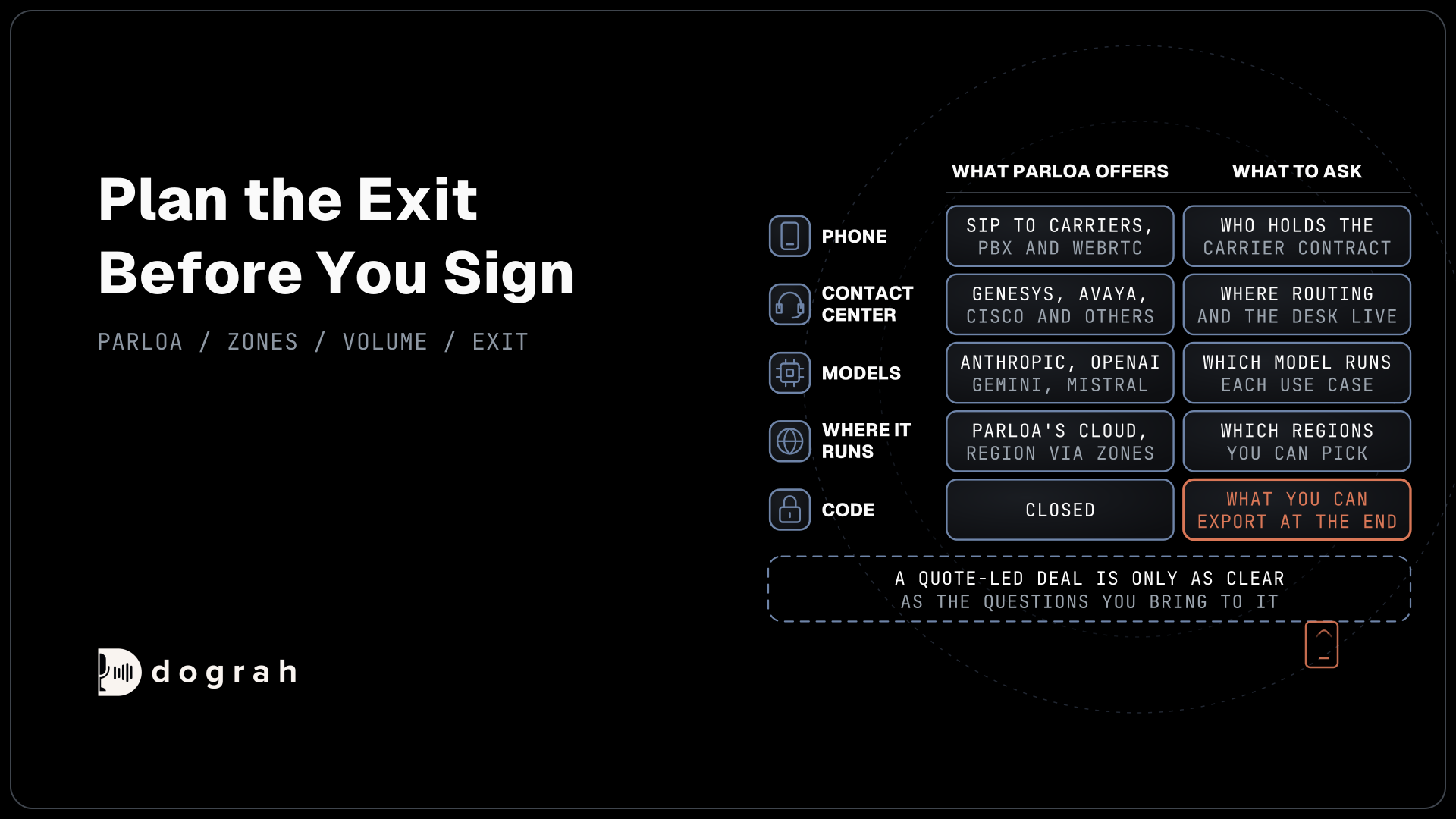
The gap is in what you own. Kore.ai is closed source, so your team configures the platform but cannot read or change the code that runs a call. Agents are written in ABL, Kore.ai's own language, which means a move to any other platform is a rebuild. Even an on-prem install runs Kore.ai's code under Kore.ai's license, so on-prem here is a hosting choice, not open code. Recordings can be fetched per session through Kore.ai's API, and the rest of an export is worth asking about up front.
Questions to ask before you sign
A quote-led deal goes better with the questions written down first. Ask how a voice call is counted in sessions on your contract, and which modules you need for the calls you plan. Ask which deployment model the quote assumes and who applies updates on a VPC or on-prem install.
Then ask the data questions, starting with where conversations will be stored and in which region. Ask whether Kore.ai will sign a BAA if calls carry health data, and how both providers bill you if you plan realtime voice with parallel speech-to-text. Finally, ask what an export includes when the contract ends, and whether numbers bought through Twilio inside Kore.ai can be ported out.
Who Kore.ai fits
Kore.ai fits a large enterprise that wants one vendor for customer service, employee support and back-office automation, with governance across all of it. It suits teams that need on-prem or a dedicated VPC under a commercial contract, and contact centers on Genesys, Five9, NiCE CXone, Amazon Connect or Talkdesk that want an AI layer on top. Buyers often praise its governance, while some report that its many tools take work to fit together, so a proof of concept on your own calls is worth the time. Our post comparing conversational AI platforms shows where Kore.ai sits among other kinds of platforms.
It fits less well a team that needs to read or change the code, or a smaller team that wants a price before a sales call. The closest suite is covered in our Cognigy review, and our roundup of Kore.ai alternatives sorts the other options by why teams leave.
Join the Dograh Community
Dograh is an OSS alternative to Vapi. Join our Slack community for queries, releases, best practices & community interactions.
Where Dograh fits
Since Kore.ai already offers on-prem, the difference Dograh brings is open code and a platform you own end to end. Its code is open source under BSD 2-Clause, so you can self-host it with Docker Compose on a server with 8 GB of RAM and 4 vCPUs or use Dograh Cloud instead. On-prem and private-cloud deployment, SSO and SAML, and audit logs come with the Enterprise plan.
The platform is voice-first, built for phone and browser calls with a web chat widget, and it leaves employee service desks and process automation to other tools. As the orchestration layer, it runs the call flow, tools and telephony, while you pick the speech-to-text, LLM and voice for each agent from its own models, your keys or open-weight models on your own servers. It connects to your carrier, and when a caller asks for a person, Dograh calls the destination first and connects the caller only when someone answers, on Twilio, Telnyx, Plivo, Cloudonix or Asterisk ARI.
Where call data lives shapes the cost. Self-hosted with local models, recordings, transcripts and audio stay on your servers, while your own provider keys move the contract and the audio still reaches each provider. Self-hosted Dograh has no per-minute platform fee, but servers, model keys and phone minutes still cost money. Dograh Cloud charges a 1¢-a-minute platform fee. Self-hosting also means the server, the database and the upgrades are yours, with community support on open source and custom SLAs on Enterprise.
Agents are not locked in either. An agent saved as JSON loads into another install through Upload Agent Definition, and completed calls download as a CSV report. Test and live calls are scored step by step by the QA step, and View Trace breaks out the speech-to-text, AI and voice time of every turn.
Glossary
- Agent Blueprint Language (ABL)
- Kore.ai's own typed, schema-driven language for defining agents on its Agent Platform. Agents written in it run only on Kore.ai.
- Kore.ai Voice Gateway (KoreVG)
- Kore.ai's telephony layer, handling routing, session state, traces and the call lifecycle. Numbers come through Twilio or your own SIP trunk.
- Session-based metering
- Billing that counts sessions rather than minutes or seats. Kore.ai's AWS listing meters each AI for Service module per session on a 12-month contract.
- Orchestration layer
- The part of a voice agent responsible for the call flow, turn-taking, tool calls and phone connection. Speech and language models are a separate layer you choose.