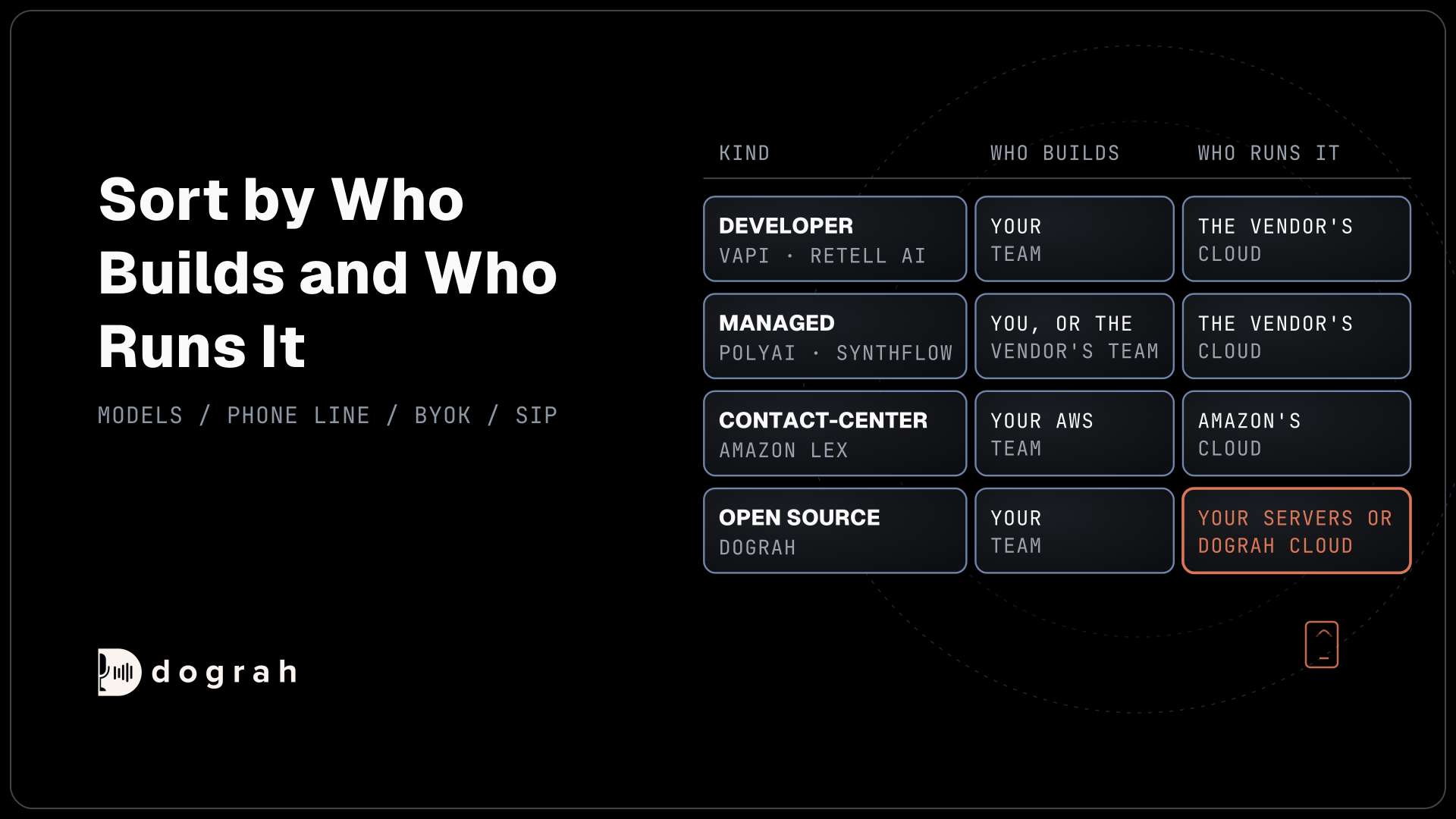

Conversational AI platforms for phone calls are divided into developer platforms, managed platforms, contact-center bots and open source. Dograh is the open-source option that ships as a full platform, while Pipecat and LiveKit Agents are frameworks you build on. Vapi, Retell AI and Bland AI, PolyAI and Synthflow, and Amazon Lex fill the other three groups.
Key Takeaways
- Sort platforms by who builds, who runs it, which models and which phone line.
- A headline per-minute rate rarely includes the models or the phone line.
- Test Dograh and every other shortlisted platform on a real phone line.
This post is part of our guide to voice AI, where the main choice is who runs the orchestration layer. We sort phone platforms by four plain questions, set their list prices side by side with Dograh first, then cover developer, managed and contact-center platforms and the open-source frameworks.
Four questions that sort the platforms
Most comparisons rank platforms by features, but four plain questions sort them faster for phone use. The first is who builds the agent: your developers in code or a visual editor, or the vendor's team for you. The second is who runs it, the vendor's cloud or your own servers.
The third is which models it uses. Some platforms bundle their own speech and language models into one rate, and others let you bring your own key (BYOK) for any provider. The fourth is how your phone line connects, through the vendor's numbers or your own carrier over SIP.
The answers decide more than the feature list does. They set who you call when a call fails, where recordings live and which parts of the bill you can change later. Our guide to what changes on a phone call covers the audio, timing and handover problems every one of these platforms has to solve.
Platforms side by side, and what each price leaves out
The last column says what each list price leaves out. Without it, a hosting fee and a bundled rate look like the same kind of number.
| Platform | Type | Who builds the agent | Models you can use | Phone line | List price | What the list price leaves out |
|---|---|---|---|---|---|---|
| Dograh | Open-source platform | Your team, on a visual canvas | Your choice of provider on your own keys, or open-weight models | Twilio, Telnyx, Plivo, Vonage, Cloudonix, Asterisk ARI and more | No per-minute platform fee self-hosted, a 1¢-a-minute platform fee on Cloud | Servers, models and phone minutes |
| Vapi | Developer platform | Your developers, by API or dashboard | Any provider, your keys or Vapi's | Billed separately, or your own carrier | $0.05 a minute hosting | Models and phone minutes |
| Retell AI | Developer platform | Your team, in prompts or a flow canvas | Retell's list, plus speech-to-speech | Retell's Twilio or Telnyx, or your SIP | $0.055 a minute voice engine | Model, voice and phone minutes |
| Bland AI | Developer platform | Your team, on a visual canvas | Bland's own, inside the rate | Your Twilio or SIP, or Bland's | $0.14 a minute on Start, or $299 plus $0.12 on Build | Phone time |
| PolyAI | Managed platform | Self-serve or PolyAI's team | PolyAI's own | Your carrier over SIP | $49, $199 or $299 per location a month, or from 9.5c a minute | Minutes past the plan |
| Synthflow | Managed no-code | Your team, with onboarding from Synthflow | Set in the contract | Set in the contract | Enterprise agreement, billed annually | Set in the contract |
| Amazon Lex | Contact-center bot | Your AWS team | Amazon's | Through Amazon Connect | $0.004 per speech request | Amazon Connect and phone minutes |
| Pipecat, LiveKit Agents | Open-source frameworks | Your developers, in code | Any | You build the phone wiring | Free to self-host | Servers, models, phone and the product around them |
Dograh: the open-source conversational AI platform
On the four questions, Dograh puts every answer in your hands. Your team builds the agent on a visual canvas, you decide whether it runs on your own servers or on Dograh Cloud, you pick the models, and your own carrier brings the calls. It is an open-source AI voice agent platform under the BSD 2-Clause license, and it ships as a full product rather than a kit of parts.
That product covers the whole call. A visual flow builder holds the conversation as steps joined by pathways, with telephony, transfers to a person, call history, and QA that scores each step of each call, on test calls and on live calls. Pre-recorded clips cover an agent's set lines in a recorded human voice, and text-to-speech fills in everything else.
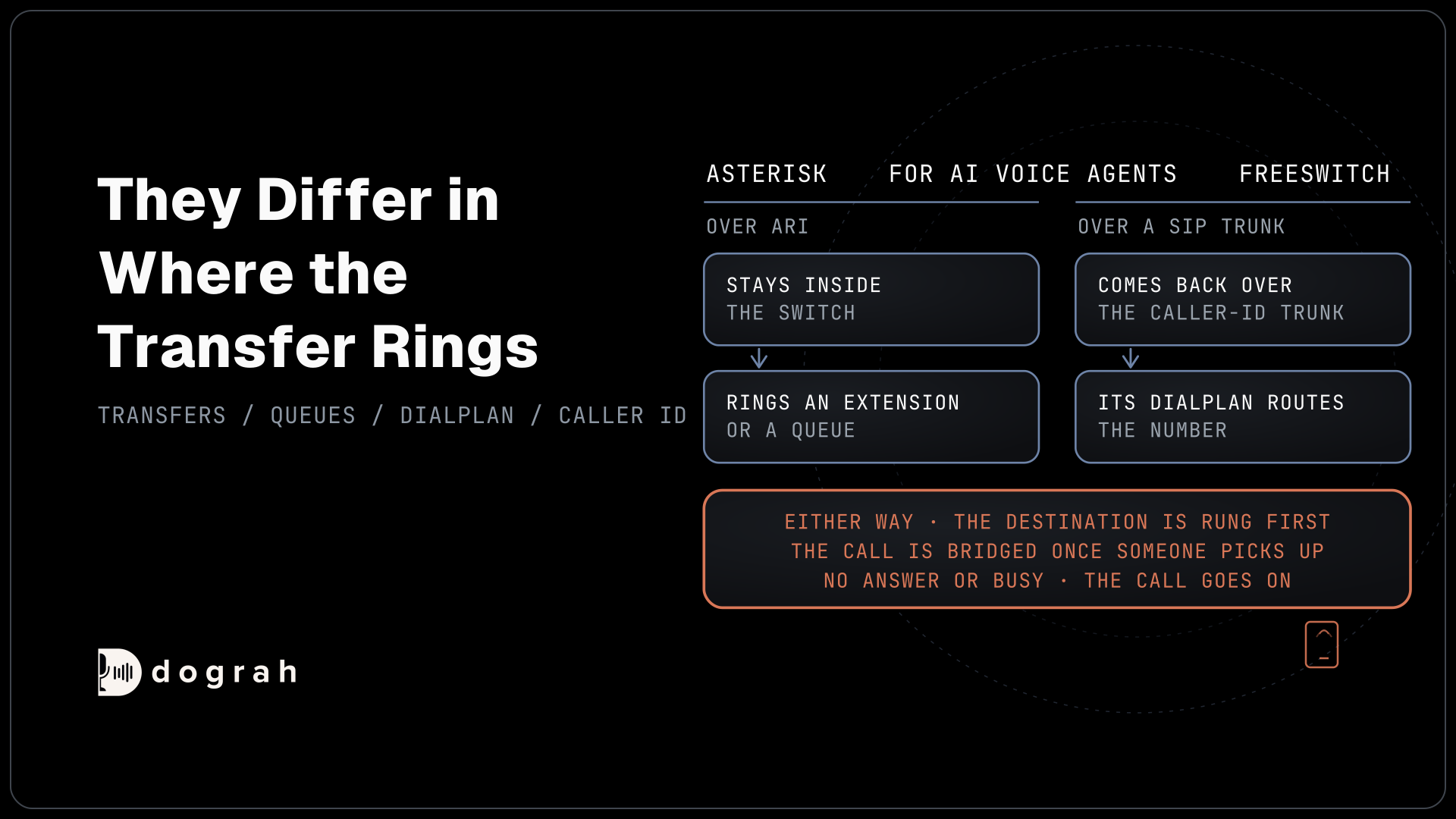
The phone side connects to Twilio, Vonage, Plivo, Telnyx, Cloudonix, Asterisk ARI or your own SIP trunk, and your numbers stay in your carrier account. Transfers to a person run on Twilio, Telnyx, Plivo, Cloudonix and Asterisk ARI. Dograh calls the destination first and connects the caller only when someone answers, and on Twilio it can play a short spoken introduction.
Dograh is the orchestration layer that runs the call flow, tools and telephony, and it is not a model. You pick the models separately, from Dograh's own to any inference provider on your keys or open-weight models running on your servers. Only that last choice keeps the call audio on your own machines. On your own key the contract is yours, but the audio still goes to that provider, and the phone carrier carries the call in every case.
Self-hosting runs on Docker Compose on a server with at least 8 GB of RAM and 4 vCPUs, and needs no GPU while your models come through API keys. Dograh Cloud is the hosted version, and Dograh Enterprise adds on-prem deployment inside your data perimeter. Self-hosted Dograh has no per-minute platform fee, but servers, model keys and phone minutes still cost money. Dograh Cloud charges a 1¢-a-minute platform fee. Its pay as you go plan includes 10 calls at once.
Running it yourself carries real work. Your team keeps the server and the database running and applies upgrades, with community support on the open-source version and custom SLAs on Enterprise. What you get back is an orchestration layer and call records no vendor can take away.
Developer platforms: Vapi, Retell AI and Bland AI
Developer platforms give your team the building blocks and run the calls on their own cloud. They differ most in how they bill the models.
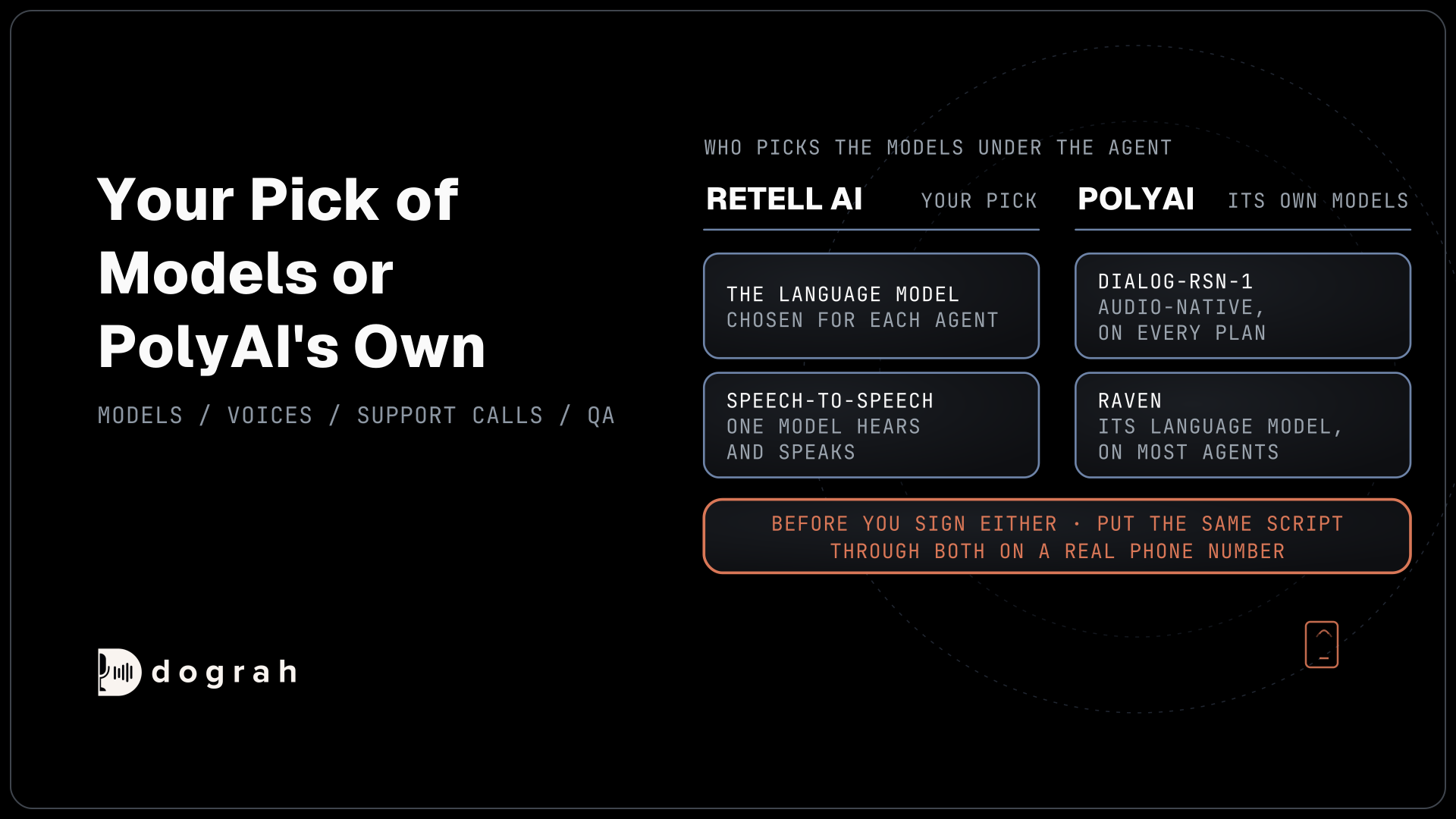
Vapi charges $0.05 a minute for hosting, with $5 of free credit to start. The language model, the speech models and the phone minutes are billed separately or on your own keys, and support for the Health Insurance Portability and Accountability Act (HIPAA) is a $2,000-a-month add-on. Retell AI puts its voice engine at $0.055 a minute, then adds the language model, the voice and $0.015 a minute for its telephony, which drops to zero on your own SIP trunk. New accounts get $10 of credit.
Bland AI works the other way. Its rate includes Bland's own language model, transcription and voices, at $0.14 a minute on Start with no platform fee, or $0.12 plus $299 a month on Build.
That is why a sticker rate misleads. Vapi's $0.05 and Retell's $0.055 are one line of the bill, while Bland's $0.14 is most of it. Price one call of your own length on each, with the models you plan to use, before you compare.
Managed and contact-center platforms
Managed platforms take more of the build off your hands, and contact-center bots plug into a cloud you may already pay for. Both trade control for less work on your side.
PolyAI has moved down-market. Its self-serve plans now include Essentials at $49 a month for 250 minutes, Plus at $199 a month for 1,000 minutes and Scale at $299 per location a month for 1,500 minutes, with 30, 25 and 20 cents for each extra minute. Its Platform plan starts from 9.5 cents a minute, with $20 of free credit, and you bring your own carrier over SIP at no charge. Enterprise adds a HIPAA business associate agreement and data residency.
Synthflow sells Enterprise agreements only, billed annually and scoped with its sales team rather than by the minute. It suits a team that wants a no-code builder and a vendor to share the launch.
The contact-center bots belong to the big clouds. Amazon Lex charges $0.004 per speech request, and phone calls reach it through Amazon Connect, which bills its own minutes. Google's Customer Engagement Suite does the same job on Google Cloud. Both make sense when your contact center already runs on that cloud and your team knows its tools.
Open-source frameworks: Pipecat and LiveKit Agents
Open source comes in two shapes: a full platform such as Dograh, covered above, or a framework. With Pipecat or LiveKit Agents, your developers write the agent in code and build the phone wiring, call records and QA themselves, which suits a team that wants to own every part of the product. Our list of the best open-source voice AI platforms compares both shapes. Pipecat is released under the BSD 2-Clause license and LiveKit Agents under Apache 2.0, and Dograh itself is built on a fork of Pipecat.
The reason most teams look at open source is ownership, and our post on voice AI platform lock-in covers what is hard to move once callers depend on a line.
Join the Dograh Community
Dograh is an OSS alternative to Vapi. Join our Slack community for queries, releases, best practices & community interactions.
How to choose for your phone line
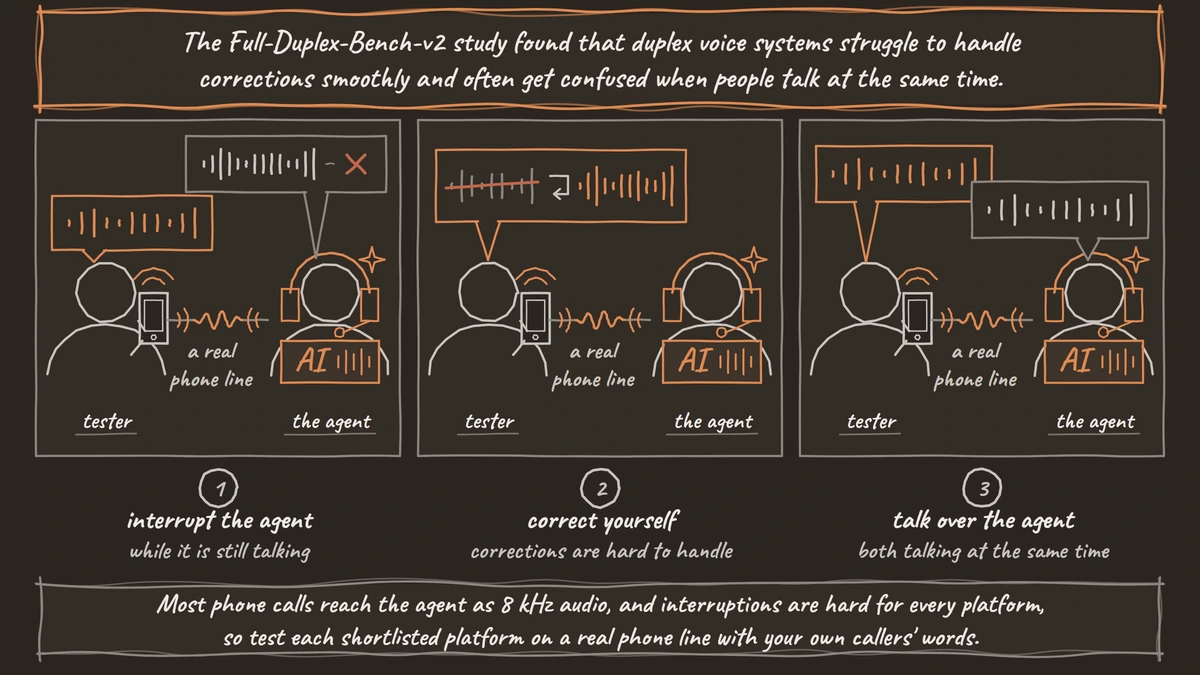
Shortlist by the four questions. If you want to own the orchestration layer without building it, start with Dograh, since you can run your test calls on your own server with no contract. Then add the hosted platforms whose answers fit, and let real calls decide. A vendor's demo usually plays 16 kHz browser audio, but a phone line carries 8 kHz, so an agent that sounds right in the demo can mishear your callers on a real call.
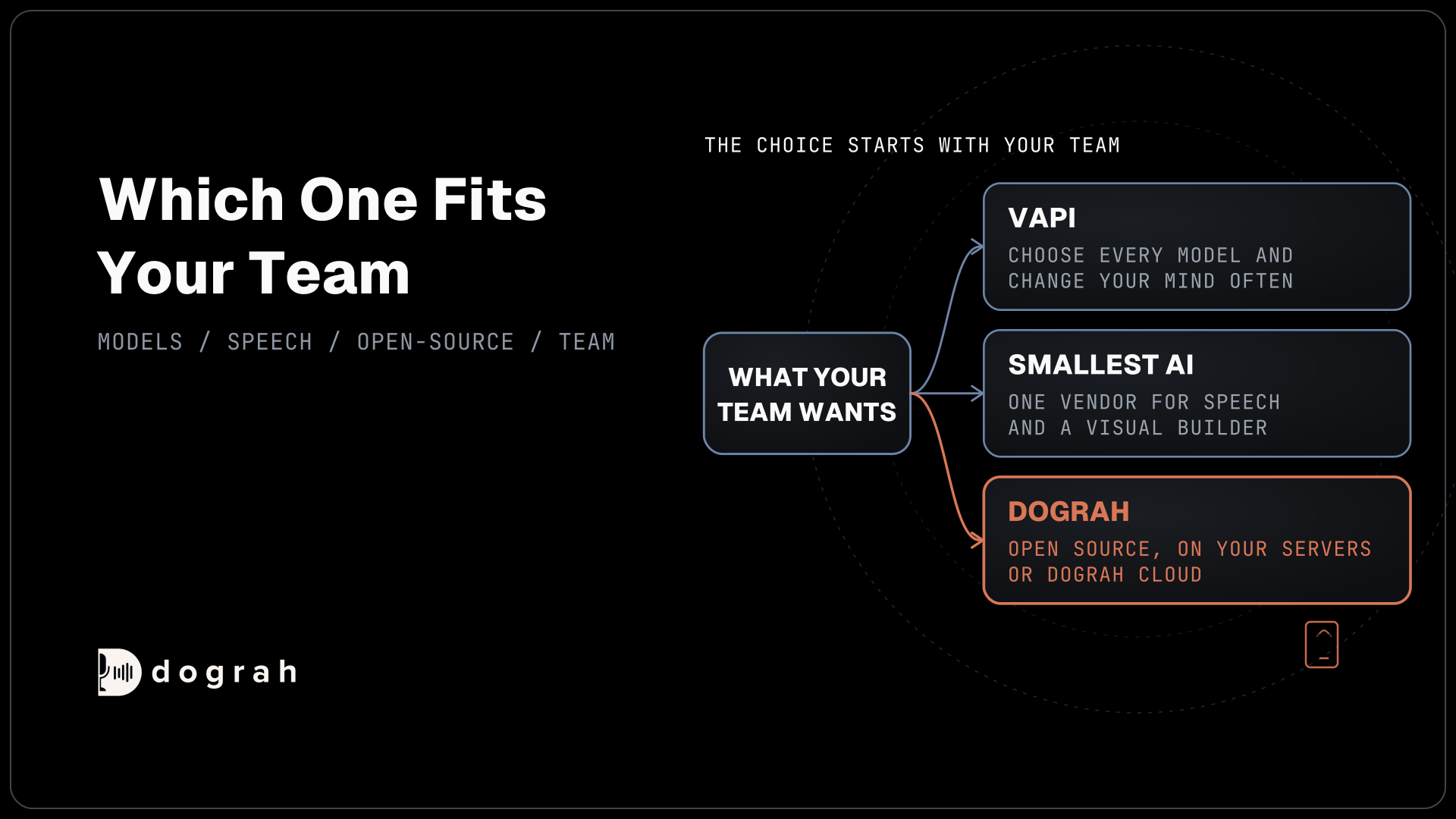
Each type fits a different team. Developer platforms suit teams with engineers who want to choose every model and pay for each part. Managed platforms suit teams that want the vendor to build and tune the agent, at the cost of control. Contact-center bots suit teams already on that cloud. Dograh suits teams that want to own the platform without building it, and the price is running the servers and upgrades yourself, or paying the Cloud platform fee.
Turn-taking needs the same test. The Full-Duplex-Bench-v2 study found that duplex voice systems struggle to handle corrections smoothly and often get confused when people talk at the same time. A demo rarely shows that, so have testers interrupt, correct themselves and talk over the agent on a real line.
Check capacity last, once you know which platforms survive the calls. Our comparison of voice agent platforms for high call volume lists how many calls each one runs at once and what happens when every line is busy.
Glossary
- Hosting fee
- A per-minute charge for running the call on a platform's cloud, separate from the models and the phone line. Vapi's is $0.05 a minute, and Retell calls its $0.055 a voice engine fee.
- Bundled rate
- One per-minute price that includes the platform's own speech and language models. Bland AI's $0.14 a minute on Start works this way, so it covers more of the bill than a hosting fee.
- Speech request
- Amazon Lex's billing unit for one spoken input it processes. Lex charges $0.004 per speech request, and the phone call itself is billed by Amazon Connect.
- Bring your own key (BYOK)
- Using your own account with a model provider inside a platform, so the provider bills you directly. The contract sits with you, but the call audio still goes to that provider.