
Voice AI lock-in sits in four layers: models, numbers, flows and call data. Many hosted platforms accept your keys and numbers, but flows and records stay with them. Dograh, the open-source AI voice agent platform, runs on your keys and numbers, and you can download any agent as a file and load it elsewhere. Self-host it or use Dograh Cloud.
Key Takeaways
- Model keys move easily. Flows and numbers are where lock-in sits.
- A free number on a platform's carrier account may never port out.
- Self-hosting keeps recordings and transcripts in your own database and storage.
This post is part of our guide to open-source voice AI agents, where owning the code is one answer to vendor risk. Here we go through a voice platform layer by layer, from what hosted platforms already let you keep to what changes when you run Dograh.
What lock-in looks like when terms change
Lock-in shows up on the day a platform changes its price or rewrites its terms, and you find out what you can move. Few companies are ready for that day. In a 2026 Zapier survey of US enterprise executives, only 6% said they could stop using their primary AI vendor without interruption, and 47% said a key business function would stop working correctly. An IBM study with Oxford Economics found 71% of executives would find switching their primary AI vendor or model difficult. Both surveys cover AI vendors in general, not voice platforms, but a voice agent stacks several of those dependencies into one product.
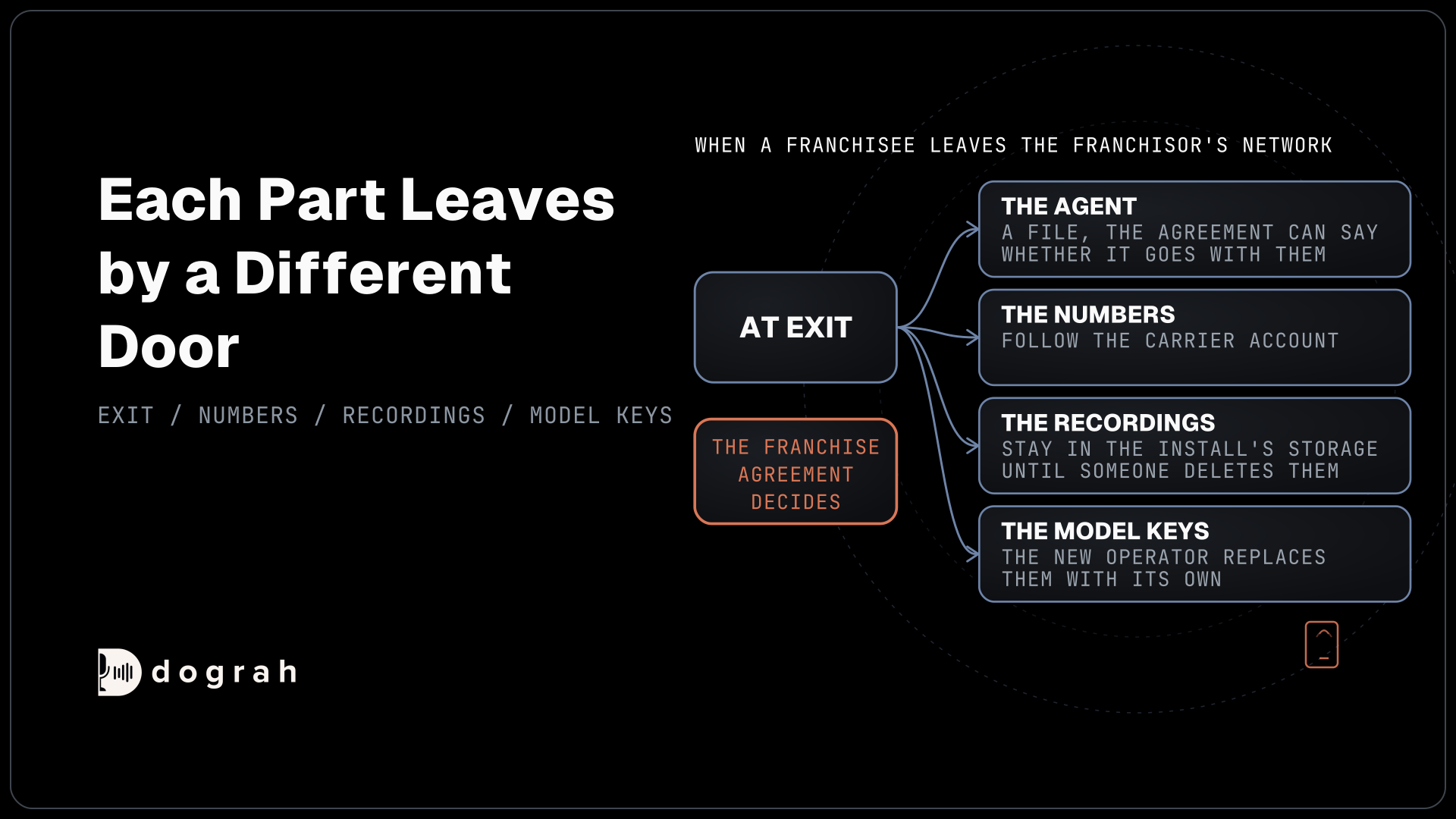
A useful test is what you could move in a week. On a voice platform, some layers move in a day and some need a rebuild. The terms themselves, notice periods and suspension clauses are covered in our post on open-source vs hosted voice AI ownership, and retired features in the hidden costs of closed voice AI platforms. This post looks at the four layers you would carry out the door.
Models and voices: the easiest layer to move
Models are the layer hosted platforms handle best. Many already let you bring your own keys for speech-to-text, the language model and the voice, billed by each provider directly. If a platform raises its model markup, you switch to your own key and carry on.
Dograh takes the same approach further. Each of the three models can use your own key, Dograh's managed models, or an open-weight model you run yourself through an OpenAI-compatible address. Switching is a setting on the Models page, as the inference providers guide shows, not a rebuild of the agent.
Voices need one extra check. A cloned voice lives in the account of the text-to-speech provider that made it. With your own key, that account is yours, and the voice goes wherever the key goes.
Bring-your-own-keys has a limit worth naming. It moves the contract with the model provider, not the path the call takes. On a hosted platform, call audio and transcripts still flow through the platform on their way to your providers, so keys alone do not move the data.
Phone numbers: whose account holds them
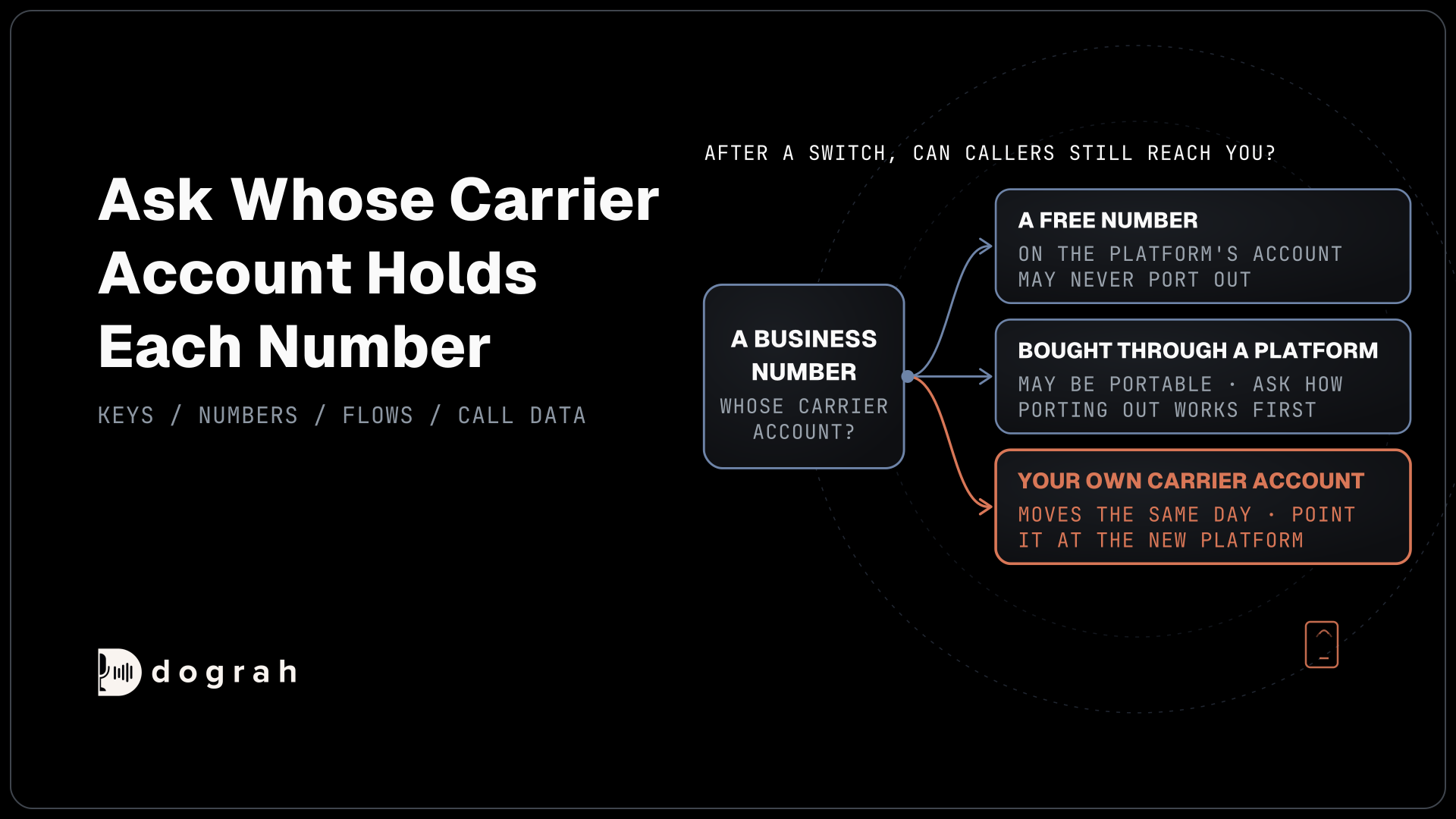
Numbers decide whether your customers can still reach you after a switch, so ask whose carrier account holds each one. There are three common cases.
A free number that a platform provisions on its own carrier account has no account number or port-out PIN in your name, so it cannot be ported. Platforms offering these usually say so and suggest importing your own number for production. A number bought through a platform from a partner carrier may be portable, so ask how porting out works before it goes on your website. A number in your own carrier account, connected to the platform, moves on the same day. You point it at the new platform.
With Dograh, the carrier relationship is yours. You connect your own carrier account, such as Twilio, Telnyx, Plivo or Vonage, or your own SIP trunk, so every number stays in your name from the start. If your number sits with an old phone company today, our guide to port your business number walks through moving it without missing calls.

Open Source Alternative to Vapi / Retell
Self-hosted voice agent platform — no per-minute fees
dograh-hq/dograh
Star on GitHub
Prompts and call flows: text moves, flows don't
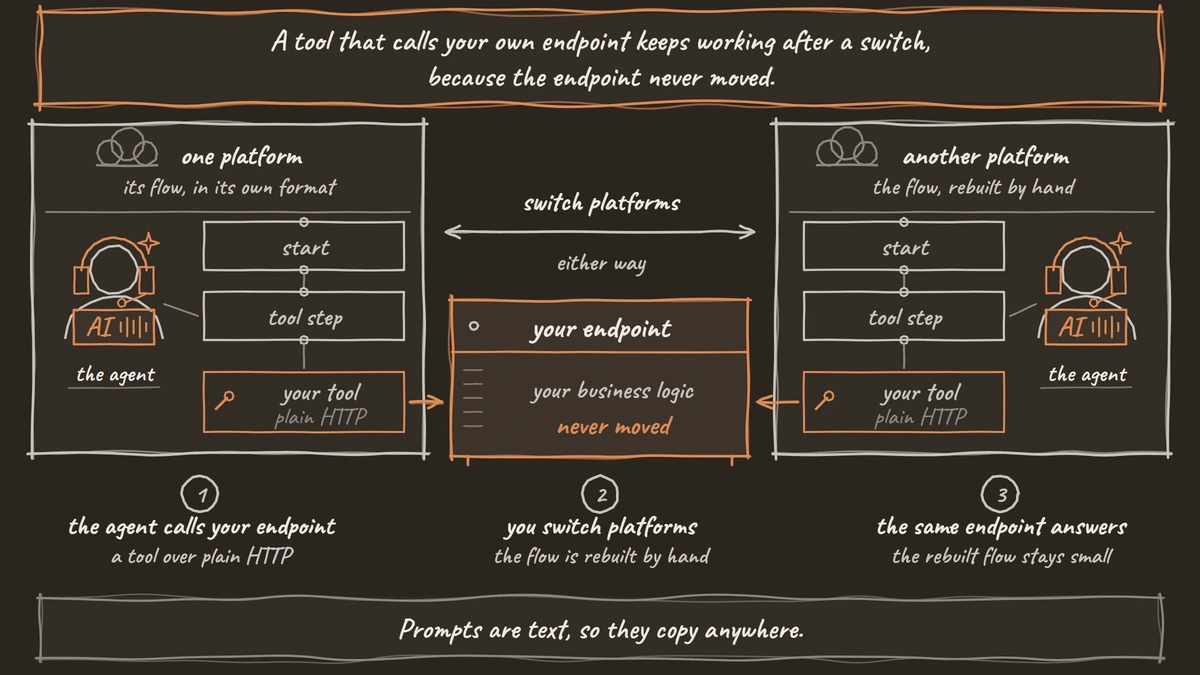
Prompts are text, so they copy anywhere. The call flow is the harder part. It holds the nodes, the conditions between them, tool definitions, what gets extracted and when calls transfer, all in the platform's own format. Moving it to another platform means rebuilding it by hand, and that rebuild is usually the biggest cost of switching.
On Dograh, an agent is a JSON definition of nodes and edges. Download Workflow in the agent editor's menu saves it as a file, and Upload Agent Definition loads it into another install. The same file moves between Dograh Cloud and your own servers in either direction. Because the code is open-source under the BSD 2-Clause license, the format is readable in the source, so a script can read the file too.
Tools travel well on any platform that calls plain HTTP. A tool that calls your own endpoint keeps working after a switch, because the endpoint never moved. Keep business logic in those endpoints rather than in platform-specific steps, and the flow you rebuild stays small.
Call data: where recordings and transcripts sit
Call records hold the history a business learns from, so before signing, ask how recordings, transcripts and extracted fields export in bulk, and what happens to them when the contract ends. On a hosted platform, the answers sit in the terms and the API.
Self-hosted Dograh keeps recordings and transcripts in your own Postgres database and your own MinIO or S3 storage, as the deployment overview describes. On either route, copies can flow out as calls happen. The Webhook node sends each call's results to your systems when it ends, and the run details API returns any call on request.
The lasting value of a voice platform is the infrastructure and control over the data. A screen for building agents is the easy part. That is where ownership pays off when terms change.
Join the Dograh Community
Dograh is an OSS alternative to Vapi. Join our Slack community for queries, releases, best practices & community interactions.
A lock-in check before you sign
Run these questions against any platform, hosted or open-source, and write down the answers:
| Layer | Question to ask | Portable answer |
|---|---|---|
| Models | Can I use my own keys for speech, the language model and the voice? | Yes, for all three |
| Voices | Which account holds a cloned voice? | My text-to-speech account |
| Numbers | Whose carrier account holds each number? | Mine, with a port-out PIN |
| Flows | Can I download an agent and load it elsewhere? | Yes, as a file |
| Call data | How do I export records, and what happens at the end? | Bulk export, or my own storage |
Self-hosting adds one more control, the timing of updates. You choose when the platform moves, as our guide to update a self-hosted voice agent platform safely shows. Self-hosted Dograh has no per-minute platform fee, but servers, model keys and phone minutes still cost money. Dograh Cloud charges a 1¢-a-minute platform fee.
A platform that gives the portable answer on every row can change its terms without stranding you. Score each one before the contract, while switching still costs nothing.
Glossary
- Bring-your-own-keys
- Using your own accounts with model providers inside a voice platform. It moves the model bill and contract to you, while call audio still flows wherever the platform runs.
- Port-out PIN
- A code a carrier gives the account holder to authorize moving a number to another carrier. A number provisioned on a platform's own carrier account has no PIN in your name.
- Agent definition
- The file that describes a voice agent's nodes, prompts, tools and transitions. On Dograh it is JSON, saved with Download Workflow and loaded into another install with Upload Agent Definition.
- Call flow
- The nodes, the conditions between them, tool definitions and transfer rules that make up a voice agent, kept in the platform's own format. It is usually the part rebuilt by hand after a switch.