
On a hosted voice AI platform you usually keep ownership of what you upload, but the vendor's terms decide how call data is stored, used to improve its service and changed. With open-source code you run yourself, the license is the only platform term. Dograh, the open-source AI voice agent platform, can be self-hosted or run on Dograh Cloud.
Key Takeaways
- Vapi and Retell let you keep your content and bring your own models.
- Their terms still set improvement use, change notice and suspension.
- Self-hosting moves call records to your database. BYOK moves only the model contract.
This post is part of our guide to open-source voice AI agents, where open code is one of two layers with its own license. Below, we credit what hosted platforms' terms give you, mark what they keep, then compare code, call data, models and terms on each route, Dograh included.
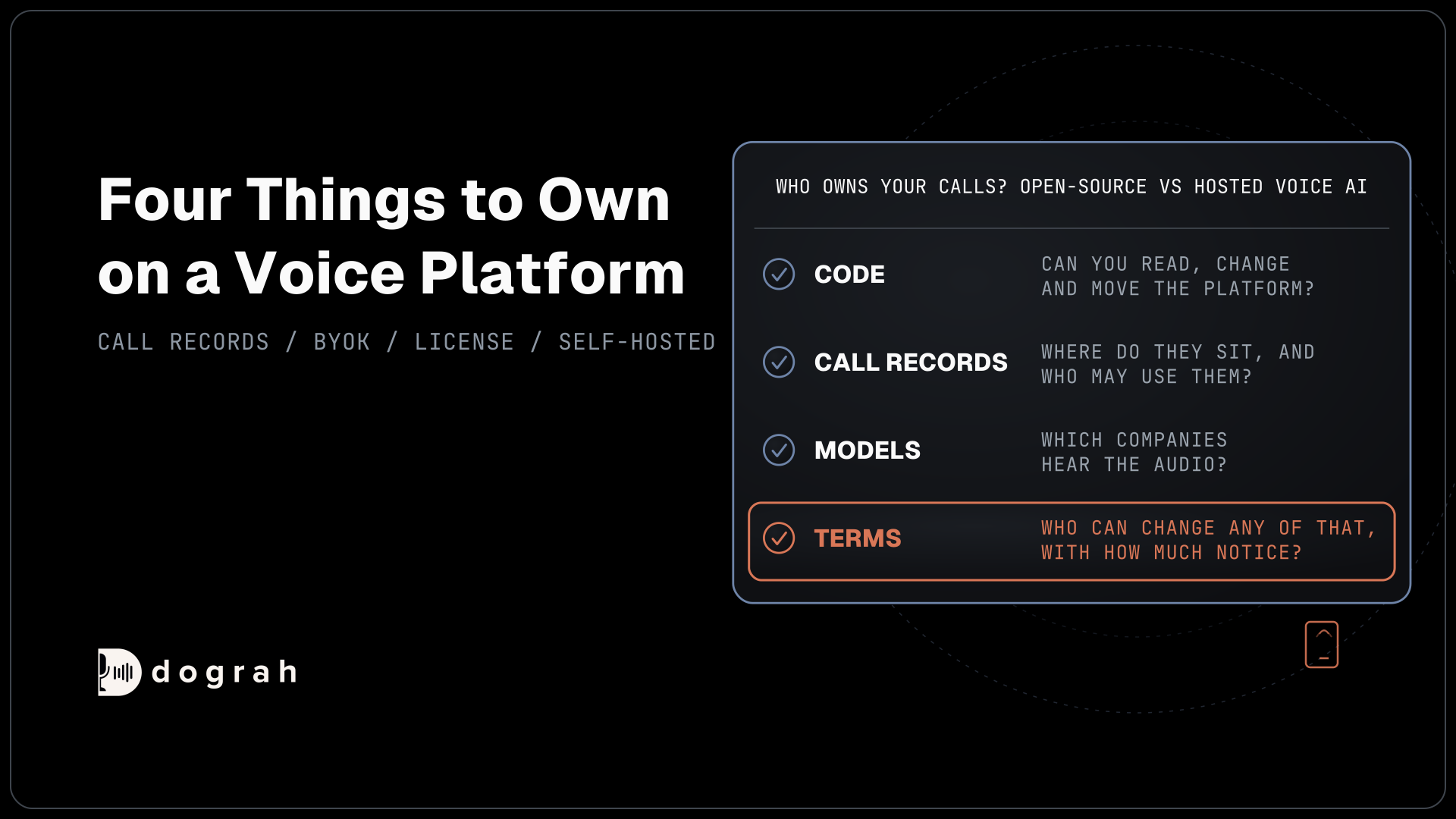
Four things to own on a voice platform
Owning your calls comes down to four questions, and each route answers them differently. The code decides whether you can read, change and move the platform. The call records decide where recordings, transcripts and logs sit, and who may use them. The models decide which companies hear the audio. The terms decide who can change any of that, and with how much notice.
Buyers already weigh these questions. In a survey of 200 IT, contact centre and customer experience leaders at multinational companies, AVOXI and Metrigy found that 61% named security and compliance requirements as the leading obstacle to wider AI voice use. Another 51% named data sovereignty and privacy requirements.
What hosted platforms get right
Hosted platforms have come a long way on data, and their better clauses deserve credit. Vapi's terms of service say you own the transcripts, recordings, audio and summaries produced for you, apart from Vapi's own templates. Vapi does not share your content with third-party services for their own model training. On some service tiers, a zero data retention setting stops it storing call data, including transcripts, audio and logs, after the call.
Both platforms let you bring your own parts. Vapi's provider keys cover speech-to-text, the language model and the voice, and once a key is checked the provider bills you directly. Recordings can go to your own Amazon S3, Google Cloud, Cloudflare R2 or Azure bucket in place of Vapi's default storage. Retell lets your own server write every reply through its custom LLM option, and you can bring your own numbers over a SIP trunk.
Bring your own key (BYOK) on its own therefore says little about ownership. It changes who bills you for the models and whose contract covers them. The audio still reaches those providers, and the hosted platform still runs every call.
Where the vendor's terms still decide
On a hosted platform, the terms decide what the vendor may do with the calls you own. Vapi's terms give it a worldwide, royalty-free license to host, store and use your content while the agreement runs. They also let Vapi use your content to improve its service, for work such as speech recognition and end-of-turn detection, as long as the processing does not identify the business or the caller.
Retell's terms of service split ownership in two. You keep the content you submit. Voice outputs, transcripts, summaries and call analytics count as AI-generated content, which you get a license to use for personal or internal business purposes. Unless you opt out of recording, you also give Retell permission to record calls and to use that data, de-identified and aggregated first, to develop and improve its AI models.
Change and exit are where the two differ most. Vapi's changes reach existing users 30 days after notice is posted, while Retell may change its terms at any time, effective once posted. Vapi may suspend service without notice in listed cases, and after termination your account files may be deleted, so export them before you leave. Our post on the hidden costs of closed voice AI platforms covers getting call data and agents out.
None of this makes either platform a poor choice. These are clear terms that many teams accept in return for a managed service. They are still terms the vendor writes and can change. The model providers inside the call add their own, which our build vs buy breakdown compares for OpenAI and ElevenLabs.

Open Source Alternative to Vapi / Retell
Self-hosted voice agent platform — no per-minute fees
dograh-hq/dograh
Star on GitHub
Code, call data, models and terms on each route
The routes differ less on features than on who holds each of the four. Every route below can run with your own model keys.
| Route | Code | Call records | Who hears the audio | Terms over the platform |
|---|---|---|---|---|
| Closed hosted platform (Vapi, Retell) | Closed, run by the vendor | Vendor's storage. Vapi can write recordings to your own bucket | The platform and the model providers | The vendor's terms, changed by the vendor |
| Dograh Cloud | Open (BSD 2-Clause), run by Dograh | Dograh's servers | Dograh, plus Dograh's models or the providers you bring keys for | Dograh Cloud's terms, plus each model provider's |
| Dograh self-hosted, API models | Open, run by you | Your own database and storage | Your model providers | The BSD 2-Clause license, plus each model provider's terms |
| Dograh self-hosted, local models | Open, run by you | Your own database and storage | Only your own servers | The BSD 2-Clause license and each model's own license |
The last row is the only one where the audio stays on machines you control, apart from the carrier that carries the call. The phone network sits outside every route, and the carrier keeps its own terms on each one.
What self-hosting Dograh changes, and what it keeps
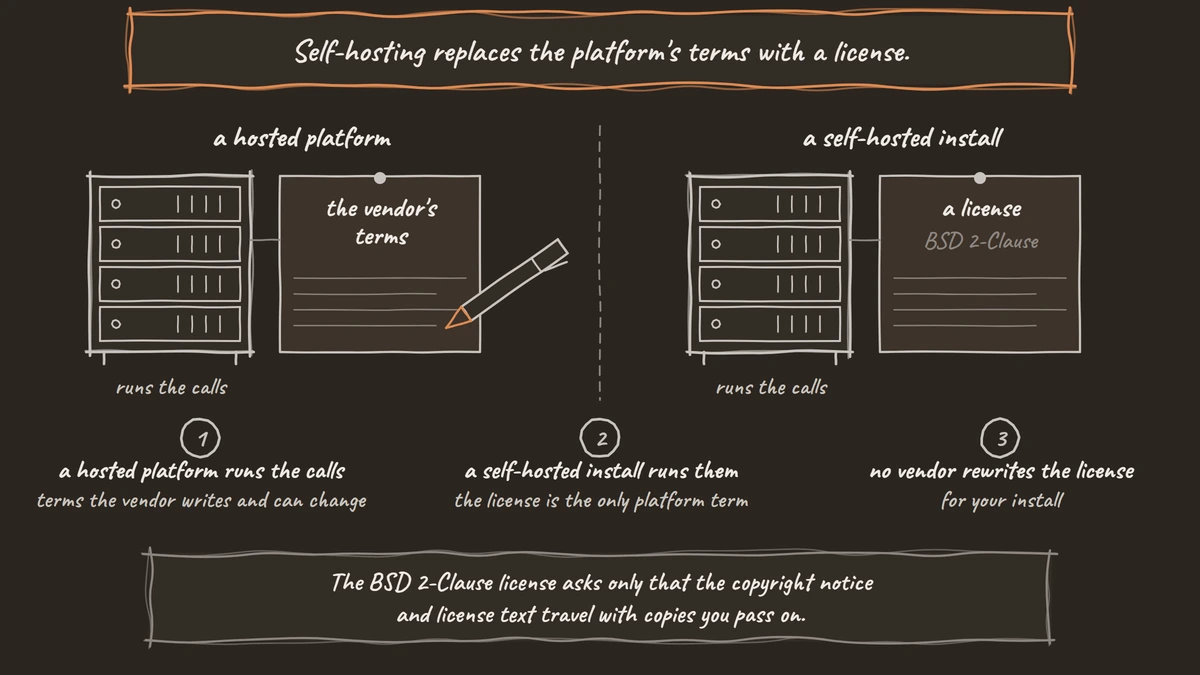
Self-hosting replaces the platform's terms with a license. Dograh's code is under the BSD 2-Clause license, a permissive license, so you can read it, change it, run it where you like and keep your changes private. No vendor can rewrite those terms for your install, suspend it or reuse your calls to improve a service.
Call records stay in your own database and storage, Postgres for call records and MinIO or Amazon S3 for recordings, as the deployment options set up. There is no retention setting and no automatic deletion, so your own storage rules decide how long calls are kept. Our post on voice agent call data retention walks through each record.
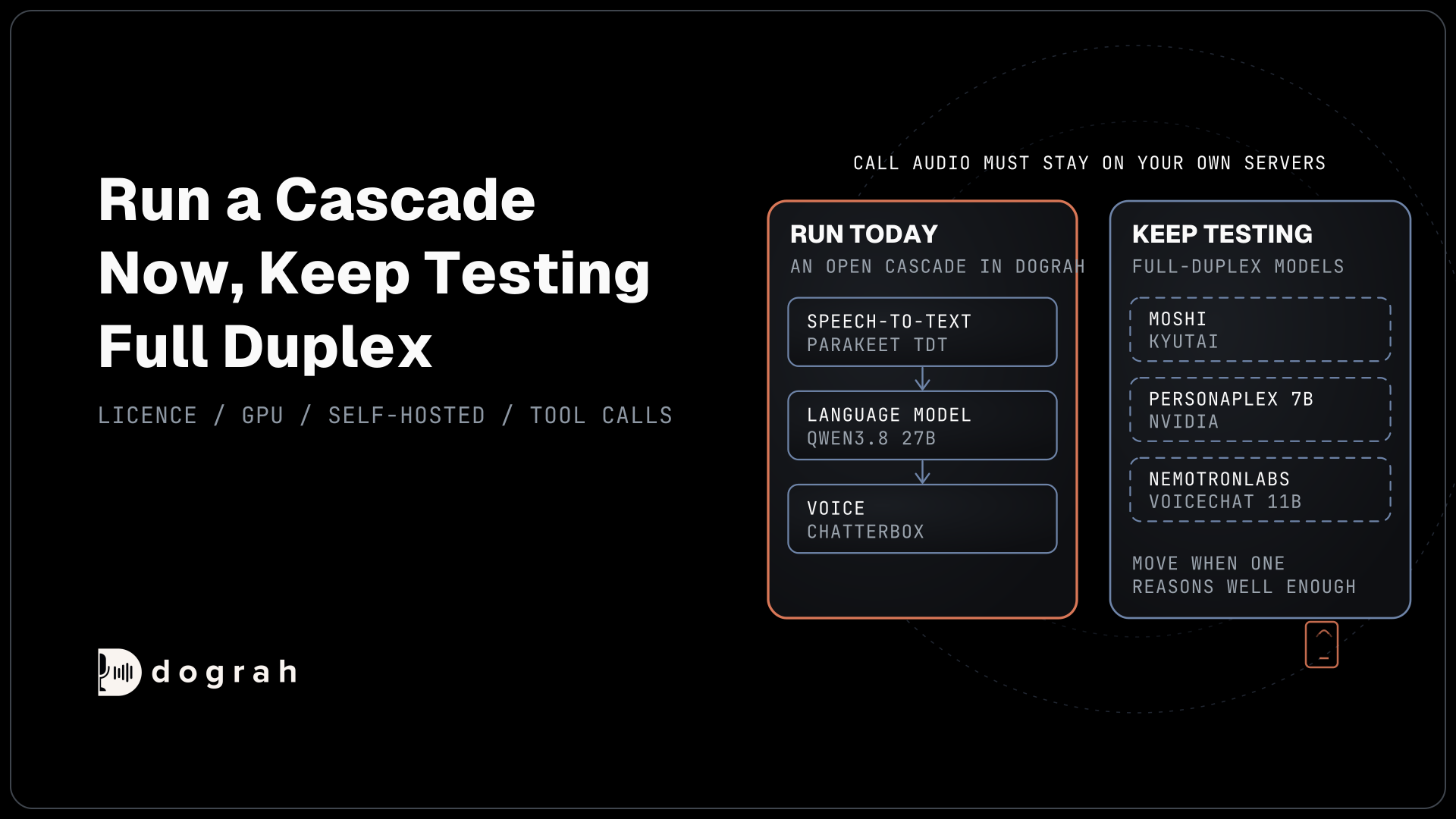
Dograh runs the orchestration layer, meaning the call flow, tools and telephony, while you pick the speech and language models as a second layer. You can use Dograh's own models, any provider with your own key, or open-weight models on your servers, all set in Model Configurations. Only local models keep the audio in-house, as our guide to running voice AI on local, self-hosted models explains.
Leaving is plain as well. Download Workflow saves an agent's definition as a file, and Upload Agent Definition loads it into another install, so an agent built on Dograh Cloud can move to your own servers later. Full call traces and built-in QA come with the platform on either route.
Self-hosting keeps the work and some of the cost. Self-hosted Dograh has no per-minute platform fee, but servers, model keys and phone minutes still cost money. Dograh Cloud charges a 1¢-a-minute platform fee. On your own servers, your team patches them and applies each release.
Join the Dograh Community
Dograh is an OSS alternative to Vapi. Join our Slack community for queries, releases, best practices & community interactions.
Questions to ask before you pick a route
Read the terms of any hosted platform the way you would read a lease. Ask whether it may use your calls to improve its service, and how you opt out. Ask how much notice it gives before its terms change, and how recordings and agent definitions come out if you leave.
If the answers fit your calls, a hosted platform is a fair choice. If a regulator or a customer needs the calls on your own servers, start with self-hosted Dograh, then pick models by where the audio is allowed to go.
Glossary
- Zero data retention
- A setting under which a hosted platform keeps no call data after the call. Vapi's terms describe it as not storing transcripts, audio or logs, and it depends on the service tier.
- AI-generated content
- The outputs a voice AI service produces, such as voice, transcripts, summaries and call analytics. Retell's terms give customers a license to use them for personal or internal business purposes, separate from the content customers submit.
- Bring your own key (BYOK)
- Connecting a platform to speech, language and voice providers with your own API keys, so the provider bills you directly. It changes whose contract covers the models, while the audio still reaches those providers.
- Permissive license
- An open-source license that lets you use, change and sell the code with few conditions. The BSD 2-Clause license asks only that the copyright notice and license text travel with copies you pass on.