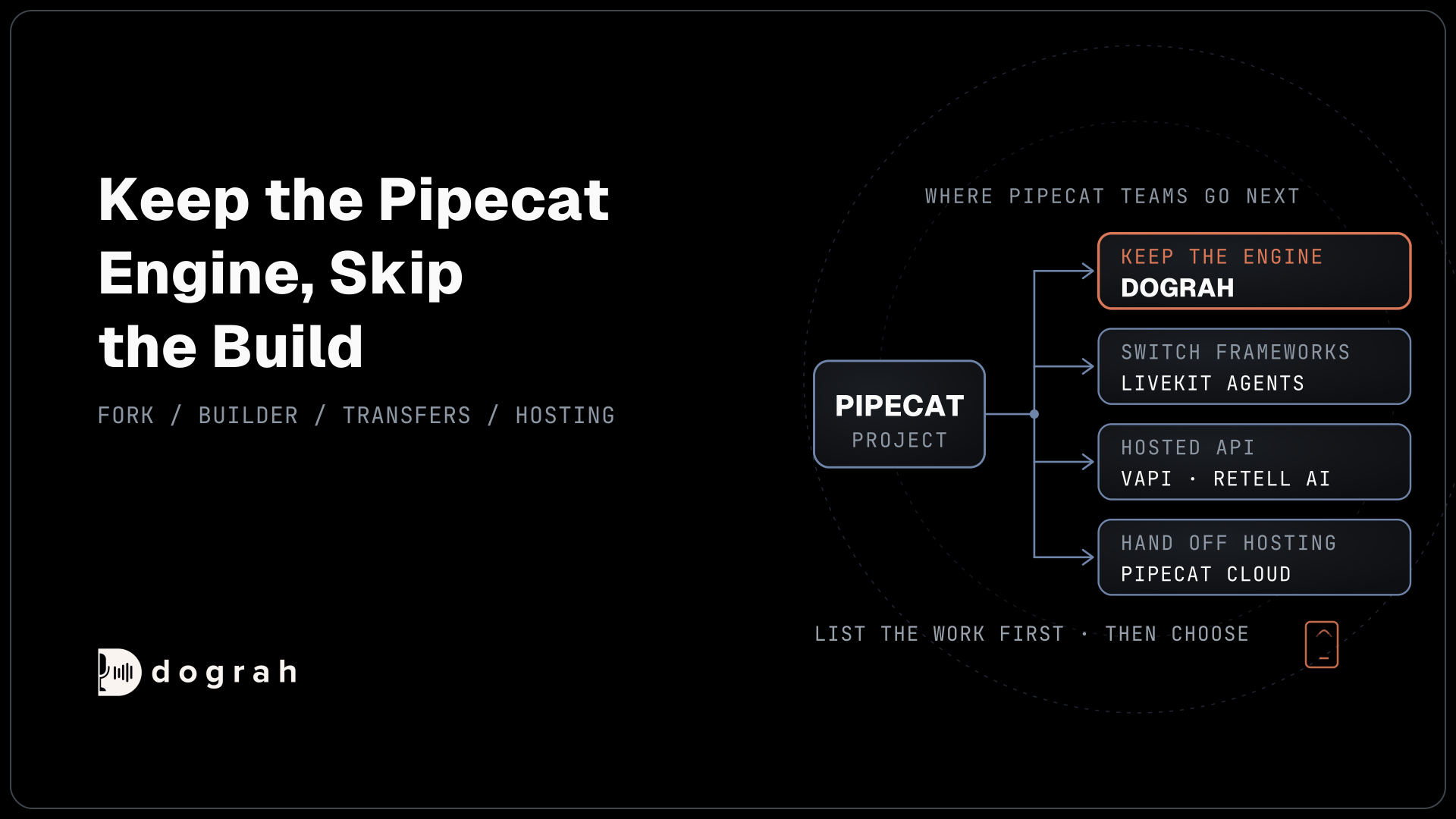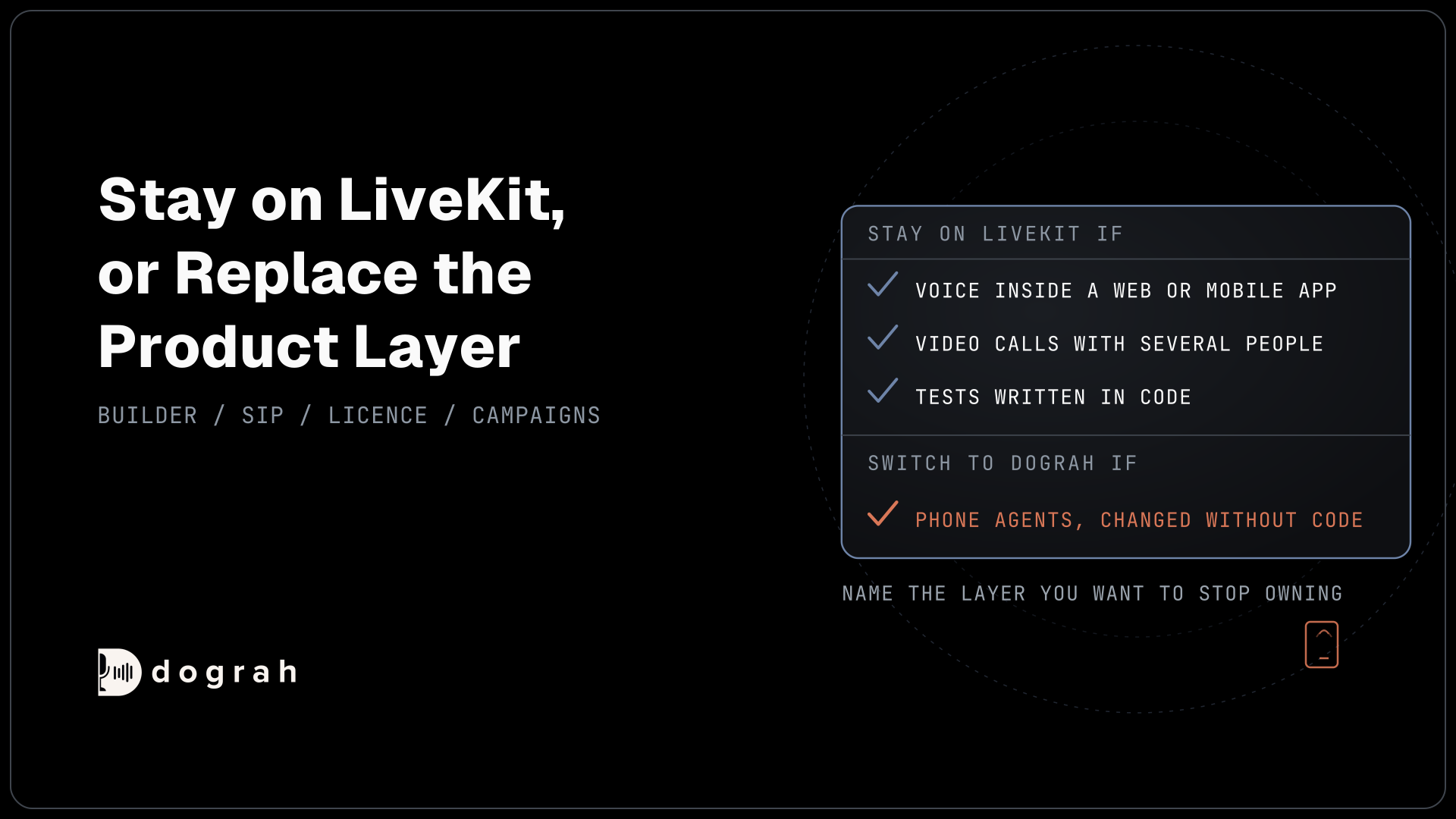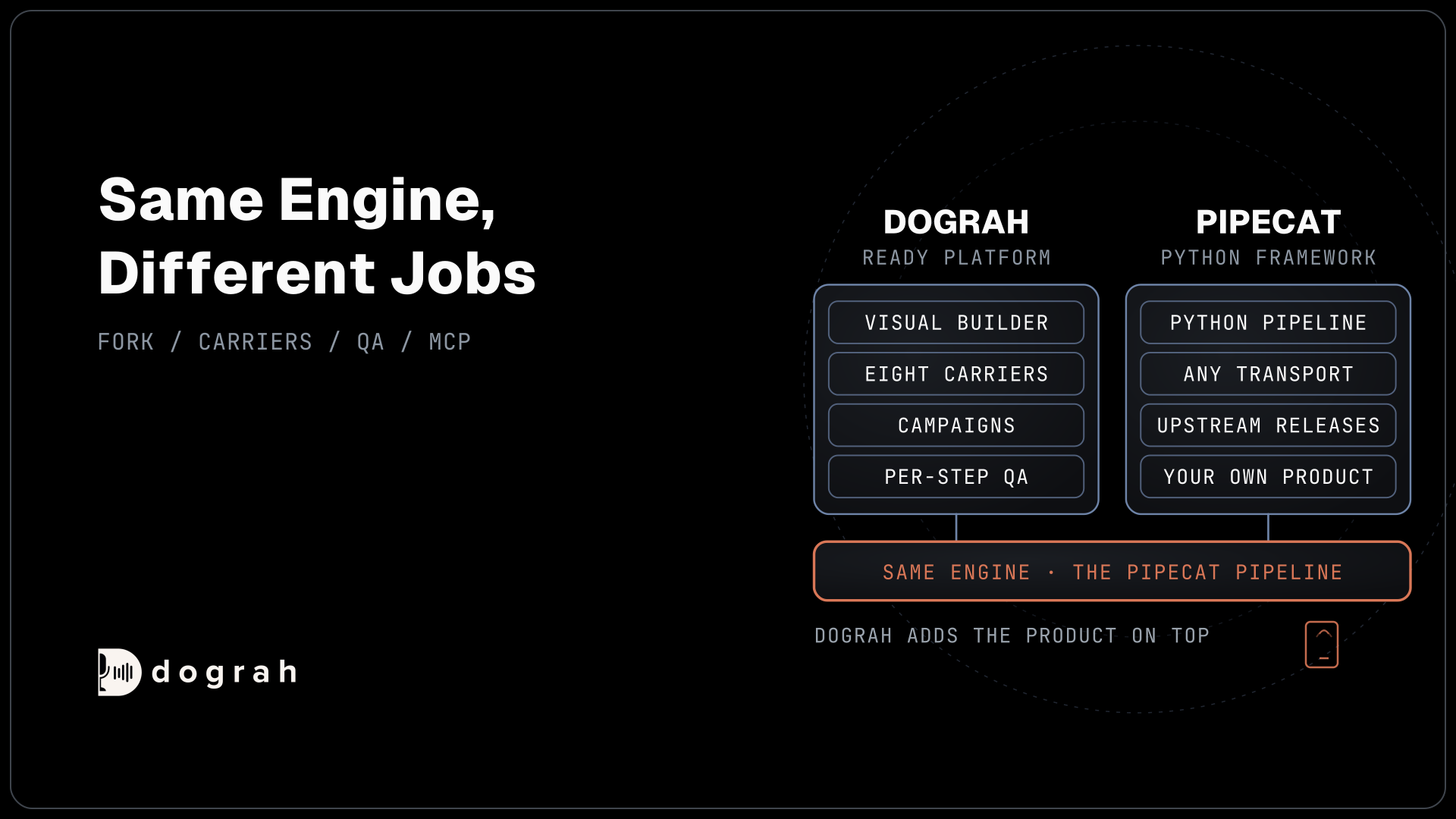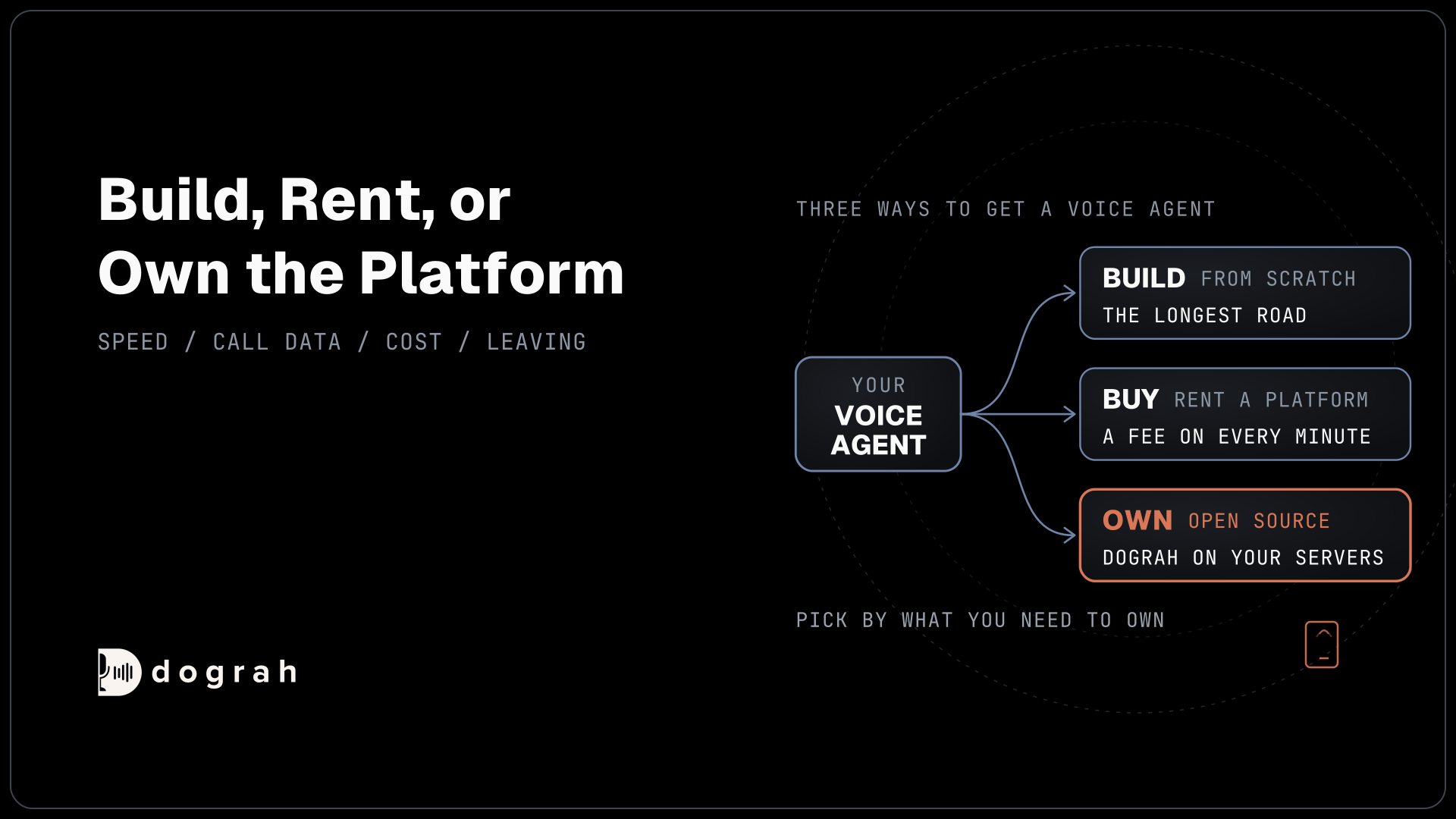

Build from scratch for full control and the longest road. Rent a closed platform for a fast start, paying a fee on every minute while it runs your agents. Or use Dograh, the open-source platform we build, which you can self-host or run on Dograh Cloud, so you own the orchestrator and choose which models hear your calls.
Key Takeaways
- Building from scratch trades months of engineering and on-call work for control.
- A provider's own terms decide whether it can keep or train on call data.
- Owning the platform and the models lets you tune agents on your own calls.
This post is part of our guide to The Business Case for AI Voice Agents: ROI and Payback, which gives building, buying and owning an open-source platform one paragraph each. Here we compare them on speed, call data, cost and leaving, with Dograh as the third.
Three ways to get a voice agent
You can build the stack yourself, rent a closed platform, or run an open-source platform you own. Building from scratch means wiring speech-to-text, a language model, a voice and telephony together, then writing turn-taking, tool calls and the call lifecycle around them. Most teams start from an open-source framework such as Pipecat or LiveKit, and our comparison of the best open-source voice AI platforms covers them. The work does not stop at launch. Someone stays on call for dropped calls and model upgrades for as long as the agent runs, and every carrier change lands on the same team.
Renting a closed platform is a fast start. You configure agents in the vendor's builder, they run on its servers, and you pay its fee on every minute. Vapi charges $0.05 a minute for hosting and Retell $0.055 a minute for voice infrastructure, with models and phone lines on top.
The third option is an open-source platform you own. Dograh comes ready to use, with a visual builder, so the first call is as quick as on a closed platform. You can self-host it, pick any speech and language models, and keep the code and your call data. Dograh runs the call flow, tools and telephony, and the models are a separate layer you choose.
The three options compared
The table puts the three side by side on what matters after the demo.
| Build from scratch | Rent a closed platform | Run an open-source platform you own (Dograh) | |
|---|---|---|---|
| Time to a first call | Longest: you write the call loop, telephony and tools | Fast: sign up and configure | Fast: run it with Docker, or start on Dograh Cloud |
| Who runs the servers | You | The vendor | You, or Dograh Cloud if you prefer |
| Where call audio goes | Wherever your chosen models run | The platform, plus the model providers it uses | Your servers, plus any hosted model you pick; with local models it stays with you |
| Per-minute platform fee | None; engineering time instead | Vapi $0.05 hosting; Retell $0.055 voice infrastructure | None self-hosted; a per-minute fee on Dograh Cloud |
| Who can change the code | You | Only the vendor | You, under a BSD-2 license |
| Leaving | Nothing to leave | Rebuild every agent elsewhere | Agents are JSON definitions you keep |
| Ongoing work | All of it, for as long as it runs | Prompts and tools | Upgrades and servers, or none on Dograh Cloud |
Self-hosting starts with a Docker install on a server you control. The fee and code rows are what change the business case most over time, because they decide what you pay on every call and how much of the agent you keep if you move.

Open Source Alternative to Vapi / Retell
Self-hosted voice agent platform — no per-minute fees
dograh-hq/dograh
Star on GitHub
Who can keep your call data
Whether a model provider can keep or train on your call data depends on its terms, and running the models on your own servers takes that question off the table.
Terms differ from one provider to the next. OpenAI's API data controls say API data is not used to train its models unless you opt in, but abuse-monitoring logs are kept for up to 30 days, and zero data retention needs OpenAI's approval.
ElevenLabs' terms of use let it use your content to improve its services, with an opt-out from training at any time and a data processing agreement for business accounts. Two providers, two different defaults. Read the terms for every model in the call, and read them again when they change.
A closed platform adds its own terms on top, because it handles the audio too. Bringing your own API key (BYOK) changes whose contract covers the audio, while the audio still goes to that provider. Only open-weight models running on your own servers, beside a platform you also run, keep the audio in your hands.
Voice adds one more layer. Under the General Data Protection Regulation (GDPR), personal data becomes biometric data when it is processed with specific technical means to identify a person. So a voice recording can count as biometric data when it is used to identify the speaker, such as a voiceprint check at login, and the stricter rules for that kind of data then apply, so check your own setup with counsel.
Owning the agents, and tuning them on your calls
Voice calls are full of personal details and business context, so the business that owns the orchestrator and the models owns its agents instead of renting them.
Every call leaves a recording and a transcript. In Dograh, the Report card on the agent's Settings page exports a CSV of completed calls with links to both. Self-hosted, those files sit in your own storage.
Over time, you can use your own call data to tune your own models for your use case, such as a speech-to-text model that hears your product names correctly, or a language model that follows your call flows more closely. That tuning is a project your team runs on data it already holds. The agent itself stays exactly as you set it up until you change it.
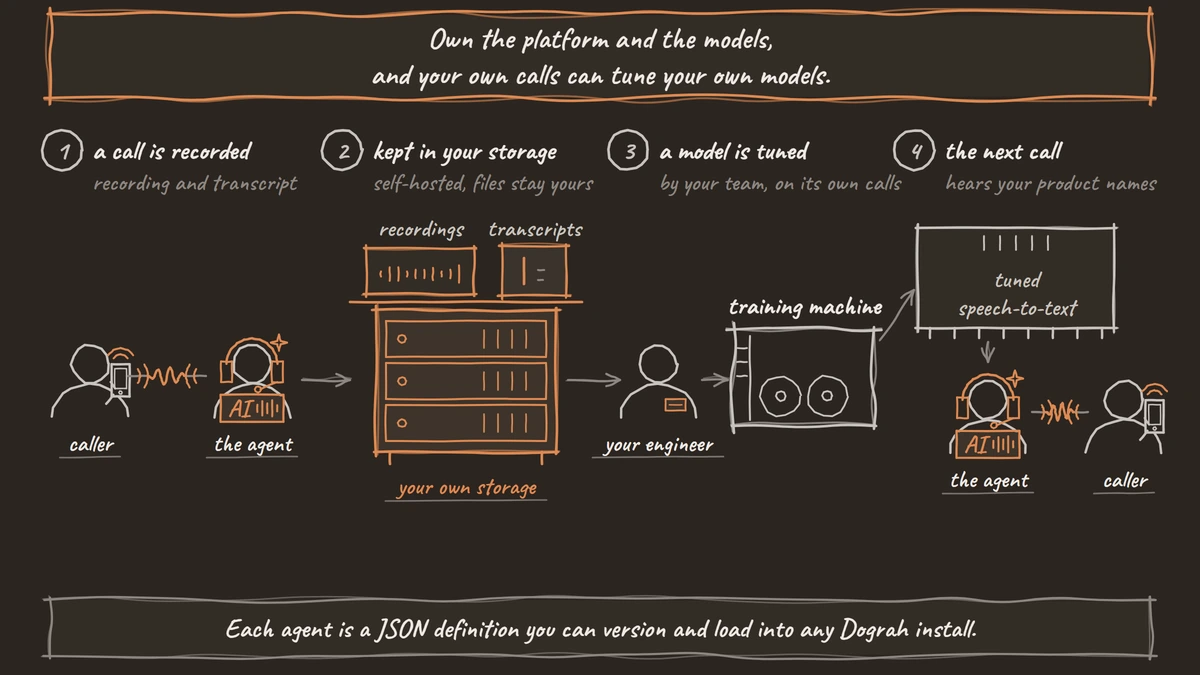
Open-weight models make this possible because you hold the weights. A common stack is Qwen3.8 27B for the language model, Parakeet TDT 0.6B v2 for speech-to-text, and Magpie TTS for fixed voices or Chatterbox where you need cloning. You connect them as model providers, and our guide to building a voice agent on fully local open-source models walks through the setup.
The agent is yours too. Each one is a workflow definition in JSON, the same structure the builder reads and writes, so you can keep it in version control and load it into any Dograh install.
Join the Dograh Community
Dograh is an OSS alternative to Vapi. Join our Slack community for queries, releases, best practices & community interactions.
Which option fits your team
Pick the option by what you need to own. Build from scratch when voice is your product and you have a team that will run it for years. Rent a closed platform when you need a test live this week at low volume and no rule limits where the audio goes. Run an open-source platform you own when calls carry personal data or when you want to tune models on your own calls. It also fits when a fee on every minute adds up at your volume.
Self-hosted Dograh has no per-minute platform fee (servers, model keys and phone minutes still cost). Dograh Cloud has a 1¢-a-minute platform fee. Our post on what an AI voice agent costs per minute adds up every line.
Leaving is the cost most teams skip. In a Zapier survey of 542 US enterprise executives, only 6% said they could stop using their primary AI vendor without any disruption. Our post on the open-source alternative to Vapi shows what changes when you run the platform yourself.
Glossary
- Orchestration layer
- The software that runs a voice agent's call flow, turn-taking, tool calls and telephony. Dograh is this layer, and the speech and language models plug into it as a separate choice.
- Open-weight model
- A model whose weights you can download and run on your own servers, such as Qwen3.8 27B or Parakeet TDT 0.6B v2. Holding the weights is what lets you keep the audio in-house and tune the model on your own calls.
- BYOK (bring your own key)
- Using your own account and API key with a model provider inside a platform. It changes whose contract covers the audio, while the audio still goes to that provider.
- Biometric data
- Under the GDPR, personal data processed with specific technical means to identify a person. A voice recording can count as biometric data when it is used to identify the speaker, such as a voiceprint check.