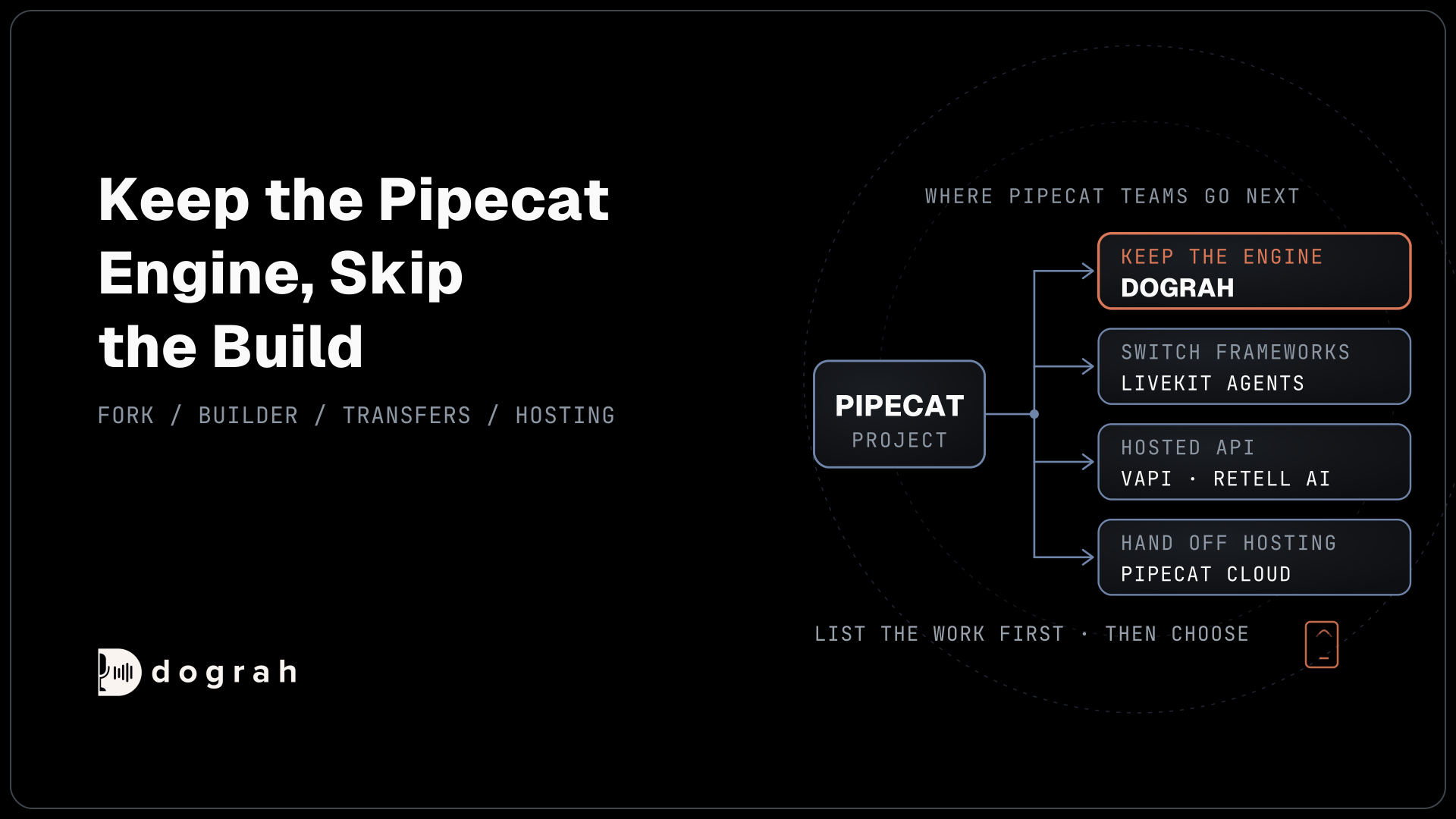

Pipecat alternatives split into two groups. Open-source options include Dograh and LiveKit Agents, and hosted APIs include Vapi and Retell AI. Dograh is an open-source, self-hostable AI voice agent platform built on a fork of Pipecat, with a visual builder, telephony, campaigns and QA ready to use. LiveKit Agents is the closest framework swap.
Key Takeaways
- Dograh keeps the Pipecat engine family and adds the product around it.
- LiveKit Agents is the closest framework swap, with native SIP and video.
- Teams building their own voice product usually do best staying on Pipecat.
This post is part of our guide to The Best Open-Source Voice AI Platforms Compared, which covers Pipecat on one page. Here we compare where Pipecat teams go next, by how much each option leaves you to build, starting with Dograh.
Why teams look past Pipecat
Teams rarely leave Pipecat because the engine is weak. It is a well-made BSD-2-Clause Python framework from Daily, with a wide choice of transports and AI services. They look elsewhere when the product around the pipeline turns into the bigger job.
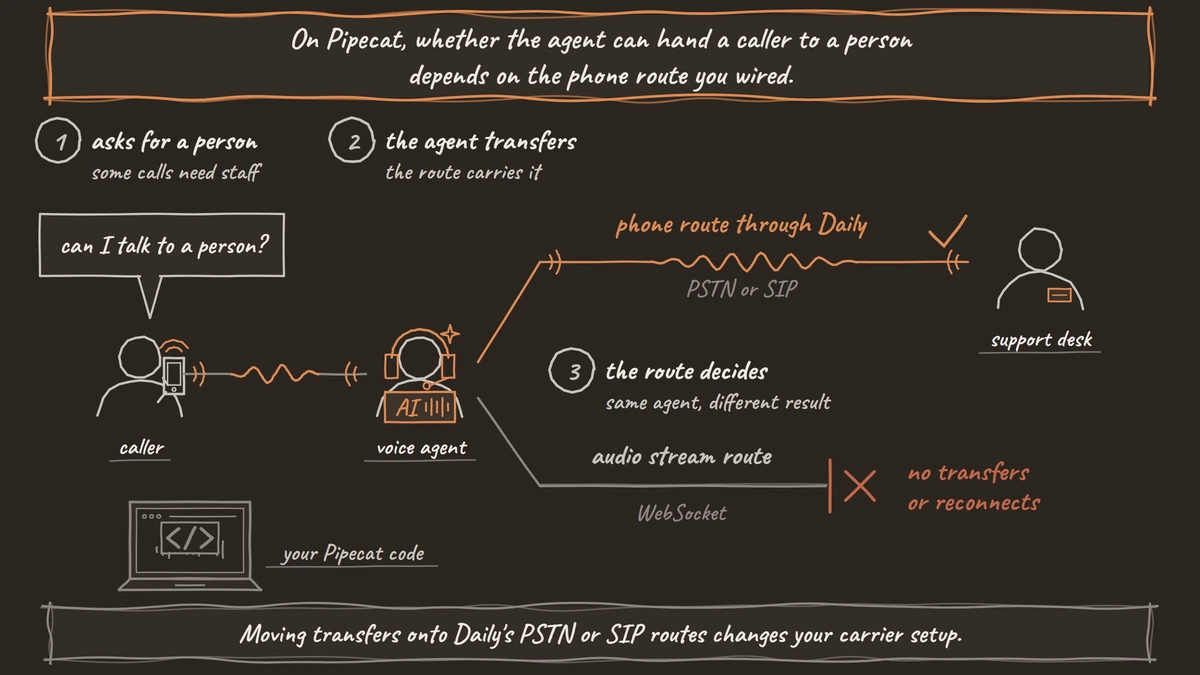
Phone calls show it first. Pipecat reaches carriers through telephony serializers, and Pipecat's telephony guide says its WebSocket integrations with Twilio, Telnyx, Plivo and Exotel have "No advanced call center features like transfers or reconnects". Transfers need Daily's PSTN or SIP routes instead, which changes your carrier setup.
Then comes the rest of the product. Somebody has to build a screen where non-developers edit prompts, outbound lists with retries, a store of call transcripts and QA on live calls. Pipecat does have an open tool, the Pipecat Flows Editor, for laying out call logic on a canvas, but it exports YAML into your project. Calls still run in your code, and everything around them is still yours to build.
Dograh: keep the engine, skip the build
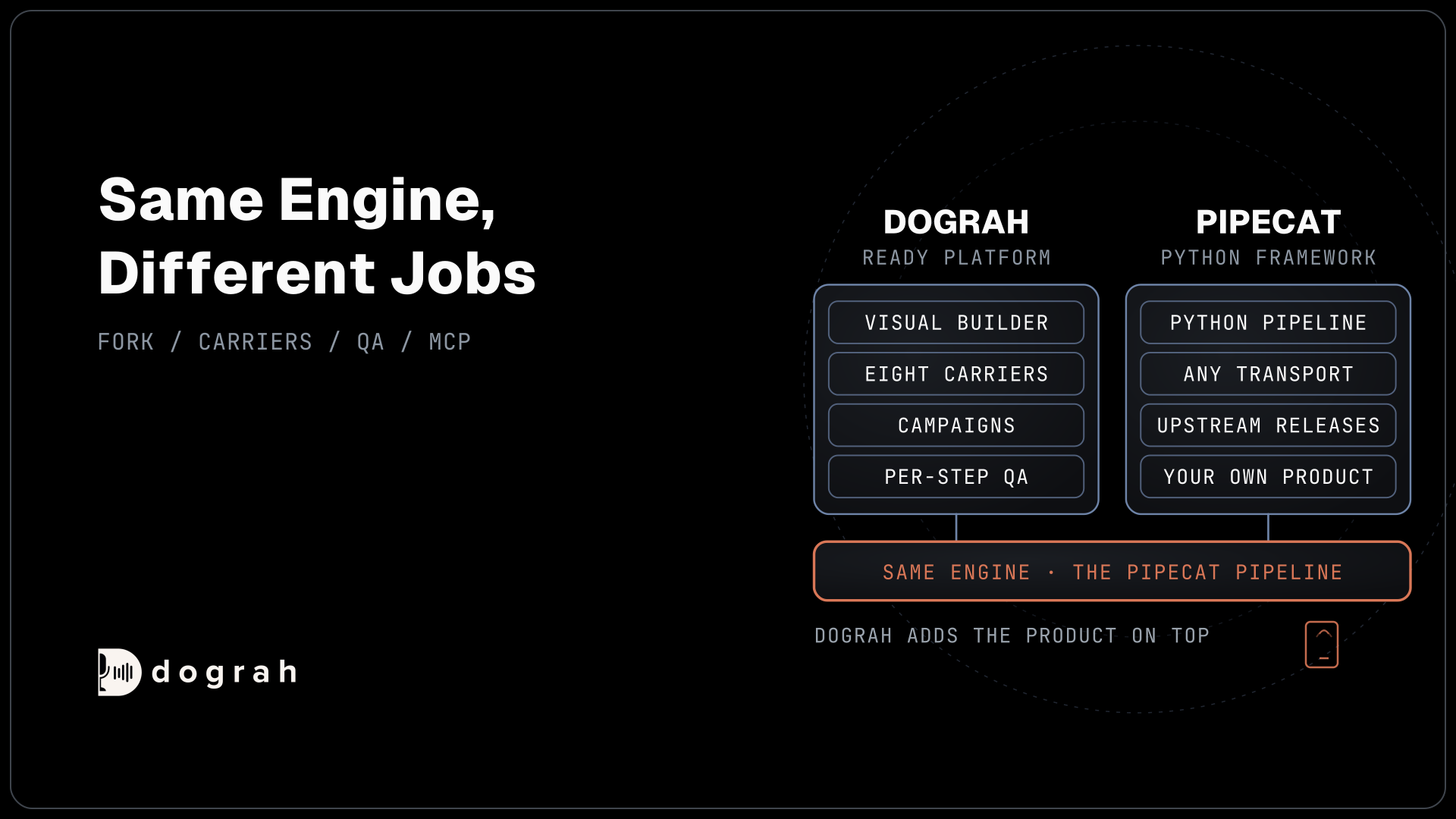
Dograh runs on a fork of Pipecat, so the pipeline that handles audio and turn-taking is one Pipecat teams already know. What changes is everything around it. Dograh is an open-source AI voice agent platform under BSD 2-Clause, and the product a Pipecat team would otherwise build comes in the box. For the move itself, see our landing page on migrating from Pipecat to Dograh.
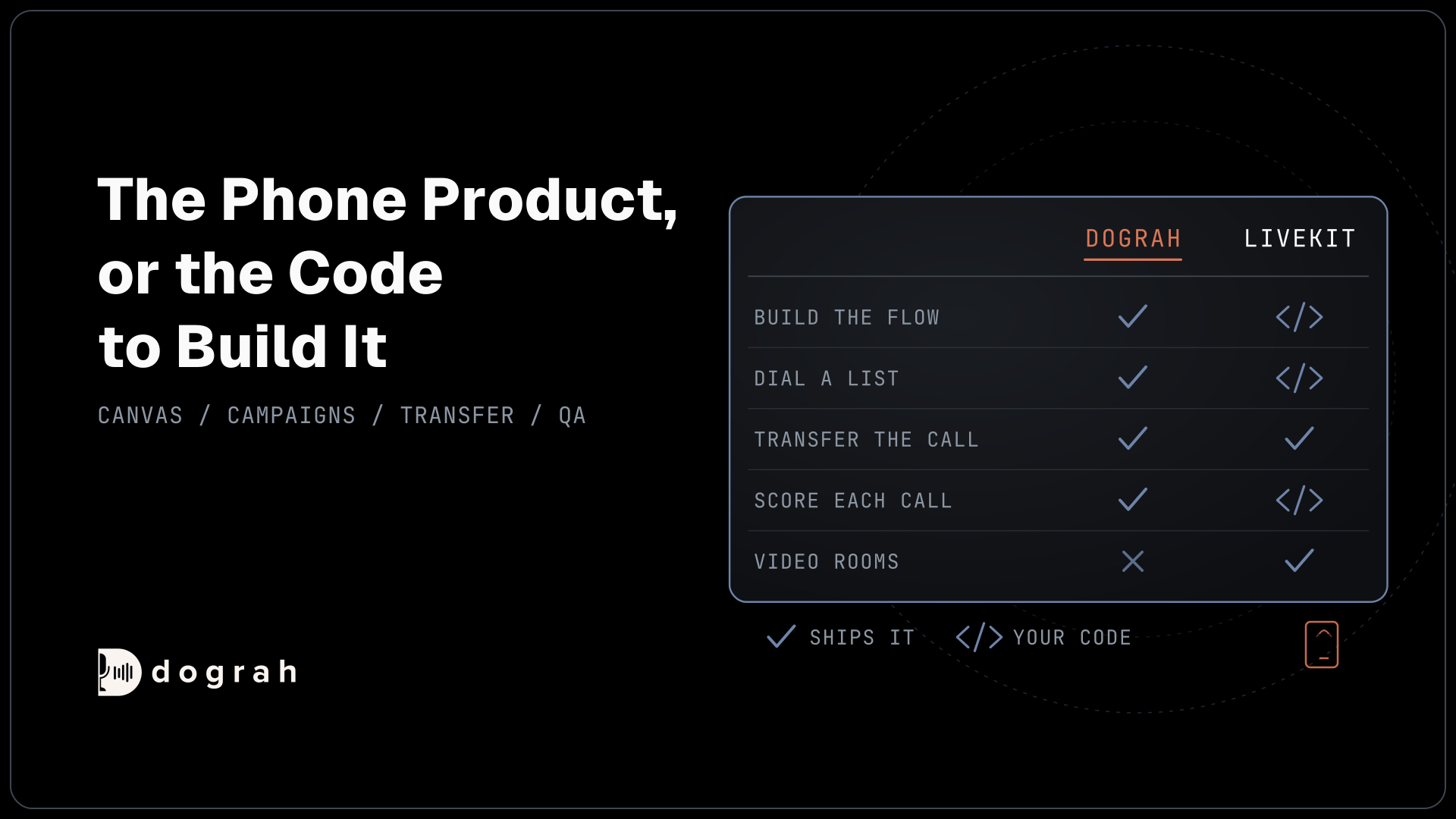
Agents are drawn in a visual workflow builder, with a greeting, agent nodes, tools, pathways and end-call outcomes, and tested in the browser by voice or in text. A support lead can change a prompt without touching Python.
Phone calls connect through your own carrier, whether that is Twilio, Vonage, Plivo, Telnyx, Exotel, Vobiz, Cloudonix or Asterisk ARI, or your own SIP trunk. The Transfer Call tool hands a caller to a person on Twilio, Telnyx, Plivo, Cloudonix and Asterisk ARI. Dograh calls the destination first and connects the caller only when someone answers. On Twilio, it can play a short spoken introduction to both people before connecting them. Outbound calls run as Campaigns, where you upload a CSV and set calling hours and retries. A running campaign can be paused and resumed later.
Every call is saved with its transcript and recording, along with a trace for debugging, and a QA node scores every step of a call after it ends. Models can be Dograh's own or any supported provider with your own keys. Any model behind an OpenAI-compatible endpoint works too, fully local ones included. An MCP server lets coding agents such as Claude Code build agents and read past call transcripts.
Self-hosted Dograh has no per-minute platform fee (servers, model keys and phone minutes still cost). Dograh Cloud has a 1¢-a-minute platform fee. For the full side-by-side, read our head-to-head with Pipecat.

Open Source Alternative to Vapi / Retell
Self-hosted voice agent platform — no per-minute fees
dograh-hq/dograh
Star on GitHub
LiveKit Agents and other open frameworks
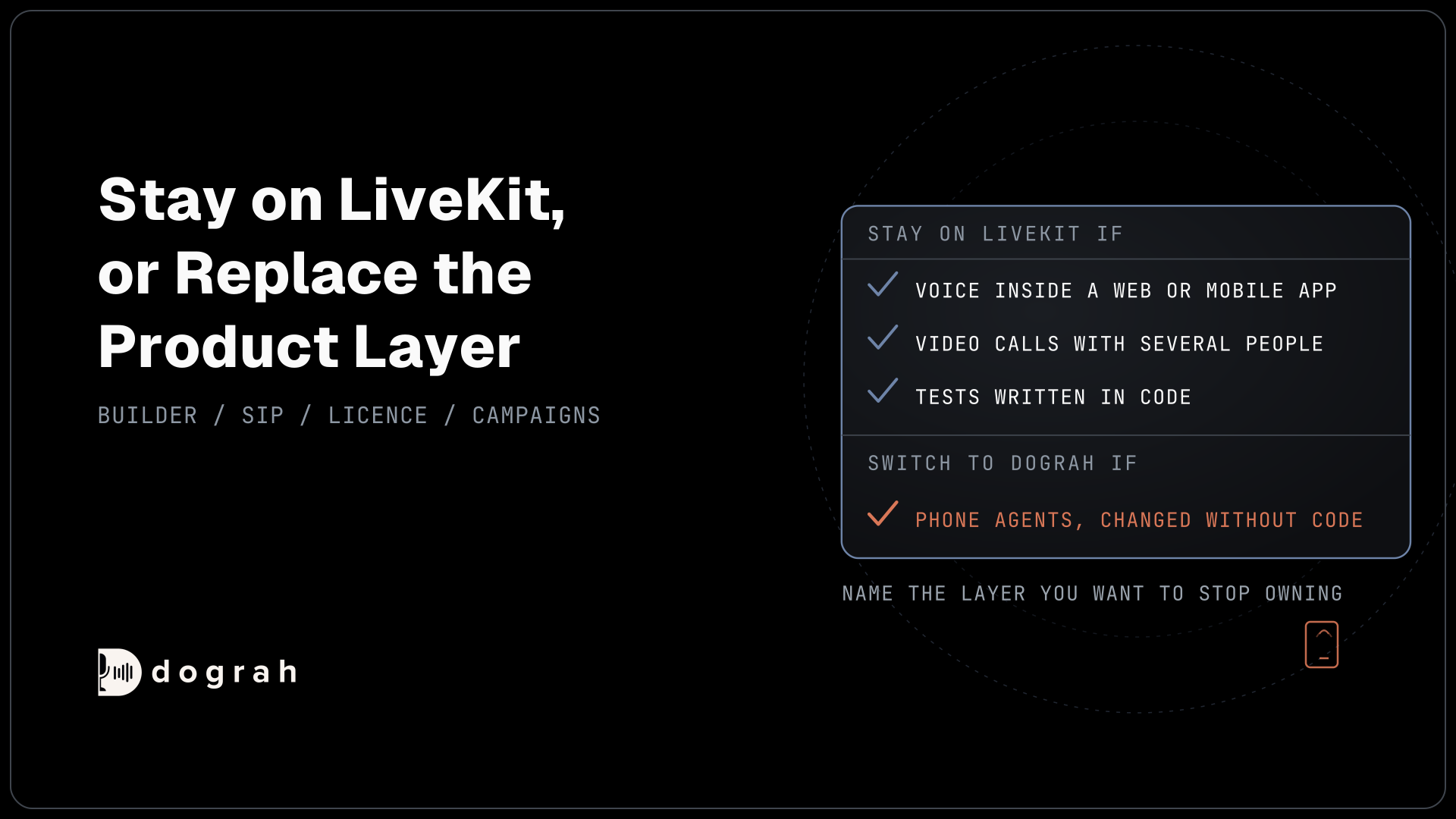
If you want to keep writing the agent in code, LiveKit Agents is the closest swap. It is an Apache-2.0 framework that runs your agent in a room on a LiveKit media server. It speaks SIP natively and supports both Python and Node. It also ships a built-in test framework for writing tests and judges. Its turn detection models come under the separate LiveKit Model License, and its Agent Builder handles simple agents only, without workflows or tests.
TEN Framework is another open framework, with a graph designer, released under Apache 2.0 with additional restrictions. Vocode, an MIT library, is now "actively looking for community maintainers", so check its activity before building on it. Our LiveKit vs Pipecat comparison goes deeper on the two leading frameworks.
Hosted APIs: Vapi and Retell AI
Hosted APIs take the servers off your hands, and the code goes with them. Vapi is a closed developer platform that charges $0.05 a minute for hosting, with models passed through at cost, and it includes 4 concurrent calls without a paid package. It does not support on-premise deployments. Retell AI is hosted and closed source as well, with voice infrastructure at $0.055 a minute.
Both suit teams that want a phone agent quickly and accept per-minute billing on someone else's cloud. Our Vapi vs Pipecat comparison covers that trade in detail.
Pipecat alternatives compared
| Option | License | What you get | Phone calls | Where it runs |
|---|---|---|---|---|
| Pipecat (baseline) | BSD-2-Clause | Python framework and Flows; the builder, call lists and QA are yours to build | Telephony serializers; transfers on Daily PSTN or SIP, not the WebSocket route | Your servers, or Pipecat Cloud |
| Dograh | BSD 2-Clause | Full platform on a Pipecat fork: builder, Campaigns, QA, transcripts, MCP server | Eight carriers or your own SIP trunk; Transfer Call on Twilio, Telnyx, Plivo, Cloudonix, Asterisk ARI | Your servers, or Dograh Cloud |
| LiveKit Agents | Apache-2.0; turn detector under its own license | Code framework, test framework, simple Agent Builder | Native SIP, cold and agent-assisted transfers | Your servers, or LiveKit Cloud |
| TEN Framework | Apache 2.0 with additional restrictions | Framework with a graph designer | SIP examples | Your servers |
| Vapi | Closed source | Hosted developer platform | Vapi numbers or imported ones | Vapi's cloud only |
| Pipecat Cloud | BSD-2-Clause framework, hosted by Daily | Your Pipecat agent, run for you | Daily PSTN and SIP, or your carrier | Daily's cloud, or your VPC on Enterprise |
Only Dograh gives you both the open code and the finished product. The frameworks give you the code, and Vapi gives you the product on its own cloud.
When staying on Pipecat is right
Stay on Pipecat if your team is building its own voice product, with its own interface, and wants to own every stage of the pipeline in Python. It also fits voice inside a web or mobile app, or a transport such as WhatsApp, where its client SDKs and transport range go further than a phone-first platform.
If the pain is servers, not features, keep Pipecat and hand off hosting. Pipecat Cloud runs your agent on Daily's infrastructure from $0.01 per active minute on its smallest agent size. Pipecat Enterprise runs agents inside your own VPC while Daily runs the control plane.
If the pain is the product around the pipeline, you need an orchestration layer, and our explainer on the orchestration layer in voice AI lists every job it runs.
Join the Dograh Community
Dograh is an OSS alternative to Vapi. Join our Slack community for queries, releases, best practices & community interactions.
Glossary
- Telephony serializer
- Pipecat's adapter that converts one carrier's audio stream format into the pipeline's own. On its WebSocket phone integrations it carries audio, but not call-centre features such as transfers or reconnects.
- Pipecat Flows Editor
- An open-source web editor for laying out Pipecat call logic on a canvas and exporting it as YAML into a Pipecat project. It designs flows, and the calls still run in your own code.
- Orchestration layer
- The software that runs the call flow, tools, telephony and call lifecycle around the speech and language models. Dograh is one. With a framework, your team builds it.