
LiveKit vs Pipecat comes down to rooms or a pipeline. LiveKit Agents (Apache-2.0) runs your agent as a participant in a room on LiveKit's media server, with native SIP, Python and Node, and a test framework. Pipecat (BSD-2-Clause) is a Python pipeline that runs over almost any transport. Both are frameworks your developers build a product on.
Key Takeaways
- LiveKit fits rooms and in-app voice, and Pipecat fits custom Python pipelines.
- Check transfers first, since Pipecat's WebSocket carrier route cannot transfer calls.
- Models set most of the bill, under either framework.
This post is part of our guide to The Best Open-Source Voice AI Platforms Compared, which points here for the direct comparison. We cover architecture, phone calls, turn detection, testing and cost, then an option for teams wanting neither.
Rooms or a pipeline
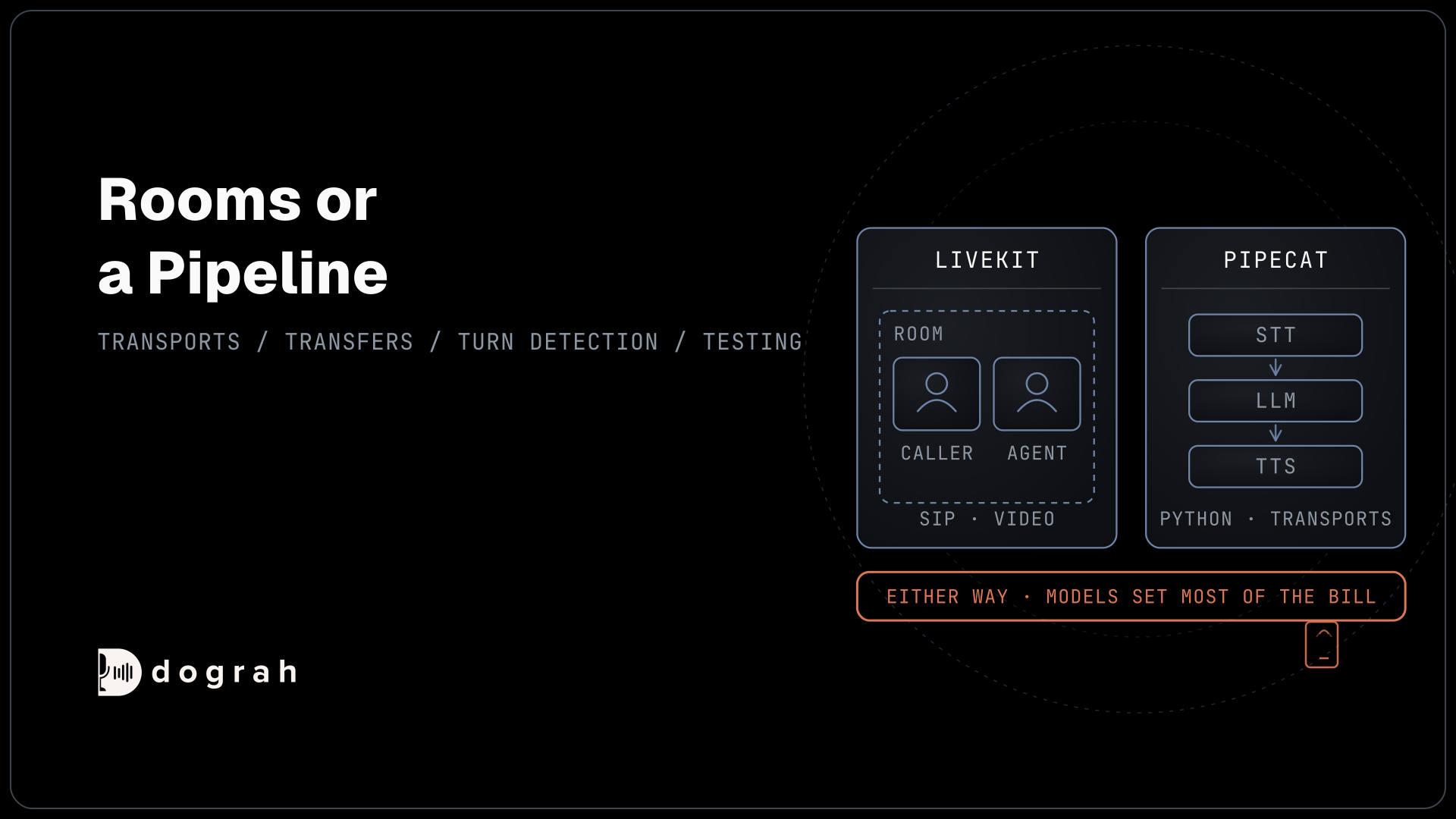
The two frameworks start from different shapes. LiveKit Agents puts your agent into a room on the LiveKit media server, where it joins as one participant beside the caller. Pipecat builds a pipeline, where audio flows through processors for speech-to-text, the language model and text-to-speech, then back out.
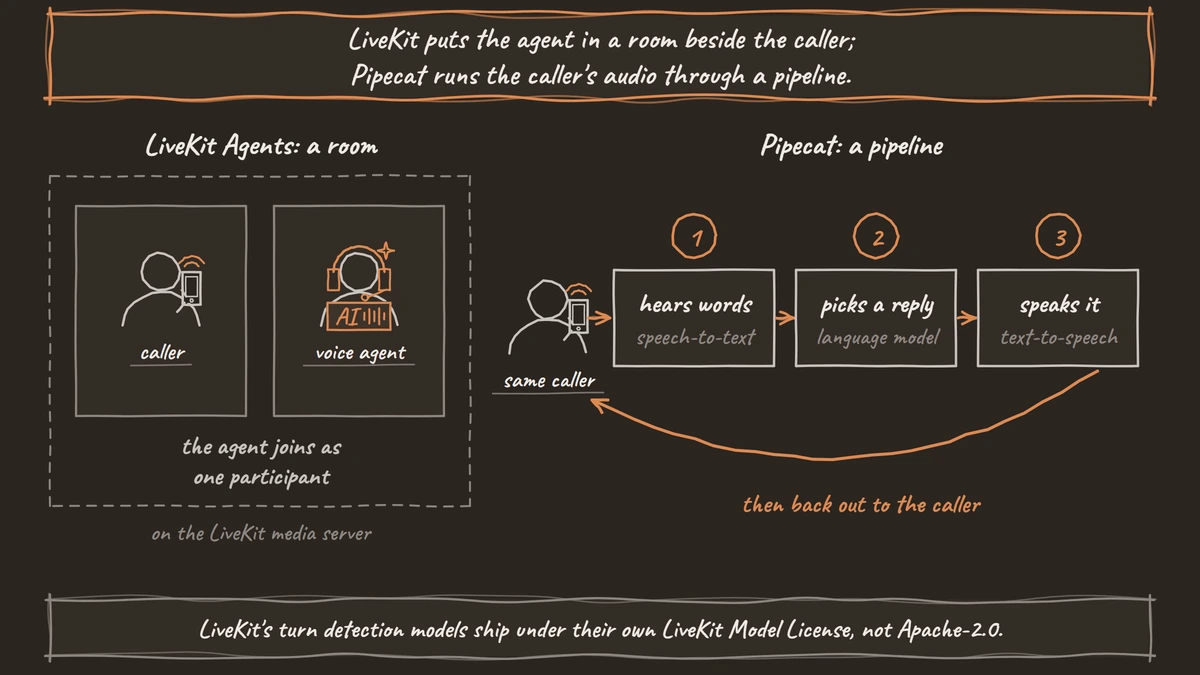
The licenses differ in one detail. Pipecat is BSD-2-Clause throughout, and its Smart Turn model is BSD 2-clause too. LiveKit Agents is Apache-2.0, while its turn detection models ship under the separate LiveKit Model License. Both frameworks are widely used, so popularity will not tell you which one fits your product.
Transports and phone calls
Pipecat treats transport as a choice. The same pipeline can run over Daily WebRTC, SmallWebRTC, a plain WebSocket, WhatsApp, or even LiveKit, with client SDKs for JavaScript, React, React Native, Swift, Kotlin, C++ and ESP32.
For phone calls, Pipecat uses telephony serializers for Twilio, Telnyx, Plivo, Exotel, Vonage and Genesys. Check the transfer story before you commit. Pipecat's telephony guide says its WebSocket integrations with Twilio, Telnyx, Plivo and Exotel have "No advanced call center features like transfers or reconnects". Daily's PSTN and SIP routes support transfers.
LiveKit speaks SIP natively. A call comes in through your SIP trunk and becomes a room the agent joins. LiveKit's telephony docs list tested carriers, including Twilio, Telnyx, Exotel and Plivo, along with cold transfers and agent-assisted transfers. LiveKit Cloud also sells US local and toll-free numbers.
For a phone-only agent, both work. LiveKit's native SIP includes transfers, while Pipecat asks you to pick your phone route with transfers in mind.
Turn detection and testing
Both frameworks now use audio models to decide when the caller has finished speaking, which shapes how natural a call feels. Our post on barge-in, endpointing and turn-taking explains why.
Pipecat's Smart Turn model is at v3.2. It is "a truly open model (BSD 2-clause license)", supports 23 languages and runs on CPU in an 8 MB quantized build.
LiveKit's turn detector is an audio model built into the Agents SDK, with 14 languages. The full v1 runs on LiveKit Inference, and v1-mini runs locally on CPU under the LiveKit Model License.
Testing is where LiveKit pulls ahead out of the box. LiveKit Agents ships a test framework, so you write tests and use LLM judges as part of development. With Pipecat, you bring your own test setup.

Open Source Alternative to Vapi / Retell
Self-hosted voice agent platform — no per-minute fees
dograh-hq/dograh
Star on GitHub
Hosting and what it costs
Both frameworks are free to self-host, and both companies sell a managed cloud. LiveKit Cloud starts with a free Build plan of 1,000 agent session minutes and 5 concurrent sessions. Ship starts at $50 a month and Scale at $500, each with included minutes and then $0.01 a minute. Pipecat Cloud charges $0.01 per active minute on its smallest agent size, with Daily phone calls at $0.018 a minute.
The framework is a small part of the bill. In a worked example from Fora Soft, a development agency, about $391 of the roughly $531 that 10,000 cascade-model minutes cost each month goes to the speech and language models, the same under either framework. Managed hosting is about $100 of it on either cloud. So choose the framework on fit, and choose the models with care.
LiveKit vs Pipecat side by side
| LiveKit Agents | Pipecat | Dograh | |
|---|---|---|---|
| What it is | Framework on a media server | Python pipeline framework | Open-source AI voice agent platform on a Pipecat fork |
| License | Apache-2.0; turn detector under the LiveKit Model License | BSD-2-Clause, Smart Turn included | BSD 2-Clause |
| Languages to build in | Python, Node | Python | Visual builder; MCP for coding agents |
| Transports | LiveKit rooms and SIP | Daily, WebSocket, WhatsApp, LiveKit and more | Phone carriers and the browser |
| Phone transfers | Cold and agent-assisted | On Daily PSTN or SIP, not WebSocket | Transfer Call on Twilio, Telnyx, Plivo, Cloudonix, Asterisk ARI |
| Testing | Built-in test framework | Bring your own | Test Audio, Test Chat, per-step QA on calls |
| Managed cloud | LiveKit Cloud | Pipecat Cloud | Dograh Cloud |
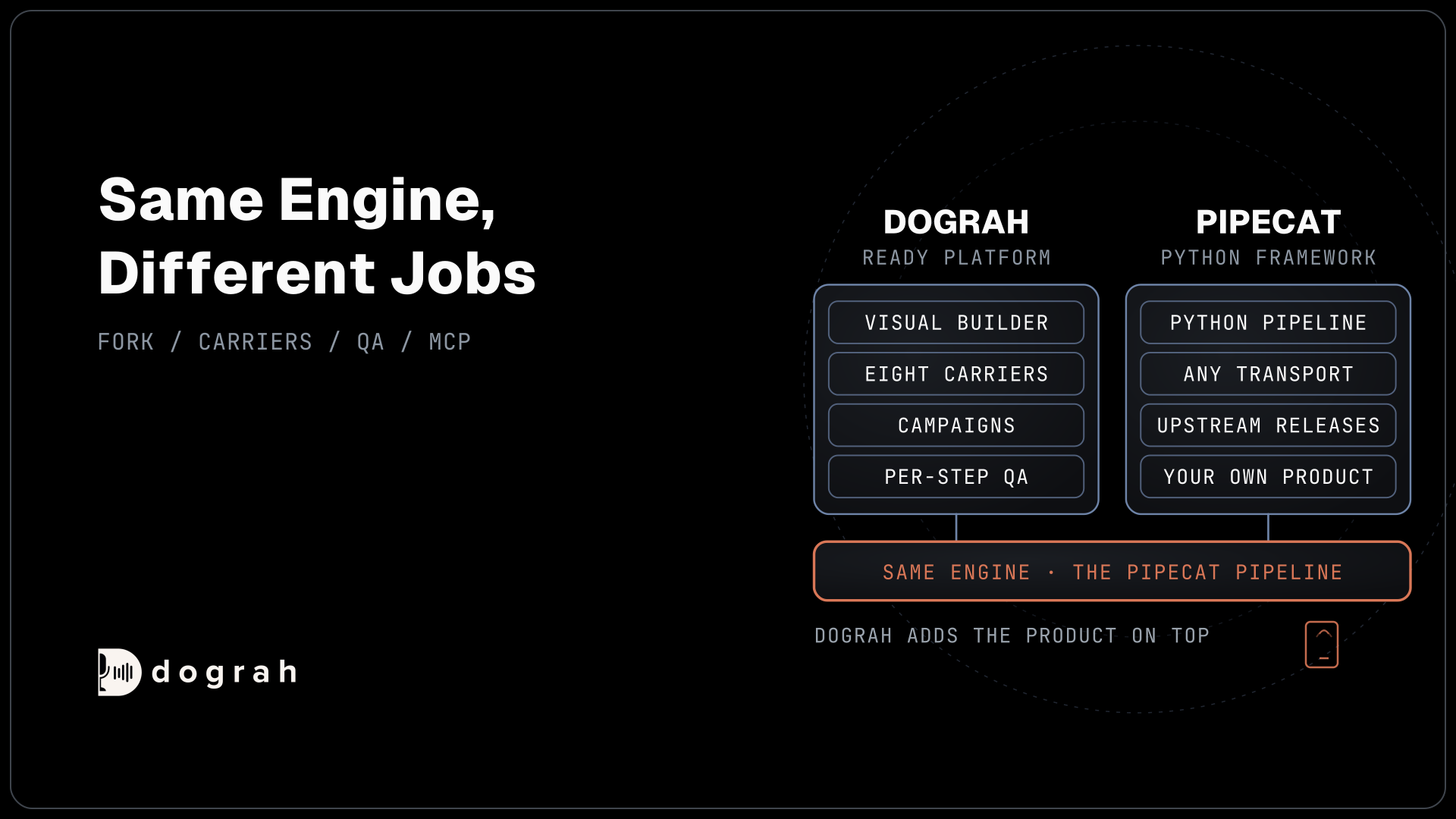
The first two columns are frameworks, so the product around the agent is yours to build. The third is the exception, covered next.
Which to pick, or neither
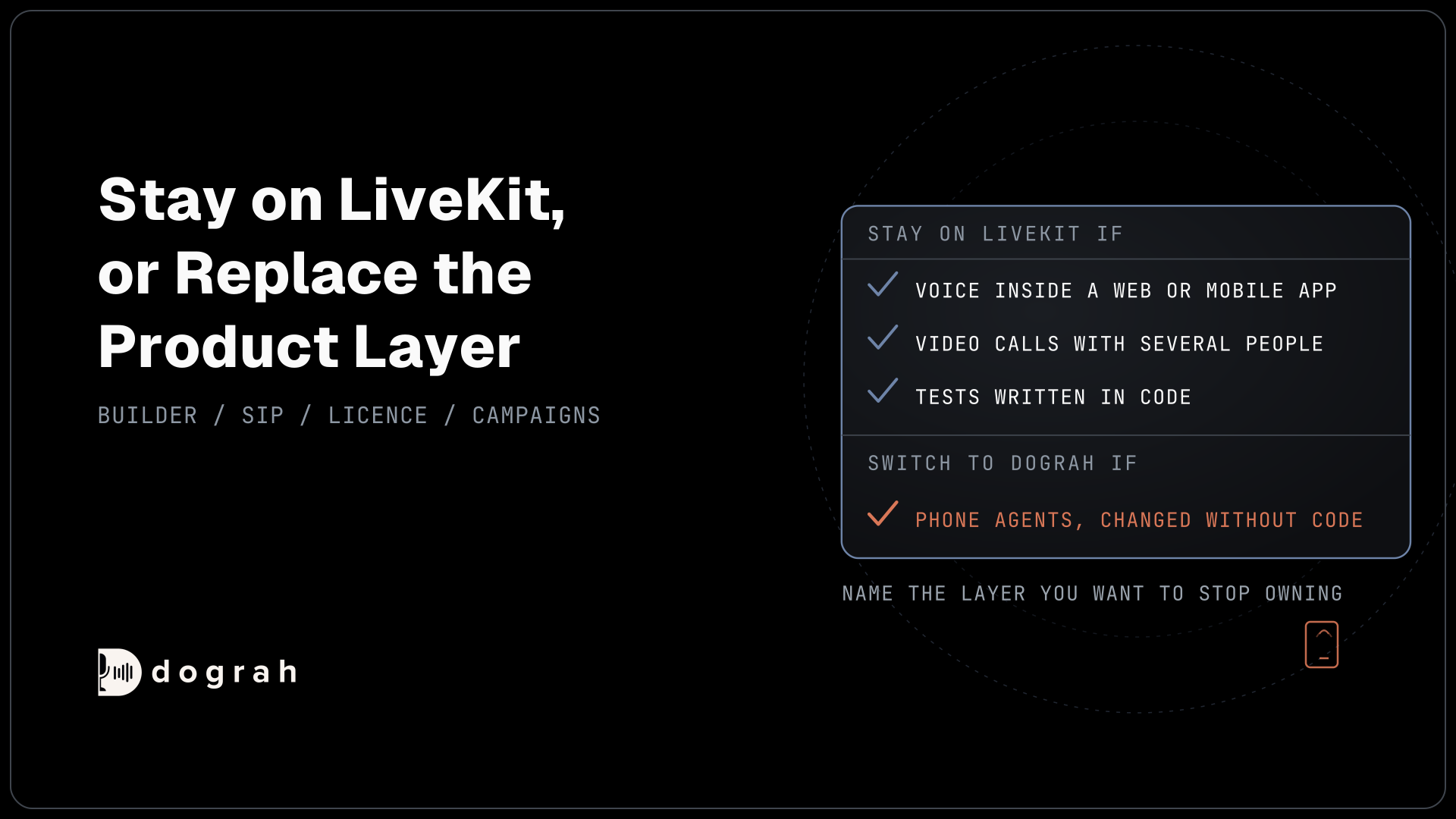
Pick LiveKit Agents for voice inside a web or mobile app, video or multi-party rooms, a Node backend, or a team that wants tests in code from day one. Pick Pipecat for a custom pipeline in Python with provider swaps at every stage, or for transports such as WhatsApp.
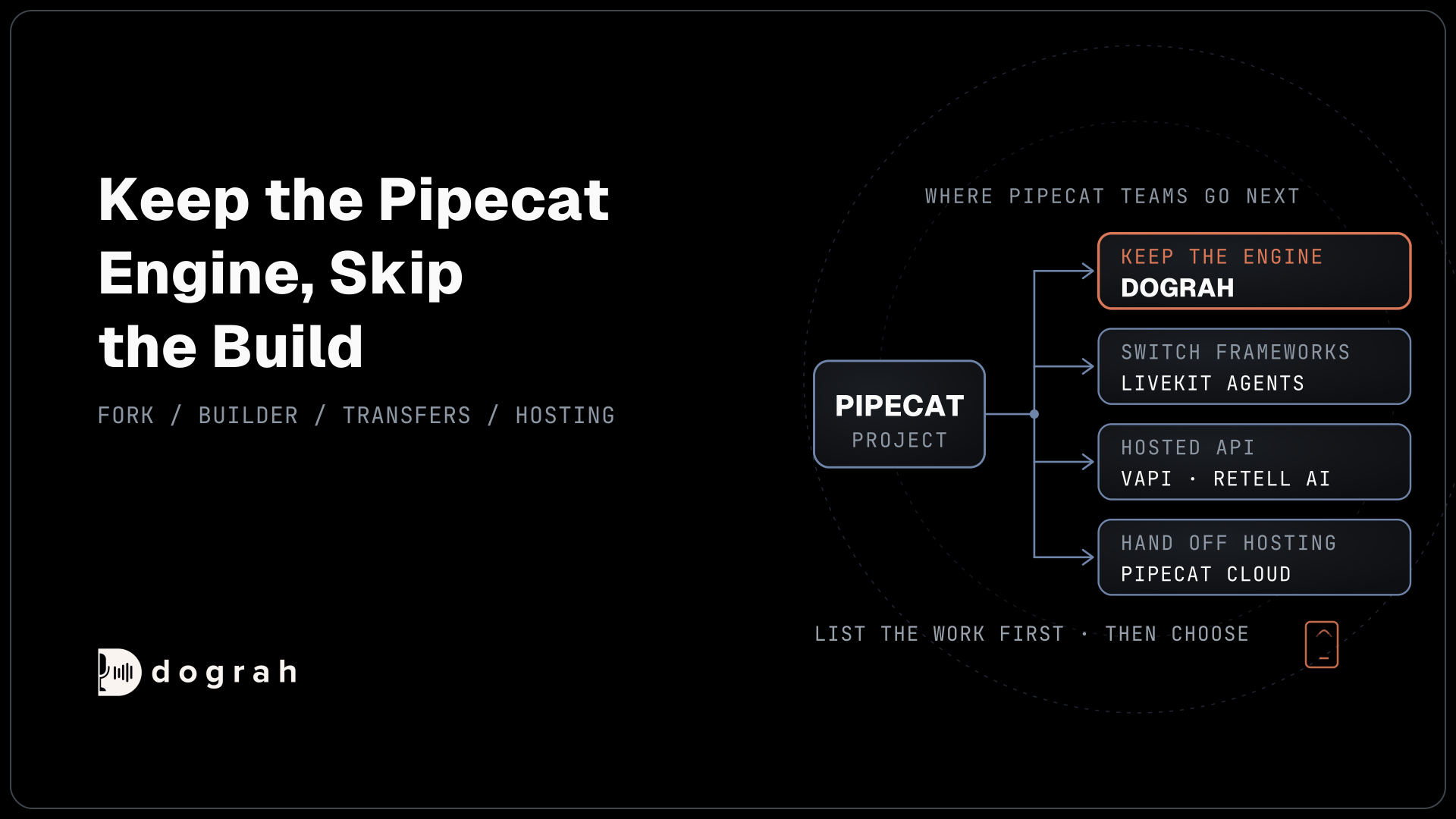
Some teams want neither build. Dograh is an open-source AI voice agent platform that runs on a fork of Pipecat and ships the product layer for phone agents.
That layer includes a visual workflow builder, eight carriers, five of them with call transfer, Campaigns for outbound lists, per-step QA, model choice down to fully local models, and an MCP server for coding agents. Self-hosted Dograh has no per-minute platform fee (servers, model keys and phone minutes still cost). Dograh Cloud has a 1¢-a-minute platform fee.
Our Dograh vs LiveKit and Dograh vs Pipecat comparisons take each framework against that platform in detail.
Join the Dograh Community
Dograh is an OSS alternative to Vapi. Join our Slack community for queries, releases, best practices & community interactions.
Glossary
- Turn detection model
- A model that decides when the caller has finished speaking. Pipecat's Smart Turn is BSD 2-clause, and LiveKit's v1-mini runs under the LiveKit Model License.
- Telephony serializer
- Pipecat's adapter that converts one carrier's audio stream into the pipeline's format. Its WebSocket phone integrations carry audio but not transfers or reconnects.
- Transport
- How audio gets in and out of the agent: a WebRTC room, a WebSocket, a phone line or a messaging app. Pipecat lets you pick one per project, while LiveKit Agents uses LiveKit rooms and SIP.