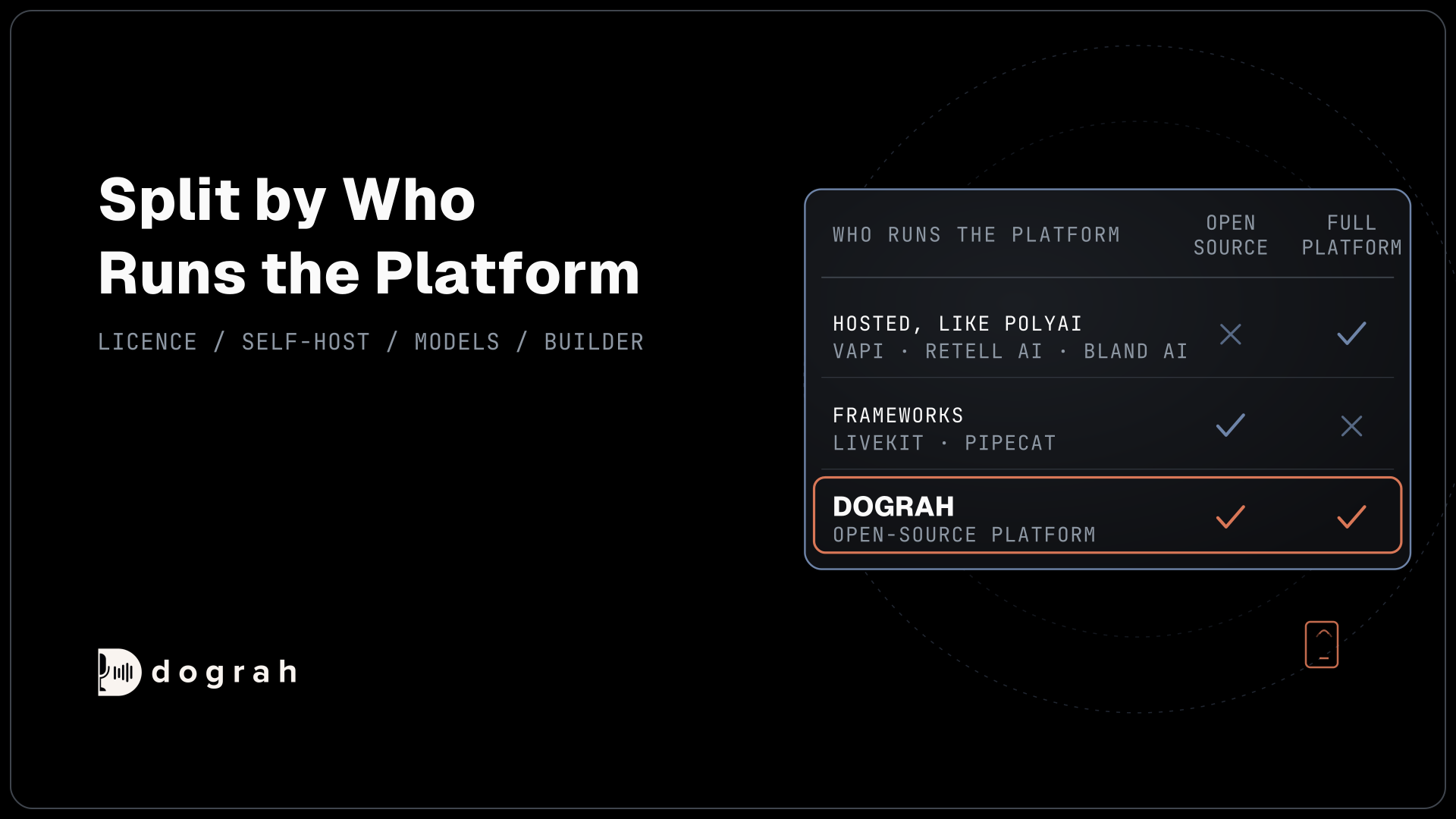

The best open-source voice AI platforms split into one full platform and several frameworks. Dograh ships the builder, telephony, campaigns, QA and call history in one BSD-2 codebase that you can self-host or run on Dograh Cloud. Pipecat (BSD-2) and LiveKit Agents (Apache-2.0) are strong frameworks that your developers build a product on.
Key Takeaways
- Read every license file, because open source sometimes stops at the engine.
- Dograh ships the product around the call. Frameworks leave it to your developers.
- Pipecat and LiveKit Agents suit teams building their own voice product.
This guide reads each project's license and sorts full platforms from frameworks, then lists what a team builds before its first real phone call. Dograh, the open-source AI voice agent platform we build, comes as the full platform. Pipecat and LiveKit Agents follow, then four smaller projects.
What open source means for a voice agent
Open source in voice AI covers very different things, so read the license file of every part you plan to ship. Some projects open the whole product. Others open the engine and keep parts such as a builder or a model under other terms.
The split shows up quickly. Bolna's core is MIT, but its hosted APIs and no-code playground are closed source. LiveKit Agents is Apache-2.0, while its turn detection models ship under a separate LiveKit Model License. TEN Framework uses Apache 2.0 with additional restrictions. Jambonz licenses self-hosting per session or per cluster.
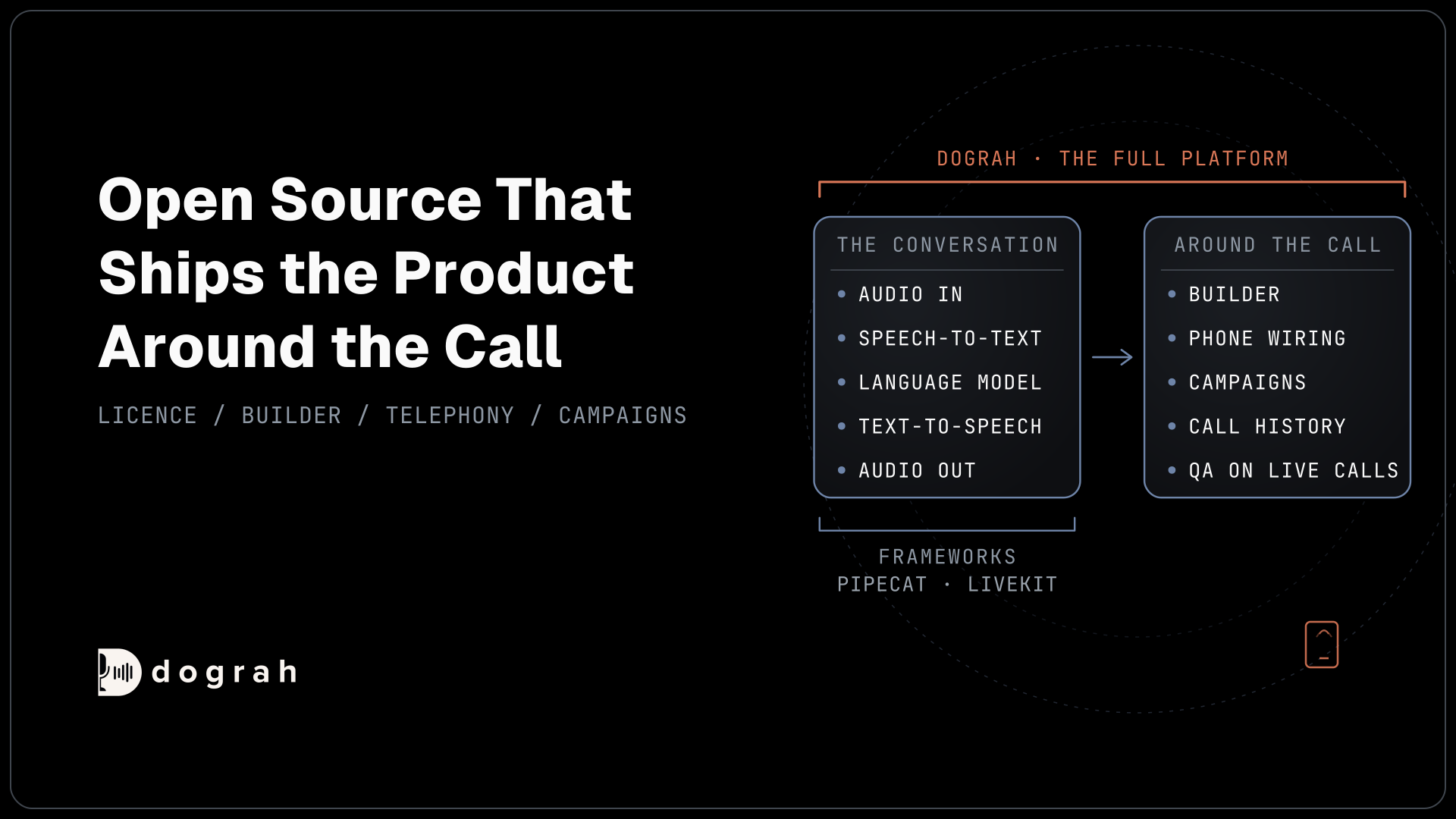
The second split is framework or platform. A voice agent framework runs the live conversation in code, from audio in through speech-to-text, the language model and text-to-speech to audio out. A platform adds the product around that loop, meaning a builder, phone wiring, outbound lists, QA and call history. With a framework, your developers build that product. With a platform, they build the agent.
Open AI tooling is now mainstream. The Linux Foundation's State of Global Open Source 2025 report puts open source AI adoption at 40%. Voice agents have moved past pilots too. In October 2026, research from G2 and RingCentral found that 57% of respondents have voice AI agents actively deployed. Once agents are live, owning the code they run on matters more.
Dograh: the full open-source platform
Dograh is the only project in this guide whose whole product is open source. The builder, telephony setup, campaigns, QA and call history sit in one BSD 2-Clause codebase you run yourself. It runs on a fork of Pipecat, so the engine underneath is one many voice developers already know.
Build and test without writing a voice stack
You start by describing the use case in a few words, and Dograh drafts a first agent. From there you edit it in the visual workflow builder, which holds a Start Call node with the greeting, agent nodes with their prompts, global instructions, tools, pathways between nodes and end-call outcomes. Nobody on the team has to write pipeline code to get a working call.
Testing happens in the same screen. Test Audio lets you talk to the agent in the browser, and Test Chat lets you iterate on prompts in text, which is faster for wording changes. Browser test calls cannot run telephony-only tools such as call transfer, so test transfers over a real phone call.
Phone lines, campaigns and transfers
Dograh connects to your own carrier account. Its eight telephony providers are Twilio, Vonage, Plivo, Telnyx, Exotel, Vobiz, Cloudonix and Asterisk ARI. A SIP trunk from another carrier connects through a ready-made SIP connection on Dograh Cloud, or through Asterisk ARI when self-hosted. Saving an inbound workflow on a Twilio number points the number at your agent straight away.
When a caller needs a person, the Transfer Call tool works on Twilio, Telnyx, Plivo, Cloudonix and Asterisk ARI. Dograh calls the destination first and connects the caller only when someone answers. On Twilio, it can play a short spoken introduction to both people before connecting them. No summary goes with the call by default, so the agent writes the caller's details to your system through an HTTP API tool first.
Outbound calls run as Campaigns. You upload a CSV with a phone number column, and each extra column becomes a variable the agent can use. A campaign sets calling hours by weekday in one time zone and retries calls that come back busy, unanswered or to voicemail. You can pause it and pick up again later. Split a list by time zone if your contacts span several.
Models, QA and coding agents
Dograh is the orchestration layer that runs the call flow, tools and telephony, and the speech and language models are a separate layer you choose. Its own models are one option. Any supported provider works with your own keys, and so does any model you serve behind an OpenAI-compatible endpoint such as Ollama or vLLM. Speech-to-speech models, such as OpenAI's and Google's realtime models, run too.
That last option is what keeps call audio fully in-house. Bringing your own keys moves the contract, not the data, because the audio still reaches the provider. Run Dograh and open-weight models on your own servers and nothing leaves them, which our tutorial on building a voice agent on fully local open-source models walks through.
Every call keeps its transcript and recording, and View Trace opens the call's trace in Langfuse. For quality, a QA node reviews the transcript after each call ends. It scores each step of the call separately, with its own tags, a 1-10 score, sentiment and a summary, on editor test calls and on live calls of the published agent. A Sample Rate setting decides what share of calls it reviews. Our post on automated QA for voice agents covers how to read those scores.
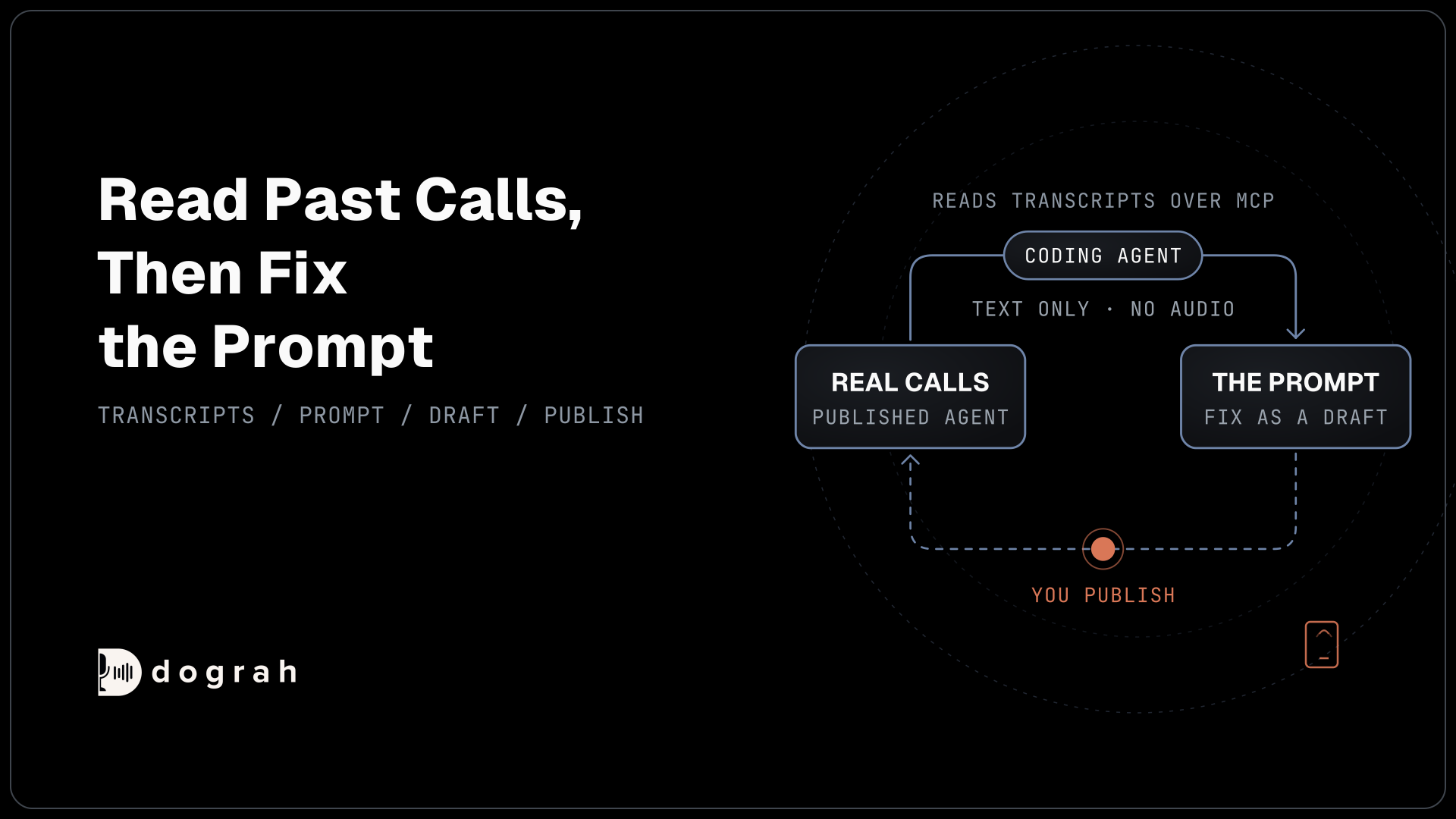
The platform also ships an MCP server, so coding agents such as Claude Code, Claude Desktop, Codex and Cursor can work inside your workspace. A coding agent can create an agent from a description, edit an existing one, search the docs and read past call transcripts and call details, though never the audio recordings. Edits to an existing agent save as drafts, so the live agent keeps running until you publish. Our guide to MCP for voice agents goes through that loop.
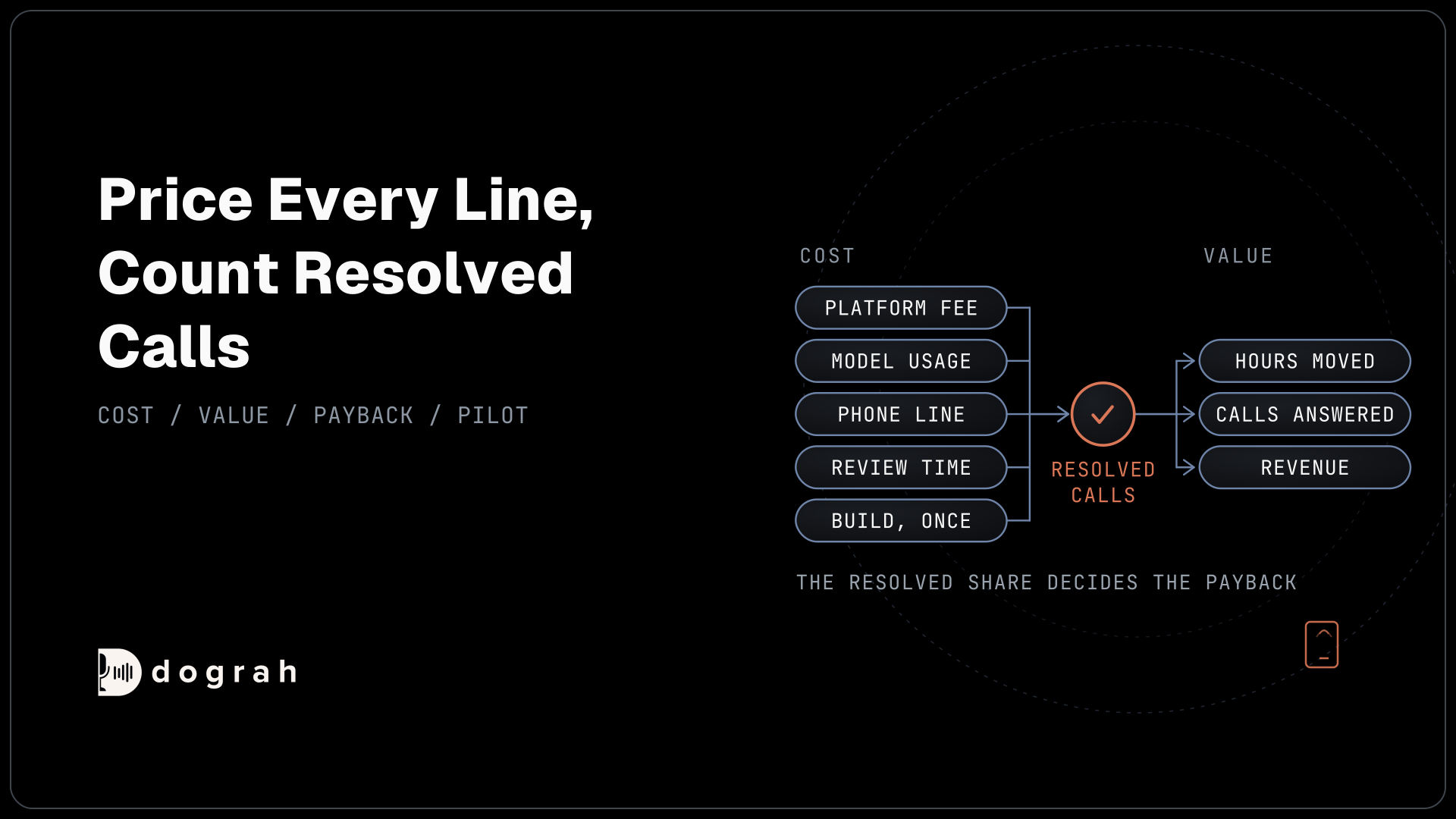
Self-hosting takes one Docker command, and it runs 10 calls at once by default. You raise that limit with a setting, and your servers and phone provider set the real ceiling. Self-hosted Dograh has no per-minute platform fee (servers, model keys and phone minutes still cost). Dograh Cloud has a 1¢-a-minute platform fee. Cloud includes 10 concurrent calls, with more on request.

Open Source Alternative to Vapi / Retell
Self-hosted voice agent platform — no per-minute fees
dograh-hq/dograh
Star on GitHub
Pipecat: the Python framework
Pipecat is an open-source Python framework from Daily, under BSD-2-Clause. Teams use it to compose a voice pipeline from processors, with more than 150 AI services to choose from.
Its strength is transport freedom. The same pipeline can run over Daily WebRTC, LiveKit, SmallWebRTC, a plain WebSocket or WhatsApp, and client SDKs cover JavaScript, React, React Native, Swift, Kotlin, C++ and ESP32. For phone calls, telephony serializers translate the audio streams of Twilio, Telnyx, Plivo, Exotel, Vonage and Genesys.
Phone features depend on the route you pick. Pipecat's telephony guide says its WebSocket integrations with Twilio, Telnyx, Plivo and Exotel have "No advanced call center features like transfers or reconnects". Transfers need Daily's PSTN or SIP routes instead.
For call logic, Pipecat Flows now ships inside the core package. An open-source Flows Editor lets you lay out a flow on a canvas and export it as YAML into your Pipecat project. It is a design tool, so calls still run in your own code, with your own call history and QA around them.
Daily also sells hosting. Pipecat Cloud charges $0.01 per active minute on its smallest agent size, and Daily phone calls add $0.018 a minute. Pipecat Enterprise runs agents in your own VPC while Daily runs the control plane. If you are weighing a move off Pipecat, our list of Pipecat alternatives covers the options, and Dograh vs Pipecat compares the platform with the framework it runs on.
LiveKit Agents: a framework on a media server
LiveKit Agents is an Apache-2.0 framework that puts your agent into a room on the LiveKit media server, the same WebRTC server LiveKit runs for video and audio apps.
One license detail matters if open source is your reason for choosing it. LiveKit's turn detection models, which decide when the caller has finished speaking, ship under the separate LiveKit Model License rather than Apache-2.0.
LiveKit puts its approach plainly: "Build your agents in code, not configuration." You write handoffs between agents and whole workflows in Python or Node, and a built-in test framework lets you write tests with LLM judges. For phone calls it speaks SIP natively, with tested carriers including Twilio, Telnyx, Plivo and Exotel, and it supports cold transfers and agent-assisted transfers.
LiveKit has a browser tool too. LiveKit's Agent Builder prototypes simple agents on LiveKit Cloud. It does not support workflows with handoffs and tasks, vision, model plugins or tests, and its Download code button turns the agent into a Python project you then maintain.
LiveKit Cloud is the hosted option. Build is free with 1,000 agent session minutes and 5 concurrent sessions. Ship starts at $50 a month and Scale at $500, each with included minutes and then $0.01 a minute, and Cloud also sells US phone numbers. Our LiveKit alternatives list covers teams leaving it, and Dograh vs LiveKit sets it against a ready platform.
LiveKit and Pipecat are often weighed against each other first, and LiveKit vs Pipecat compares the two frameworks directly, from licenses to phone calls.
Four smaller open projects
Four more open projects come up when teams search this space, and each fits a narrower job. TEN Framework is a framework for conversational voice agents with a graph designer called TMAN Designer. It is released under Apache 2.0 with additional restrictions, so read its license before you ship it inside a product.
Bolna calls its repository an end-to-end open-source voice agents platform, and the orchestration core is MIT. Its hosted APIs and no-code web playground are closed source, and its telephony covers Twilio and Plivo.
Vocode is an MIT library for voice-based LLM agents. Its README says the project is "actively looking for community maintainers", which is worth weighing before you build on it.
Jambonz is a telephony layer for voice AI that handles SIP trunks and call routing. Its feature server is MIT, while self-hosting the full product is licensed per session or as a flat fee per cluster, with no per-minute charge.
The open-source options in one table
The table sorts each project by what ships in the box, since that decides how much your team builds.
| Project | License | What ships | Phone calls | Hosted option |
|---|---|---|---|---|
| Dograh | BSD 2-Clause | Full platform: visual builder, telephony, Transfer Call, Campaigns, per-step QA, transcripts and traces, MCP server | Twilio, Vonage, Plivo, Telnyx, Exotel, Vobiz, Cloudonix, Asterisk ARI, or your own SIP trunk | Dograh Cloud, or on-prem on Enterprise |
| Pipecat | BSD-2-Clause | Python framework, Flows, Flows Editor for design | Serializers for six carriers; transfers on Daily PSTN or SIP | Pipecat Cloud, Pipecat Enterprise in your VPC |
| LiveKit Agents | Apache-2.0; turn detector under the LiveKit Model License | Python and Node framework, test framework, Agent Builder for simple agents | Native SIP, cold and agent-assisted transfers | LiveKit Cloud |
| TEN Framework | Apache 2.0 with additional restrictions | Framework with TMAN Designer | SIP examples | Self-host |
| Bolna | MIT core; playground closed | Orchestration core | Twilio, Plivo | Bolna's hosted service |
| Vocode | MIT | Library; seeking maintainers | Build it yourself | Self-host |
| Jambonz | Feature server MIT; self-host licensed | Telephony layer | SIP trunks and routing | Licensed self-host |
Only one row ships the product around the call. Every other row leaves part of it to your developers, which is the subject of the next section.
What you build on a framework before the first call
Before the first real call, a team on a framework builds the parts around the conversation. Pipecat and LiveKit Agents run that conversation well. The work sits around it.
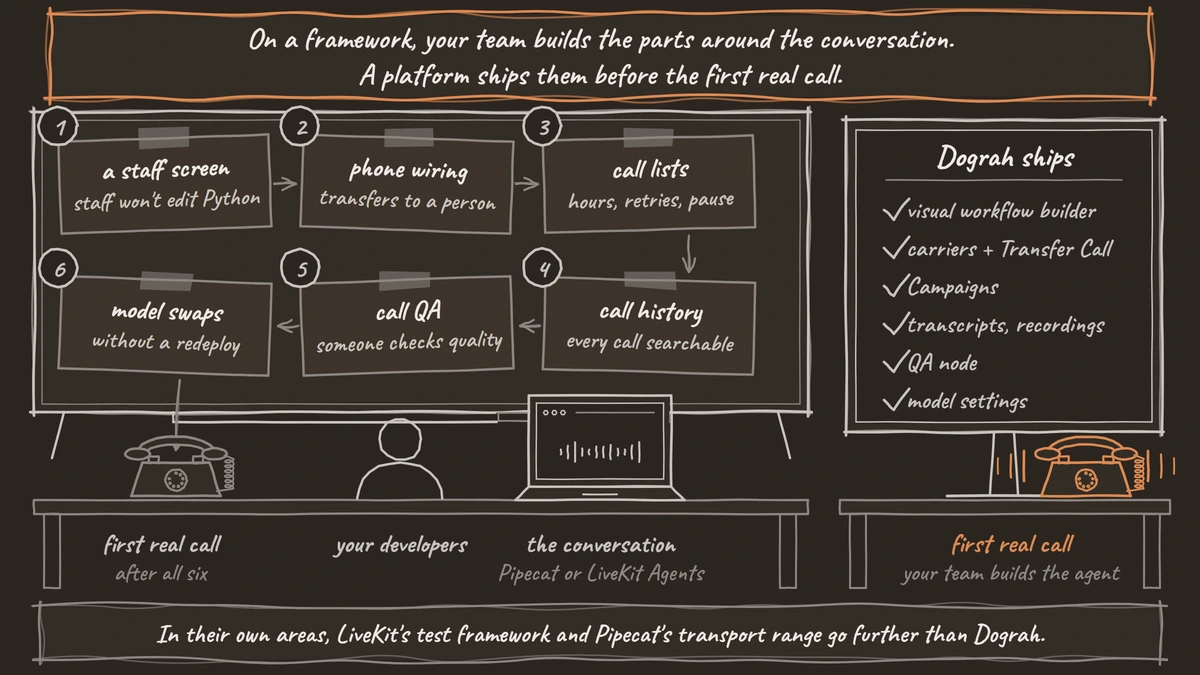
Start with a screen for the people who change the agent, since product and support staff will not edit Python to fix a greeting. Then wire each carrier, including transfers to a person. On Pipecat's WebSocket phone integrations that means a different route, because they cannot transfer. Outbound calling needs lists, calling hours, retries and a way to pause. Every call needs its transcript and recording stored and searchable, and somebody has to review live calls for quality. Finally, the team needs a way to swap models without a redeploy.
Dograh ships each of those. The visual workflow builder is the screen, and eight carriers plus Transfer Call cover phone wiring. Campaigns handle lists, hours, retries and pausing, and every call keeps its transcript, recording and trace. The QA node reviews calls step by step and the model settings switch providers per agent. On top of that, the MCP server lets a coding agent work on all of it.
None of that makes the frameworks weaker. LiveKit's test framework and Pipecat's transport range go further than Dograh in their own areas. The question is whether your team wants to build the product layer or start from one. Our view, after building Dograh on Pipecat, is that Pipecat is an excellent base, and a production phone deployment on it needs a lot of extra plumbing.
Join the Dograh Community
Dograh is an OSS alternative to Vapi. Join our Slack community for queries, releases, best practices & community interactions.
How to choose an open-source voice AI platform
Choose by what you are building and who will maintain it. Pick LiveKit Agents if your agent lives inside a web or mobile app, or needs video and multi-party rooms. Its client SDKs and test framework suit product teams that write code every day.
Pick Pipecat if your developers want to own every stage of the pipeline in Python, or need a transport such as WhatsApp or a custom WebRTC setup. Pipecat Cloud covers hosting if you do not want servers.
Pick Dograh if the goal is phone agents running on your own servers, built and changed by people who are not voice engineers. Inbound lines, outbound campaigns, transfers to staff and QA are ready on day one, and the code stays open.
Some teams compare these against a hosted API instead. Vapi is closed source with a $0.05-a-minute hosting fee, and it does not support on-premise deployments. Vapi vs Pipecat and Vapi vs LiveKit compare it with each framework.
If Vapi is what you are leaving, our post on the open-source alternative to Vapi covers what self-hosting changes. Whichever you shortlist, run the same script on a real phone line before you decide. Most phone calls still reach the agent as 8 kHz audio, while a browser demo runs at 16 kHz, so an agent that sounds fine in the browser can mishear on the phone.
Each comparison above has its own deep dive:
- Pipecat Alternatives
- LiveKit Alternatives
- Dograh vs Pipecat
- Dograh vs LiveKit
- LiveKit vs Pipecat
- Vapi vs Pipecat
- Vapi vs LiveKit
Glossary
- Voice agent framework
- A code library, such as Pipecat or LiveKit Agents, that runs the live conversation: audio in, speech-to-text, the language model, text-to-speech and audio out. The builder, phone wiring, call history and QA around it are left to your developers.
- Telephony serializer
- Pipecat's adapter that converts one carrier's audio stream format into the pipeline's own. On Pipecat's WebSocket phone integrations, the serializer carries audio but not call-centre features such as transfers.
- Turn detection model
- A model that decides when the caller has finished speaking, so the agent knows when to answer. LiveKit's ship under the LiveKit Model License, separate from the Apache-2.0 framework.
- OpenAI-compatible endpoint
- A model server that accepts OpenAI's request format. Dograh can call a model served this way by Ollama or vLLM on your own machine, which is how a call runs on fully local models.