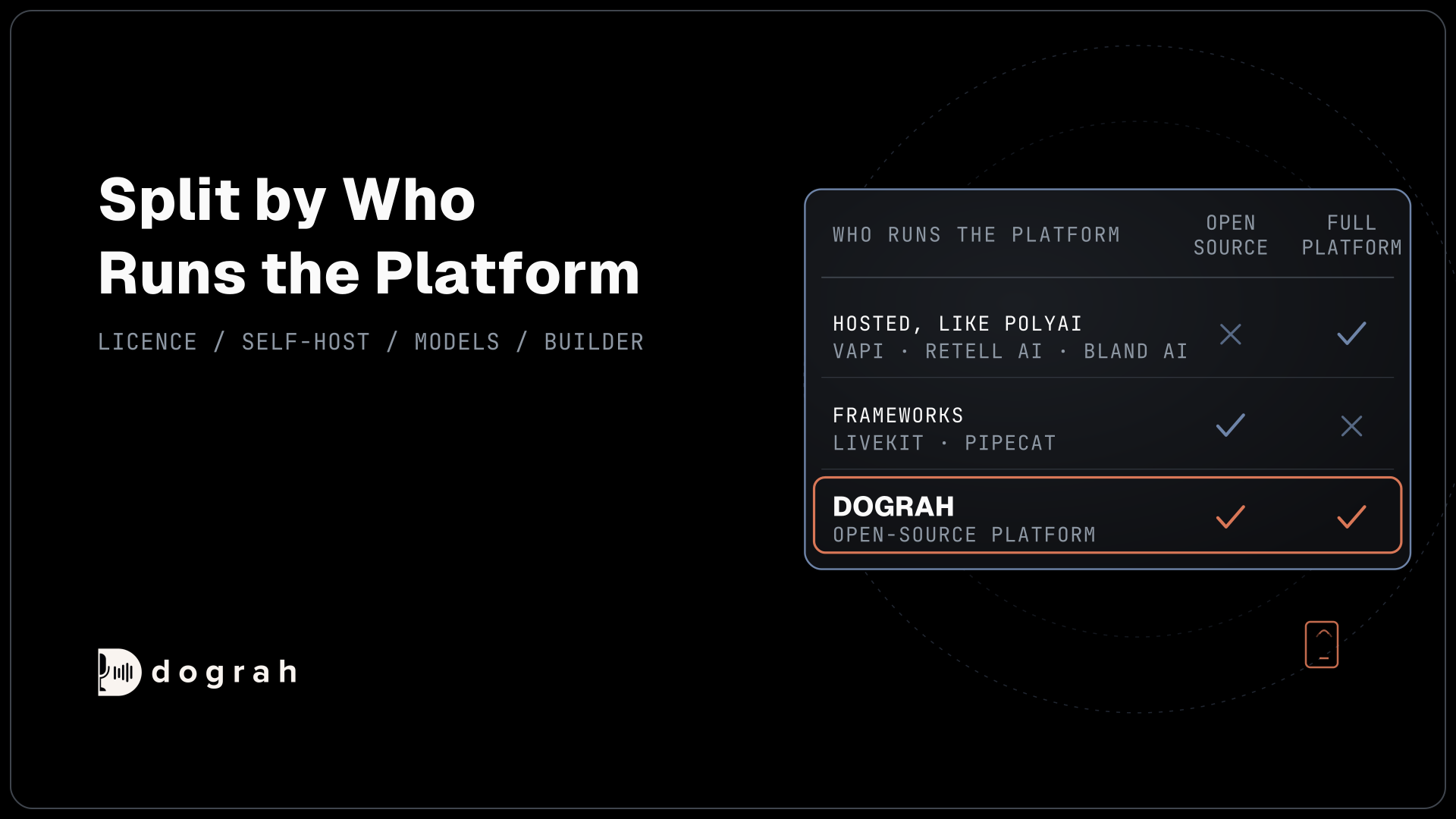

PolyAI alternatives split by who runs the platform. Dograh, the open-source AI voice agent platform we build, runs on your own servers or Dograh Cloud, with a visual builder and any model you choose. Vapi, Retell AI, Bland AI, Synthflow and Voiceflow are hosted and closed source, like PolyAI. LiveKit Agents and Pipecat are open-source frameworks.
Key Takeaways
- PolyAI is now self-serve, so compare where the agent runs and who owns the code.
- Dograh is open source under BSD-2-Clause, on your servers or on Dograh Cloud.
- Pull the agent with PolyAI's ADK, rebuild it, then move one number at a time.
This guide sets eight PolyAI alternatives against PolyAI on license, where each one runs, model choice and price, and covers Dograh first, right after the comparison table. It also says when staying on PolyAI is the better call, and what moving an agent off it takes.
Why teams look for a PolyAI alternative
Most teams look for an alternative to PolyAI when they want more control over where the agent runs and which model it uses. PolyAI is the enterprise voice AI company at poly.ai, founded in 2017 by Cambridge machine learning researchers. It raised an $86 million Series D in December 2025 and says it has passed $200 million in total funding, so it is a serious vendor.
One old reason to leave no longer holds. PolyAI opened its platform to self-serve builders on 18 May 2026. Anyone can now sign up and build in Agent Studio, a visual editor, or describe the agent in plain words to Wren. Developers can use the Agent Development Kit (ADK), a command-line kit, or the REST APIs. Teams can build and edit PolyAI agents themselves, so "we have to go through the vendor" is not the reason to switch any more.
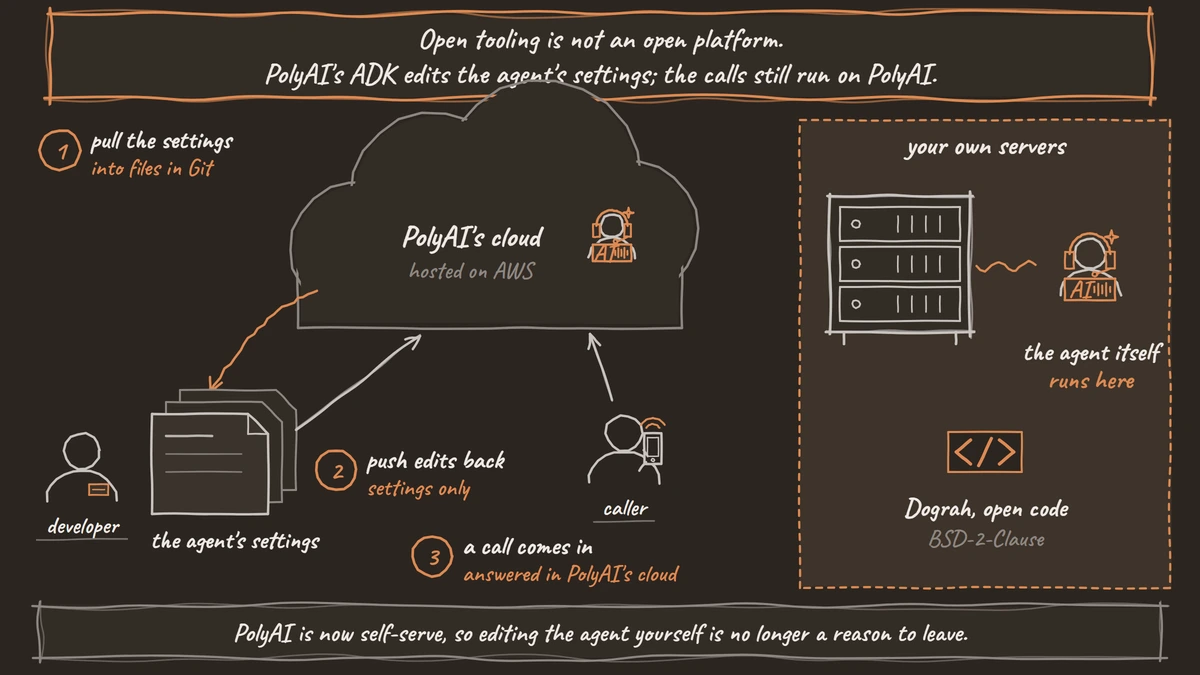
What remains is the runtime. PolyAI runs agents on its own cloud, hosted on AWS, with US, EU and UK regions. The ADK is open source under Apache-2.0, but by PolyAI's own description it "does not run your agent", and "There is no local runtime." You can hold the agent's settings in Git, while the calls still run on PolyAI.
The model is the second reason. Raven, PolyAI's own language model, runs most PolyAI deployments, and Raven 3.5 covers 24 languages. OpenAI and Amazon Bedrock models from a set list cover more. To use a model outside that list, PolyAI's bring-your-own-model setup asks you to send the endpoint and credentials "to your PolyAI representative".
The third is price. PolyAI quotes its platform's per-minute rate through its sales team, so a small pilot starts with a conversation. That rate does include ongoing improvements, maintenance and 24/7 support, which matters later in this guide.
How we compared the alternatives
We compared each alternative on five points that change a buying decision. The license decides whether you can read the code and keep running it if the vendor changes course. Where it runs means your own servers, or only the vendor's cloud. Model choice covers your own provider keys and open-weight models you host. List prices come from each vendor's own pricing page. Last, a full platform ships the builder, telephony, call history and QA, while a framework leaves the product to your developers.
Latency is left out. It depends on your models and phone path far more than on the platform, so measure it on your own calls.
Parloa and NICE Cognigy also come up on PolyAI shortlists, mostly from contact-centre buyers. The table keeps to the eight products voice teams weigh most often.
PolyAI alternatives in one table
| Product | Open source | Self-host or on-prem | List price | What you get, and what's missing |
|---|---|---|---|---|
| PolyAI (baseline) | No; the ADK is Apache-2.0 but runs nothing locally | Runs on PolyAI's cloud, hosted on AWS, with US, EU and UK regions | Platform per minute, quoted by sales; Dialog-RSN-1 model API 2¢/min plus tokens | Agent Studio, Raven model, contact-centre connectors, and improvements, maintenance and 24/7 support inside the rate |
| Dograh | Yes, BSD-2-Clause | Yes, with Docker Compose; on-prem or private cloud on Enterprise; or Dograh Cloud | Self-hosted: no per-minute platform fee. Dograh Cloud: a per-minute platform fee (see the Dograh section). Models and phone extra | Full platform: visual builder, your own carrier, call traces, per-step QA and any models, including open-weight ones you host. No built-in SMS or recording redaction |
| Vapi | No | Runs on Vapi's cloud | $0.05/min hosting, plus models and phone. Core $29/mo, Pro $999/mo minimum. HIPAA add-on $2,000/mo | Developer platform with your own model keys, built as Assistants and Squads. Visual Workflows retired in August 2026 |
| Retell AI | No | Runs on Retell's cloud; a dedicated stable server is an Enterprise add-on | $0.07 to $0.31/min, from $0.055/min voice infrastructure. 20 concurrent calls free, then $8/mo each | Visual Conversation Flow builder and a choice of language models |
| Bland AI | No | On-prem or VPC on Enterprise | Start $0.14/min, 100 calls a day; Build $0.12/min plus $299/mo. Phone extra | One rate covers Bland's own models. The BAA needs Enterprise |
| Synthflow | No | Runs on Synthflow's cloud, with US and EU regions | Enterprise contracts from $30,000 a year | Flow Designer and launch support inside an annual contract |
| Voiceflow | No | Hosted on Voiceflow; private cloud on Enterprise | Plan fee, add-ons and usage credits | One agent across chat and phone |
| LiveKit Agents | Yes, Apache-2.0 | Yes, or LiveKit Cloud | Free to self-host. Cloud: Build free with 1,000 min, Ship from $50/mo, Scale from $500/mo, then $0.01/min | Framework with telephony and any model. Your developers build the product around it |
| Pipecat | Yes, BSD-2-Clause | Yes, or Pipecat Cloud | Free to self-host. Cloud $0.01/min per active agent | Python framework from Daily. Phone wiring, call history and QA are yours to build |
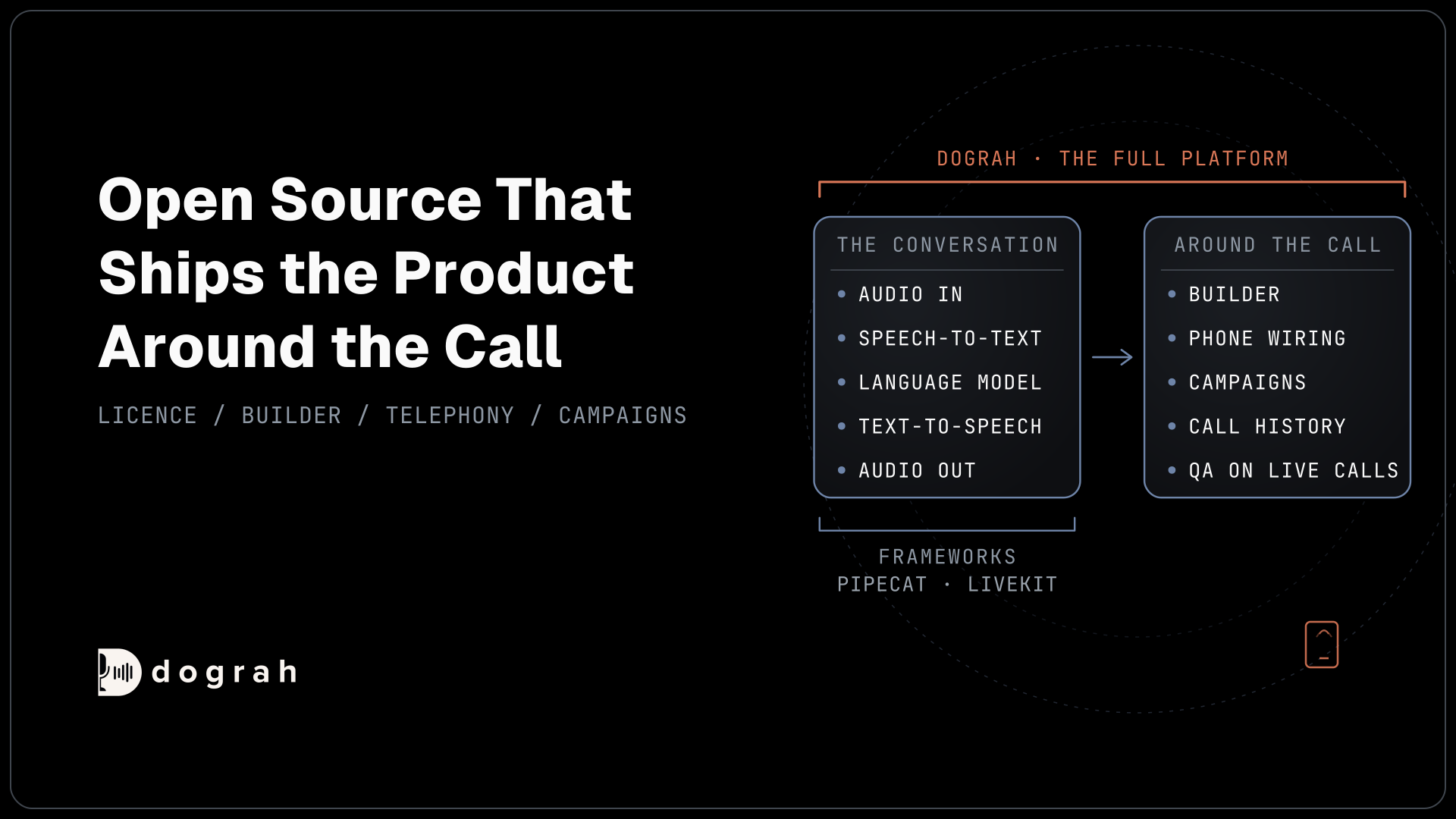
Of the three you can run yourself, only Dograh ships as a full platform. LiveKit Agents and Pipecat are frameworks.
Dograh: run the platform yourself
Dograh's code is open under BSD-2-Clause, so your team can change it and self-host it for free. Its GitHub repository holds the whole platform, from telephony and Transfer Call to Campaigns for outbound lists, call traces and automatic QA that scores each step. PolyAI teams used to Agent Studio will find the visual workflow builder familiar. You describe your use case and an AI drafts a starting workflow, which you then edit node by node. Your own team changes the agent whenever it wants, and because the code is open, it can change the platform too.
The biggest change from PolyAI is the model layer. Dograh is the orchestration layer that runs the call flow, tools and telephony, and the speech and language models are a separate layer you choose. That can be Dograh's own models, or your own keys for providers such as OpenAI, Google, Azure OpenAI, AWS Bedrock, Groq and OpenRouter. It can also be an open-weight model behind an OpenAI-compatible endpoint, such as Ollama or vLLM, on your own servers. Your team sets this itself under Models, with no representative involved.
If you bring your own key (BYOK) for a provider, the call audio still reaches that provider. The audio stays in-house only when Dograh and the speech and language models all run on your own servers.
Dograh runs on your own phone setup, whether that is Twilio, Vonage, Plivo, Telnyx, Cloudonix, Exotel, Vobiz or Asterisk ARI. On Dograh Cloud, Managed SIP connects your own SIP trunk or PBX. Transfer Call works on Twilio, Telnyx, Plivo, Cloudonix and Asterisk ARI. It passes no summary by default. On Twilio it can play a short spoken introduction to both people. Write the details to your system with an HTTP API tool before the transfer.
Be clear about what Dograh leaves to you. It has no built-in SMS, no recording redaction and no retention setting, and it ships no native connectors for contact-centre suites. Business systems connect through HTTP API tools, MCP tools, the Webhook node and the API Trigger.
Self-hosting uses Docker Compose and runs 10 calls at once by default, a limit you can raise. Self-hosted Dograh has no per-minute platform fee (servers, model keys and phone minutes still cost). Dograh Cloud has a 1¢-a-minute platform fee. Our side-by-side comparison with PolyAI goes through the two row by row.

Open Source Alternative to Vapi / Retell
Self-hosted voice agent platform — no per-minute fees
dograh-hq/dograh
Star on GitHub
Hosted alternatives to PolyAI
Five hosted PolyAI competitors come up most often, and like PolyAI, each runs on the vendor's own cloud.
Vapi
Vapi is a self-serve developer platform with a published hosting fee of $0.05 a minute, and models pass through at the provider's price. You can bring your own keys for any part of the call or a custom language model at your own URL. Where PolyAI's rate includes a vendor that keeps improving the agent, here your developers write and tune everything. Its visual Workflows were retired on 18 August 2026, so building is now Assistants and Squads. See Vapi vs PolyAI for the head-to-head, and Vapi alternatives for the rest of its field.
Retell AI
Retell bills each part of a minute separately. Voice infrastructure is $0.055 a minute, its published range for a full AI voice agent minute runs from $0.07 to $0.31, and 20 calls at once are included. It has a visual Conversation Flow builder and a wide choice of language models, all on Retell's cloud. Teams that want a published rate card with a drawn flow often look here first. Retell AI alternatives covers its side of the field.
Bland AI
Bland runs on its own speech and language models, and one per-minute rate covers them, much as PolyAI leans on Raven. Start allows 100 calls a day and Build 2,000, so a busy contact centre would need Enterprise, which is also where Bland's BAA and on-prem option sit. Bland AI alternatives covers its side of the field.
Synthflow and Voiceflow
Synthflow sells one Enterprise plan, with contracts from $30,000 a year that are scoped around integrations and launch support, so it is the closest to PolyAI's managed model. Voiceflow builds one support agent for chat and phone, with private cloud hosting on Enterprise. Our guide to Synthflow alternatives compares both.
Open-source routes: LiveKit Agents and Pipecat
Open-source tooling and an open-source platform are different things. PolyAI's ADK is open source, but it edits configuration for agents that run on PolyAI. An open platform lets you run the agent itself on your own servers.
LiveKit Agents and Pipecat are open-source frameworks. PolyAI itself documents running its Dialog-RSN-1 model inside LiveKit Agents, which shows how a model can sit inside an open framework. Pipecat is a Python framework from Daily, and Dograh is built on a fork of it. In our experience it is an excellent base, but production needs phone integrations, call history, QA on live calls and the call lifecycle around it. Dograh ships those parts.
If open source is your main reason for leaving, our post on the open-source alternative to PolyAI explains what changes when you own the platform. For the wider field, see the best open-source voice AI platforms.
What PolyAI costs
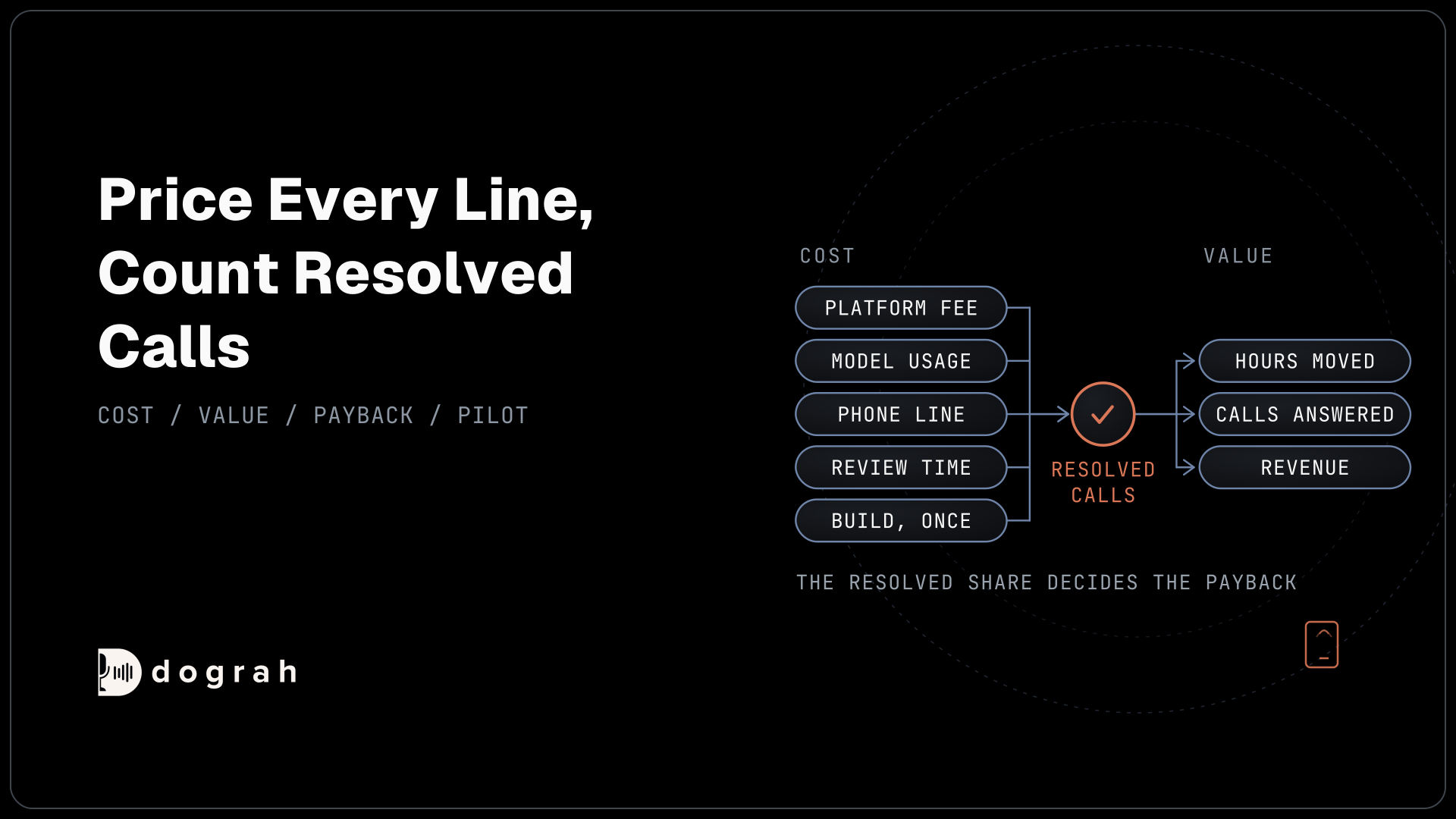
PolyAI sells two different things at two different prices. On PolyAI's pricing page, the platform is "priced on a per-minute basis, which includes proactive performance improvements, maintenance and 24/7 support". The rate itself comes from the sales team. Usage is billed on connected time, "with no minimums and no rounding up to the minute", and your own carrier connects over SIP at no charge.
The second price is the Dialog-RSN-1 model API at 2¢ per connected minute, plus text tokens. It buys the model alone, and the page lists "Telephony and orchestration" as "Not included". So 2¢ is never the price of a PolyAI agent, and it should not be set against a platform fee such as Vapi's $0.05 hosting. Our breakdown of PolyAI pricing explains what a quote depends on and what each number buys.
When staying on PolyAI makes sense
PolyAI is the better fit for some teams, and the reasons come from its own pages. Stay if you want a vendor that keeps improving the agent, with maintenance and 24/7 support inside the per-minute rate. Stay if Raven 3.5 in 24 languages suits your callers, or if you rely on ready connectors for Five9, NICE, Genesys, Salesforce or ServiceNow.
Certificates are another reason. PolyAI lists SOC 2 Type II, ISO 27001 and PCI DSS on the vendor itself, with data held in US, UK and EU regions. It also sends SMS through Twilio and gives users without PII access a redacted copy of each recording.
Dograh has no built-in SMS or redaction, and self-hosting puts uptime and upgrades in your team's hands. What it gives back is control, since you own the code and decide where it runs.
What moving off PolyAI takes
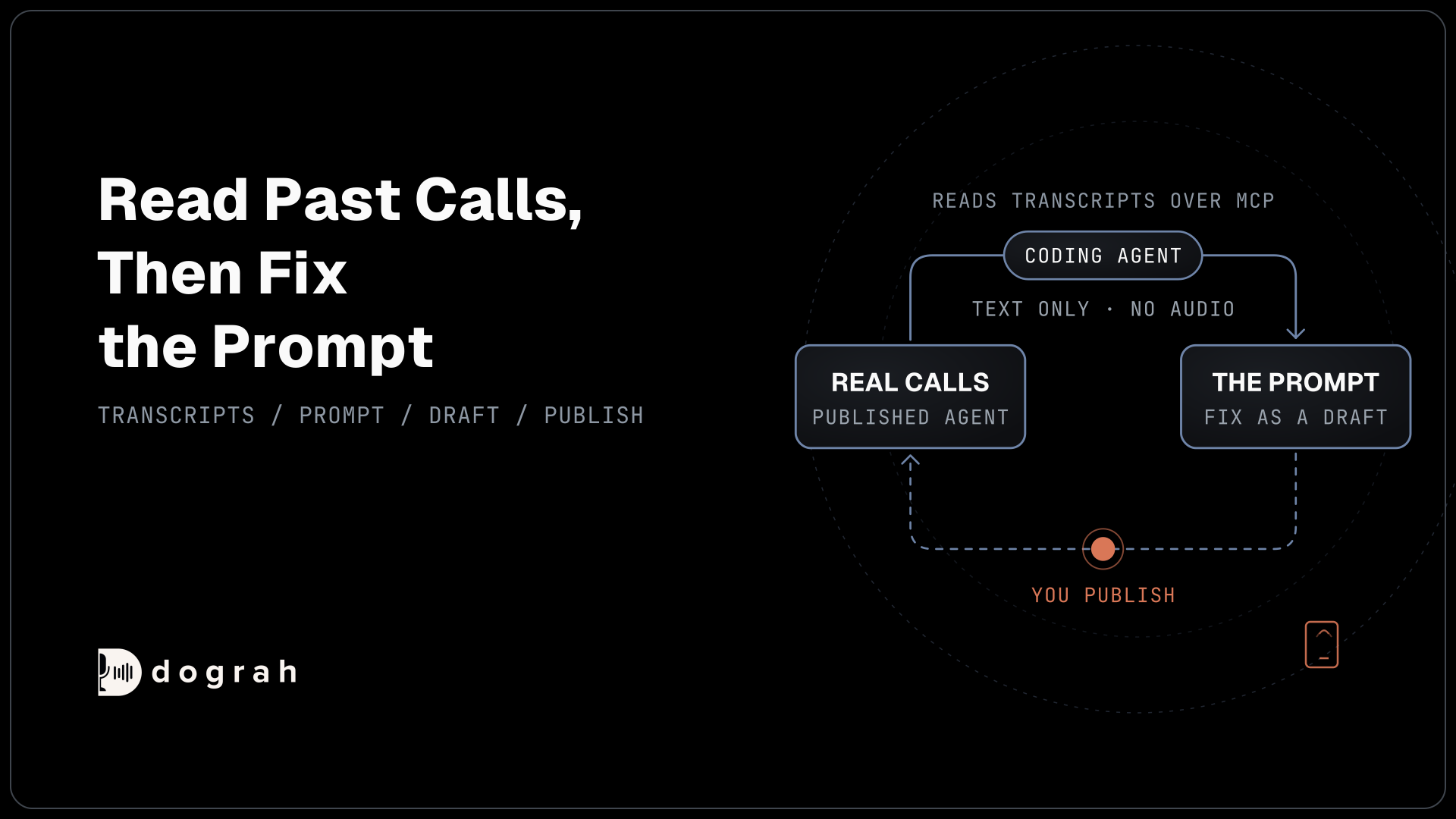
Moving can happen one number at a time, so PolyAI keeps answering calls until each rebuilt agent passes its tests. The good news is that PolyAI documents a way to get the agent out. Its ADK pulls the whole configuration into local files, including rules, flows, knowledge topics, Python functions, handoffs and SMS templates. Those files run only on PolyAI, so treat them as a spec. Rebuild each part in Dograh, by hand in the builder or with an AI assistant that reads the files and drafts the agent through Dograh's MCP (Model Context Protocol) server. Then check every node yourself. Our landing page on moving from PolyAI to Dograh lays out that number-by-number plan.
Prompts tuned for Raven need retesting on whichever model the new agent uses. Numbers in your own Twilio account move by setting each number's inbound workflow in Dograh. For numbers bought from PolyAI, ask PolyAI about porting. The full walk-through is in how to migrate from PolyAI to open-source voice AI.
Join the Dograh Community
Dograh is an OSS alternative to Vapi. Join our Slack community for queries, releases, best practices & community interactions.
Picking your PolyAI alternative
Teams that would rather write the agent in code can start with LiveKit Agents or Pipecat. On a hosted self-serve plan, Vapi suits developers who want an API and a published fee, and Retell AI suits teams that want a drawn flow with a rate card. Bland AI fits teams happy for the vendor to pick every model. Stay on PolyAI if you want the vendor to keep improving the agent inside one rate.
If you want your own team to control the models and where the agent runs, Dograh fits that brief. It is open source under BSD-2-Clause, so you can self-host it without a sales contract. You choose every model, from your own provider keys to open-weight models on your own servers, and your numbers stay with your carrier. On-prem support comes on Enterprise if you want a contract. To try it, run it from GitHub with Docker Compose, or start on Dograh Cloud.
Whichever you shortlist, run the same call script on a real phone line. Most phone calls reach the agent as 8 kHz audio, while a browser demo runs at 16 kHz.
Each part of this guide has its own deep dive:
- Dograh vs PolyAI
- Open-Source Alternative to PolyAI
- PolyAI Pricing Explained
- How to Migrate From PolyAI to Open-Source Voice AI
- Vapi vs PolyAI
Glossary
- Runtime
- Where the voice agent actually runs during a live call. PolyAI agents run on PolyAI's cloud even when their settings live in your Git repository. A self-hosted Dograh agent runs on your own servers.
- Agent Development Kit (ADK)
- PolyAI's open-source command-line kit for pulling, editing and pushing agent configuration as local files. It does not run the agent, so it is open tooling rather than an open platform.
- Platform fee
- What a voice AI vendor charges for running the call itself, separate from the speech and language models and the phone line. Self-hosted Dograh has no per-minute platform fee.
- Bring your own key (BYOK)
- Using your own account with a model provider instead of the platform's. You hold the contract and the bill, but the call audio still goes to that provider.