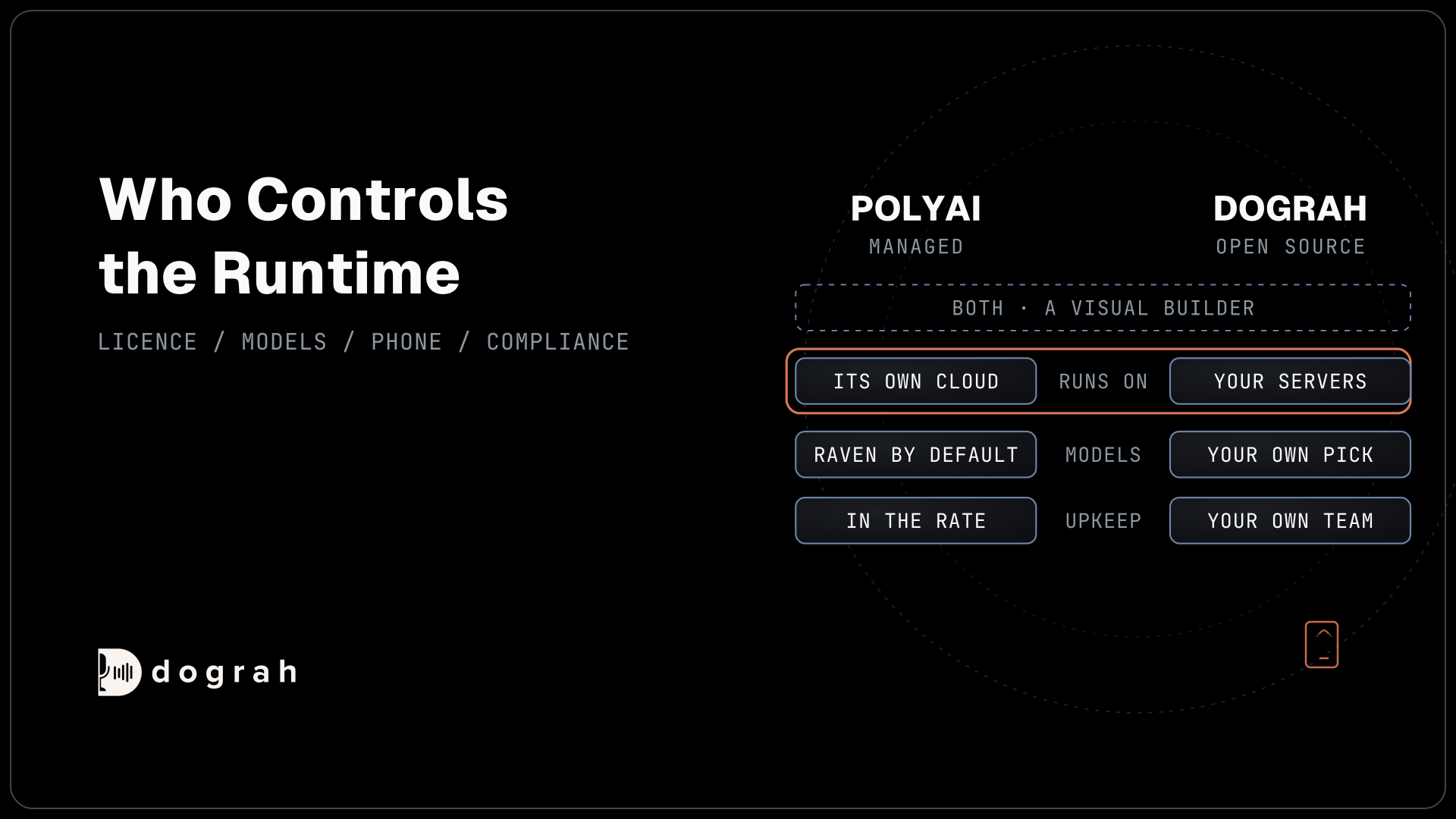

Choosing Dograh vs PolyAI comes down to who controls the runtime. PolyAI is closed source and runs agents on its own cloud, with a per-minute rate quoted by sales that includes maintenance and 24/7 support. Dograh, the open-source AI voice agent platform we build, runs on your own servers or Dograh Cloud, with any model you choose.
Key Takeaways
- Both have visual builders now, but only Dograh can run on your servers.
- PolyAI runs most agents on Raven, while on Dograh your team picks every model.
- PolyAI fits teams that want maintenance and 24/7 support inside one rate.
This post is part of our guide to PolyAI alternatives, which gives Dograh one place among eight options. Here the two products meet row by row, on control, models, phone and compliance, and the post ends with when each one fits better.
The two platforms, row by row
PolyAI sells a managed platform on its own cloud, while Dograh is open-source software you can run anywhere.
| Row | PolyAI | Dograh |
|---|---|---|
| License | Closed platform; the Agent Development Kit (ADK) command-line kit is Apache-2.0 but runs nothing locally | Open source under BSD-2-Clause, with the code on GitHub |
| Where it runs | PolyAI's own cloud, hosted on AWS, with US, EU and UK regions. But you pick a region, not your own servers | Your own servers with Docker Compose, Dograh Cloud, or on-prem and private cloud on Enterprise. But self-hosting puts the servers on your team |
| How you pay | Platform per minute, quoted by sales, with improvements, maintenance and 24/7 support included. A separate model API costs 2¢/min | Self-hosted: no per-minute platform fee. Dograh Cloud: a per-minute platform fee (see below) |
| Models | Raven, PolyAI's own model, on most deployments, plus a set list of OpenAI and Amazon Bedrock models. A custom model goes through your PolyAI representative | Dograh's models, your own keys for supported providers, or open-weight models you host |
| Builder | Agent Studio (visual), Wren (plain language), the ADK and REST APIs, plus Builder MCP | A visual workflow builder of nodes and pathways, QA that scores each step, and an MCP server for AI assistants |
| Phone | PolyAI numbers, your own Twilio account, or a custom SIP trunk you set up yourself | Your own carrier, from Twilio and Telnyx to Exotel and Asterisk ARI, or Dograh Managed SIP on Dograh Cloud |
| Transfer to a person | Handoffs to human agents over SIP | Transfer Call on Twilio, Telnyx, Plivo, Cloudonix and Asterisk ARI, with the details written to your system by an HTTP API tool first |
| Compliance | SOC 2 Type II, ISO 27001 and PCI DSS listed on the vendor | Self-host inside your own compliance perimeter, so there is no vendor platform to certify |
| Call data | Redacted recordings for users without PII access; SMS through Twilio | Self-hosted, recordings and transcripts stay on your own storage. No built-in redaction or SMS |
| Support | 24/7 support inside the per-minute rate | Community support on the open-source version; priority support on Custom volume plans and a dedicated account manager on Enterprise |
The PolyAI rows come from PolyAI's platform overview and its pricing and model pages. Its platform lists Five9, NICE, Genesys, Salesforce and ServiceNow among its connectors.
Who controls the agent and the runtime
On both platforms your own team builds and edits the agent, and the difference is where it runs. PolyAI has been self-serve since 18 May 2026. Builders work in Agent Studio without code or describe an agent to Wren, and developers use the ADK and REST APIs. Builder MCP lets an AI assistant build and publish agents too.
The ADK keeps the agent's settings in local files you can store in Git. It does not run the agent, and PolyAI says there is no local runtime, so every call still runs on PolyAI's cloud.
Dograh's visual workflow builder starts from a use case you describe, then you edit its nodes and pathways. Edits save as a draft, and Publish makes a version live. Dograh's MCP server lets an AI assistant create and edit agents as well. Because the platform's code is open, your team can also change the platform itself. Our post on the open-source alternative to PolyAI explains what that ownership changes.
Models: Raven by default or your own pick
PolyAI picks its default model for you, while Dograh leaves every model to your team. Raven, PolyAI's own language model, runs most PolyAI deployments, and Raven 3.5 covers 24 languages. OpenAI and Amazon Bedrock models from a set list cover more. To use a model outside that list, you send the endpoint and credentials to your PolyAI representative.
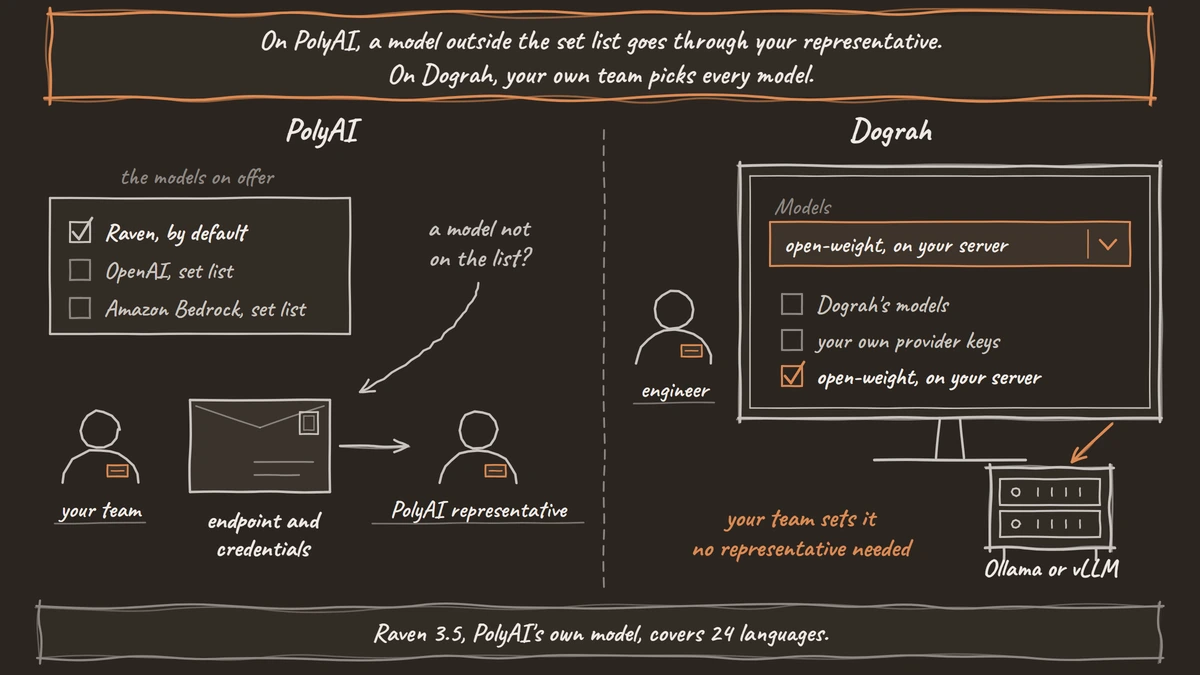
Dograh is the orchestration layer that runs the call flow, tools and telephony, and the speech and language models are a separate layer you choose. That can be Dograh's own models, or your own keys for providers such as OpenAI, Google, Azure OpenAI, AWS Bedrock and Groq. It can also be an open-weight model behind an OpenAI-compatible endpoint, such as Ollama or vLLM. If you bring your own key (BYOK), the call audio still reaches each provider. The audio stays in-house only when the speech and language models run on your own servers too.

Open Source Alternative to Vapi / Retell
Self-hosted voice agent platform — no per-minute fees
dograh-hq/dograh
Star on GitHub
Phone, compliance and call data
PolyAI bundles phone options and data controls into its platform, while Dograh hands each of them to your own setup. PolyAI agents answer on PolyAI numbers, your own Twilio account or a custom SIP trunk, and your own carrier connects over SIP at no charge. It also sends SMS through Twilio.
Dograh connects to your own carrier, whether that is Twilio, Vonage, Plivo, Telnyx, Cloudonix, Exotel, Vobiz or Asterisk ARI. Transfer Call works on Twilio, Telnyx, Plivo, Cloudonix and Asterisk ARI. It passes no summary by default. On Twilio it can play a short spoken introduction to both people. Dograh has no SMS tool, so an HTTP API tool asks your own provider to send a text.
PolyAI's compliance page lists ISO 27001, SOC 2 Type II, PCI DSS and GDPR, and says its systems are designed to meet HIPAA where relevant. With self-hosting, no BAA with Dograh is needed, because Dograh never sees the data. If your servers run in a cloud account such as AWS, that provider needs a BAA. Your model providers may need their own, and your phone carrier may too, depending on what it stores, so check that list with counsel.
On call data, PolyAI gives users without PII access a redacted copy of each recording. Self-hosted Dograh keeps recordings and transcripts on your own storage, with no redaction or retention setting, so your own team deletes what it no longer needs.
When PolyAI fits better
PolyAI is the better fit for some teams, and the reasons are concrete. Choose it if you want a vendor that keeps improving the agent, with maintenance and 24/7 support inside the per-minute rate. Choose it if Raven 3.5 in 24 languages suits your callers, or if you need ready connectors for Five9, NICE, Genesys, Salesforce or ServiceNow.
It also fits buyers who need certificates on the vendor itself, such as SOC 2 Type II, ISO 27001 and PCI DSS, with built-in SMS and redacted recordings. A team with no engineers to run servers will find that rate covers work Dograh leaves to you.
When Dograh is the stronger fit
Dograh fits teams that want to own the platform as well as the agent. It is open source under BSD-2-Clause, so you can self-host it today without a sales contract and change any part of it. Your team also chooses every model, including ones on your own servers.
Running it yourself is real work, because Docker, secrets, telephony and monitoring move to your team. Teams that don't want servers can start on the cloud version instead. Self-hosted Dograh has no per-minute platform fee (servers, model keys and phone minutes still cost). Dograh Cloud has a 1¢-a-minute platform fee. Our breakdown of PolyAI pricing explains what PolyAI's quote depends on.
Self-hosting runs on Docker Compose. When you are ready to move, our guide on how to migrate from PolyAI to open-source voice AI starts with pulling the agent through PolyAI's ADK. Run your real call script on both over a phone line first, since most phone calls still reach the agent as 8 kHz audio while a browser demo runs at 16 kHz.
Join the Dograh Community
Dograh is an OSS alternative to Vapi. Join our Slack community for queries, releases, best practices & community interactions.
Glossary
- Runtime
- Where the voice agent actually runs during a live call. A PolyAI agent runs on PolyAI's cloud even when its settings live in your Git repository. A self-hosted Dograh agent runs on your own servers.
- Raven
- PolyAI's own language model, built for customer service calls. It runs most PolyAI deployments, and Raven 3.5 covers 24 languages. Other models come from a set OpenAI and Amazon Bedrock list.
- Bring your own key (BYOK)
- Using your own account with a model provider instead of the platform's. You hold the contract and the bill, but the call audio still goes to that provider.
- Open-weight model
- An AI model whose weights you can download and run on your own servers. Hosting one is the only way to keep call audio from reaching an outside model provider.