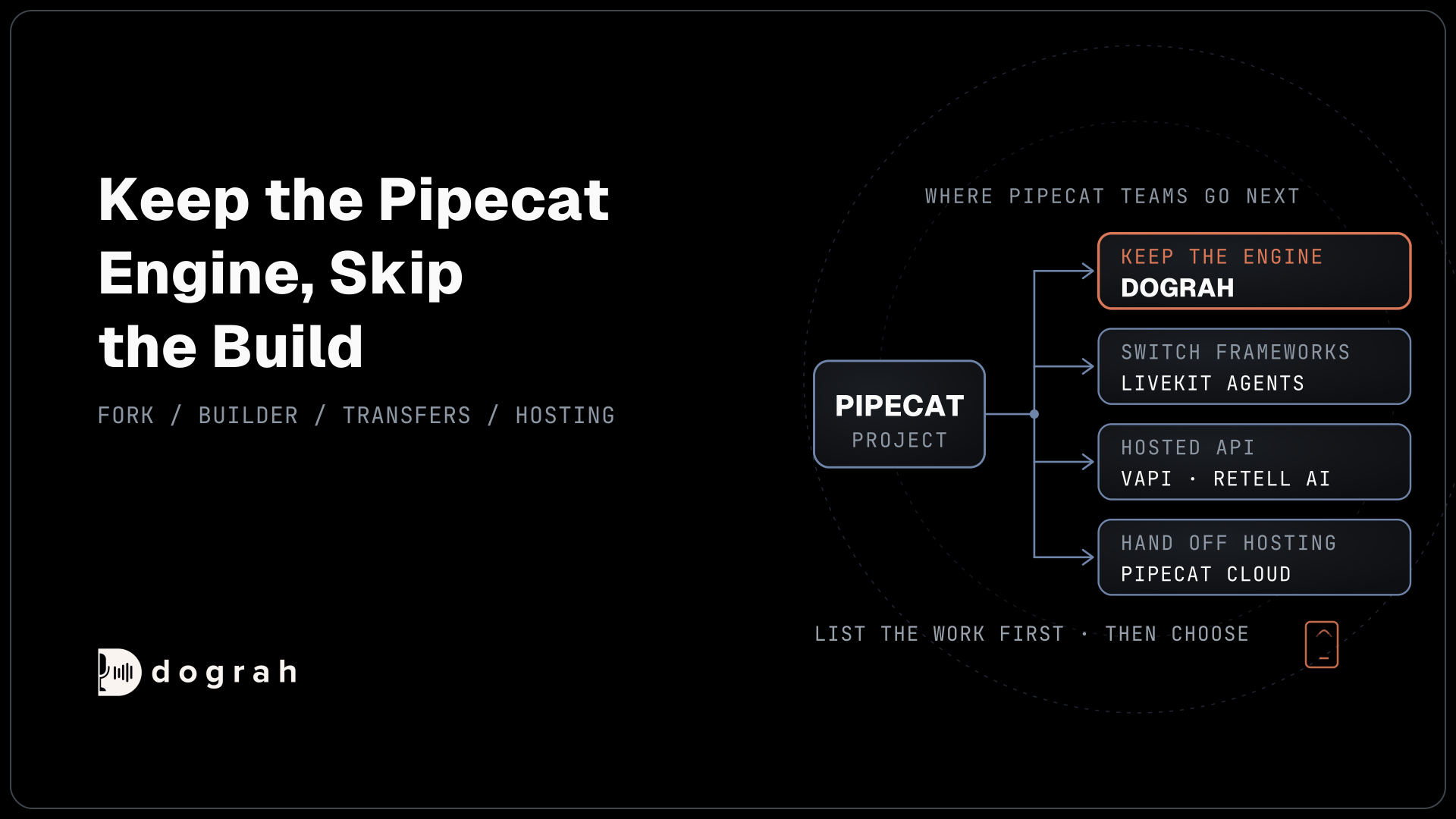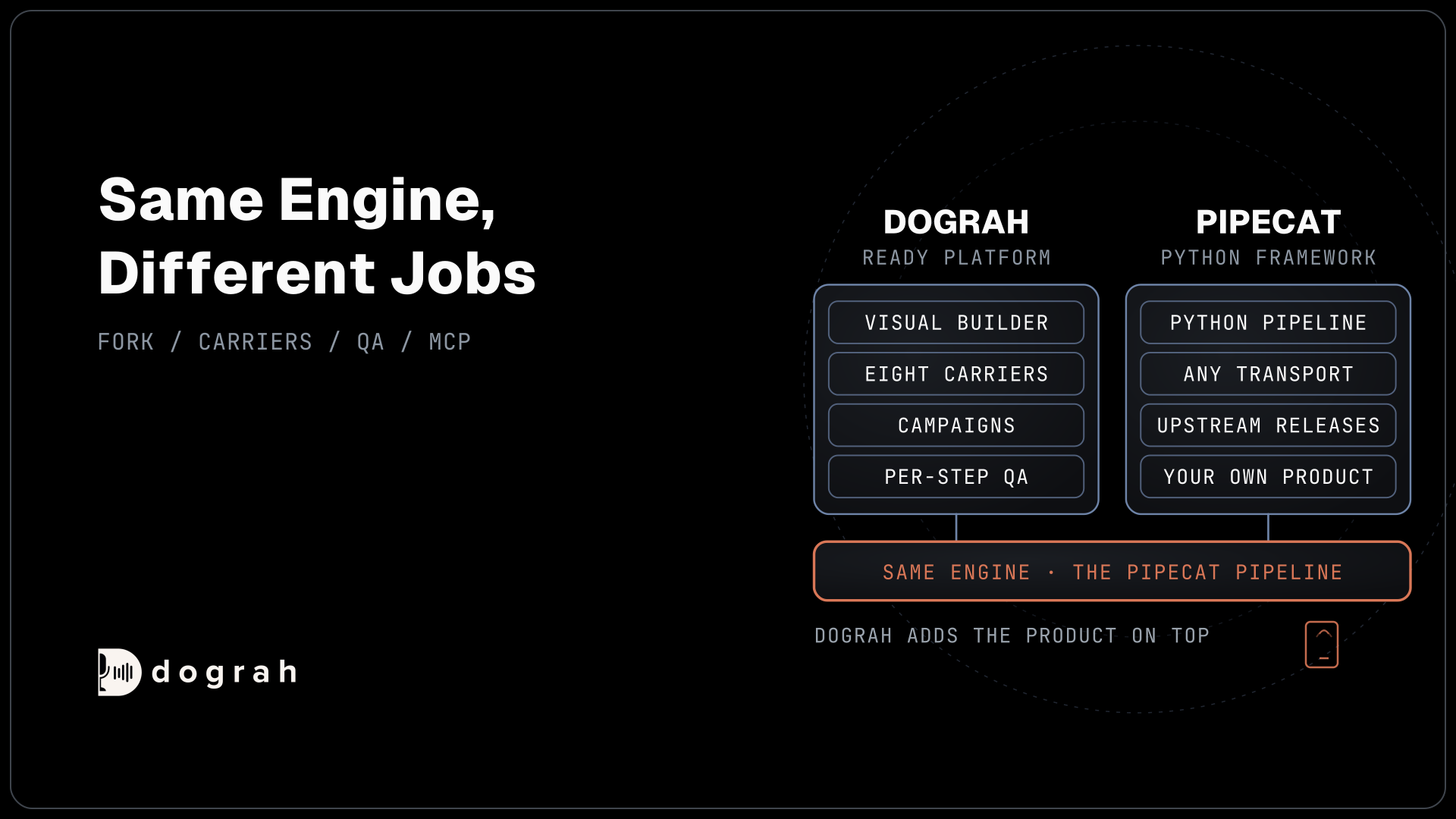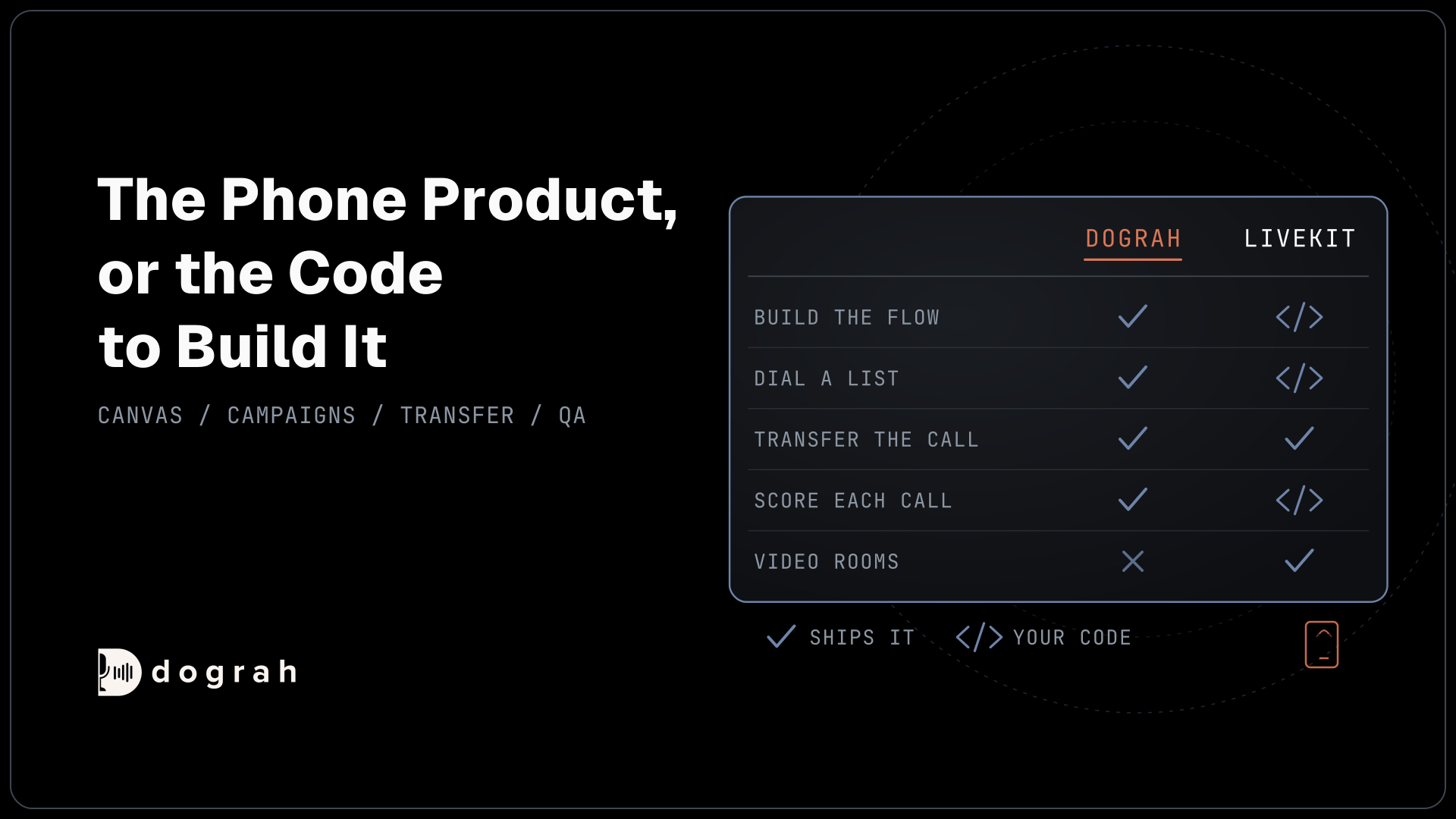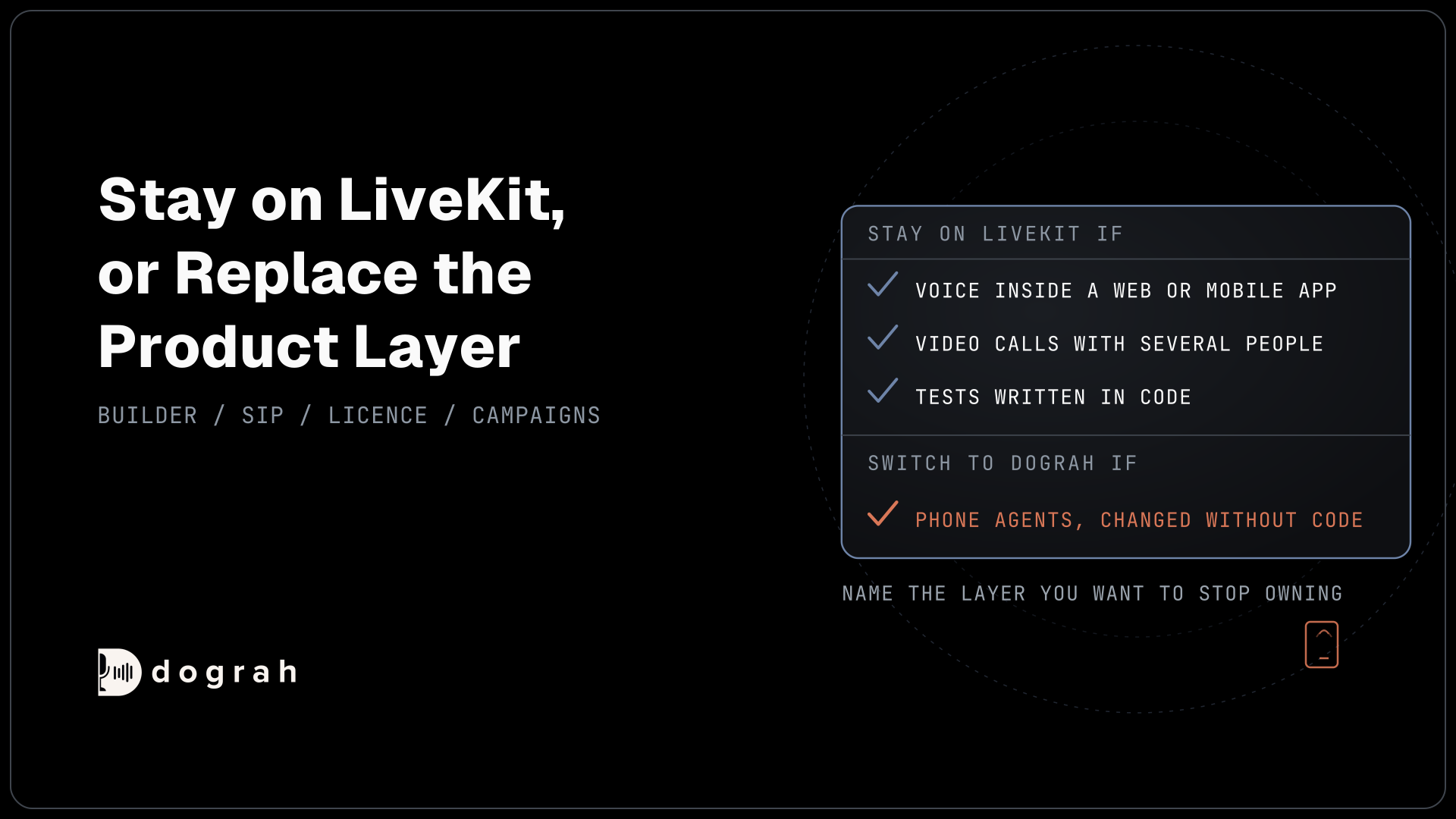

The main LiveKit alternatives are Dograh, Pipecat, TEN Framework and Vapi. Dograh is an open-source AI voice agent platform with a visual builder, telephony, campaigns and QA, ready on your own servers or its managed cloud. Pipecat and TEN are framework swaps, and Vapi is a hosted API. Teams building video or in-app voice usually stay on LiveKit.
Key Takeaways
- Dograh replaces the product layer a LiveKit team builds around its agent.
- LiveKit's Agent Builder handles simple agents only, with no workflows or tests.
- Video calls and multi-party rooms are good reasons to stay on LiveKit.
This post is part of our guide to The Best Open-Source Voice AI Platforms Compared, which sums LiveKit up in a few paragraphs. Here we sort the alternatives by the layer each one replaces, starting with Dograh.
Why teams look for a LiveKit alternative
LiveKit Agents is a well-built Apache-2.0 framework. Teams look elsewhere when they want phone agents that people outside engineering can build and change.
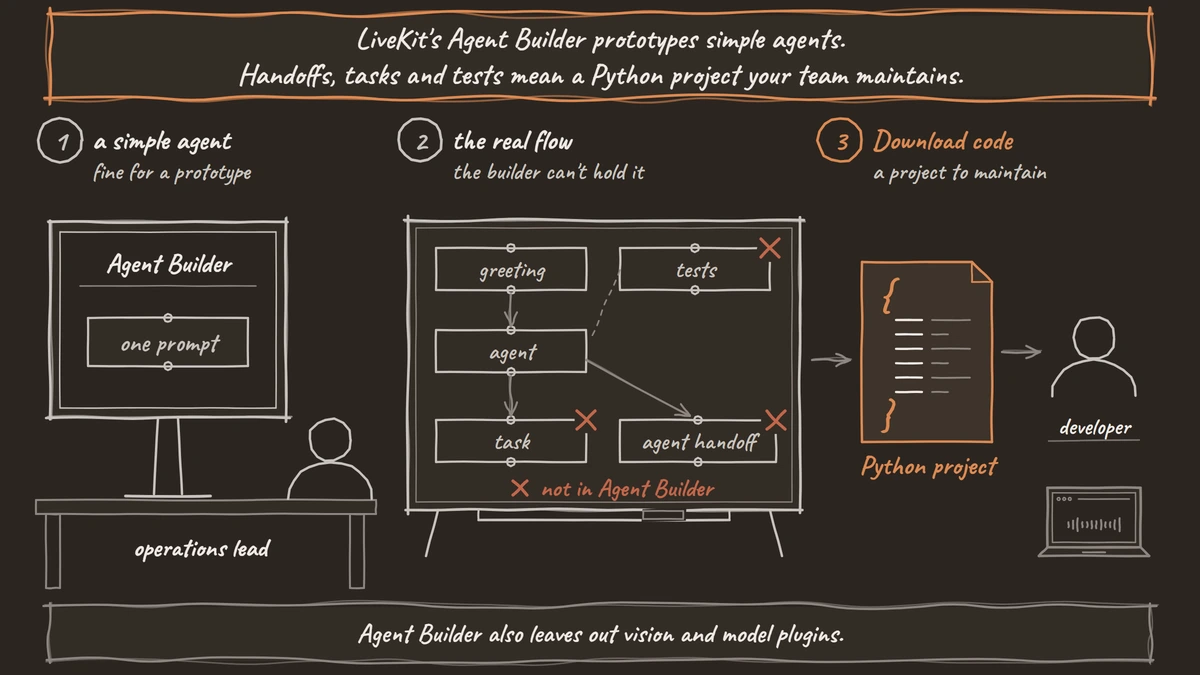
LiveKit is code first by design, and its own line is "Build your agents in code, not configuration." Its browser tool has limits. LiveKit's Agent Builder prototypes simple agents on LiveKit Cloud. It does not support workflows with handoffs and tasks, vision, model plugins or tests, and its Download code button hands you a Python project to maintain.
Licensing is the other trigger. The framework is Apache-2.0, but LiveKit's turn detection models ship under the separate LiveKit Model License. If open source is the reason you chose LiveKit, read that license before you ship.
The rest is the product around the agent. That means a screen for prompt changes, outbound lists with retries, transcripts people can search and QA on live calls, and on LiveKit your team builds or buys each of those.
Dograh: the product LiveKit leaves you to build
Dograh is open source under BSD 2-Clause and ships that product layer for phone agents. It runs on a fork of Pipecat rather than on LiveKit, and you self-host it or use Dograh Cloud.
Its visual workflow builder runs full workflows with many steps. A call moves through a greeting, agent nodes with their own prompts, tools, pathways and end-call outcomes, and a support lead can change any of it without code. You test it in the browser by voice or in text.
Phone calls run through your own carrier account. The eight built-in telephony providers are Twilio, Vonage, Plivo, Telnyx, Exotel, Vobiz, Cloudonix and Asterisk ARI, or you can bring your own SIP trunk. When a caller needs a person, Transfer Call works on Twilio, Telnyx, Plivo, Cloudonix and Asterisk ARI. Dograh calls the destination first and connects the caller only when someone answers. On Twilio, it can play a short spoken introduction to both people before connecting them.
Outbound lists run as Campaigns, with a CSV upload, calling hours by weekday, retries and pause and resume. Each call keeps its transcript and recording, and its View Trace button opens the trace in Langfuse.
For quality, a QA node reviews each call after it ends and scores every step separately, on test calls and live ones. Models come from Dograh or from any supported provider with your own keys. You can also point an agent at any model behind an OpenAI-compatible endpoint, fully local ones included. An MCP server lets coding agents such as Claude Code build agents and read past call transcripts.
Self-hosted Dograh has no per-minute platform fee (servers, model keys and phone minutes still cost). Dograh Cloud has a 1¢-a-minute platform fee. Our head-to-head with LiveKit goes through the two feature by feature.

Open Source Alternative to Vapi / Retell
Self-hosted voice agent platform — no per-minute fees
dograh-hq/dograh
Star on GitHub
Pipecat and other open frameworks
If your team wants to keep writing the agent in code, Pipecat is the natural swap. It is a BSD-2-Clause Python framework from Daily, and it treats transport as a choice, from Daily WebRTC and WebSockets to WhatsApp or even LiveKit itself. Phone calls go through carrier serializers or Daily's PSTN and SIP routes, and Pipecat Cloud hosts agents from $0.01 per active minute.
TEN Framework is another open option, with a graph designer, released under Apache 2.0 with additional restrictions. Our LiveKit vs Pipecat comparison sets the two leading frameworks against each other on licenses, transport, turn detection and phone calls.
Vapi, if you want hosted
Vapi is the route for teams that would rather not run anything. It is a closed developer platform that charges $0.05 a minute for hosting, with models passed through at cost, and includes 4 concurrent calls before you buy a package. It runs only on Vapi's cloud, with no on-premise option. That trades LiveKit's open code for speed of setup. Our Vapi vs LiveKit comparison covers the trade in full.
LiveKit alternatives compared
| Option | License | Layer you replace | Phone calls | Where it runs |
|---|---|---|---|---|
| LiveKit (baseline) | Apache-2.0; turn detector under its own license | n/a | Native SIP, cold and agent-assisted transfers, US numbers on Cloud | Your servers, or LiveKit Cloud |
| Dograh | BSD 2-Clause | Agent code and the product around it: builder, Campaigns, QA, transcripts | Eight carriers or your own SIP trunk; Transfer Call on Twilio, Telnyx, Plivo, Cloudonix, Asterisk ARI | Your servers, or Dograh Cloud |
| Pipecat | BSD-2-Clause | Agent framework; transport is your choice | Carrier serializers; transfers on Daily PSTN or SIP | Your servers, or Pipecat Cloud |
| TEN Framework | Apache 2.0 with additional restrictions | Agent framework | SIP examples | Your servers |
| Vapi | Closed source | Everything, on Vapi's cloud | Vapi numbers or imported ones | Vapi's cloud only |
Dograh is the one row that keeps the code open and removes the product work. The frameworks keep the code open and leave the product to you.
When staying on LiveKit is right
Stay on LiveKit if your agent lives inside a web or mobile app, or joins video calls with several people. That is what its media server and client SDKs are built for, and a phone-first platform does not try to match it.
It also suits teams that like writing tests. LiveKit Agents ships a test framework with LLM judges, while Dograh's QA reviews calls after they happen, as our post on automated QA for voice agents explains. For phones, LiveKit's telephony docs list SIP with tested carriers, plus cold and agent-assisted transfers.
If the pain is running servers, move to LiveKit Cloud instead of switching. LiveKit Cloud's pricing starts with a free Build plan of 1,000 agent session minutes and 5 concurrent sessions. Ship starts at $50 a month with 5,000 minutes included and Scale at $500 with 50,000, and each charges $0.01 a minute beyond its allowance.
Join the Dograh Community
Dograh is an OSS alternative to Vapi. Join our Slack community for queries, releases, best practices & community interactions.
Glossary
- Agent session minute
- LiveKit Cloud's billing unit, one minute of an agent connected to a session. Each plan includes a monthly allowance, and Ship and Scale charge $0.01 a minute beyond it.
- Turn detection model
- A model that decides when the caller has finished speaking. LiveKit's ship under the LiveKit Model License, separate from the Apache-2.0 framework.
- Agent-assisted transfer
- LiveKit's name for a transfer in which a person is brought onto the line before the caller is handed over. A cold transfer passes the call straight on, using SIP REFER.