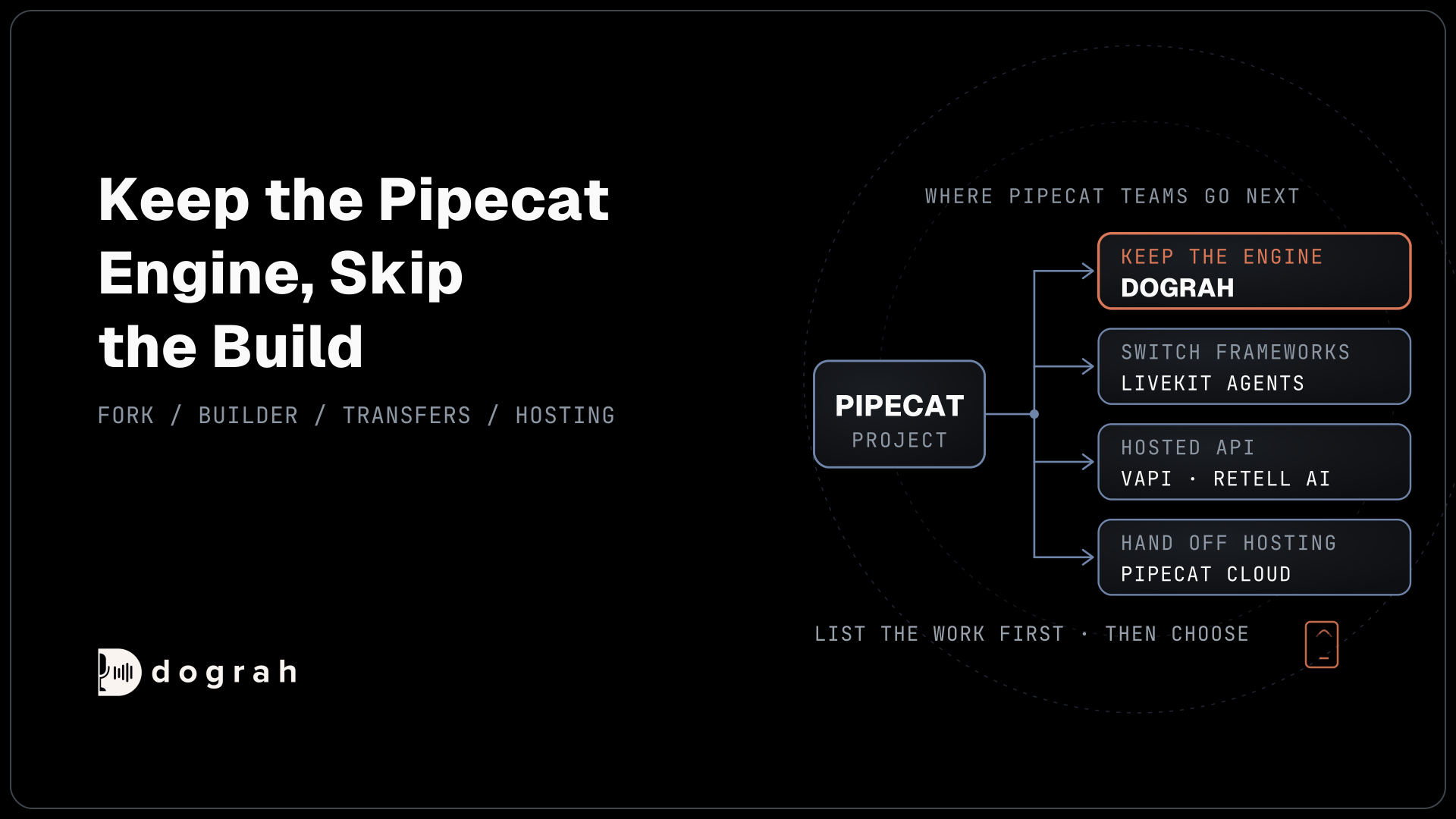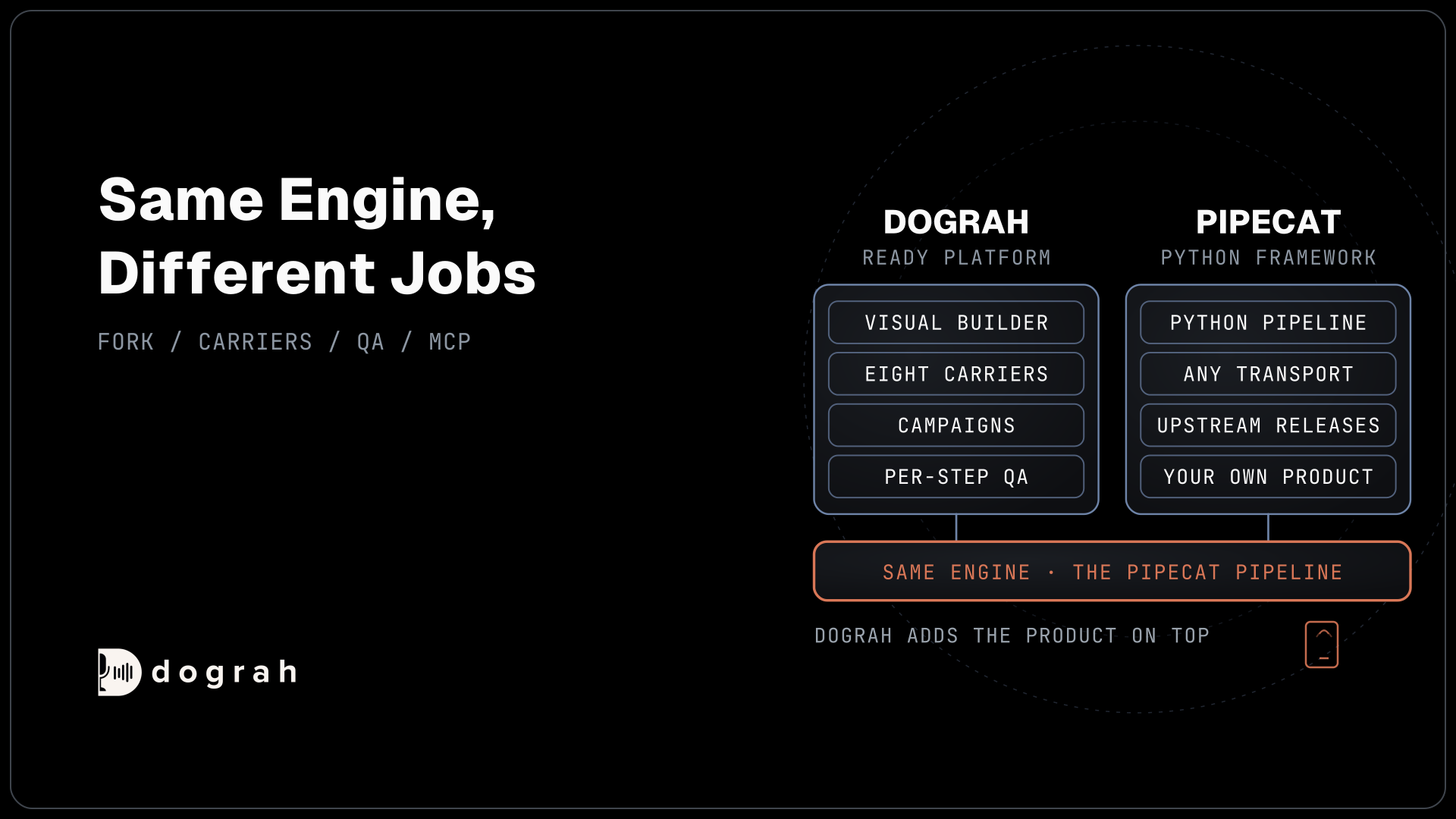

Dograh vs LiveKit is a ready platform against a framework you build on. Dograh is an open-source AI voice agent platform with a visual builder, telephony, campaigns, QA, transcripts, any supported or local model and an MCP server, self-hosted or on its managed cloud. LiveKit Agents is a code framework, with LiveKit Cloud as its hosted option.
Key Takeaways
- Dograh ships the phone product, and LiveKit Agents gives you code to build it.
- LiveKit's Agent Builder handles simple agents only, with no workflows or tests.
- Choose LiveKit for video rooms and for voice inside your own app.
This post is part of our guide to The Best Open-Source Voice AI Platforms Compared, which introduces LiveKit briefly. Here we put it beside Dograh on building, phone calls, QA, models and hosting, section by section.
A platform and a framework
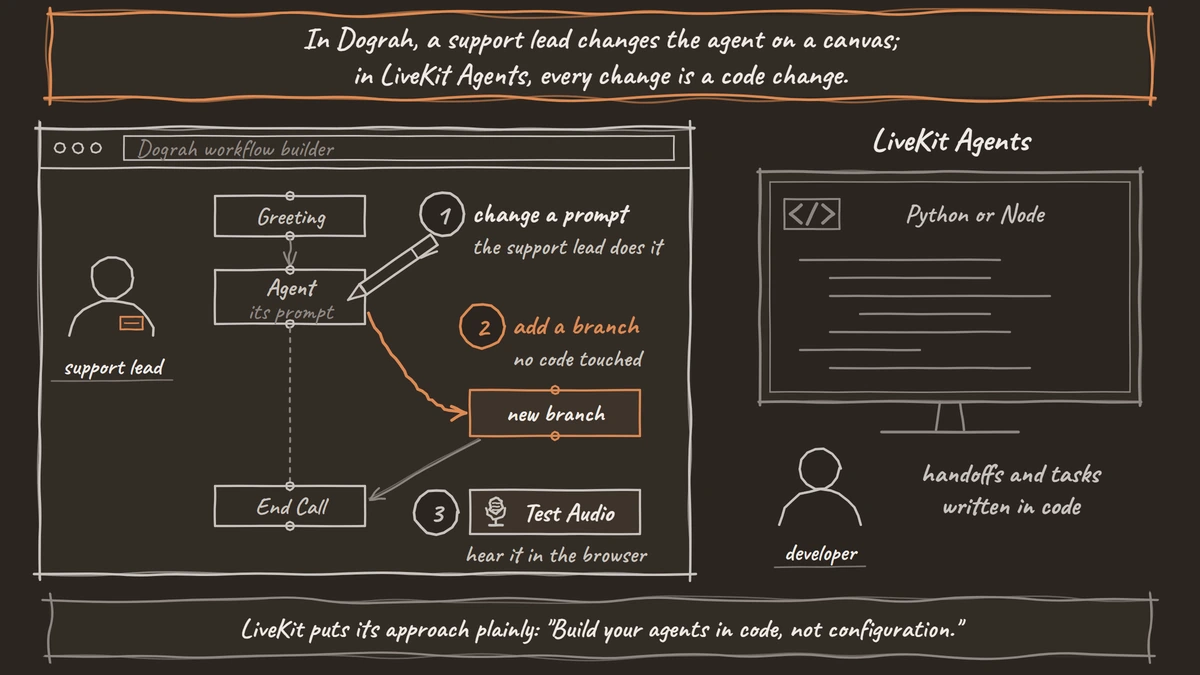
Both projects are open source, but they start in different places. LiveKit Agents is an Apache-2.0 framework that runs your agent as a participant in a room on the LiveKit media server. LiveKit puts its approach plainly, "Build your agents in code, not configuration."
Dograh is an open-source AI voice agent platform under BSD 2-Clause. It runs on a fork of Pipecat rather than on LiveKit, and it ships the product a phone team uses every day, from the builder to call review.
One license detail sits on LiveKit's side. Its turn detection models, which decide when the caller has finished speaking, ship under the separate LiveKit Model License rather than Apache-2.0. Dograh's whole codebase sits under one BSD 2-Clause license.
Building the agent: canvas or code
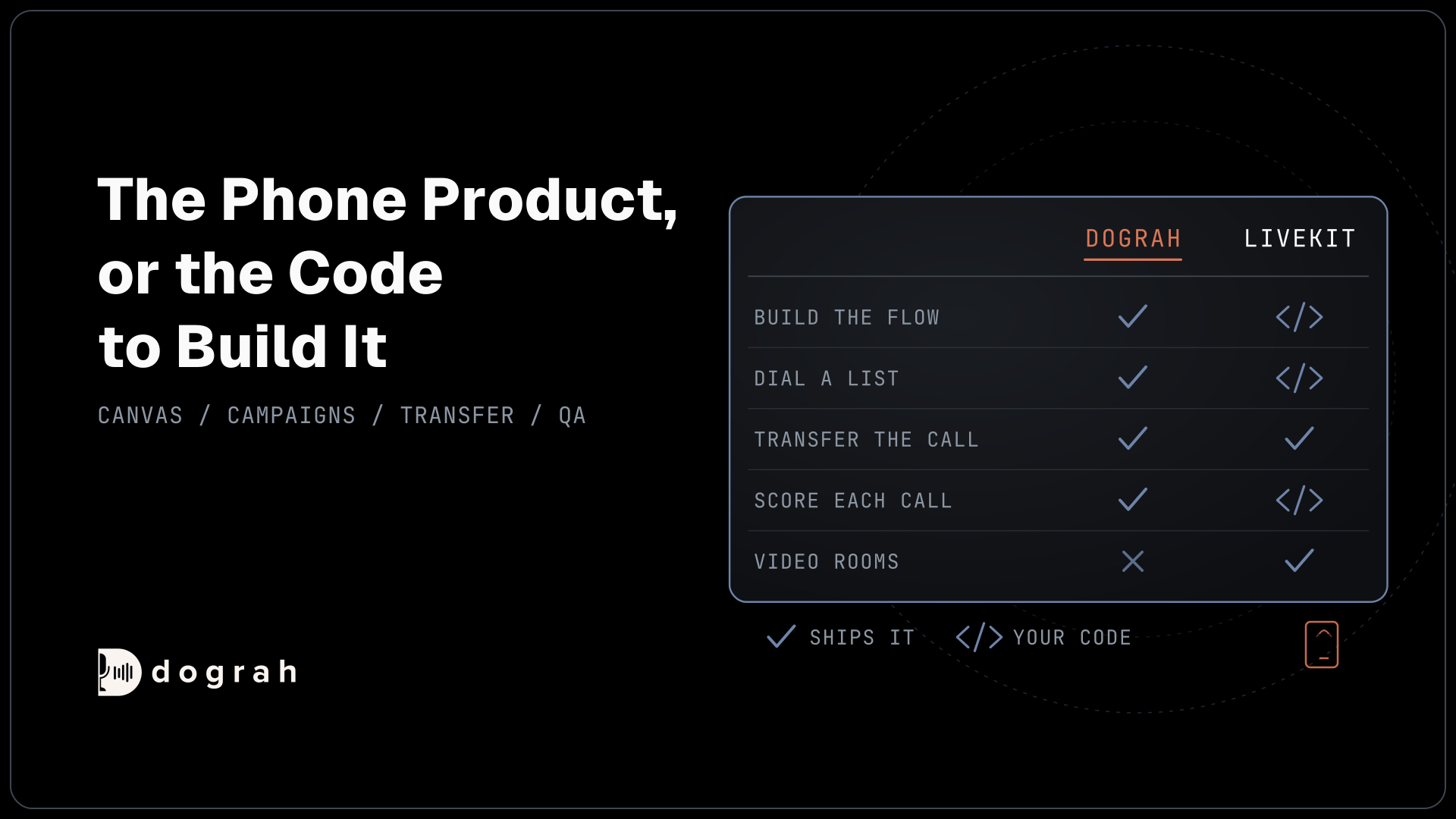
In Dograh, an agent is a flow on a canvas. The visual workflow builder holds the greeting, agent nodes with their prompts, tools, pathways and end-call outcomes, and a support lead can change a prompt or add a branch without touching code. Test Audio and Test Chat try the change in the browser.
In LiveKit Agents, the agent is Python or Node. You write handoffs and tasks in code, which gives a developer full control and makes every change a code change.
LiveKit does have a browser tool. LiveKit's Agent Builder prototypes simple agents on LiveKit Cloud at no extra cost. It does not support workflows with handoffs and tasks, vision, model plugins or tests, and its Download code button turns the agent into a Python project you maintain from then on.
Phone calls and outbound lists
Both handle phone calls, in different ways. Dograh connects to your own carrier account. The eight built-in telephony providers are Twilio, Vonage, Plivo, Telnyx, Exotel, Vobiz, Cloudonix and Asterisk ARI, or you can bring your own SIP trunk. Its Transfer Call tool works on Twilio, Telnyx, Plivo, Cloudonix and Asterisk ARI. Dograh calls the destination first and connects the caller only when someone answers. On Twilio, it can play a short spoken introduction to both people before connecting them.
LiveKit speaks SIP natively. LiveKit's telephony docs list carriers it has tested, including Twilio, Telnyx, Exotel and Plivo, plus cold transfers and agent-assisted transfers. LiveKit Cloud also sells US local and toll-free numbers.
Outbound lists are where the build shows. In Dograh, Campaigns take a CSV, dial inside calling hours you set per weekday, retry busy or unanswered numbers and can be paused and resumed. LiveKit places outbound calls over SIP from your code, so the list, its hours and its retries live in software your team writes.

Open Source Alternative to Vapi / Retell
Self-hosted voice agent platform — no per-minute fees
dograh-hq/dograh
Star on GitHub
QA, models and coding agents
Quality checks happen at different moments. LiveKit Agents ships a test framework, so developers write tests with LLM judges before release, and LiveKit Cloud adds transcripts and traces for live sessions. Dograh saves each call's transcript and recording, and its QA node reviews each call after it ends, scoring every step separately on test calls and live ones. Our post on automated QA for voice agents shows how to read those scores.
For models, Dograh offers its own or any supported provider with your own keys. It also takes any model behind an OpenAI-compatible endpoint such as Ollama or vLLM, so a call can run on fully local models. LiveKit connects providers through its plugins, and LiveKit Cloud adds LiveKit Inference with credits included on its plans.
Dograh also has an MCP server. Coding agents such as Claude Code, Claude Desktop, Codex or Cursor can create an agent, or edit one as a draft that goes live only when you publish. They can also read past call transcripts, though not the recordings. Our guide to MCP for voice agents walks through that loop.
Dograh vs LiveKit side by side
| Dograh | LiveKit Agents and LiveKit Cloud | |
|---|---|---|
| What it is | Open-source AI voice agent platform | Open-source framework on the LiveKit media server, plus a managed cloud |
| License | BSD 2-Clause | Apache-2.0; turn detection models under the LiveKit Model License |
| Building the agent | Visual workflow builder that runs full flows; MCP for coding agents | Python or Node code; Agent Builder for simple agents |
| Phone calls | Eight carriers or your own SIP trunk; Transfer Call on Twilio, Telnyx, Plivo, Cloudonix, Asterisk ARI | Native SIP with tested carriers; cold and agent-assisted transfers; US numbers on Cloud |
| Outbound lists | Campaigns with calling hours, retries, pause and resume | Outbound calls over SIP from your code |
| Testing and QA | Test Audio and Test Chat; per-step QA node on test and live calls | Test framework with LLM judges; transcripts and traces on Cloud |
| Models | Dograh's own, your keys, or an OpenAI-compatible endpoint, fully local included | Provider plugins; LiveKit Inference on Cloud |
| Video and rooms | Voice only | Video, multi-party rooms, client SDKs |
| Hosted option | Dograh Cloud, 10 concurrent calls included | LiveKit Cloud: Build free, Ship from $50/mo, Scale from $500/mo |
On price, each side publishes its own terms. LiveKit Cloud's pricing page lists Build free with 1,000 agent session minutes and 5 concurrent sessions, Ship at $50 a month with 5,000 minutes and 20 sessions, and Scale at $500 with 50,000 minutes and up to 600. Ship and Scale then charge $0.01 a minute. Self-hosted Dograh has no per-minute platform fee (servers, model keys and phone minutes still cost). Dograh Cloud has a 1¢-a-minute platform fee. Both are free to self-host, where your servers set the limit, and ours starts at 10 concurrent calls by default, a setting you can raise.
When LiveKit fits better
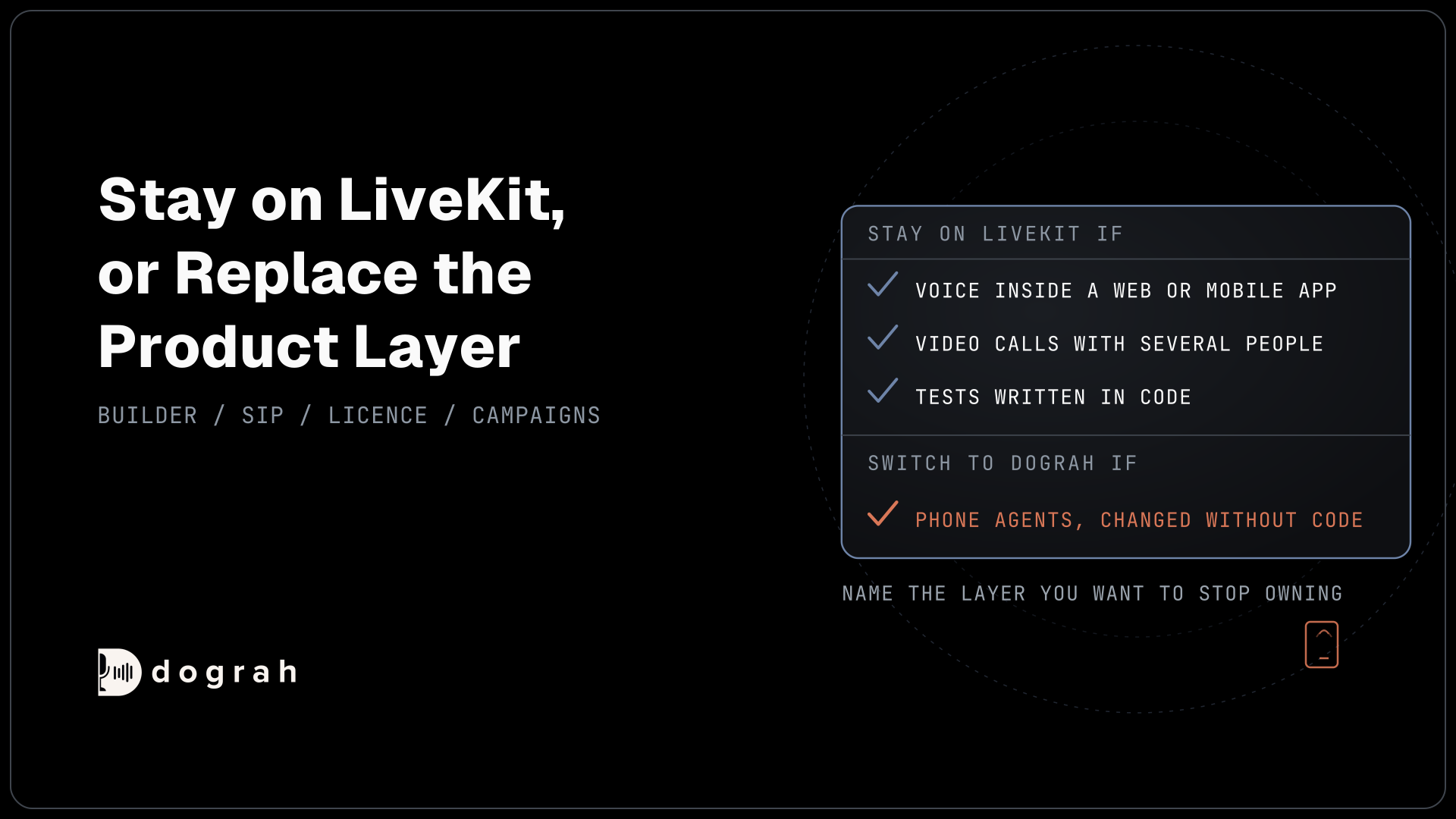
Pick LiveKit if your agent lives inside a web or mobile app, or joins video calls with several people. Its media server and client SDKs are built for rooms, and Dograh is built for the phone.
LiveKit also suits developers who want to write and test everything in code. Its test framework with LLM judges catches regressions before release, and handoffs written in code can go further than a canvas. Teams that want phone numbers from the same vendor can buy US numbers on LiveKit Cloud, while Dograh works through your carrier account.
If you have decided LiveKit is not for you but Dograh is not the fit either, our list of LiveKit alternatives covers the other routes.
Join the Dograh Community
Dograh is an OSS alternative to Vapi. Join our Slack community for queries, releases, best practices & community interactions.
Glossary
- Media server
- The server that routes live audio and video between everyone in a session. LiveKit Agents joins a room on LiveKit's media server as one participant, and you can self-host the server or use LiveKit Cloud.
- Agent session minute
- LiveKit Cloud's billing unit, one minute of an agent connected to a session. Each plan includes a monthly allowance, and Ship and Scale charge $0.01 a minute beyond it.
- Agent-assisted transfer
- LiveKit's name for a transfer in which a person is brought onto the line before the caller is handed over. A cold transfer passes the call straight on, using SIP REFER.