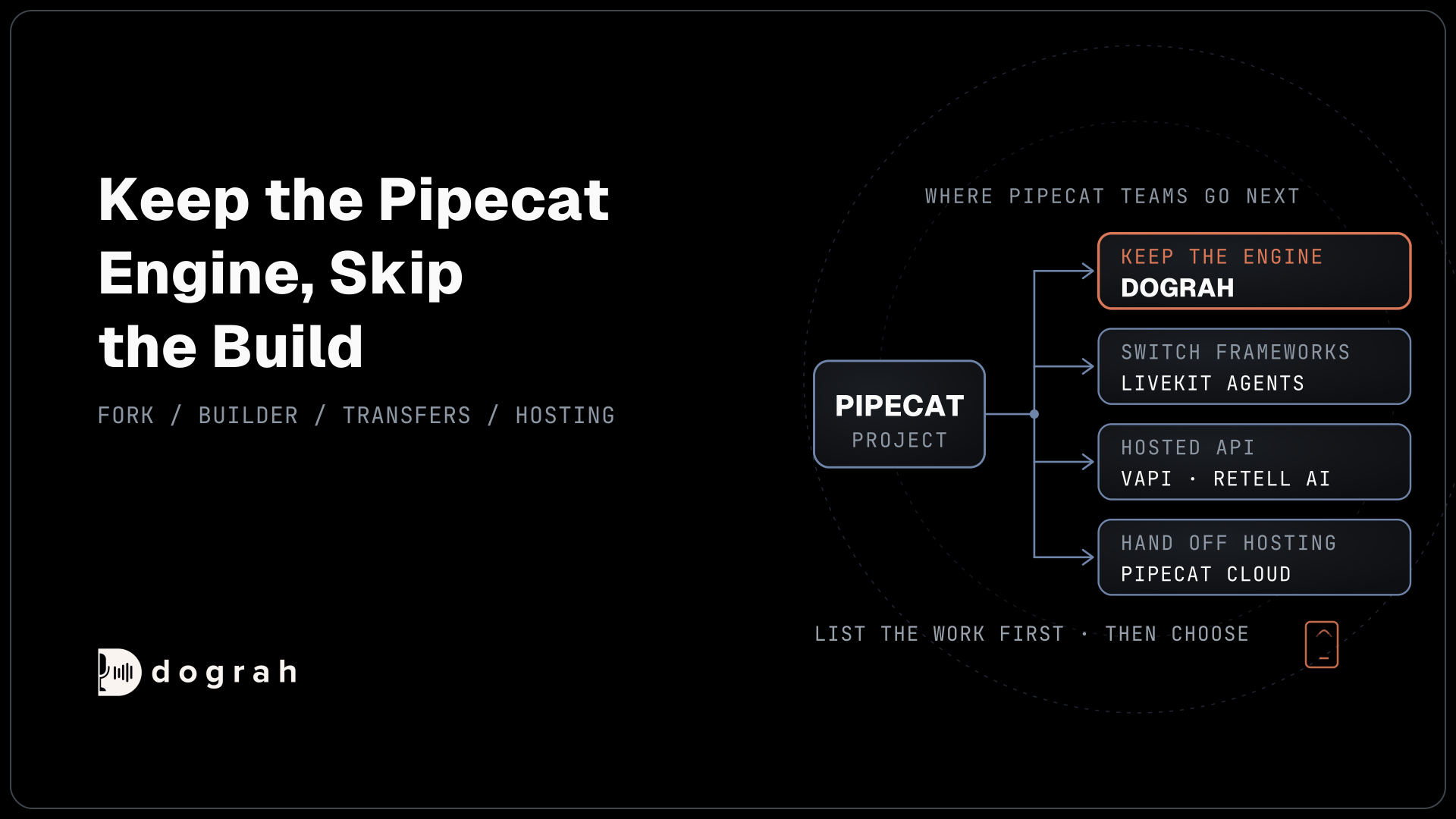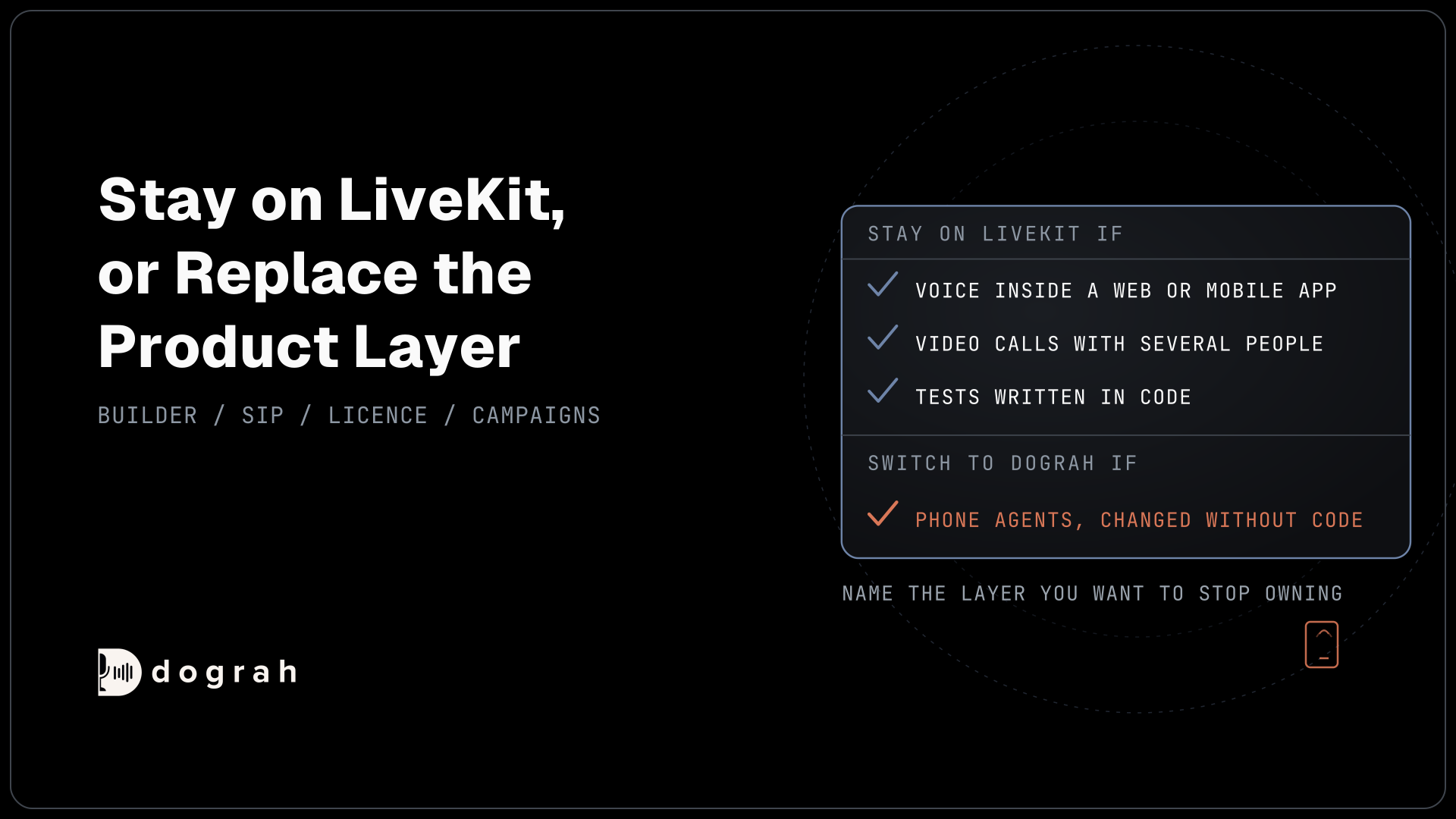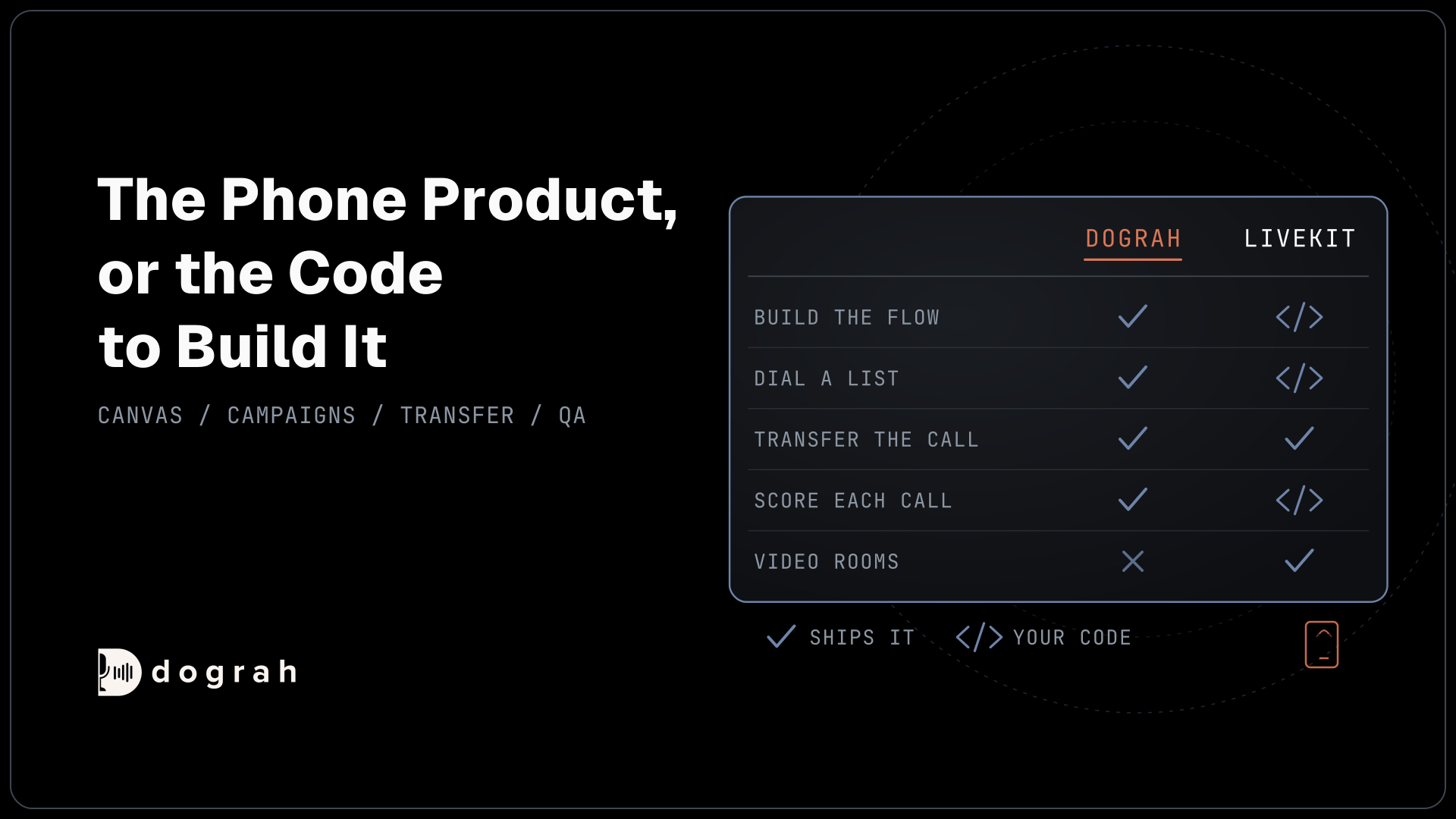

Dograh vs Pipecat is a ready platform against the framework it runs on. Dograh is an open-source, self-hostable AI voice agent platform built on a fork of Pipecat. It ships the visual builder, telephony, campaigns, QA, transcripts, model choice including local models, and an MCP server. Pipecat alone fits teams building a fully custom voice product in Python.
Key Takeaways
- Dograh runs on a fork of Pipecat, so one sits on top of the other.
- Dograh ships what a Pipecat team builds before its first real call.
- Pipecat alone fits teams building their own product or non-phone voice.
This post is part of our guide to The Best Open-Source Voice AI Platforms Compared, which lists in short what you build on a framework before the first call. Here we take Pipecat specifically, item by item, and show what Dograh already ships.
Same engine, different jobs
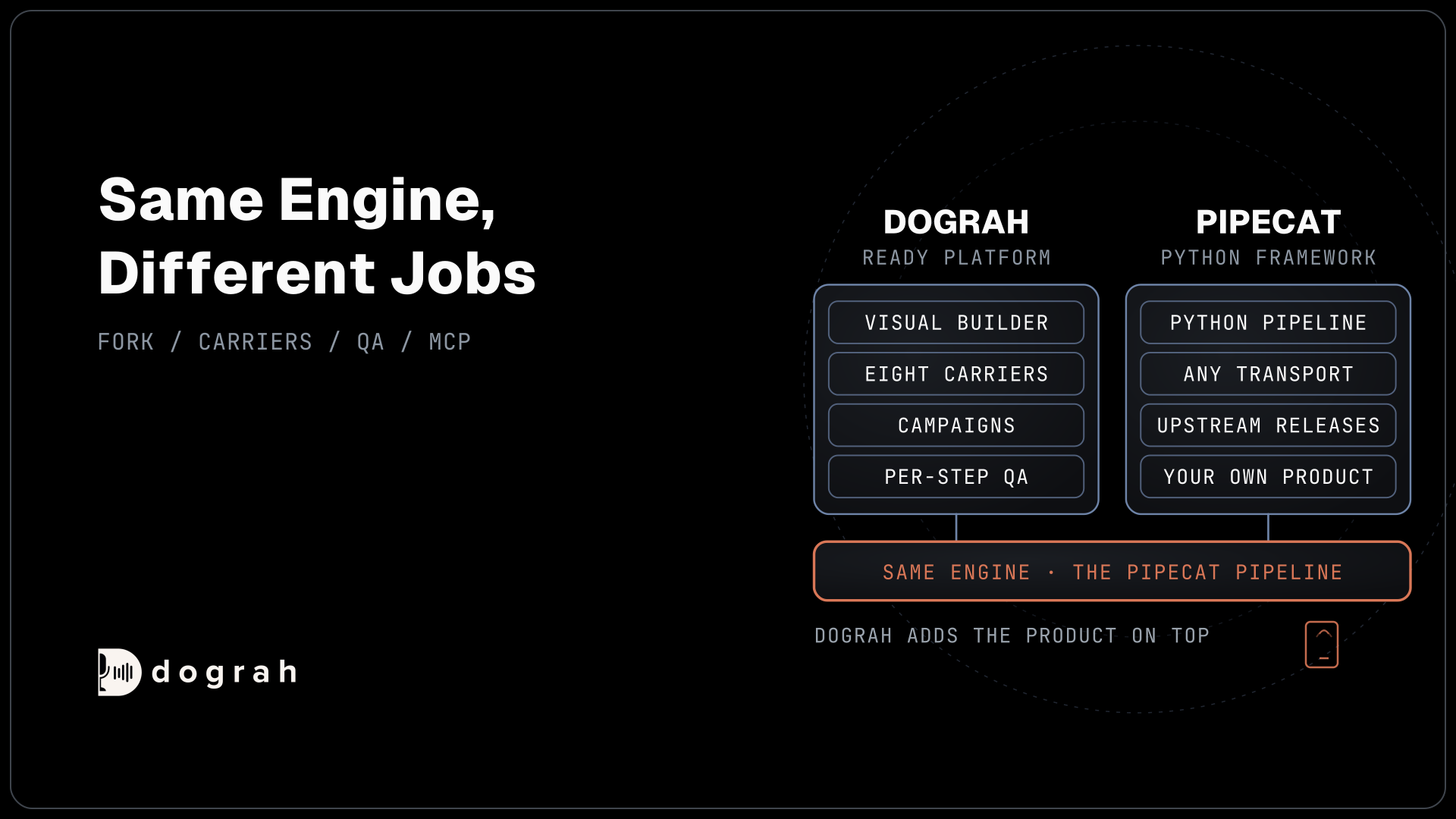
Dograh and Pipecat do different jobs on the same engine. Dograh pins its own fork of Pipecat inside its repository, so every call it handles runs on the Pipecat pipeline. The difference is how much product sits on top of that pipeline when you start.
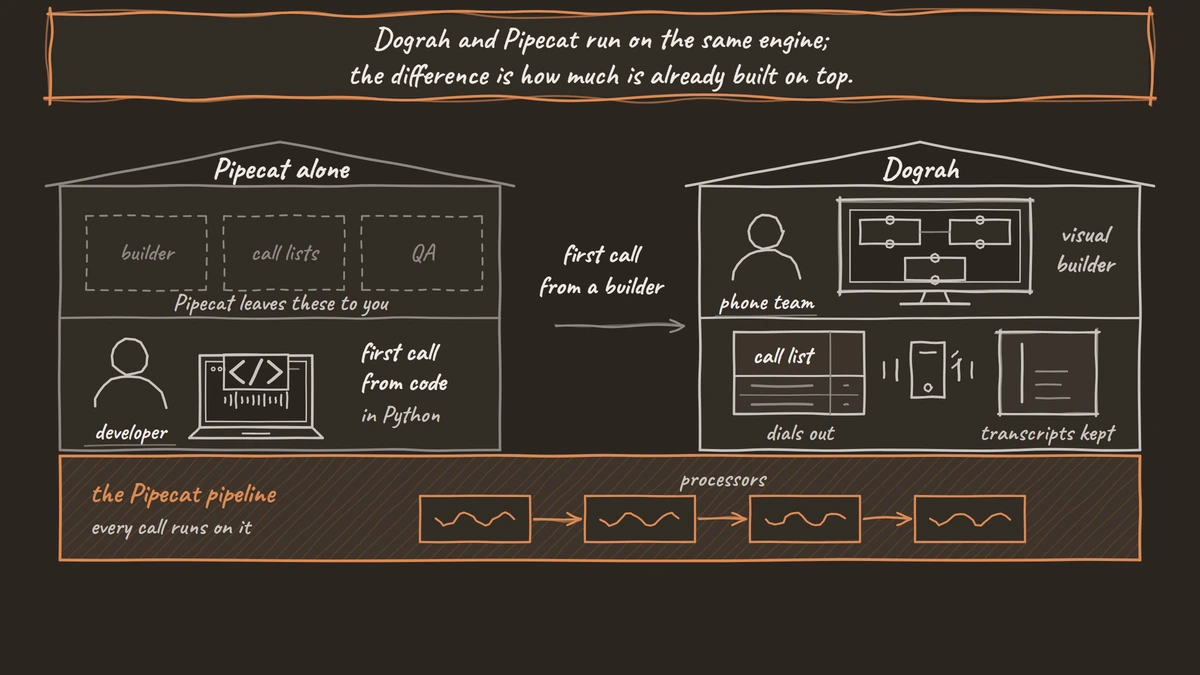
Pipecat is an open-source Python framework from Daily under BSD-2-Clause. You compose a pipeline from processors and choose a transport, with more than 150 AI services to pick from.
Dograh, the open-source AI voice agent platform, also ships under BSD 2-Clause. It wraps the pipeline in the product a phone team needs, so the first working call comes from a builder instead of from code. Both licenses let you change the code and run it yourself.
What Pipecat leaves you to build
A Pipecat project starts with a pipeline and ends wherever your team stops building. For a phone agent in production, the build list is long.
Carrier wiring comes first. Pipecat reaches carriers through telephony serializers for Twilio, Telnyx, Plivo, Exotel, Vonage and Genesys. Pipecat's telephony guide says those WebSocket integrations with Twilio, Telnyx, Plivo and Exotel have "No advanced call center features like transfers or reconnects". To hand a caller to a person, you move to Daily PSTN or SIP.
Call logic is next. Pipecat Flows now ships inside the core package, and the open-source Flows Editor lets you lay out a flow on a canvas and export it as YAML into your project. It is a design tool, so the call still runs in your code.
Then comes the product itself. Somebody has to build a screen where non-developers change prompts, outbound lists with calling hours and retries, a store of transcripts and recordings, QA on live calls and a way to switch models without a redeploy. Each one is a project of its own.
What Dograh ships on top
Dograh ships each item on that list, ready on the first day. The visual workflow builder replaces flow code. You describe the use case in a few words and Dograh drafts an agent. From there you edit nodes, prompts, tools and pathways on a canvas, then try it in the browser with Test Audio or Test Chat.
Eight carriers are built in (Twilio, Vonage, Plivo, Telnyx, Exotel, Vobiz, Cloudonix and Asterisk ARI), and you can bring your own SIP trunk. The Transfer Call tool works on Twilio, Telnyx, Plivo, Cloudonix and Asterisk ARI. Dograh calls the destination first and connects the caller only when someone answers. On Twilio, it can play a short spoken introduction to both people before connecting them.
Campaigns take a CSV, dial within calling hours set per weekday in one time zone, retry busy or unanswered numbers and can be paused. Each call keeps its transcript and recording, and its trace opens in Langfuse. A QA node then scores every step of the call separately, with tags, a 1-10 score, sentiment and a summary.
Models are your choice. You can use Dograh's own or any supported provider with your own keys, and any model behind an OpenAI-compatible endpoint such as Ollama or vLLM works too. With Dograh self-hosted and local models on your own servers, call audio never reaches a third party, as our tutorial on building a voice agent on fully local open-source models shows.
Through the MCP server, a coding agent such as Claude Code or Cursor can create agents and edit them, with edits saved as drafts. It can also read past call transcripts, though not the recordings. Our guide to MCP for voice agents covers that loop.
You can self-host with one Docker command or start on the hosted cloud. Self-hosted Dograh has no per-minute platform fee (servers, model keys and phone minutes still cost). Dograh Cloud has a 1¢-a-minute platform fee.

Open Source Alternative to Vapi / Retell
Self-hosted voice agent platform — no per-minute fees
dograh-hq/dograh
Star on GitHub
Dograh vs Pipecat side by side
| Dograh | Pipecat | |
|---|---|---|
| What it is | Open-source AI voice agent platform | Open-source Python framework |
| License | BSD 2-Clause | BSD-2-Clause |
| Engine | A pinned fork of Pipecat | Pipecat itself, every upstream release |
| Building the agent | Visual workflow builder, or a coding agent through MCP | Python code, with Flows and the Flows Editor for design |
| Phone calls | Eight carriers or your own SIP trunk; Transfer Call on Twilio, Telnyx, Plivo, Cloudonix, Asterisk ARI | Serializers for six carriers; transfers on Daily PSTN or SIP |
| Outbound | Campaigns with calling hours, retries, pause and resume | Build it yourself |
| Call history and QA | Transcripts, recordings, traces, per-step QA node | Build it yourself or add a tool |
| Models | Dograh's, your own keys, or an OpenAI-compatible endpoint, fully local included | Any of 150+ services you wire in |
| Transports beyond the phone | Browser and web widget | Daily, LiveKit, WebSocket, WhatsApp, mobile and embedded SDKs |
| Hosted option | Dograh Cloud | Pipecat Cloud, or Pipecat Enterprise in your VPC |
The table shows the trade plainly. Dograh removes the build for phone agents, and Pipecat keeps more freedom in transports and the pipeline itself.
When Pipecat alone fits better
Pick Pipecat on its own if you are building a voice product of your own, with your own interface, and want to own every stage of the pipeline in Python. It also fits video or multimodal apps, and transports such as WhatsApp or a custom WebRTC setup, where its client SDKs reach further than a phone-first platform.
Pipecat also gets every upstream release the day it ships. Dograh runs on a pinned fork, so a new Pipecat feature reaches Dograh only when the fork moves forward.
If servers are the worry, Daily sells hosting. Pipecat Cloud runs agents from $0.01 per active minute on its smallest agent size, with Daily PSTN calls at $0.018 a minute on top. Pipecat Enterprise runs agents in your VPC, while Daily runs the control plane.
For the cost side of building versus adopting a platform, read Build vs Buy: Should You Build Your Own Voice AI Stack?. If you are leaving Pipecat altogether, our list of Pipecat alternatives covers the other routes.
Join the Dograh Community
Dograh is an OSS alternative to Vapi. Join our Slack community for queries, releases, best practices & community interactions.
Glossary
- Pinned fork
- A copy of another project's code that a repository fixes at one chosen version. Dograh pins its Pipecat fork as a submodule, so upstream Pipecat changes arrive only when that pin moves.
- Telephony serializer
- Pipecat's adapter that converts one carrier's audio stream into the pipeline's format. Its WebSocket phone integrations carry audio but not transfers or reconnects.
- Daily PSTN
- Daily's own phone-network route for Pipecat agents, priced per minute. Unlike the WebSocket integrations, it supports transferring a caller to a person.