
The open-source alternative to PolyAI is Dograh, the AI voice agent platform we build. It is BSD-2 licensed, runs on your own servers or Dograh Cloud with any model, and your team edits agents in a visual builder. PolyAI publishes the code for its Agent Development Kit (ADK), but agents built with it still run only on PolyAI's cloud.
Key Takeaways
- Open code, the runtime and the call audio are three separate kinds of control.
- PolyAI's ADK is open source, but every PolyAI call still runs on PolyAI.
- Self-hosting Dograh puts uptime and upgrades in your own team's hands.
This post is part of our guide to PolyAI alternatives, where open-source tooling and an open-source platform are two different things. Here we show that difference on three levels, then set out what PolyAI's managed service includes and what self-hosting moves to your team.
Three levels of control: code, runtime and audio
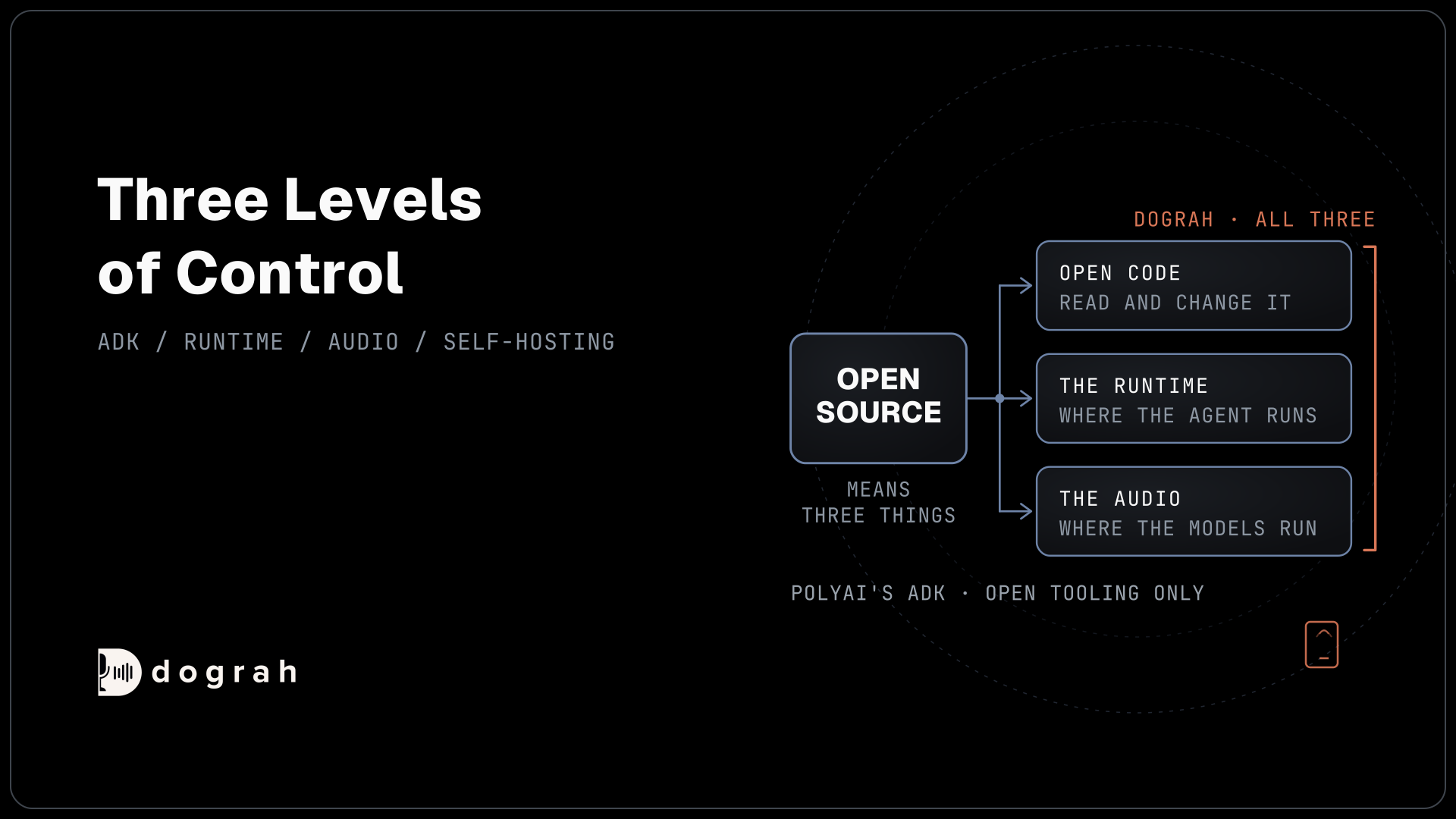
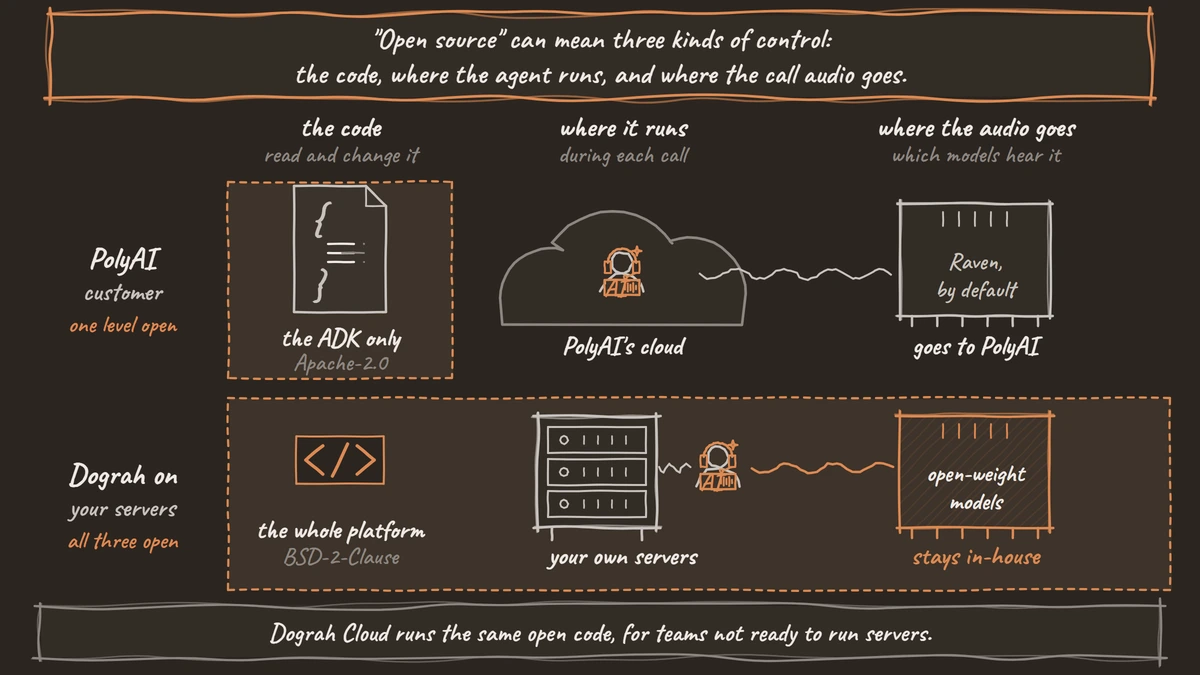
"Open source" can mean three different things, and each one gives you a different kind of control. The first is open code, which you can read and change. The second is the runtime, the place where the agent runs during a call. The third is where the call audio goes, which depends on where the speech and language models run.
| Level | PolyAI | Dograh | LiveKit Agents and Pipecat |
|---|---|---|---|
| Open code | The ADK is Apache-2.0; the platform is closed | The whole platform is BSD-2-Clause | Apache-2.0 (LiveKit Agents) and BSD-2-Clause (Pipecat) |
| Where it runs | PolyAI's own cloud, hosted on AWS, with US, EU and UK regions | Your own servers, Dograh Cloud, or on-prem on Enterprise | Your own servers, or each project's managed cloud |
| Where the audio goes | To PolyAI and the model it runs, Raven by default | Stays in-house when the speech and language models also run on your servers | Wherever your developers point the models |
| Who builds the agent | Your team in Agent Studio, the ADK or APIs | Your team in a visual builder, or through the MCP server | Your developers, in code |
| What ships with it | Builder, phone, analytics, and improvements, maintenance and 24/7 support in the rate | Builder, telephony, campaigns, QA and call history | The call pipeline; the product around it is yours to build |
Only one column gives you all three levels. A framework opens the runtime too, but your developers then build the builder, phone wiring and call history themselves.
PolyAI's ADK: open tooling, closed runtime
PolyAI does publish open-source code, but it is tooling for its own platform. The ADK is a command-line kit that pulls an agent's settings into local files you can keep in Git. In PolyAI's own words, it "does not run your agent", and "There is no local runtime." Every call still runs on PolyAI's cloud.
The model layer works the same way. Raven, PolyAI's own model, runs most PolyAI deployments, and other models come from a set OpenAI and Amazon Bedrock list. For anything else, PolyAI's bring-your-own-model setup asks you to send the endpoint and credentials to your PolyAI representative.
None of this is hidden, and it is a sensible design for a managed service. It does mean the agent cannot leave PolyAI as a running system. That matters when you change vendors. In a Zapier survey of US enterprise executives published in April 2026, only 6% said they could stop using their main AI vendor without disruption.
Dograh: a full open-source platform
Dograh opens all three levels, and the whole product sits in one public repository. That covers the builder, telephony setup, campaigns, QA and call history. You can run it on your own servers or start on Dograh Cloud with the same code.
Your team builds and edits agents in the visual workflow builder. Describe your use case and an AI drafts a starting workflow, which you can change node by node whenever you need to.
An AI assistant can also create and edit agents through Dograh's MCP server, which helps when a team rebuilds many agents at once.
Dograh is the orchestration layer that runs the call flow, tools and telephony, and the speech and language models are a separate layer you choose. That can be Dograh's own models, your own keys for supported providers, or open-weight models behind an OpenAI-compatible endpoint such as Ollama or vLLM. With your own keys, the call audio still reaches each provider. Only when the platform and the models all run on your servers does the audio stay in-house. Our side-by-side comparison with PolyAI sets the two products out row by row.

Open Source Alternative to Vapi / Retell
Self-hosted voice agent platform — no per-minute fees
dograh-hq/dograh
Star on GitHub
What PolyAI's managed service includes
PolyAI's price buys ongoing work that an open-source platform leaves to you. On PolyAI's pricing page, use of the voice agent "is priced on a per-minute basis, which includes proactive performance improvements, maintenance and 24/7 support". The rate itself is quoted by its sales team.
Around that sit pieces you would otherwise assemble. PolyAI lists SOC 2 Type II, ISO 27001 and PCI DSS on the vendor, regions in the US, EU and UK, SMS through Twilio, and redacted recordings for users without PII access. It also connects to Five9, NICE, Genesys, Salesforce and ServiceNow.
For a contact centre with no engineers to run servers, that bundle is a fair reason to stay. Dograh has no built-in SMS, recording redaction or native contact-centre connectors. Business systems connect to it through HTTP API tools and webhooks instead.
What self-hosting moves to your team
Self-hosting Dograh gives you the code and the servers, and with them the work of running both. Uptime and upgrades move to your own team. It runs on Docker Compose and handles 10 calls at once by default, a limit you can raise.
In return, there is no per-minute platform fee. You still pay for servers, model keys and phone minutes. Dograh Cloud has a 1¢-a-minute platform fee and is the middle path for teams that want open code without running servers on day one.
Frameworks sit at the far end. LiveKit Agents and Pipecat give your developers the call pipeline and leave the product to them. Dograh is built on a fork of Pipecat. Our roundup of the best open-source voice AI platforms covers the wider field.
When you decide to move, start with our guide on how to migrate from PolyAI to open-source voice AI. Test the rebuilt agent on a real phone line, because most phone calls reach the agent as 8 kHz audio while a browser demo runs at 16 kHz.
Join the Dograh Community
Dograh is an OSS alternative to Vapi. Join our Slack community for queries, releases, best practices & community interactions.
Glossary
- Runtime
- Where the voice agent actually runs during a live call. Owning the code is not the same as owning the runtime: PolyAI's ADK code is open, but PolyAI agents run only on PolyAI's cloud.
- Agent Development Kit (ADK)
- PolyAI's Apache-2.0 command-line kit for pulling, editing and pushing agent settings as local files. It has no local runtime, so it is open tooling rather than an open platform.
- Open-weight model
- An AI model whose weights you can download and run on your own servers. Running one is the only way to keep call audio from reaching an outside model provider.
- Orchestration layer
- The part of a voice platform that runs the call flow, tools and telephony. In Dograh it is separate from the speech and language models, which you choose yourself.