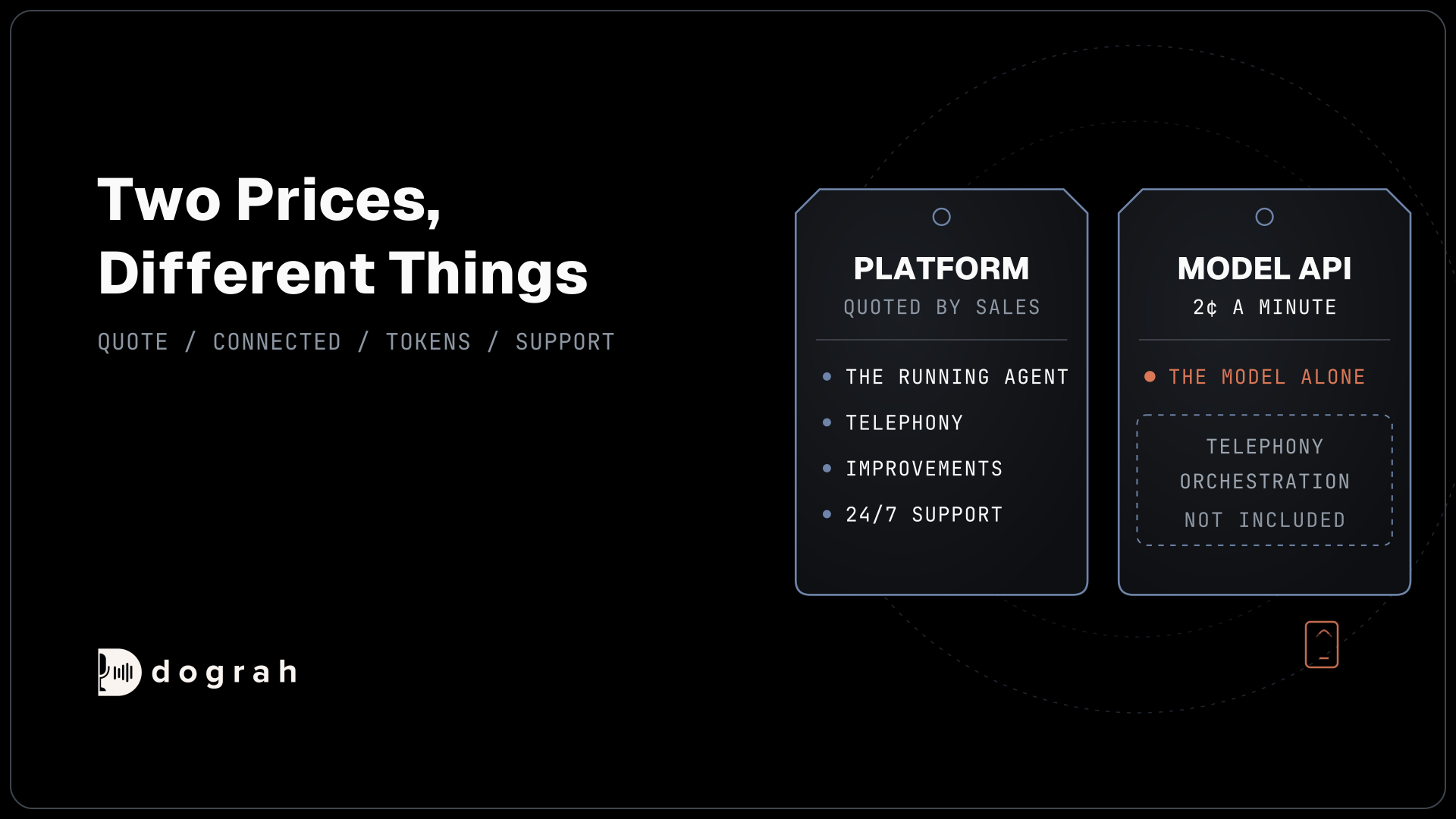

PolyAI pricing has two parts. Its platform is priced per minute at a rate the sales team quotes, including improvements, maintenance and 24/7 support. Its Dialog-RSN-1 model API costs 2¢ per connected minute plus tokens, without telephony. Dograh, the open-source AI voice agent platform we build, is an alternative you can self-host or run on Dograh Cloud.
Key Takeaways
- PolyAI's platform rate is quoted by sales and includes maintenance and 24/7 support.
- The 2¢ API buys the model alone, without telephony or call orchestration.
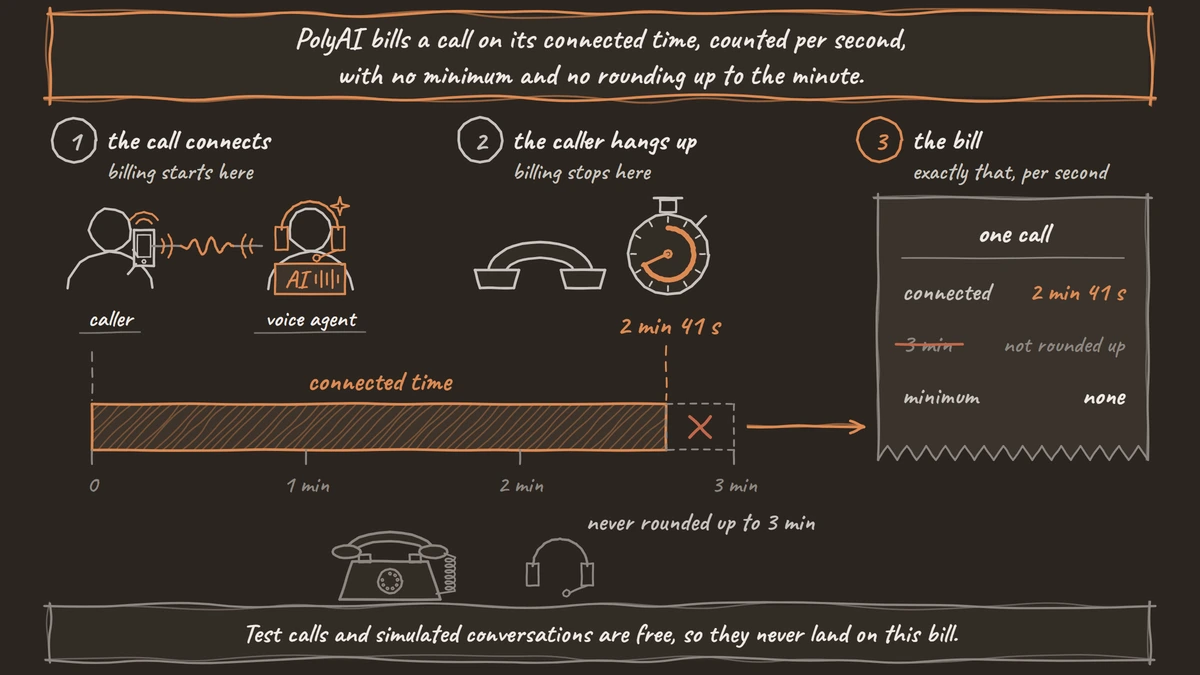
- Calls are billed on connected time, per second, so call length drives the bill.
This post is part of our guide to PolyAI alternatives, which notes that PolyAI sells two things at two different prices. Here we cover what the platform rate includes and how a quote is built, then what the 2¢ API leaves out. The last section sets each number beside Dograh's.
Two prices: the platform and the model API
PolyAI sells its full voice agent platform and, separately, the model behind it. The platform is what most buyers mean by PolyAI, with Agent Studio, telephony, analytics and a team that keeps the agent working. Its per-minute rate comes from the sales team.
The Dialog-RSN-1 API is newer and self-serve. It gives developers PolyAI's speech model for their own voice stack, at a printed price of 2¢ a minute plus text tokens. The two prices buy very different things, so they should never be compared as if they were the same product.
What the platform rate includes
The platform rate covers the running agent and the work around it. On PolyAI's pricing page, ongoing use "is priced on a per-minute basis, which includes proactive performance improvements, maintenance and 24/7 support". So the vendor keeps tuning the agent after launch, and that work is not billed as a separate services line.
Usage is "Billed on connected time, with no minimums and no rounding up to the minute." A call that lasts 2 minutes and 41 seconds is billed as exactly that. With no minimum commitment, a small pilot pays only for the minutes it uses, once the rate is agreed.
The same page lists what comes at no extra charge. Your own carrier "connects over SIP at no charge". Test calls, simulated conversations and A/B tests on live traffic are free, and so are new versions of the models as they ship. Pre-built connectors are listed as basics too. So is SOC 2 and ISO 27001 certified infrastructure, with voice and chat running on the same agents.
How a PolyAI quote is built
A PolyAI quote starts from your call volume and the shape of your calls. The platform tab of the pricing page leads to "Talk to our team", and dated captures of PolyAI's pricing page show the sales form's first question is annual call volume, banded from fewer than 10,000 to more than 1,000,000 calls a year.
From there, the usual enterprise pattern applies. Volume sets the band, and longer calls mean more connected minutes. The model matters too. In PolyAI's own model guide, "The model directly affects response quality, latency, and cost", so Raven, PolyAI's own model, and the OpenAI or Amazon Bedrock options may price differently. Concurrency, the number of calls running at once, and the systems the agent must connect to shape the rest.
Ask for the per-minute rate in writing, with what it includes and any volume commitment, and price it at your own monthly minutes.

Open Source Alternative to Vapi / Retell
Self-hosted voice agent platform — no per-minute fees
dograh-hq/dograh
Star on GitHub
The Dialog-RSN-1 API: 2¢ and what it leaves out
The API is the price PolyAI prints, and it buys the model alone. PolyAI's API limits page prices it at "$0.02 per minute, billed per second from WebSocket open to close". Text tokens cost $2.00 per million input, $0.20 cached input and $5.00 output, and turn detection is included in the minute rate.
The pricing page lists "Telephony and orchestration" as "Not included". To answer a phone call with it, you still need a phone carrier and a platform or framework that runs the call flow, tools and handoffs. PolyAI documents running the model inside LiveKit Agents for exactly that reason.
A few limits matter for planning. Each account gets 2 concurrent calls until a card is added, then 10, with more through sales. The model is English only for now, and sessions are capped at 60 minutes. New connections are refused once the prepaid balance is spent, and new API accounts get a launch credit to start with.
What each published number buys
Every vendor's per-minute figure buys a different slice of the call, so compare what is inside each one. The table sets the published numbers side by side.
| Price | What it buys | What you still pay for |
|---|---|---|
| PolyAI platform, per minute (quoted by sales) | The running agent, telephony options, analytics, improvements, maintenance and 24/7 support | Your phone carrier, if you bring one; anything outside your contract |
| PolyAI Dialog-RSN-1 API, 2¢/min plus tokens | The speech model only | A phone carrier and a platform or framework to run the call |
| Vapi, $0.05/min hosting | Vapi's platform running the call | Every model at the provider's price, and the phone line |
| Retell AI, from $0.055/min voice infrastructure | Retell's platform running the call | The language model, voice and phone line; $0.07 to $0.31/min in total |
| Synthflow, contracts from $30,000 a year | Synthflow's platform, with launch support in the contract's scope | Usage under the contract's rates |
| Dograh, self-hosted | The full open-source platform, no platform fee | Servers, models and the phone line |
| Dograh Cloud, per-minute platform fee | Dograh's platform running the call | Models (Dograh's or your own keys) and the phone line |
The Vapi figure is from Vapi's pricing page, and the Retell figures from Retell AI's pricing page. Only the PolyAI platform row includes a vendor that keeps improving the agent for you.
Self-hosted Dograh has no per-minute platform fee (servers, model keys and phone minutes still cost). Dograh Cloud has a 1¢-a-minute platform fee. For the full math across vendors, models and carriers, see what an AI voice agent costs per minute. Price each option at your own monthly minutes before you talk to any sales team.
Our Dograh vs PolyAI comparison covers everything beyond price, and Vapi vs PolyAI sets PolyAI against a published rate card.
Join the Dograh Community
Dograh is an OSS alternative to Vapi. Join our Slack community for queries, releases, best practices & community interactions.
Glossary
- Connected time
- The time a call is actually connected, which is what PolyAI bills. It is counted per second, with no rounding up to the minute and no minimum.
- Platform fee
- What a voice AI vendor charges for running the call itself, separate from the speech and language models and the phone line. PolyAI's platform rate also includes maintenance and 24/7 support.
- Text tokens
- The units of text a language model reads and writes. PolyAI's Dialog-RSN-1 API charges for them on top of its per-minute rate, with repeated text billed at a lower cached rate.
- Concurrency
- How many calls run at the same time. The Dialog-RSN-1 API allows 2 until a card is added, then 10. More goes through PolyAI's sales team.