
Vapi fits developer teams that want to pick any model and build the agent themselves, paying $0.05 a minute for hosting plus provider costs. PolyAI fits enterprises that want a managed agent on its Raven model by default, priced per minute through sales with support included. Dograh, the open-source platform we build, fits teams that want to own their agents, self-hosted or on Dograh Cloud.
Key Takeaways
- Vapi publishes a $0.05 hosting fee, while PolyAI's rate comes from its sales team.
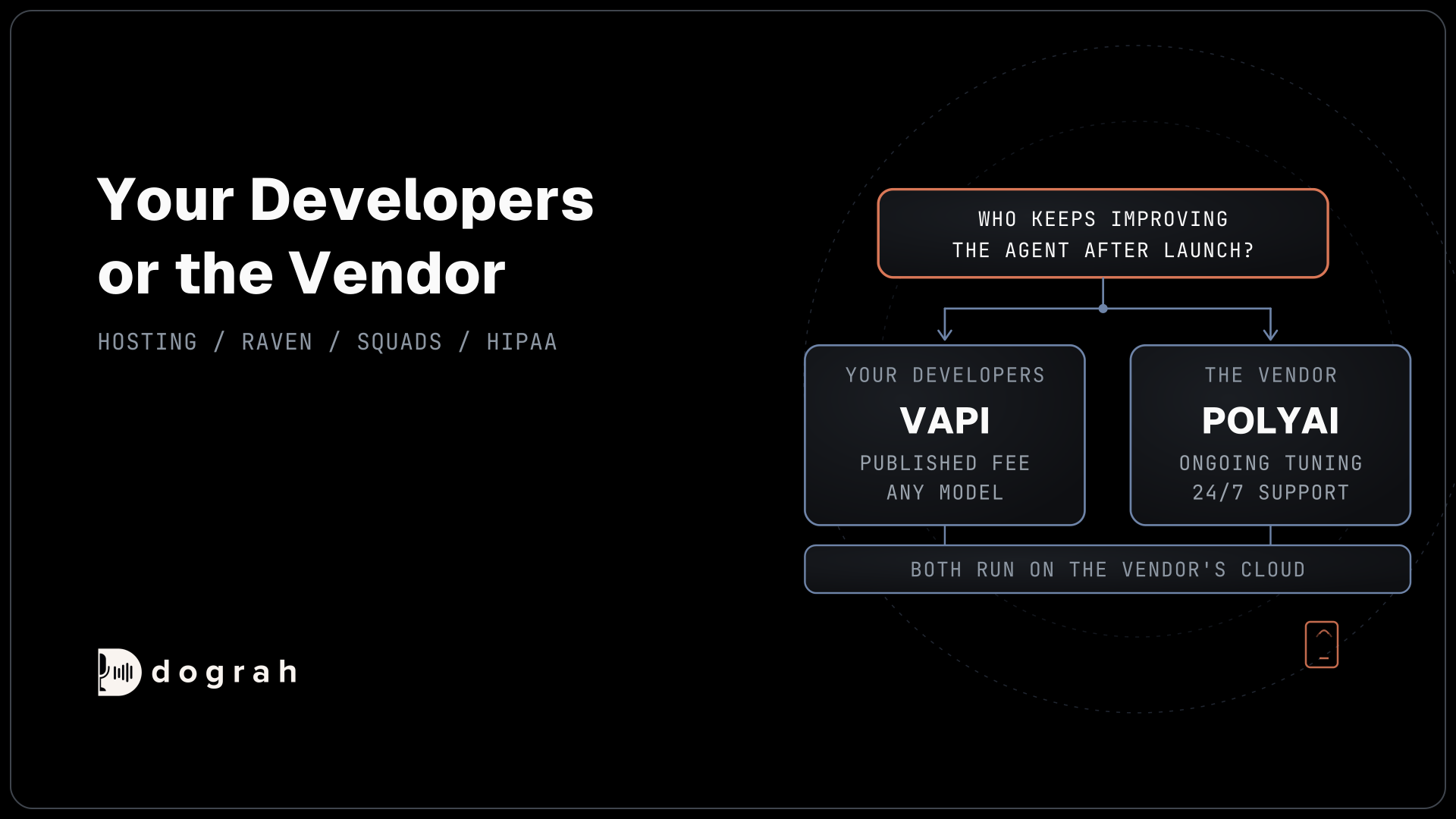
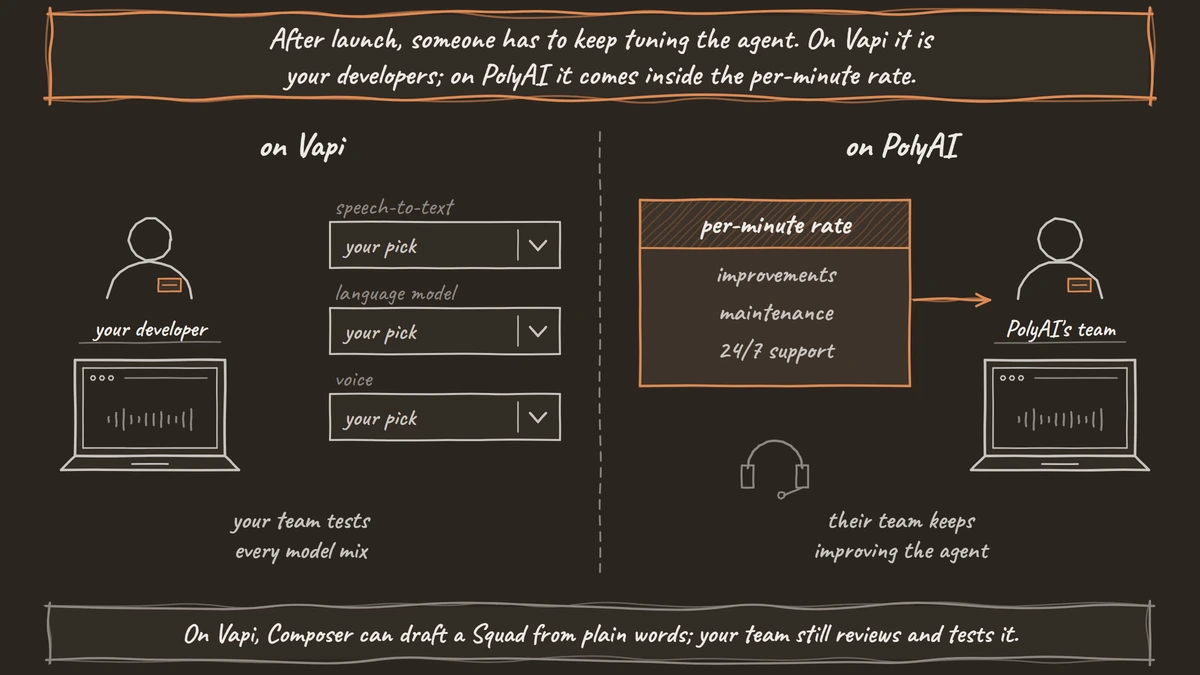
- PolyAI's rate includes ongoing tuning and 24/7 support, while Vapi leaves that to your developers.
- Both run only on the vendor's cloud, and neither offers code you can self-host.
This post is part of our guide to PolyAI alternatives, where Vapi is the self-serve developer platform with a published hosting fee. Here the two meet on cost, models, building, hosting and data, with a fair view of who each suits. If you want open source or on-prem hosting, the last section covers Dograh.
A developer API against a managed platform
Vapi sells platform minutes your developers build on, while PolyAI sells a platform with a team that keeps the agent improving. Most rows below follow from that.
| Row | Vapi | PolyAI |
|---|---|---|
| How you start | Self-serve, prepaid: $0.05/min hosting with no package | Self-serve sign-up for building since May 2026; the platform's per-minute rate is quoted by sales |
| What the price includes | Vapi's platform running the call. Models pass through at cost, phone extra | Improvements, maintenance and 24/7 support, billed on connected time with no minimums |
| Packages | Core $29/mo (10 calls at once); Pro 10% of hosting with a $999/mo minimum (30 calls); Premier through sales | One platform rate from sales; a separate model API at 2¢/min plus tokens, without telephony |
| Models | Any supported provider at cost, your own keys, or a custom language model at your own URL | Raven, PolyAI's own model, on most deployments, plus a set OpenAI and Amazon Bedrock list |
| Builder | Assistants and Squads, with Composer drafting a Squad. Visual Workflows stopped on 19 August 2026 | Agent Studio (no code), Wren (plain language), the Agent Development Kit (ADK) and REST APIs |
| Phone | Vapi numbers, your own carrier, Vapi telephony or SIP | PolyAI numbers, your own Twilio account, or a custom SIP trunk; your own carrier over SIP at no charge |
| HIPAA | A $2,000/mo add-on with a BAA, on any package | Systems designed to meet HIPAA where relevant, per PolyAI's compliance page |
| Where it runs | Vapi's cloud; Vapi says it does not support on-premise deployments | PolyAI's cloud, hosted on AWS, with US, EU and UK regions |
The Vapi figures come from Vapi's pricing page and its package docs. Contact-centre buyers should also note PolyAI's ready connectors for Five9, NICE, Genesys, Salesforce and ServiceNow.
What each one costs to start
Vapi's bill grows with your minutes and the models you pick, while PolyAI's starts with a sales conversation. On Vapi, 10,000 minutes a month means $500 of hosting, plus speech-to-text, the language model and the voice at each provider's price, and your phone line. Past 4 calls at once you need a package or extra lines at $10 a month each. Our breakdown of Vapi pricing prices every line.
On PolyAI's pricing page, the platform is "priced on a per-minute basis, which includes proactive performance improvements, maintenance and 24/7 support". Usage is billed per second on connected time, with no minimums. The 2¢ Dialog-RSN-1 API is a different product, the model alone, with "Telephony and orchestration" listed as "Not included". So never set 2¢ against Vapi's $0.05, since they buy different things.
The fair comparison is Vapi's hosting plus your models and the engineering time to tune them, against PolyAI's quoted rate. Our post on PolyAI pricing explains what that quote depends on.
Models and building the agent
On Vapi you pick every model and build in code or the dashboard, while PolyAI leads with its own model and a no-code studio. Vapi's FAQ confirms that "You can bring your own custom models for any part of the pipeline", through your own provider keys or a custom language model at a URL you host. That makes it easy to try a newer model, and it makes your team responsible for testing each combination.
Vapi builds with Assistants and Squads, groups of assistants that hand a call between them. Visual Workflows were retired on 18 August 2026, and Vapi recommends Squads as the replacement. Composer, in the dashboard, drafts a Squad from a plain-language request, which you then review and test.
PolyAI's own language model, Raven, runs most of its deployments, and Raven 3.5 covers 24 languages. OpenAI and Amazon Bedrock models from a set list cover more. PolyAI's platform overview lists Agent Studio for no-code building and Wren for describing an agent in plain words, while developers get the ADK and REST APIs. A custom model outside the list goes through your PolyAI representative.

Open Source Alternative to Vapi / Retell
Self-hosted voice agent platform — no per-minute fees
dograh-hq/dograh
Star on GitHub
Hosting, compliance and call data
Both run on the vendor's own cloud, so the difference is in what each adds. Vapi sells HIPAA as a $2,000-a-month add-on and emails a BAA for signature. HIPAA mode and zero data retention (ZDR) cannot run together. Vapi keeps raw call data for 14, 30 or 180 days, depending on the package.
PolyAI runs agents on its own cloud, hosted on AWS, with US, EU and UK regions. It lists SOC 2 Type II, ISO 27001 and PCI DSS, and says its systems are designed to meet HIPAA where relevant. Users without PII access get a redacted copy of each recording, and SMS goes out through Twilio. Whichever vendor signs a BAA, it takes on obligations while your own HIPAA duties stay with you, so check them with counsel.
Picking between them
Pick Vapi if your developers want to choose every model and start on a published fee. Pick PolyAI if you run a contact centre and want a vendor that keeps improving the agent, with 24/7 support and ready contact-centre connectors.
Run the same call script on both over a real phone line before you sign. Most phone calls reach the agent as 8 kHz audio, while a browser demo runs at 16 kHz, so a demo that sounds sharp can still mishear callers.
Where an open-source platform fits
Both are hosted and closed source, and neither gives you code you can run on your own servers. Teams that want that control, without starting from a framework, can use Dograh.
| Question | Vapi | PolyAI | Dograh |
|---|---|---|---|
| Can you read and change the code? | Closed source | Closed platform; its ADK is open but runs nothing locally | Yes, BSD-2-Clause |
| Where does it run? | Vapi's cloud | PolyAI's cloud, with US, EU and UK regions | Your own servers, or Dograh Cloud |
| Who picks the models? | You, by key or URL | Raven by default, plus a set list | You: Dograh's models, your keys, or local models |
| Do you start from a framework? | No, an API and dashboard | No, a no-code studio | No, a visual builder with telephony built in |
Dograh's visual workflow builder drafts a starting workflow from the use case you describe, so you begin from a working agent, not a blank framework. Its telephony, QA and call traces are already built in.
Self-hosting runs on Docker Compose and puts uptime in your team's hands. Self-hosted Dograh has no per-minute platform fee (servers, model keys and phone minutes still cost). Dograh Cloud has a 1¢-a-minute platform fee.
To try it, start on Dograh Cloud or run it from GitHub. Our Dograh vs PolyAI comparison covers the trade in full.
Join the Dograh Community
Dograh is an OSS alternative to Vapi. Join our Slack community for queries, releases, best practices & community interactions.
Glossary
- Hosting fee
- Vapi's charge for running the call on its platform, $0.05 a minute with no package. Models and phone lines are billed on top, at each provider's price.
- Squads
- Vapi's way to build multi-step calls: a group of assistants that hand the call between them. It replaced Vapi's visual Workflows, which stopped running in August 2026.
- Raven
- PolyAI's own language model for customer service calls. It runs most PolyAI deployments, and Raven 3.5 covers 24 languages, with OpenAI and Amazon Bedrock models as set alternatives.
- Zero data retention (ZDR)
- A Vapi setting that stops it keeping call data. It can't run together with Vapi's HIPAA mode, so a team chooses one or the other.