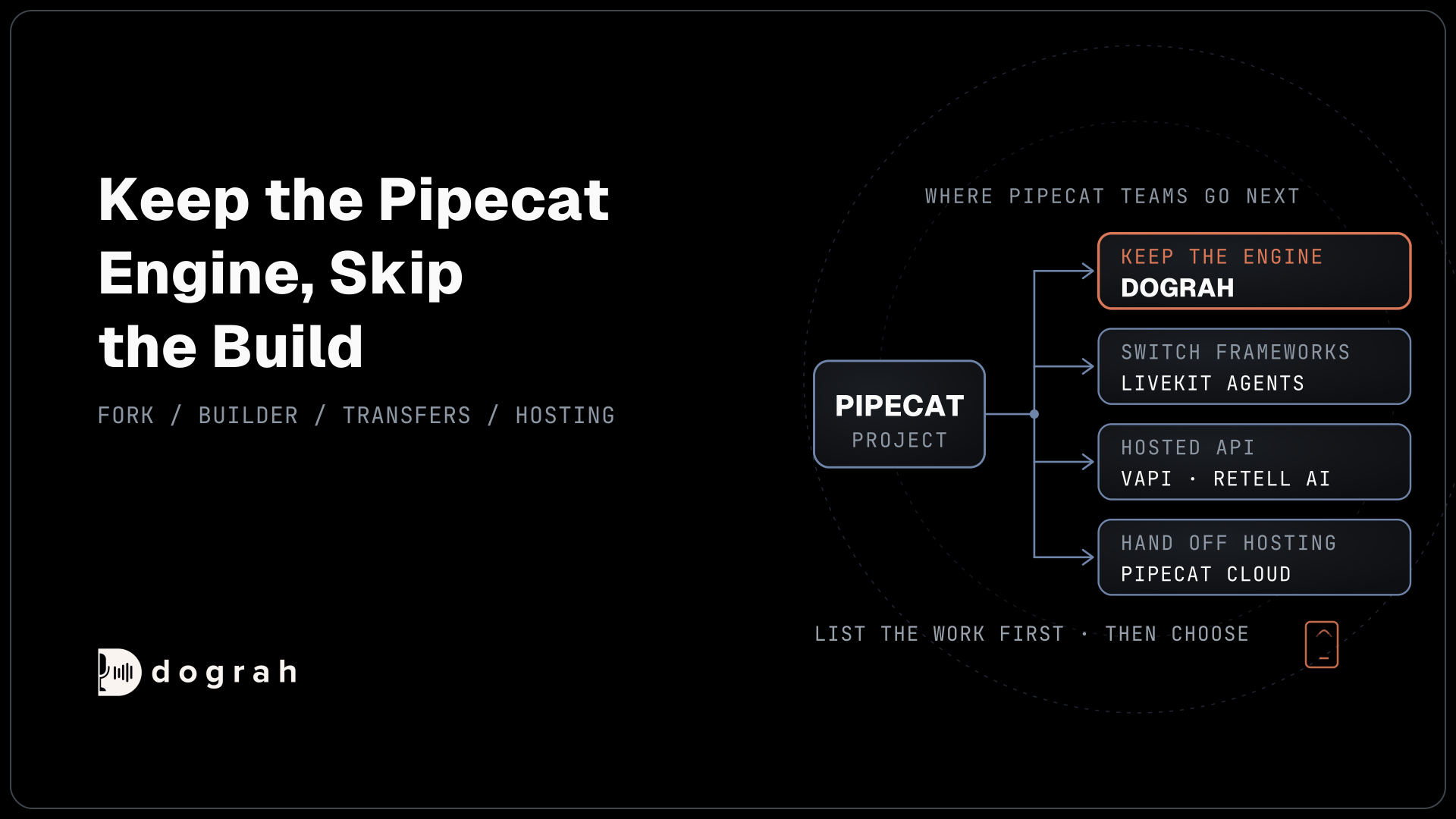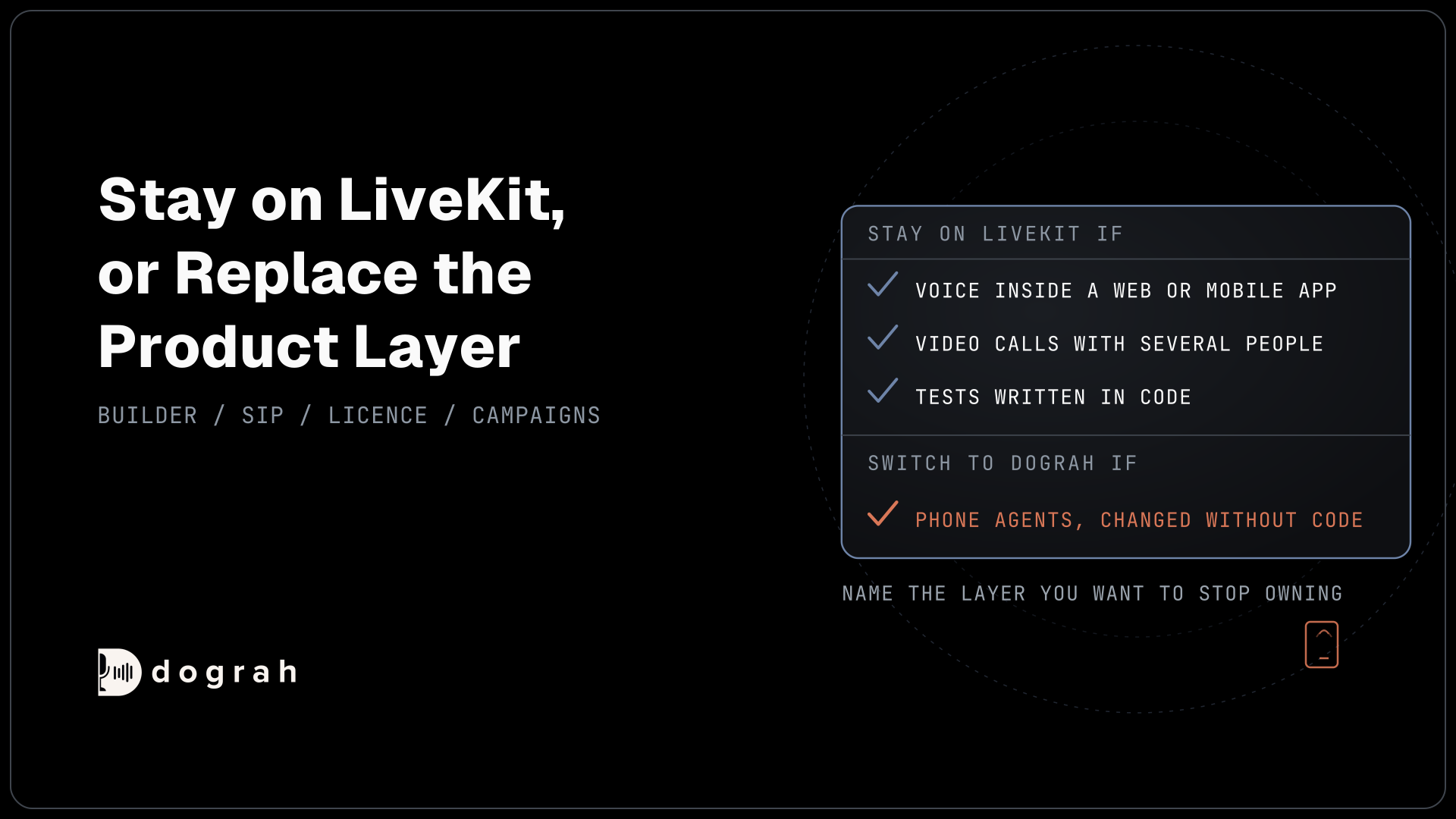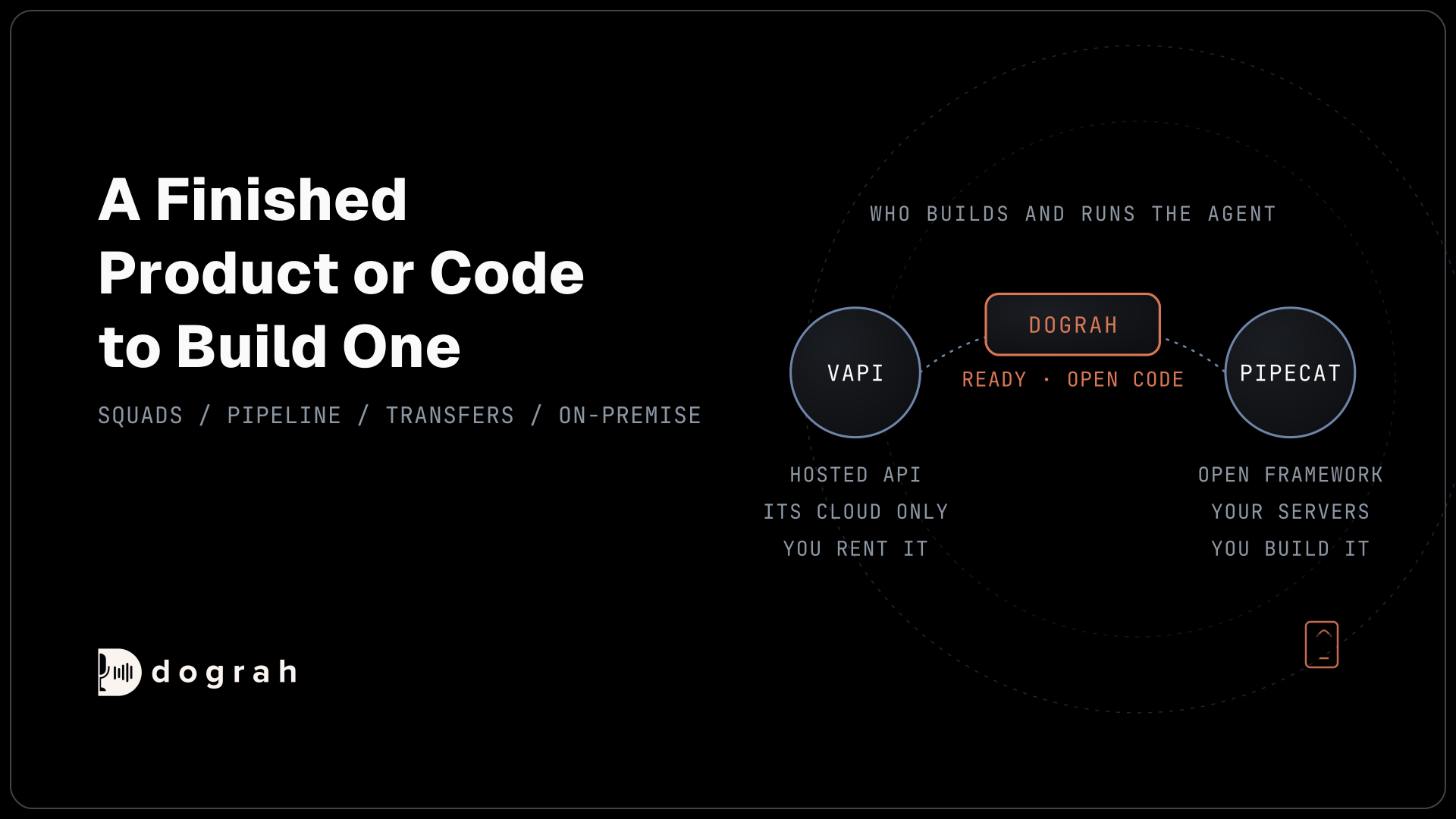

Vapi vs Pipecat is a hosted API against an open-source framework. Vapi is closed source and runs only on its own cloud, charging $0.05 a minute for hosting plus models. Pipecat is free under BSD-2-Clause, but your team writes the agent and runs it. Dograh, an open-source platform, sits between them, ready to self-host or run on Dograh Cloud.
Key Takeaways
- Vapi rents you a finished product, and Pipecat gives you code to build one.
- Vapi has no on-premise option, while Pipecat runs wherever you run it.
- Pipecat's WebSocket phone route cannot transfer calls, so plan transfers first.
This post is part of our guide to The Best Open-Source Voice AI Platforms Compared, which sets Vapi against the open options. Here we compare it with Pipecat directly, then show where Dograh fits between the two.
A hosted API and an open framework
Vapi and Pipecat solve the same problem from opposite ends. Vapi calls itself "the developer platform for building voice AI agents". It is closed source. The company runs the servers, and you configure assistants through its dashboard and API.
Pipecat is an open-source Python framework from Daily under BSD-2-Clause. You write the agent as a pipeline of processors and run it on servers you control, or pay Daily to run it on its managed Pipecat Cloud.
So speed is the wrong test. Both send audio through the same kinds of speech and language models, so the models set most of the latency and most of the bill. The real choice is who builds and runs the agent, and where call data goes.
Building the agent
In Vapi, you build with Assistants, each with its own prompt and tools, and Squads, which hand a call between several assistants. You can bring your own model keys for any part of the pipeline, or point it at your own language model through a custom LLM URL. Vapi retired its visual Workflows on 18 August 2026, so call logic now lives in assistants and squads.
In Pipecat, you build in Python. You pick a processor for each stage of the call, from speech-to-text through to text-to-speech, out of more than 150 services, and write call logic with Pipecat Flows. An open-source Flows Editor lets you lay out a flow on a canvas and export it as YAML into your project. Everything around the agent, such as call history and a screen for non-developers, is yours to build.
Phone calls and concurrency
Vapi handles phone numbers for you. Its own telephony and SIP carry no extra charge, and you can bring numbers from carriers such as Twilio, which bill you directly. More simultaneous calls means buying a concurrency package. With no package, Vapi includes 4 concurrent calls and 1 phone number. Core costs $29 a month for 10. Pro costs 10% of your hosting fee with a $999 monthly minimum and gives you 30, and extra lines are $10 each a month.
Pipecat connects to carriers through telephony serializers for Twilio, Telnyx, Plivo, Exotel, Vonage and Genesys. Plan transfers before you pick a route. Pipecat's telephony guide says its WebSocket integrations with Twilio, Telnyx, Plivo and Exotel have "No advanced call center features like transfers or reconnects", while Daily's PSTN and SIP routes support transfers.
Concurrency on Pipecat is whatever your servers handle. On Pipecat Cloud, you pay $0.01 per active minute on the smallest agent size, and Daily phone calls add $0.018 a minute.

Open Source Alternative to Vapi / Retell
Self-hosted voice agent platform — no per-minute fees
dograh-hq/dograh
Star on GitHub
Price, data and compliance
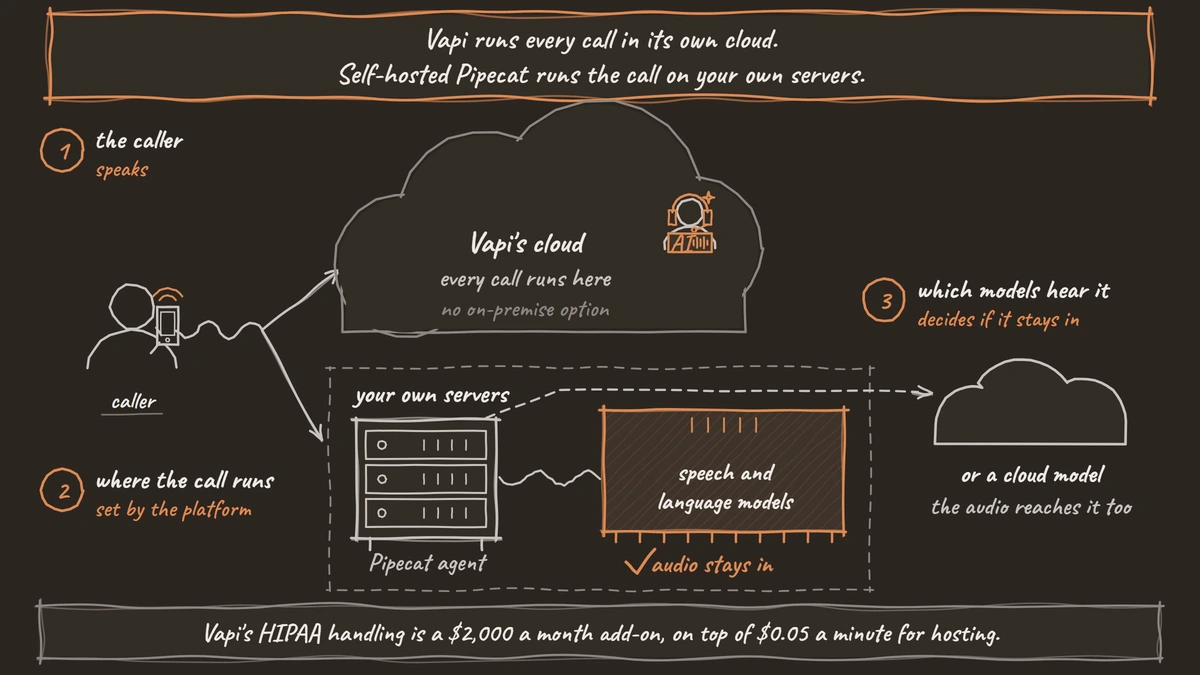
Vapi's pricing page lists "$0.05/min Vapi hosting" and passes models through at cost. Packages for more concurrency come on top, and HIPAA handling is a $2,000 a month add-on.
Pipecat costs nothing to use. You still pay for the servers and for model and phone usage, or for Pipecat Cloud if Daily runs it. Our post on the open-source alternative to Vapi works through what dropping the hosting fee changes at real volumes.
Data location is the sharper difference. Vapi's FAQ answers plainly, "No, Vapi does not support on-premise deployments." Every call runs through its cloud. Self-hosted Pipecat runs the call on your servers. The audio still reaches any cloud model you call, so it stays fully in-house only when the speech and language models run on your servers too.
Vapi vs Pipecat side by side
| Vapi | Pipecat | Dograh | |
|---|---|---|---|
| What it is | Closed hosted voice API | Open-source Python framework | Open-source AI voice agent platform on a Pipecat fork |
| License | Closed source | BSD-2-Clause | BSD 2-Clause |
| Building | Assistants and Squads in a dashboard or API | Python pipeline, Pipecat Flows | Visual workflow builder, or a coding agent through MCP |
| Where it runs | Vapi's cloud only | Your servers, Pipecat Cloud or your VPC on Enterprise | Your servers, Dograh Cloud or on-prem on Enterprise |
| Phone calls | Vapi numbers or your carrier's | Serializers for six carriers; transfers on Daily PSTN or SIP | Eight carriers or your own SIP trunk; Transfer Call on Twilio, Telnyx, Plivo, Cloudonix, Asterisk ARI |
| Concurrency | 4 calls without a package; 10 or 30 with Core or Pro | Set by your servers | 10 by default self-hosted, adjustable; 10 included on Cloud |
| HIPAA | $2,000 a month add-on | Your setup | Self-hosted: no BAA with Dograh; model providers and carrier may need their own |
Pick Vapi if you want a phone agent live this week with no one running servers, and per-minute billing on its cloud suits you. Pick Pipecat if you are building a voice product of your own and want every stage in Python.
Dograh: a ready product with open code
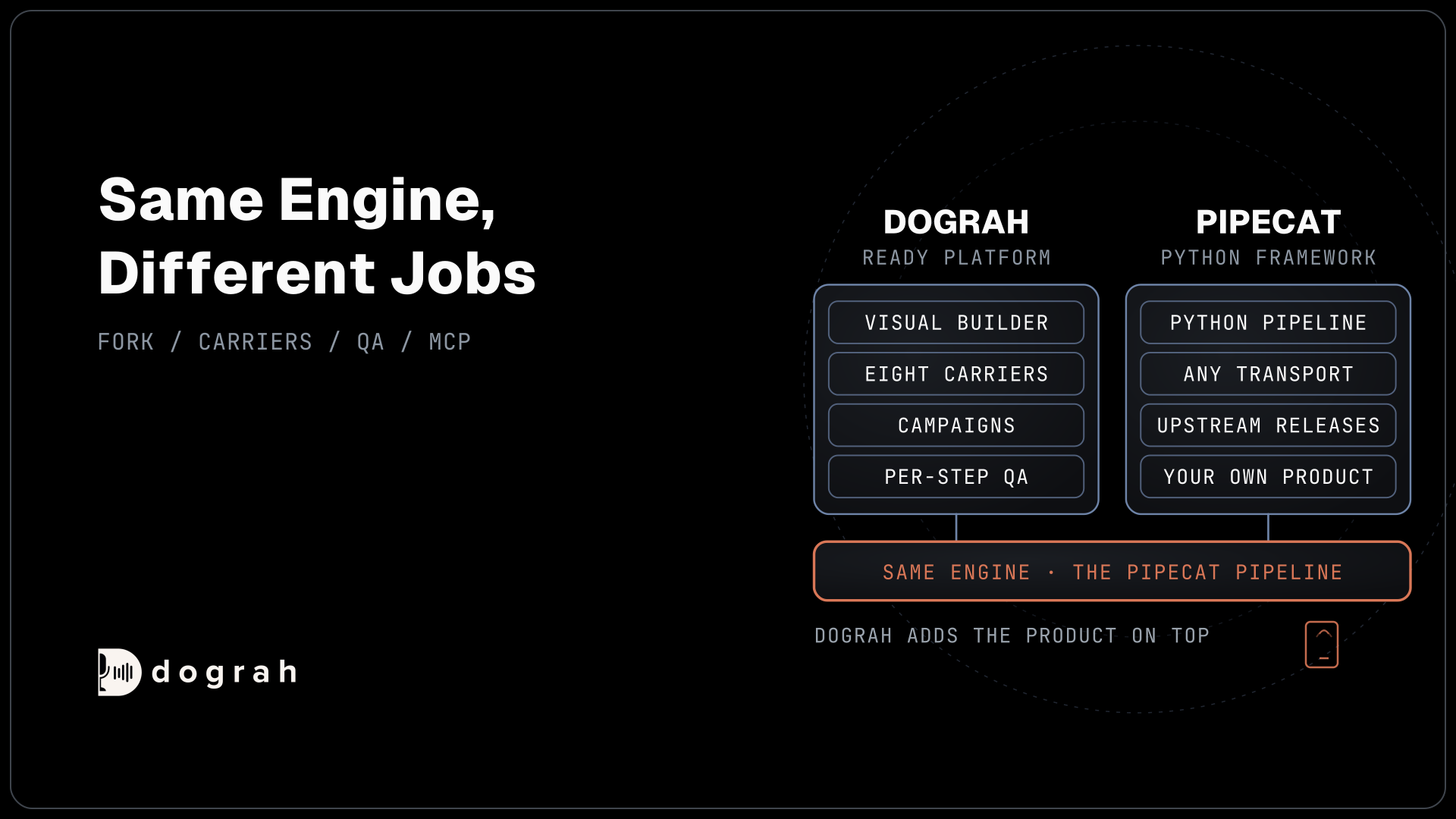
Dograh gives you a hosted product's ease with open-source control. It runs on a fork of Pipecat and ships what Vapi users expect on day one. The code is BSD 2-Clause, so you can self-host it or start on Dograh Cloud.
Agents are built in a visual workflow builder instead of code, and a coding agent such as Claude Code can build or edit them through Dograh's MCP server.
Phone calls run through eight telephony providers, including Twilio, Telnyx, Plivo, Cloudonix and Asterisk ARI, where Transfer Call calls the destination first and connects the caller only when someone answers. On Twilio, it can play a short spoken introduction to both people before connecting them.
Campaigns handle outbound lists, and a QA node scores each step of a call after it ends. You can use the platform's own models or bring your own keys, and any model served behind an OpenAI-compatible endpoint works too, fully local ones included. Self-hosted Dograh has no per-minute platform fee (servers, model keys and phone minutes still cost). Dograh Cloud has a 1¢-a-minute platform fee.
For the full head-to-heads, read Dograh vs Vapi and Dograh vs Pipecat.
Join the Dograh Community
Dograh is an OSS alternative to Vapi. Join our Slack community for queries, releases, best practices & community interactions.
Glossary
- Concurrency package
- Vapi's paid plans that set how many calls can run at once. Without a package you get 4 and Core gives 10. Pro gives 30, and extra lines cost $10 each a month.
- Telephony serializer
- Pipecat's adapter that converts one carrier's audio stream into the pipeline's format. Its WebSocket phone integrations carry audio but not transfers or reconnects.
- On-premise deployment
- Running the voice platform on servers you own or control, so calls never pass through the vendor's cloud. Vapi does not offer it, while Pipecat and Dograh can run this way.