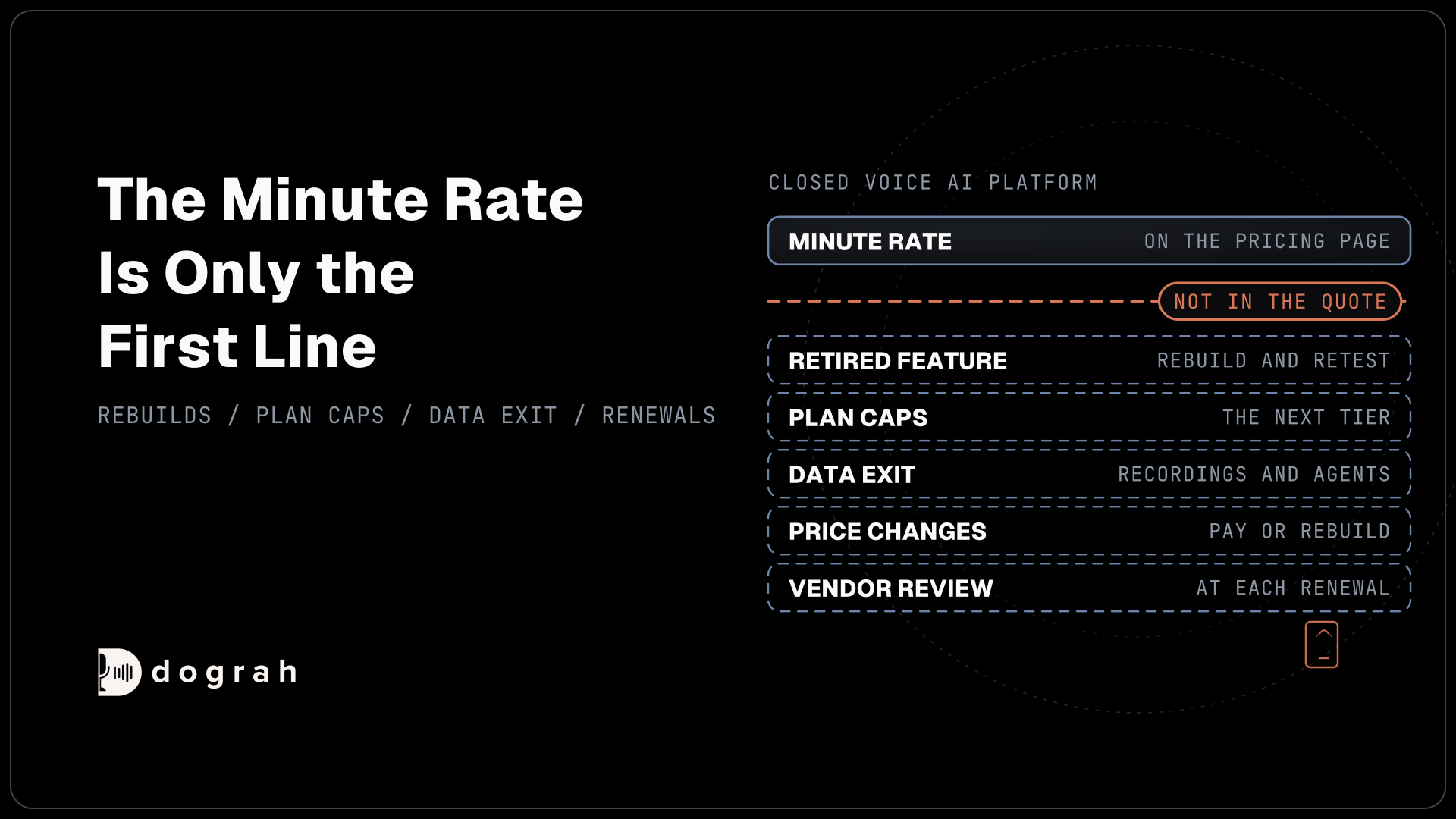

The hidden costs of a closed voice AI platform come after the minute rate. You rebuild when a feature is retired, upgrade when a plan cap is hit, request your own call data and absorb price changes. With Dograh, our open-source voice agent platform, the code and call data stay with you, self-hosted or on Dograh Cloud.
Key Takeaways
- A retired feature can force a rebuild that no minute rate warned you about.
- Plan caps on daily calls and concurrency push teams into the next tier.
- Open source moves these costs to servers and people you control.
Two platforms can quote the same minute rate and still cost very different amounts a year later. We go through the costs that show up after you sign, one by one, and how each changes when you run Dograh yourself. It is part of our guide to open-source voice AI agents.
The minute rate is only the first line
The per-minute price is the cost a closed platform shows you, and it is rarely the one that hurts. Most hosted voice platforms bill a platform rate and pass the speech, language model and phone minutes through on top. That part is visible, and our breakdown of what an AI voice agent costs per minute does the math line by line.
The costs in this post never show up on a pricing page. They arrive months later, when the vendor changes something you depend on, or when you try to leave. You pay for each one in engineering and review time, and none of them is in the quote.
If you are still choosing between building a stack and renting one, Build vs Buy: Should You Build Your Own Voice AI Stack? compares the options. Here we stay with what renting costs after you sign.
When the vendor retires a feature you built on
A closed platform can retire the feature your agents run on, and the rebuild is yours to pay for. Vapi gave a clear example. Its notice on Workflows said the product would be retired on August 18, 2026, and that from August 19, existing workflows would no longer run. Teams had to move to Assistants or Squads, with Squads as the recommended replacement.
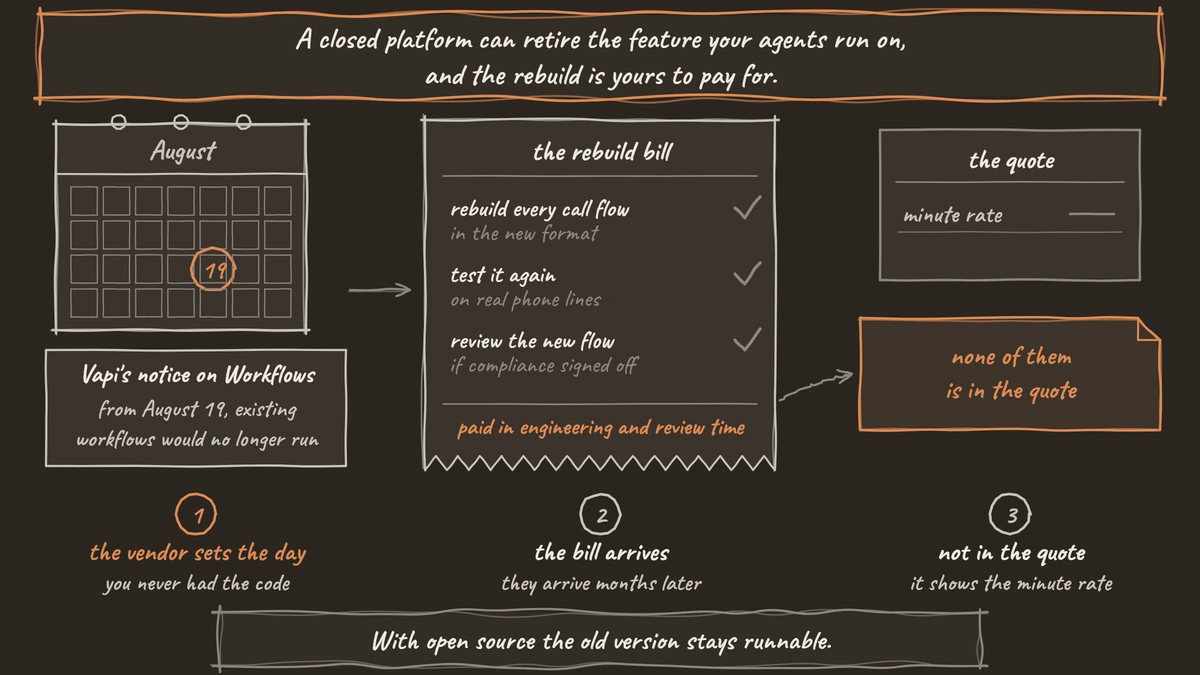
That move is re-platforming without ever leaving the vendor. Every call flow has to be rebuilt in the new format and tested again on real phone lines. Prompts tuned for one structure behave differently in another, so the testing is the slow part. If your compliance team signed off on the old flow, it has to review the new one too.
On a closed platform you cannot keep running the old version yourself, because you never had the code. With open source the old version stays runnable. A Dograh agent is a JSON definition of nodes and edges, and the code that runs it is public under the BSD 2-Clause license, so you decide when to upgrade.

Open Source Alternative to Vapi / Retell
Self-hosted voice agent platform — no per-minute fees
dograh-hq/dograh
Star on GitHub
Plan caps that force the next tier
Usage caps are the second cost the minute rate hides, because they decide when you have to change plans. Bland AI's pricing page shows how this works. Its Start plan charges $0.14 a minute and allows 10 concurrent calls, 100 calls a day, 100 calls an hour and one voice. The Build plan costs $299 a month plus $0.12 a minute, with 50 concurrent calls, 2,000 calls a day and 1,000 an hour.
A campaign that has to reach 500 people in a morning does not fit the first plan, whatever its minute rate. So the real price of that campaign includes the monthly fee of the next tier. The concurrent call limit works the same way on most hosted platforms, where extra simultaneous calls are sold as an add-on.
Self-hosted Dograh runs 10 concurrent calls by default, and you raise that number with the DEFAULT_ORG_CONCURRENCY_LIMIT setting. Past that point, your servers and your phone provider set the ceiling. Adding capacity means adding servers, which you size and pay for yourself.
Getting your call data and agents out
Data exit is the cost you meet when you try to leave, and it is easy to underestimate. You need the recordings, the transcripts and every agent definition in a form another system can read. A pricing page rarely says how any of that comes out, so ask before you sign.
Regulators now treat this as a real cost. Under the European Union's Data Act, cloud and software-as-a-service customers have a right to switch providers and to export their data in a machine-readable format. From 12 January 2027, providers can no longer charge a switching fee or data egress fees for that move. Contract fees and early-exit penalties are a separate question, so check with counsel how the rules apply to your own contract.
Self-hosted, Dograh keeps recordings and transcripts in your own storage, the bundled MinIO by default or Amazon S3 if you switch it on. Each recording is a WAV file, and the caller and the agent are also saved as separate tracks. There is nothing to export, because the files never sat with a vendor. One thing does leave by default: anonymous usage telemetry, which stops once you set ENABLE_TELEMETRY=false and remove POSTHOG_API_KEY.
Price changes and a review at each renewal
A closed platform sets its own prices, and when they change, your choices are to pay or to rebuild somewhere else. That is lock-in in its plainest form. An InfoWorld piece on open infrastructure makes the same point about usage-billed AI platforms in general, with people from Percona and the Linux Foundation arguing that open standards protect buyers from price rises and platform changes.
Renewals bring a second cost, the vendor review. Each closed vendor that hears your calls goes back through your security questionnaire and legal review, and every new subprocessor reopens part of it. Our post on why procurement stalls on closed voice AI covers where those reviews get stuck.
Open code changes what the reviewer is asked to trust. Your team can read what the platform does with each call, and a self-hosted install takes the platform vendor out of the data path. The reviews that remain are for the model providers and the phone carrier you choose.
Join the Dograh Community
Dograh is an OSS alternative to Vapi. Join our Slack community for queries, releases, best practices & community interactions.
What open source moves, and what it keeps
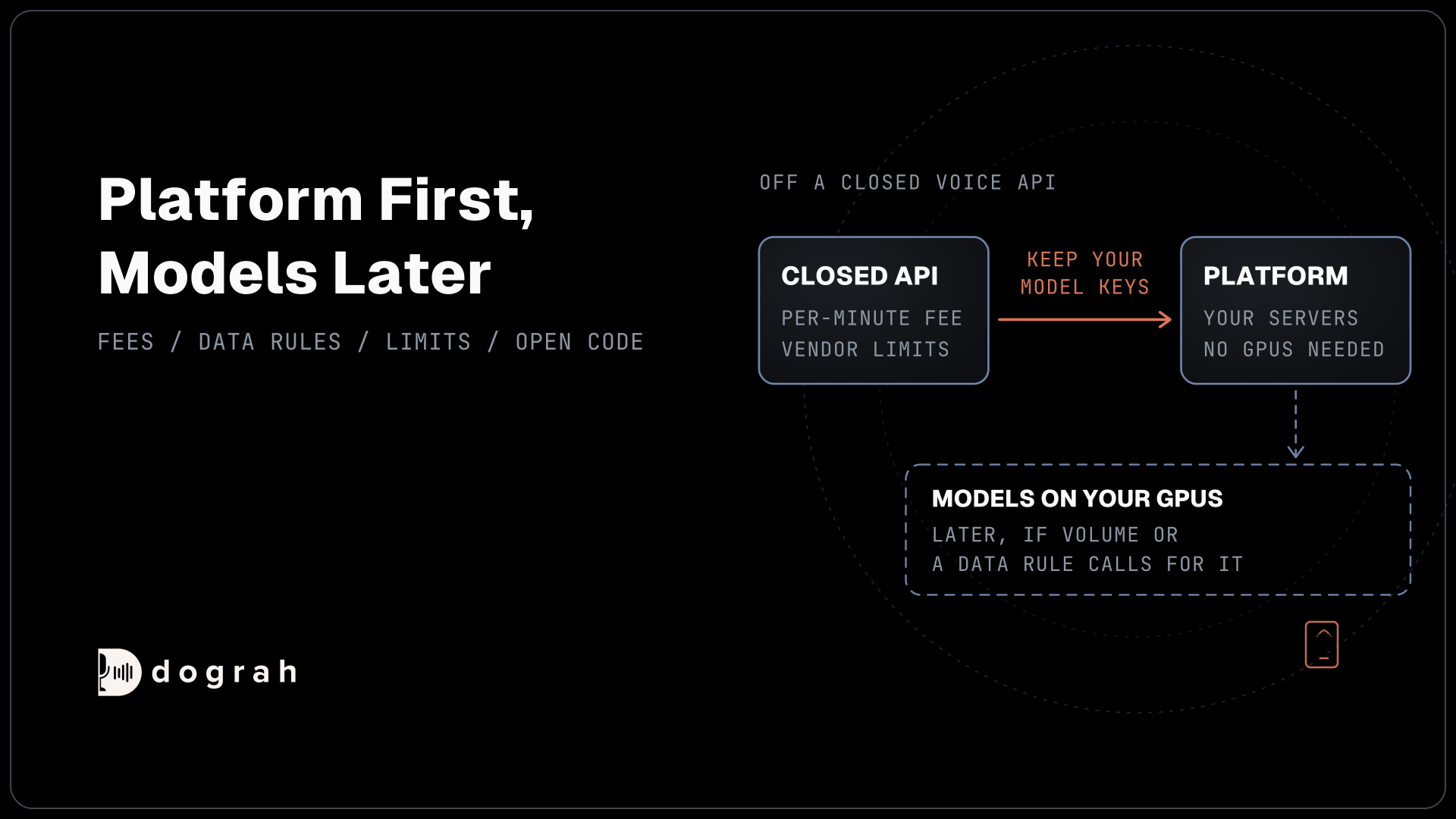
Open source moves these costs to servers and people you control, and someone still has to pay them. Your team patches the install, applies each release and watches capacity. On that bill, self-hosting Dograh adds no per-minute platform fee, while the servers, the model keys and the phone minutes are still yours to pay. A team that would rather not run servers can use Dograh Cloud at a 1¢-a-minute platform fee.
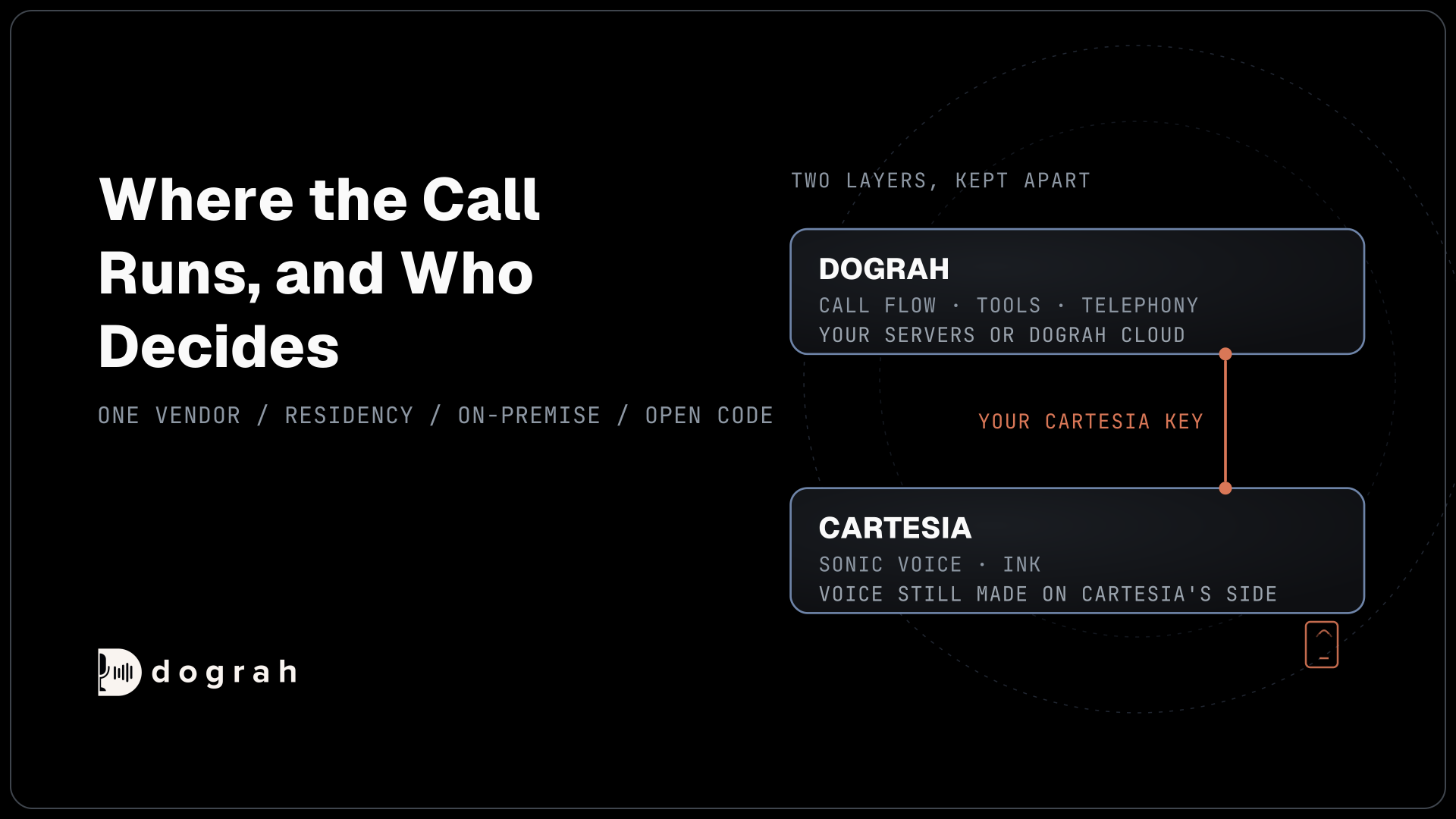
The model bill splits off from the platform. Dograh runs the call flow, the tools and the telephony, while the speech and language models sit in a separate layer that you pick. Your own keys for hosted models put the vendor contract in your name, though the caller's audio still goes out to those vendors. Open-weight models on your own servers are what keep the audio in-house.
Count these costs before you sign, next to the minute rate. If the platform you already use is producing them, our post on when to move from a closed voice API to self-hosting covers the signals that it is time.
Glossary
- Re-platforming
- Rebuilding and retesting your agents in a new product or format, often because a vendor retired the one you used. It costs engineering and review time, and no minute rate includes it.
- Concurrent call limit
- The number of calls a plan lets run at the same moment. On hosted platforms extra capacity is usually a paid add-on. Self-hosted, your servers and phone provider set the ceiling.
- Switching fee
- A charge a cloud or software provider adds when a customer moves to another provider, including data egress. The EU Data Act removes these fees from 12 January 2027.
- Orchestration layer
- The software that runs a voice agent's call: the flow, turn-taking, tool calls and the phone connection. Dograh is this layer, and the speech and language models plug into it as a separate choice.