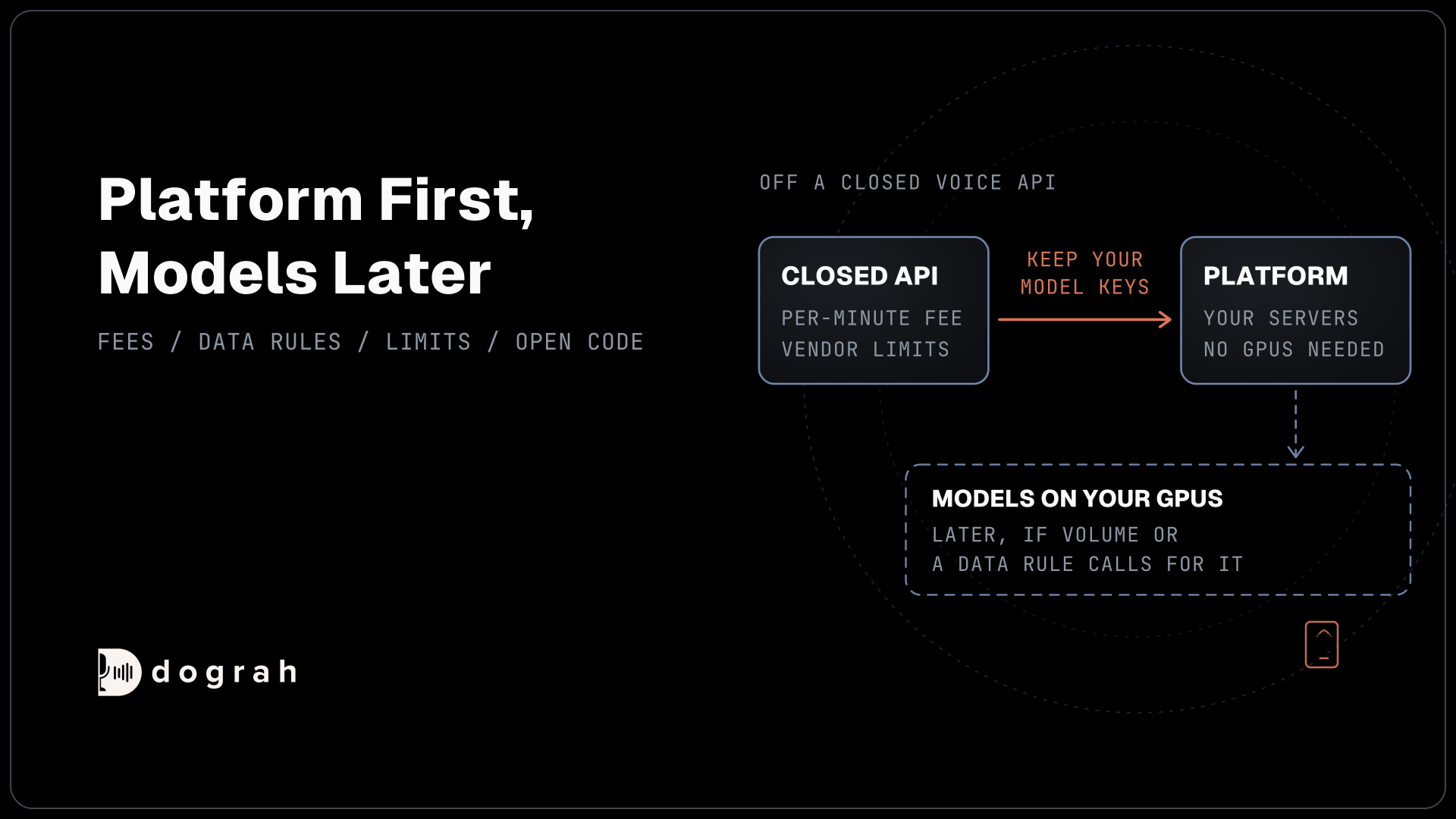

Cartesia Managed Agents is a hosted voice agent platform built on Cartesia's own speech models, at $0.03 a minute plus phone and model. It suits teams that want one vendor. For teams that want the parts open, Dograh, our open-source AI voice agent platform, keeps Cartesia's voices under your own key and runs self-hosted or on Dograh Cloud.
Key Takeaways
- Managed Agents is a sensible product for teams that want one vendor.
- Residency, on-prem models and BAAs exist, all through Cartesia's Enterprise sales team.
- Dograh keeps Cartesia's voices while you own the platform and the data path.
Cartesia launched Managed Agents on October 29, wrapping its voices in a hosted phone agent. Here is our read as builders of an open-source platform, covering what Cartesia got right and what a regulated buyer should ask about where calls run, before we say when the open route fits better.
What Cartesia launched
Cartesia's launch post calls Managed Agents an end-to-end voice agent platform for enterprise conversations. It bundles telephony, tool calls into systems such as CRMs, and outbound batches of thousands of calls, and Cartesia says the same stack already powers tens of millions of conversations. The post also announced knowledge bases and agents in 44 languages, with switching mid-call among English, Spanish, Hindi, French and Japanese first and the rest coming soon.
The case Cartesia makes is design. It built the listening, turn-taking, reasoning, tool calling and speech as one system and tuned the parts together. Cartesia's launch post puts Managed Agents first on two agent benchmarks, both run with GPT-5.5 as the reasoning model.
In the docs, you build an agent in a Playground or through the API, pick a language model from Cartesia's catalog of OpenAI, Anthropic and Gemini models, and connect a Cartesia number, Twilio or a SIP trunk. The system tools end calls, detect voicemail, send keypad tones and transfer to a number. Cartesia lists Managed Agents at $0.03 a minute, down from $0.06, with $0.014 a minute on a Cartesia number and the language model billed on top.
What Cartesia got right
Owning the voice is a real advantage. Sonic 3.6 ranks fourth on the Artificial Analysis Speech Arena, where two ElevenLabs models hold the top two places, and Ink 2 hears the caller with turn detection built in. A team that wraps its own agent around those models can tune the hand-offs between them in ways a reseller cannot.
The path to a first call is short. Nothing needs deploying and no model account needs opening, and the per-minute price is public. For a team that wants one vendor and one bill, that is a sensible product, and we would not argue them out of it.
Cartesia also gave its Line SDK users a clear route. Agents built with the open-source Line SDK can move to Managed Agents, or keep running on the team's own servers.
Where the call runs, and who decides
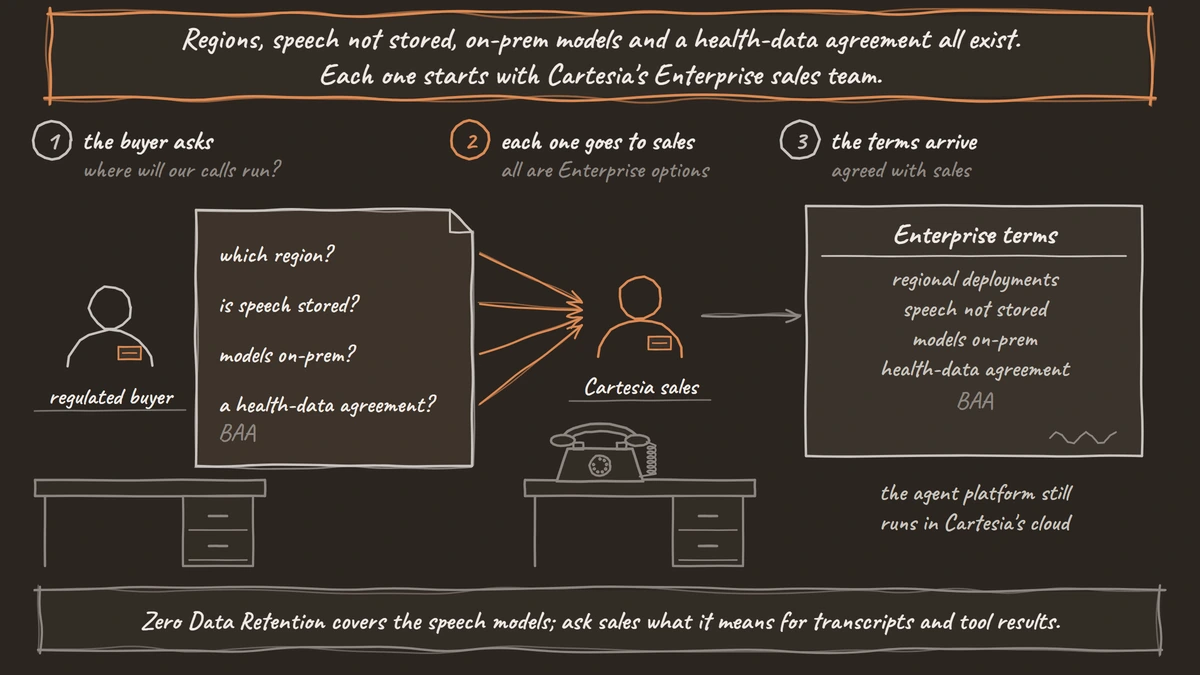
The launch post says nothing about where calls run, which is where many regulated buyers start. Cartesia's docs fill part of that in. On Enterprise, Cartesia offers dedicated regional deployments in the US, EU, UK, India and Australia, a business associate agreement (BAA) under the Health Insurance Portability and Accountability Act (HIPAA), and on-premise or private-cloud deployment of its models through its sales team.
The narrower point is scope. Cartesia's Zero Data Retention page covers the inputs and outputs of its speech models and does not address agent call data such as transcripts and tool results. The on-prem option covers the models, while the agent platform runs in Cartesia's cloud. Each answer starts with a sales conversation, so a buyer learns the terms after the evaluation begins.
For teams under the General Data Protection Regulation (GDPR), a transfer of personal data outside the EU needs a legal basis such as an adequacy decision or approved contract terms. Where the call audio, the transcript and the model calls are processed decides which of those you need, and your counsel should confirm the setup.
Our post on GDPR and voice AI covers the rules, and our data residency checklist lists every setting to ask about.
What you can change later
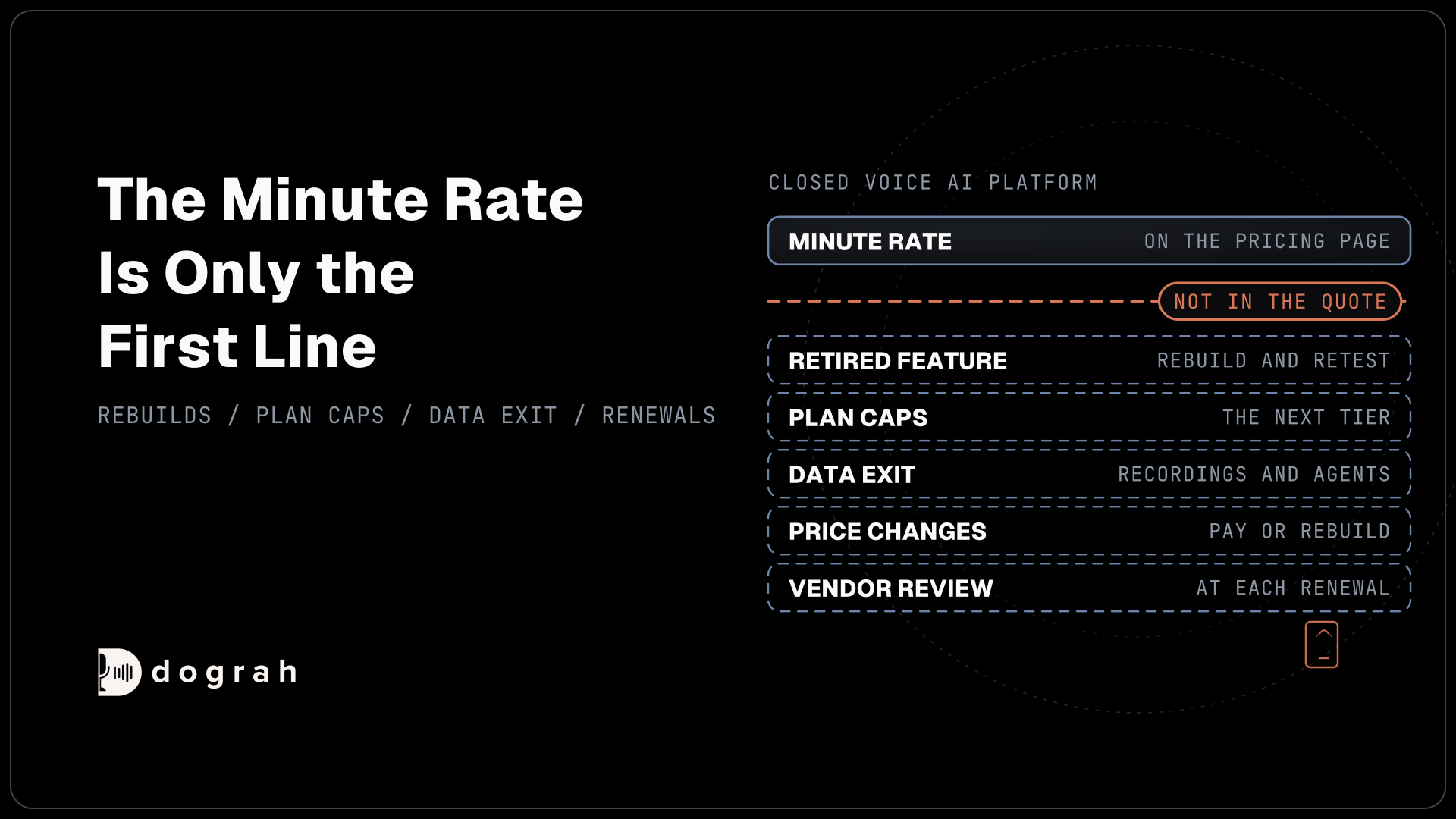
The language model comes from Cartesia's catalog. It manages that integration, so you need no provider account or key, and the models on offer are the ones it chooses to list. The voice and the speech-to-text are its own, which is the point of the product.
That is a fair trade for many teams, and a hard one for others. If a new model suits your calls better next year, or a contract requires a specific provider, the platform decides whether you can use it. Our post on the hidden costs of closed voice AI platforms works through where that shows up on the bill.
Line SDK users face the same choice on a deadline. Cartesia stops hosting Line SDK agents on December 1, 2026, so those teams pick Managed Agents, their own servers or another platform before then.

Open Source Alternative to Vapi / Retell
Self-hosted voice agent platform — no per-minute fees
dograh-hq/dograh
Star on GitHub
Dograh: the open shape, Cartesia voices included
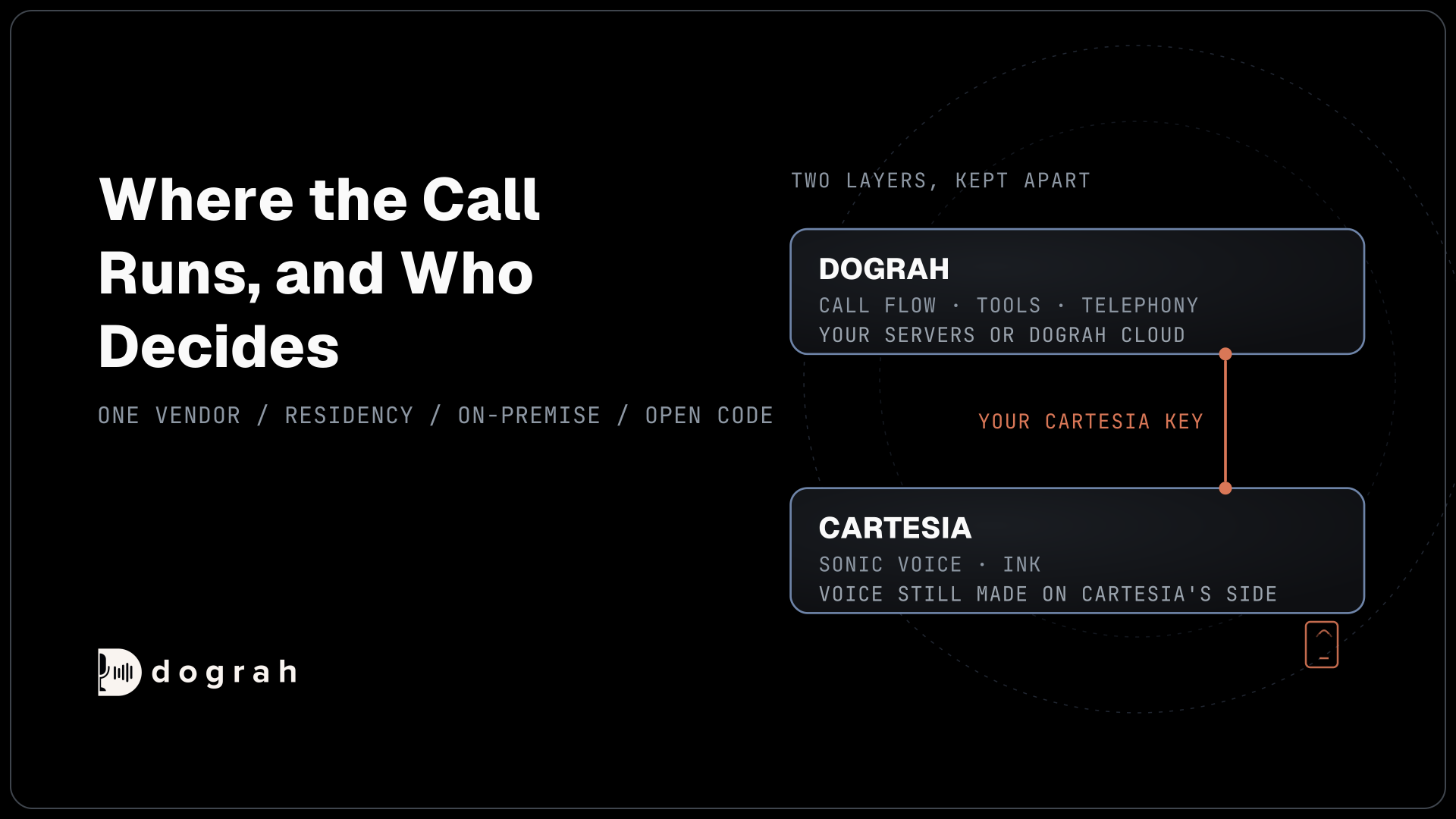
Dograh is the other shape of the same job. The whole platform is open source under BSD-2-Clause, so you can read the code and audit what happens to a call. Cartesia is a built-in provider in the voice settings, so you can keep a Sonic voice, cloned voices included, and Ink speech-to-text with your own Cartesia key.
Where Managed Agents bundles everything, Dograh keeps the two layers apart. As the orchestration layer it runs the call flow, tools and telephony, and you choose the speech and language models. A Sonic voice under your own key is still generated on Cartesia's side, as is any audio Ink transcribes. Any of the other supported providers is one setting away, and several keys per provider spread the load.
For the strictest data boundary, run Dograh on your own servers with one Docker command and point speech-to-text and the voice at local models through Speaches. Before you start it, set ENABLE_TELEMETRY=false and remove POSTHOG_API_KEY, since a self-hosted install otherwise sends anonymous usage telemetry. Our comparison of self-hosted vs managed voice AI covers what that hands to your team.
The agent side ships in the open code too. Dograh has a Knowledge Base for documents, webhooks after each call, and a Transfer Agent tool that hands a caller to another agent. When the caller needs a human instead, Transfer Call covers Twilio, Telnyx, Plivo, Cloudonix and Asterisk ARI. It rings the person first and brings the caller in only after they answer, and on Twilio a short spoken introduction can play to both sides before they talk. Callers answer by voice.
On your own servers, Dograh adds no per-minute platform fee, though the servers, model keys and phone minutes are still yours to pay. Dograh Cloud swaps that for a 1¢-a-minute platform fee.
Join the Dograh Community
Dograh is an OSS alternative to Vapi. Join our Slack community for queries, releases, best practices & community interactions.
Our take: who should pick which
Pick Managed Agents if you want Cartesia's voice and agent from one vendor, with nothing to run and residency terms you are happy to negotiate on Enterprise. It also covers keypad tones out, Cartesia's own numbers and API batches today.
Pick an open platform if you need to read the code, keep calls on your own servers, or change the model and voice whenever you like. Dograh lets you do that and still keep the Cartesia voice your callers know. If you are weighing more options, our guide to Cartesia alternatives compares the hosted and open platforms in one table.
Glossary
- Managed Agents
- Cartesia's hosted voice agent platform, launched in October 2026. It runs in Cartesia's cloud with Cartesia's speech models and a language model from its catalog.
- Zero Data Retention
- A Cartesia Enterprise option under which the inputs and outputs of its speech models are not stored. Its page does not address agent call data.
- Regional deployment
- A dedicated Cartesia deployment that keeps model traffic in one region, offered in the US, EU, UK, India and Australia on Enterprise.
- Orchestration layer
- The software that runs a voice agent's call flow, tools and telephony around the speech and language models, as Dograh does.