
Self-host a voice AI platform when call records must sit on your own servers or you need to change the code, and your team can run servers. Choose a managed cloud to start today. Dograh, an open-source AI voice agent platform, runs both ways with the same agents. You can self-host it or run it on Dograh Cloud.
Key Takeaways
- Choose where the platform runs first, then which models hear the audio.
- Self-hosting the platform needs an ordinary server, not a GPU.
- Agents move between Dograh Cloud and a self-hosted install without a rebuild.
This post is part of our guide to open-source voice AI agents, where the same open-source platform can run on your servers or on someone else's. Below, we weigh the work self-hosting asks for against what a managed cloud gives you, with Dograh as the worked example.
Two decisions: the platform and the models
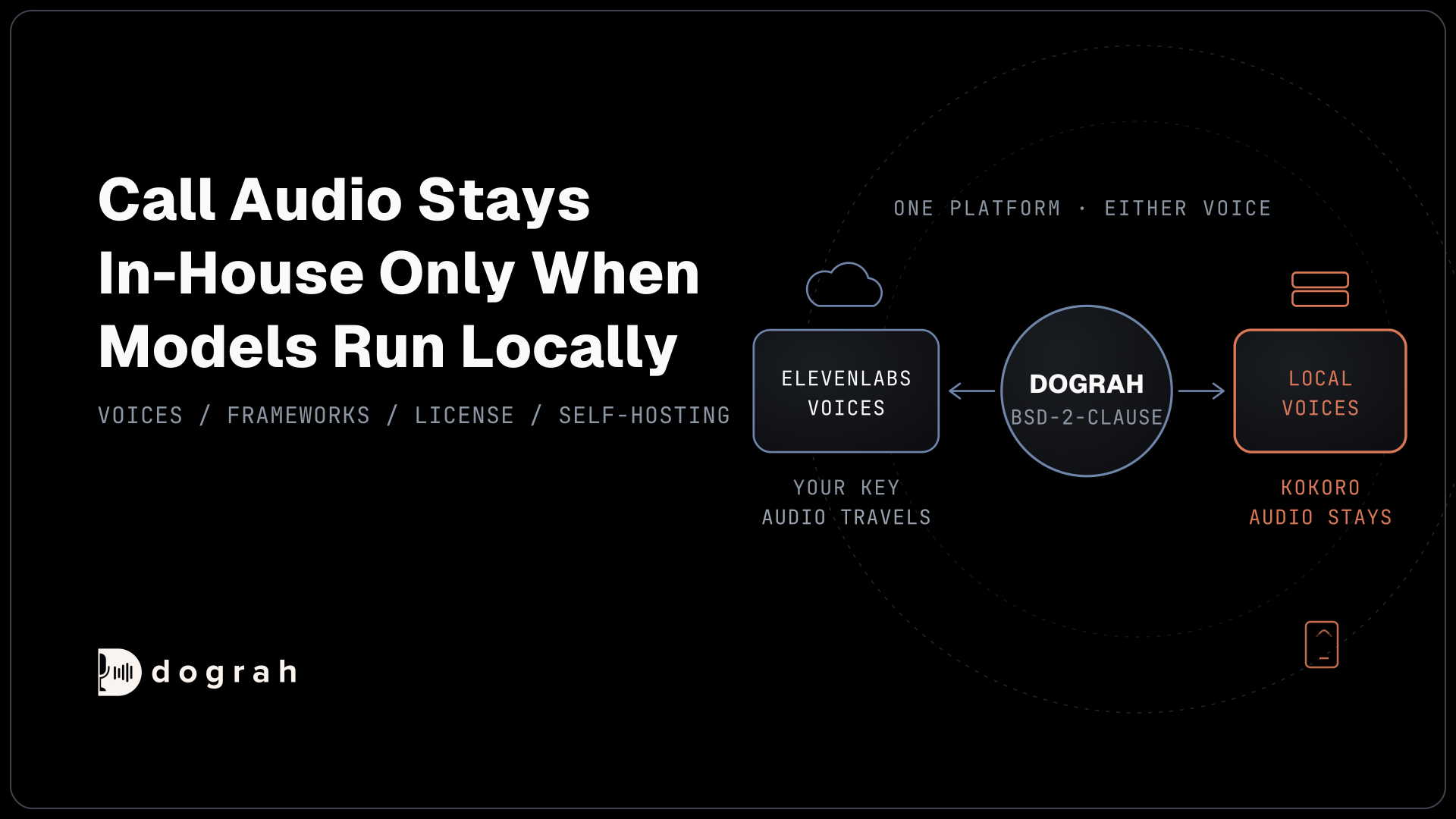
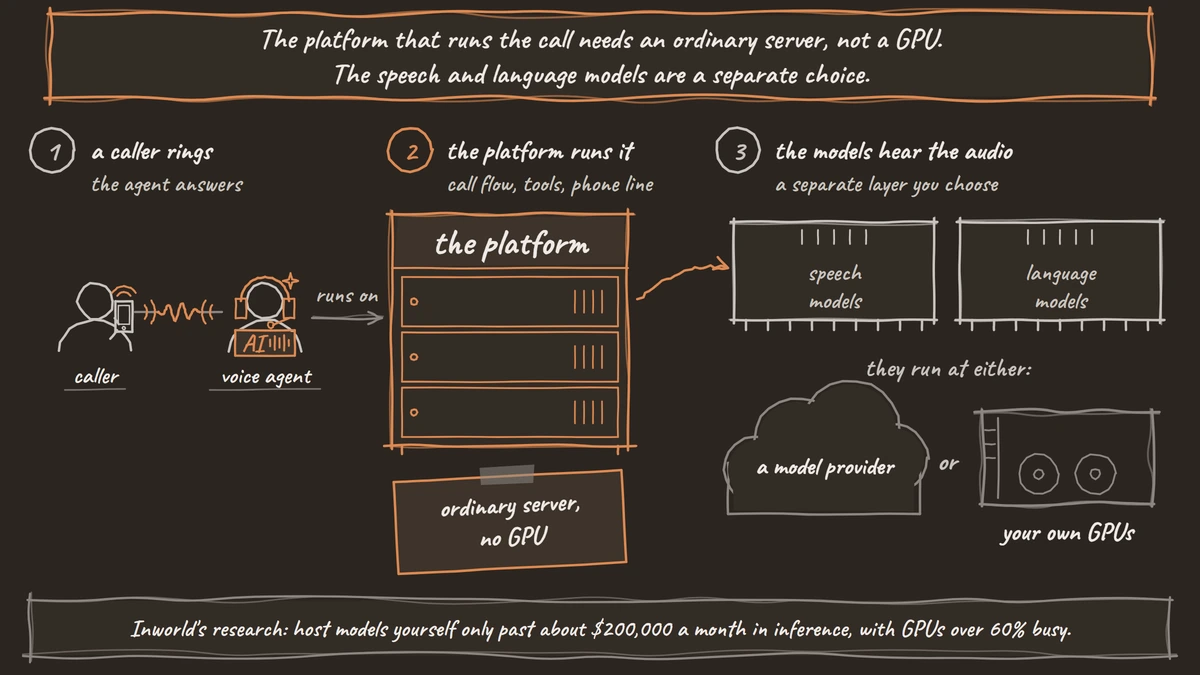
A voice agent has two layers, so a deployment is two decisions. Dograh is the orchestration layer that runs the call flow, tools and telephony, and the speech and language models are a separate layer you choose. This post covers where the platform runs. Where the models run, and who you pay for them, is in our post on BYOK vs managed models.
Keeping the two apart changes the math. Inworld, which sells model infrastructure, publishes research saying a team should self-host only when monthly inference spend passes about $200,000 and its GPUs stay above 60% busy. Those numbers are about running models on your own GPUs. Self-hosting the platform that runs the call needs an ordinary server, not a GPU, so a small team can do it long before it reaches any model-hosting threshold.
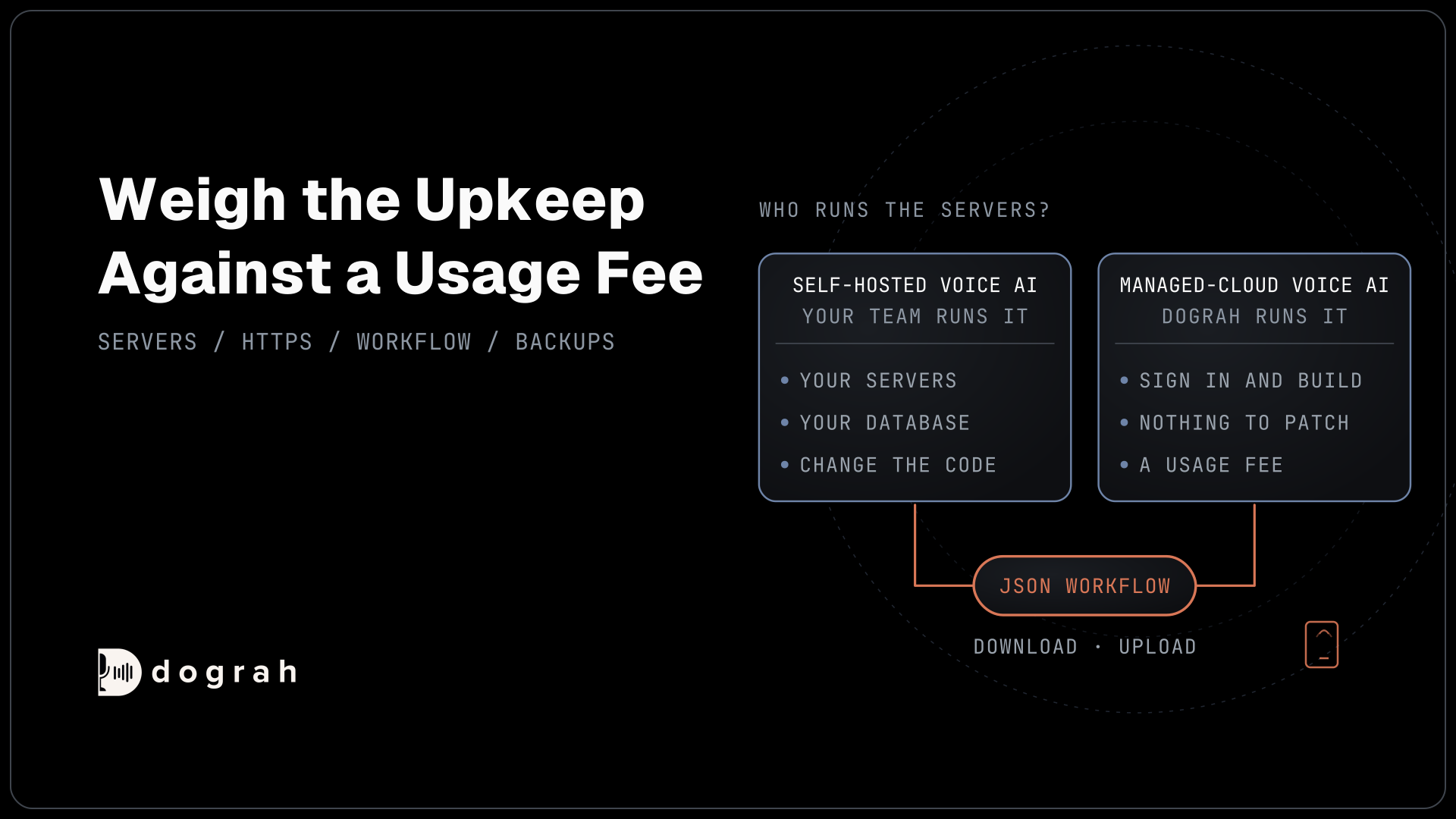
What self-hosting asks of your team
Self-hosting gives you the servers, and every job that comes with them. A Dograh server for real callers needs at least 8 GB of RAM and 4 vCPUs. It needs HTTPS, because browsers only open the microphone on a secure page, plus open ports for browser audio.
The upkeep is yours too. You pull new images to update Dograh, and the API and web app images must carry the same version tag.
When call volume grows, you add API workers behind nginx, as the scaling guide shows. Self-hosted Dograh runs 10 concurrent calls by default, adjustable with DEFAULT_ORG_CONCURRENCY_LIMIT, and your servers and phone provider set the practical ceiling.
A fresh install also starts with open defaults. Signup is open until you set ENABLE_SIGNUP=false, and telemetry runs until you switch it off. Backups of the database and recordings are yours too, since there is no retention setting or automatic deletion.
In return, call records sit in your own database and storage, and you can read and change every line of the code.
What a managed cloud gives you
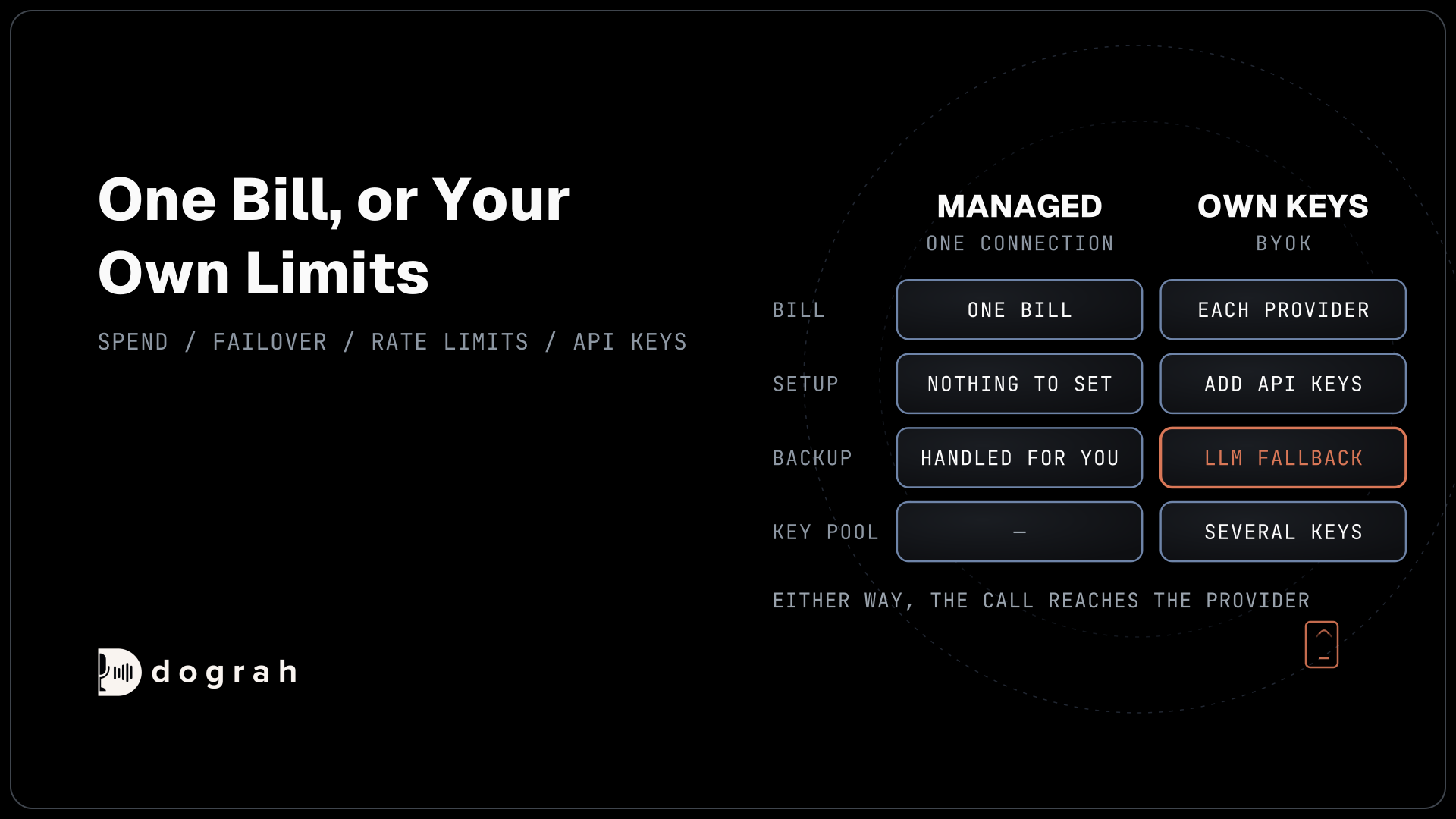
A managed cloud trades that work for a usage fee. On Dograh Cloud you sign in and build, with no servers to size or patch. You can bring your own model keys or use Dograh's managed models.
Self-hosted Dograh has no per-minute platform fee (servers, model keys and phone minutes still cost). Dograh Cloud has a 1¢-a-minute platform fee. Dograh's managed models cost about $0.07 a minute for most models, billed separately from that fee, as the pricing page lists. Pay as you go includes 10 concurrent calls, and for more you contact Dograh. Dograh Cloud names no data region, so a team that must keep calls in one country runs Dograh on servers there, itself or through the Enterprise plan.
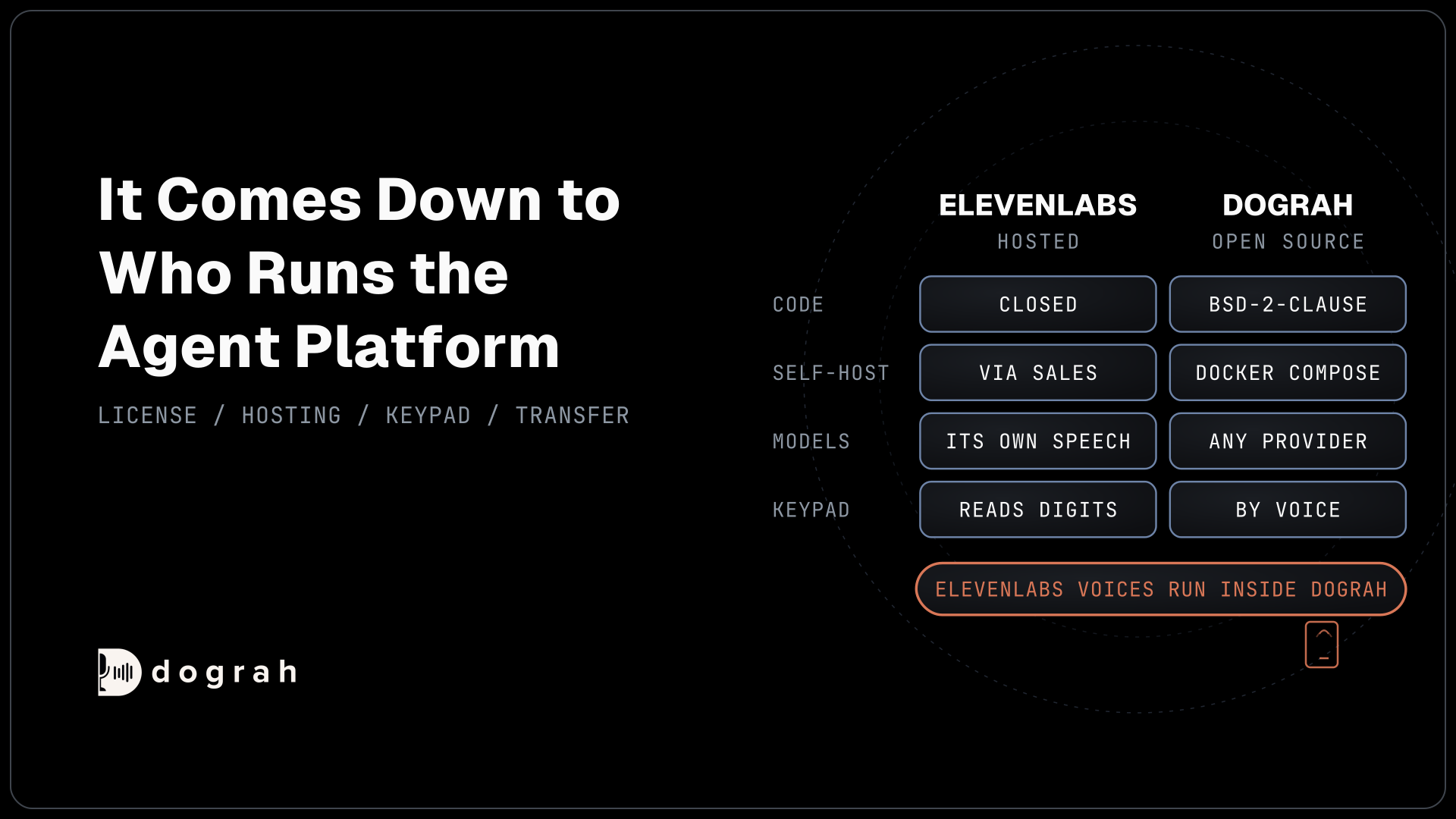
Closed hosted platforms are managed-only, and each prices its own bundle. Vapi charges $0.05 a minute for hosting, with models billed at cost on top. Retell charges $0.055 a minute for its voice infrastructure, with models and the phone line billed on top. With either, the code stays closed and the platform runs only on the vendor's servers.
Many companies are rethinking where AI runs. In Cloudian's 2026 survey of 203 enterprise IT decision-makers, nearly four in five (79%) had already moved some AI workloads off public cloud. Forty percent said actual cloud AI spending exceeded their projections.

Open Source Alternative to Vapi / Retell
Self-hosted voice agent platform — no per-minute fees
dograh-hq/dograh
Star on GitHub
Self-hosted vs managed cloud, side by side
The table compares the ways to run the same kind of voice agent, with a closed hosted platform for contrast.
| Self-hosted Dograh | Dograh Cloud | Dograh Enterprise | Closed hosted platform (Vapi) | |
|---|---|---|---|---|
| Who runs the servers | Your team | Dograh | Your data centre or private cloud, with Dograh's help | The vendor |
| Where call records live | Your database and storage | Dograh Cloud | Inside your data perimeter | The vendor's storage |
| Platform fee | None per minute | Per minute (see above) | Custom | $0.05 a minute hosting, models at cost |
| Read and change the code | Yes, BSD-2 | Read yes, change by self-hosting | Yes, the same open code | No |
| Concurrent calls to start | 10, adjustable | 10, more on request | Agreed with Dograh | 4 with no package |
| Time to a first test call | One Docker install | Under 2 minutes from sign-in | A deployment project | Sign up, then build in the vendor's dashboard |
Join the Dograh Community
Dograh is an OSS alternative to Vapi. Join our Slack community for queries, releases, best practices & community interactions.
How to choose, and how to switch later
Pick the place you can run well today, because you can move later. Self-host when call records must stay on your servers or you need to change the code. It suits a team that already runs servers and wants no per-minute platform fee. Choose Dograh Cloud when you want a first agent live this week and nobody owns servers yet. Take Enterprise when you need on-prem but want Dograh to help run it.
Moving later is not a rebuild. A Dograh agent is a JSON workflow definition. Download it from the editor on Dograh Cloud with Download Workflow, then add it to a self-hosted install with Upload Agent Definition. You can also mix the two. A Service Key from a Dograh Cloud account lets a self-hosted install use Dograh's managed models, billed to that Cloud account.
If you are still deciding whether to build your own stack at all, our post on build vs buy for voice AI covers that first. For the case that large companies will move voice AI onto their own servers, read why on-prem will win enterprise voice AI.
Teams that need no outbound connections at all can go further, with air-gapped voice agents.
Glossary
- Managed cloud
- A deployment where the vendor runs the servers, updates and scaling, and you use the platform through a web app and API. You pay per minute or per seat instead of running infrastructure.
- Platform fee
- What a voice AI platform charges per minute for running the call, separate from the speech and language models and the phone line. Self-hosted Dograh has none.
- Service Key
- A key from a Dograh Cloud account that a self-hosted Dograh install can use to reach Dograh's managed models. Usage is billed to the Cloud account that owns the key.