
The open-source alternative to ElevenLabs' agent platform is Dograh, an open-source AI voice agent platform under BSD-2-Clause that you can self-host or run on Dograh Cloud. It can keep ElevenLabs voices with your own key, or use open voices such as Kokoro on your own servers. LiveKit Agents and Pipecat are open-source frameworks.
Key Takeaways
- ElevenLabs' private deployment is licensed software that runs in your own cloud.
- Kokoro and Chatterbox replace the voice. Dograh replaces the whole agent platform.
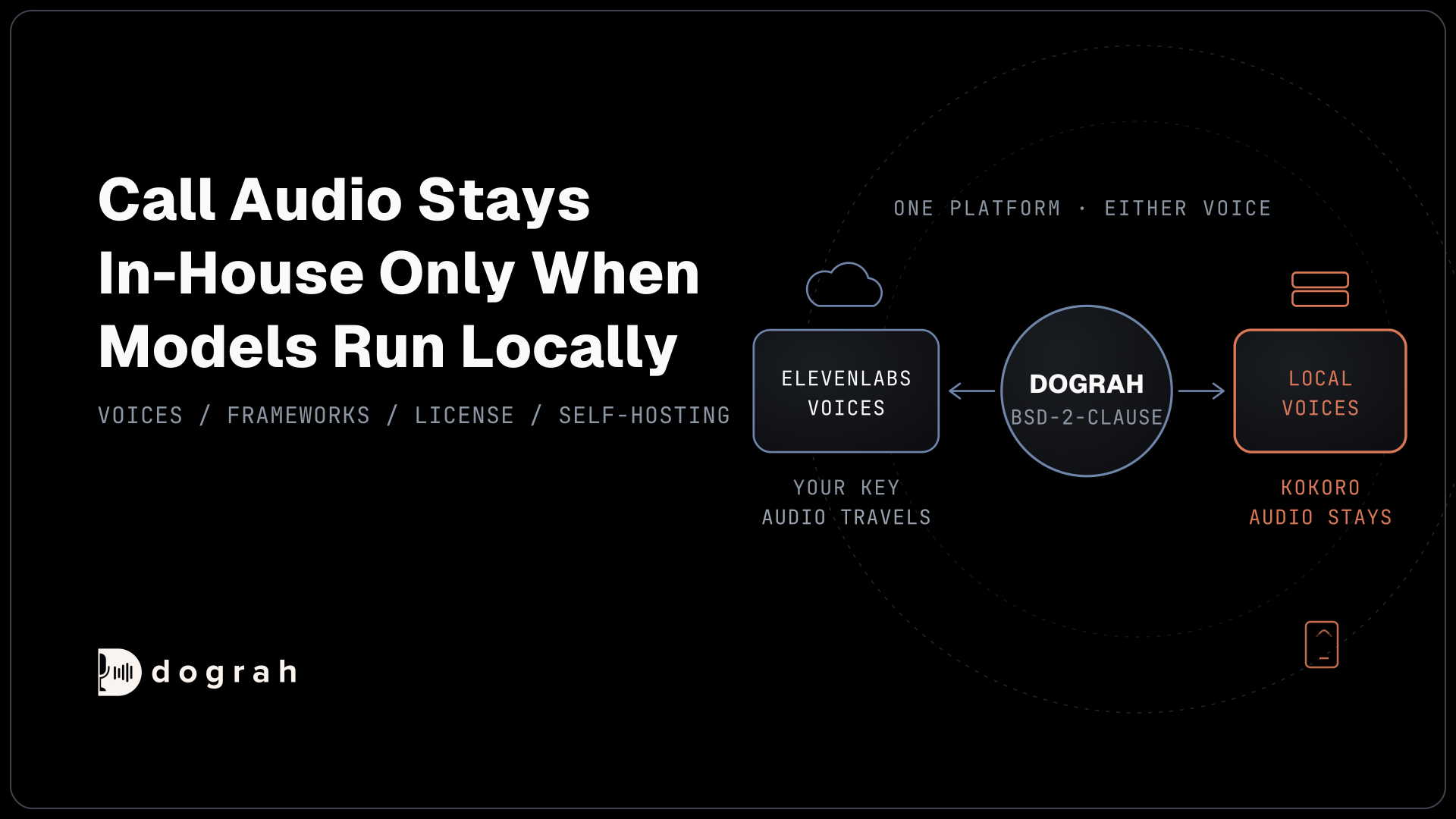
- Call audio stays in-house only when the speech models run locally too.
This post is part of our guide to ElevenLabs alternatives, which notes that ElevenLabs' private deployment is licensed software in your cloud account, while open source needs no contract. Here we sort open voices, open frameworks and an open platform, then run Dograh with ElevenLabs voices and with local ones.
What ElevenLabs lets you run yourself
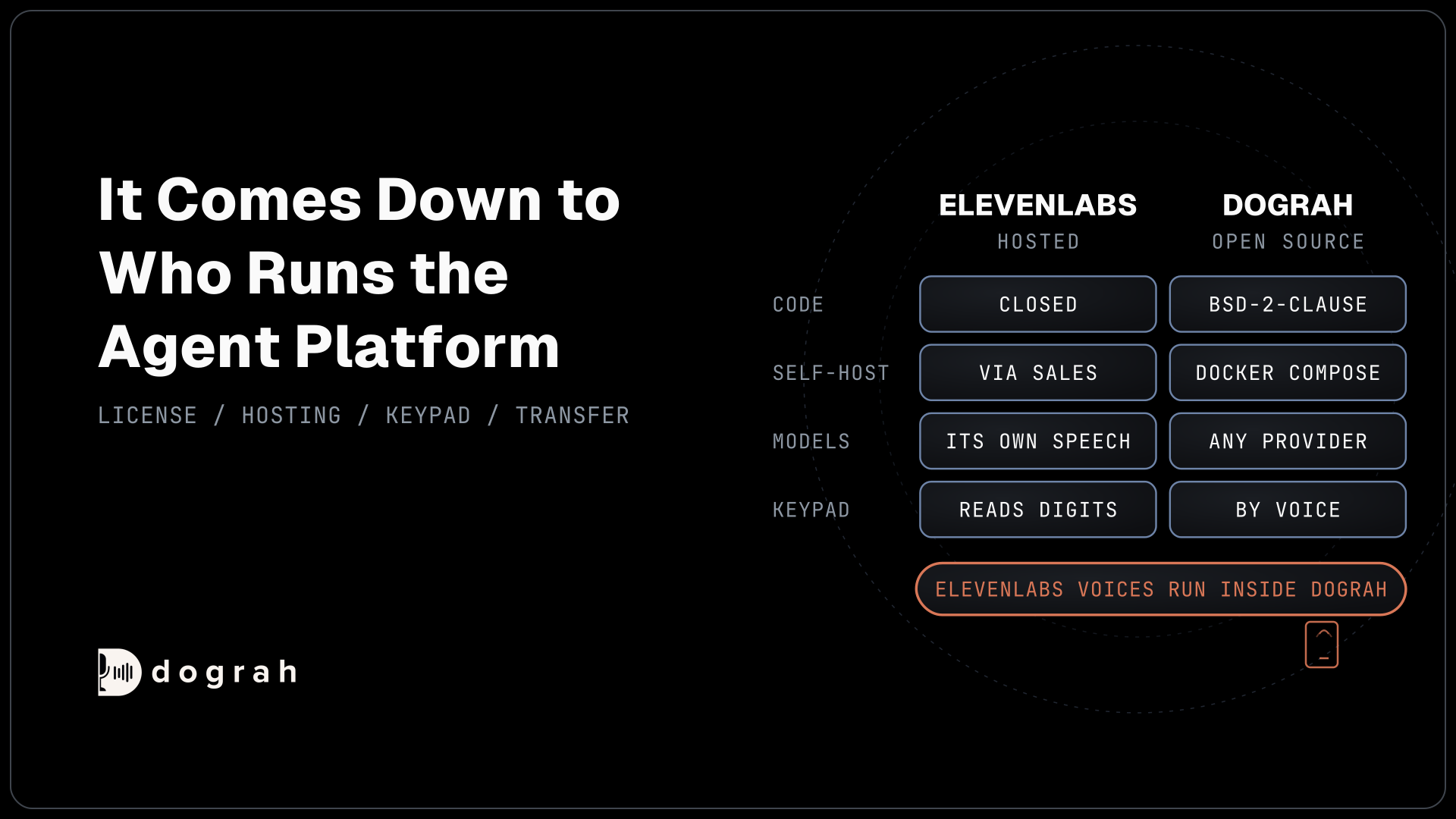
ElevenLabs runs ElevenAgents on its own cloud, and what you can run yourself comes through a sales contract. ElevenLabs' private deployment runs ElevenAgents inside your own AWS or GCP account, with an Azure version planned. It is arranged through the sales team, prospects sign an NDA first, and the models on offer are the v2 and v2.5 voices and Scribe V2 for transcription.
That is licensed software. ElevenLabs' public GitHub holds SDKs for Python, JavaScript, Swift and Kotlin, a CLI and examples, mostly under MIT. Those are the tools you call the platform with. The agent platform's code is not among them, so a private deployment runs ElevenLabs' code under ElevenLabs' agreement.
Open source changes who controls the platform. Dograh's code is on GitHub under BSD-2-Clause, which lets you use, change and redistribute it, commercially too, as long as the copyright notice stays. You can install it today with no sales call, and your security team can read the code it approves. Your version keeps running whatever the vendor decides. Our post on BSD-licensed voice AI covers the license itself.
Open voices, open frameworks, open platform
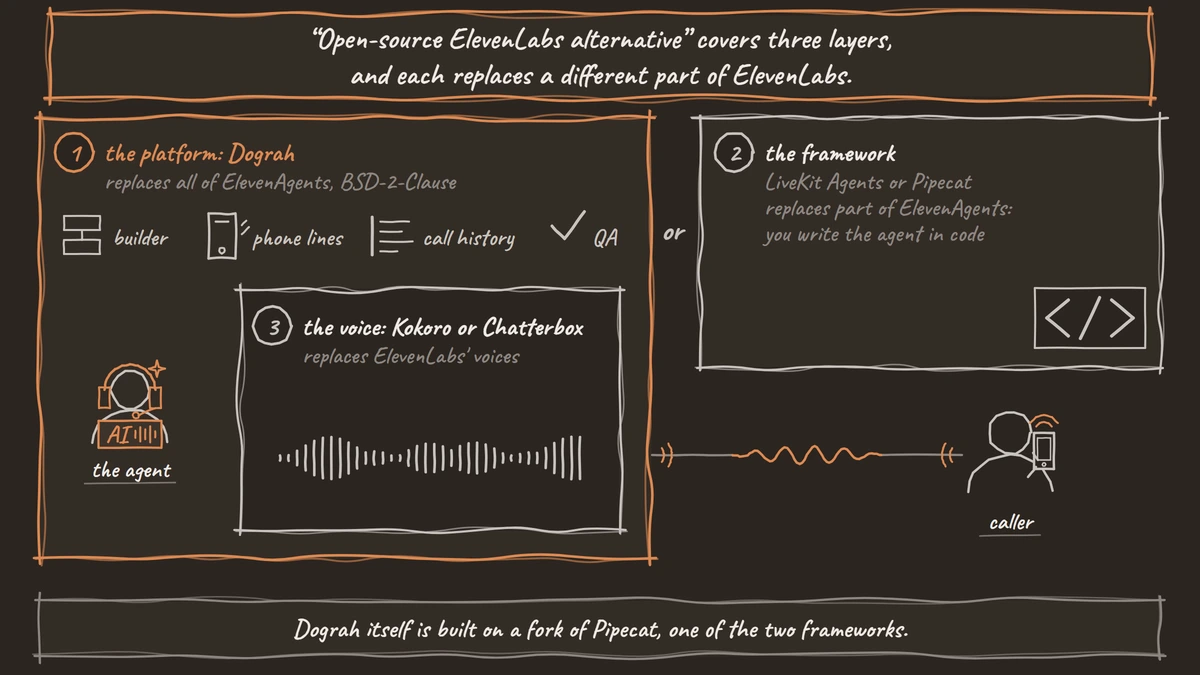
"Open-source ElevenLabs alternative" covers three different layers, and each replaces a different part of ElevenLabs.
| Layer | Open option | License | What it replaces |
|---|---|---|---|
| Voice | Kokoro 82M | Apache-2.0 | ElevenLabs' text to speech, with fixed voices and no cloning |
| Voice | Chatterbox | MIT | ElevenLabs' voices and voice cloning, from a short reference clip |
| Framework | LiveKit Agents | Apache-2.0 | Part of ElevenAgents. Your developers write the agent in code |
| Framework | Pipecat | BSD-2-Clause | Part of ElevenAgents. Your developers write the agent in Python |
| Platform | Dograh | BSD-2-Clause | All of ElevenAgents: builder, telephony, call history and QA, with any voice |
On the voice layer, Kokoro is an 82-million-parameter model under Apache-2.0, with a set of fixed voices. Chatterbox is MIT-licensed, with a Turbo model built for low-latency voice agents and a multilingual model covering 23 languages. Every Chatterbox output carries Resemble's Perth watermark.
Two traps catch teams here. A model that is free to download may not be free to use in a business. F5-TTS is licensed CC BY-NC 4.0, which rules out commercial use, and XTTS-v2 comes under Coqui's own Public Model License. And a speech-to-text model such as Voxtral transcribes the caller, so it cannot stand in for a voice.
Frameworks and a platform differ in how much is left to build. Pipecat is a Python framework from Daily, and Dograh itself is built on a fork of it. In our experience it is an excellent base, but production needs phone integrations, call history, QA on live calls and the call lifecycle, which is the part Dograh ships.

Open Source Alternative to Vapi / Retell
Self-hosted voice agent platform — no per-minute fees
dograh-hq/dograh
Star on GitHub
Dograh with ElevenLabs voices
The quickest route keeps the voice your callers already know. ElevenLabs is a built-in voice provider in Dograh, with Flash v2.5 as the default and Turbo v2.5, Multilingual v2, Eleven v3 and v3 Conversational, v4 and v4 Turbo to pick from. You paste a voice ID from your Voice Library, cloned voices included, and add your own ElevenLabs key. Scribe v2 Realtime is available as the speech-to-text option too.
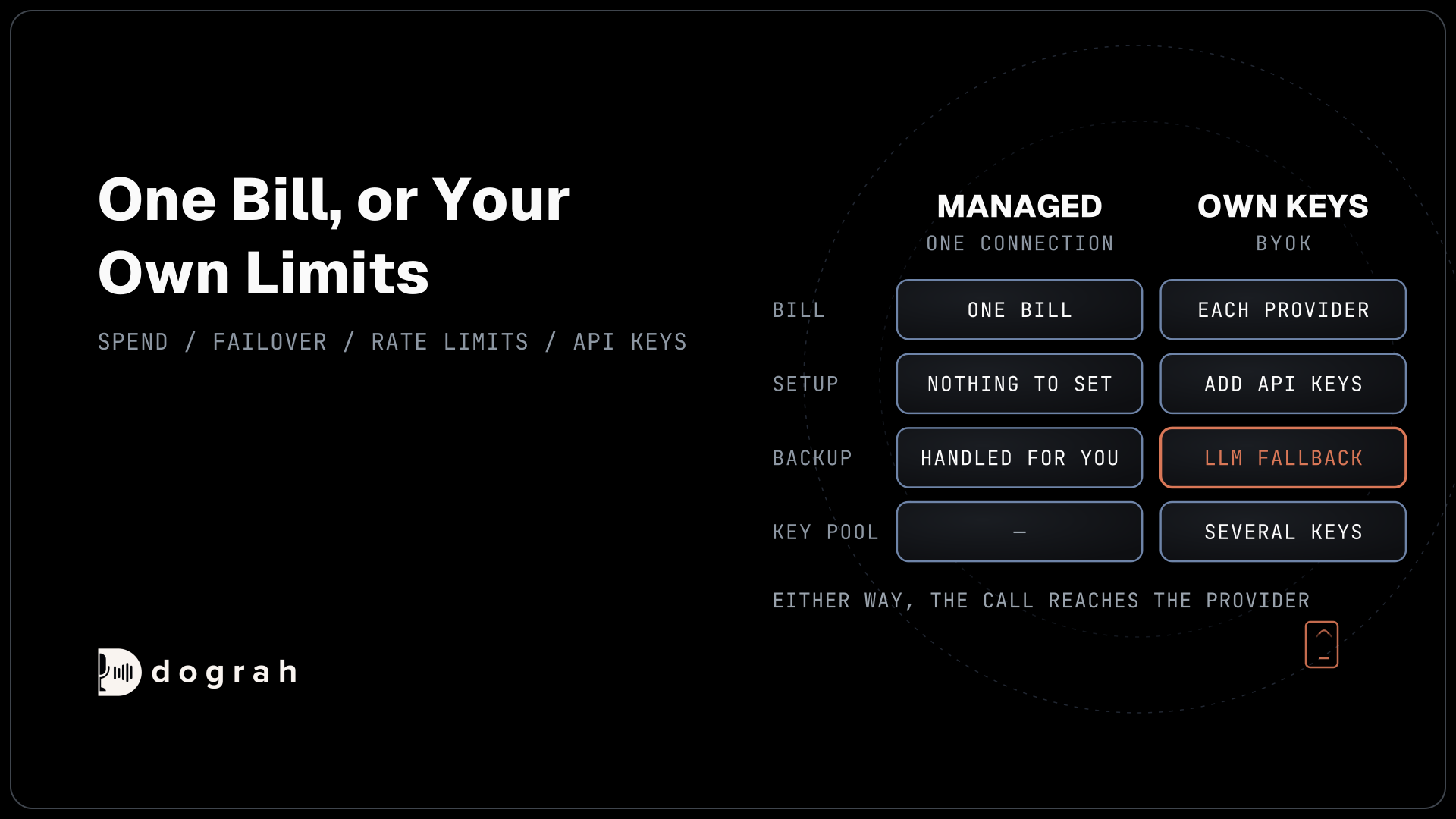
The voice settings also take a base URL, so you can point Dograh at an ElevenLabs Data Residency endpoint, such as the EU one. Bringing your own key moves the contract, but the data still travels. The agent's replies still go to ElevenLabs' API to become speech, and with Scribe the caller's audio does too, exactly as from ElevenAgents.
ElevenLabs voices also suit Dograh's hybrid audio. You record the lines a call always needs, and the language model plays a clip when one fits and falls back to a cloned version of the same voice for everything else. Pre-recorded audio plays directly, so those parts of the call are not billed as text to speech.
Dograh with open voices on your own servers
Self-hosting the platform keeps recordings and transcripts on your servers, and the caller's voice goes wherever the models run. Dograh is the orchestration layer that runs the call flow, tools and telephony, and the speech and language models are a separate layer you choose.
For local voices, Dograh has a Local Models provider for Speaches, an OpenAI-compatible speech server. Its default voice model is Kokoro, and it takes any OpenAI-compatible text-to-speech endpoint with a custom model name, so Chatterbox is a model to test behind such a server. The same provider runs Whisper models for speech-to-text, and the language model can be any open-weight model behind an OpenAI-compatible endpoint, such as Ollama or vLLM. You set each one up in Dograh's model configuration.
Be honest about quality before you switch. In an Interspeech 2025 study, listeners took real human recordings for human 70.68% of the time and ElevenLabs clones 69.85%. The best open-weight model tested, F5-TTS, reached 50.26%, and its license rules out commercial use anyway. On the Artificial Analysis Speech Arena, Kokoro and Chatterbox sit outside the top 60, while Eleven v4 Turbo holds first place.
That is why many teams mix the two. ElevenLabs voices carry most calls, and local voices take the calls whose audio must never leave the building. Our tutorial on building a voice agent with local open-source models walks through the local setup, and air-gapped voice agents covers running with no internet at all.
What running it yourself takes
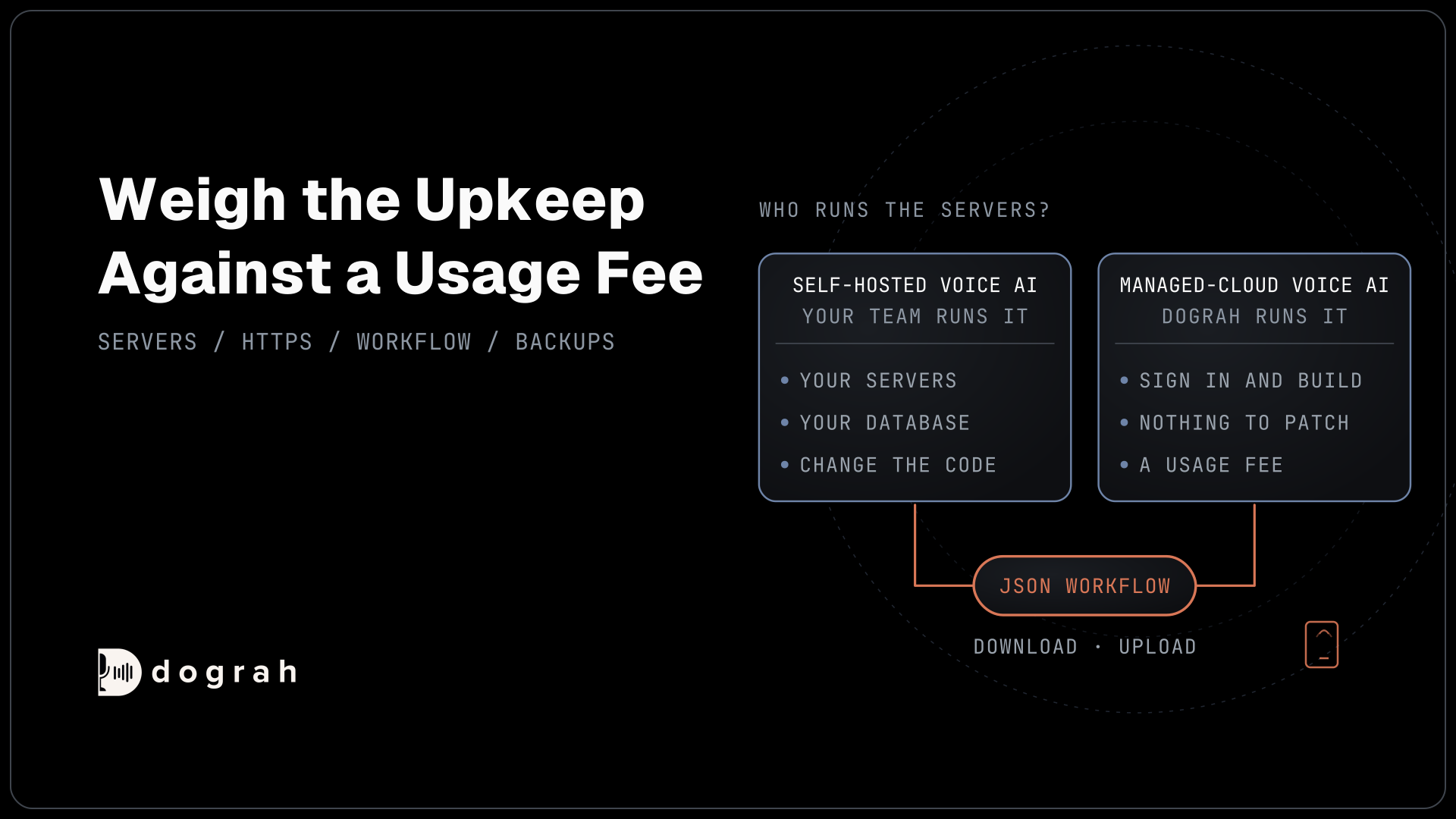
Owning the platform moves the hosting work onto your team. Self-hosting uses Docker Compose, and your team keeps the servers patched and secure. A self-hosted install runs 10 calls at once by default, a limit you can raise, though your servers and phone carrier set the real ceiling. Telemetry is on by default, so run ENABLE_TELEMETRY=false ./start_docker.sh and delete POSTHOG_API_KEY from docker-compose.yaml.
Open voices add GPU servers, while ElevenLabs voices add ElevenLabs' bill on your own account. Self-hosted Dograh has no per-minute platform fee (servers, model keys and phone minutes still cost); Dograh Cloud has a 1¢-a-minute platform fee.
Choose Dograh if you want the full agent platform as open source, with the voice still your choice, or LiveKit Agents or Pipecat if your developers would rather write the agent in code. Stay on ElevenAgents if a hosted platform from one vendor is what you need. Our Dograh vs ElevenLabs comparison sets the two side by side, row by row.
Join the Dograh Community
Dograh is an OSS alternative to Vapi. Join our Slack community for queries, releases, best practices & community interactions.
Glossary
- Private deployment
- ElevenLabs' option to run ElevenAgents inside a customer's own AWS or GCP account, arranged through sales under an NDA. The code stays licensed from ElevenLabs, so it is not open source.
- Speaches
- An OpenAI-compatible speech server for self-hosted text to speech and speech-to-text. Dograh's Local Models provider connects to it, with Kokoro as the default voice model.
- Open-weight model
- A model whose weights you can download and run on your own servers. The license still decides commercial use: Kokoro is Apache-2.0, while F5-TTS is non-commercial.
- Perth watermark
- An imperceptible mark Resemble AI adds to every Chatterbox output, so generated speech can be detected later.