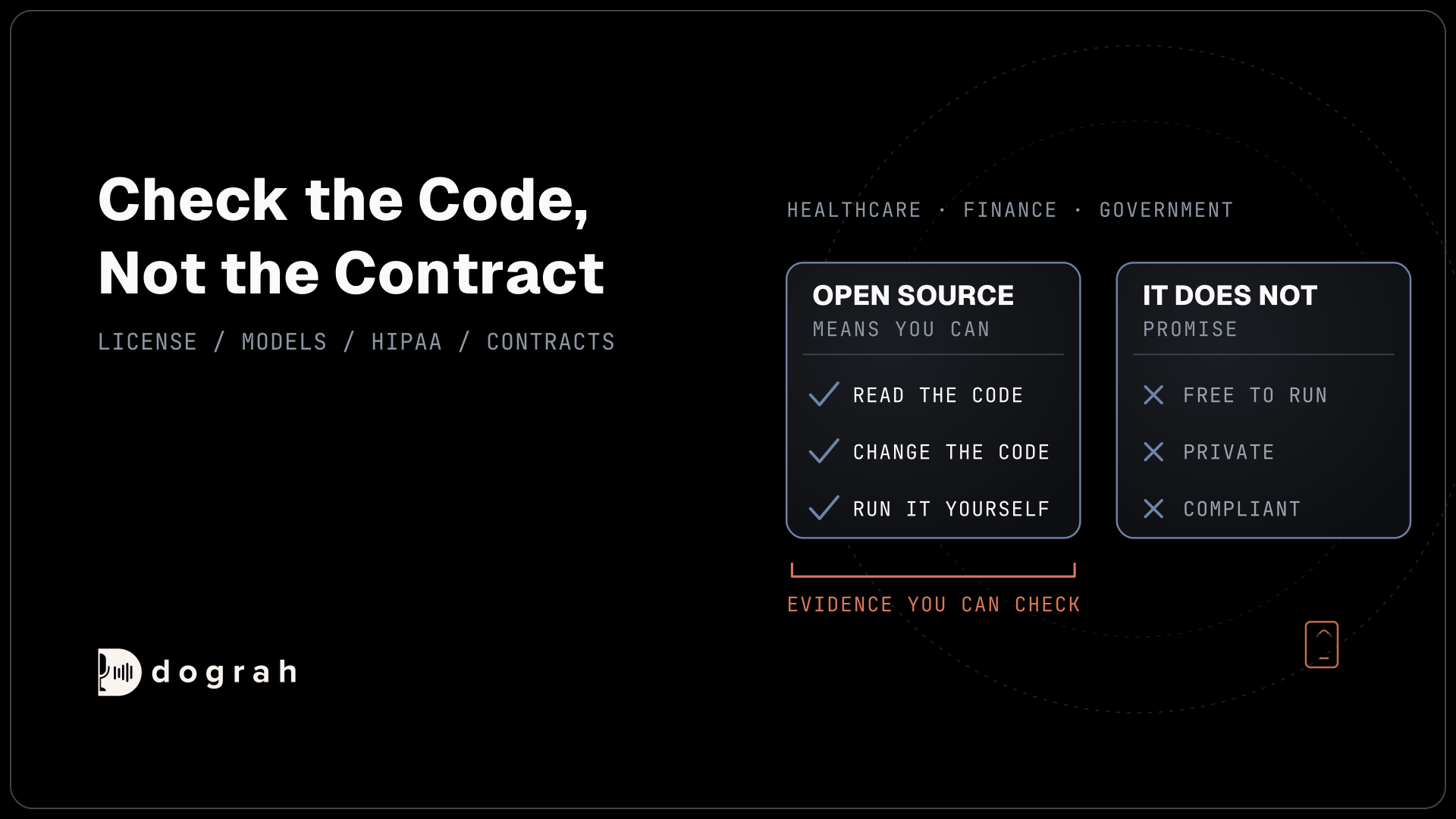

BSD-licensed voice AI is voice agent software under BSD 2-Clause. You can use, change, sell and ship it, inside a closed product if you like, as long as the copyright notice and license text travel with it. Your changes can stay private. Dograh uses this license, and you can self-host it or run it on Dograh Cloud.
Key Takeaways
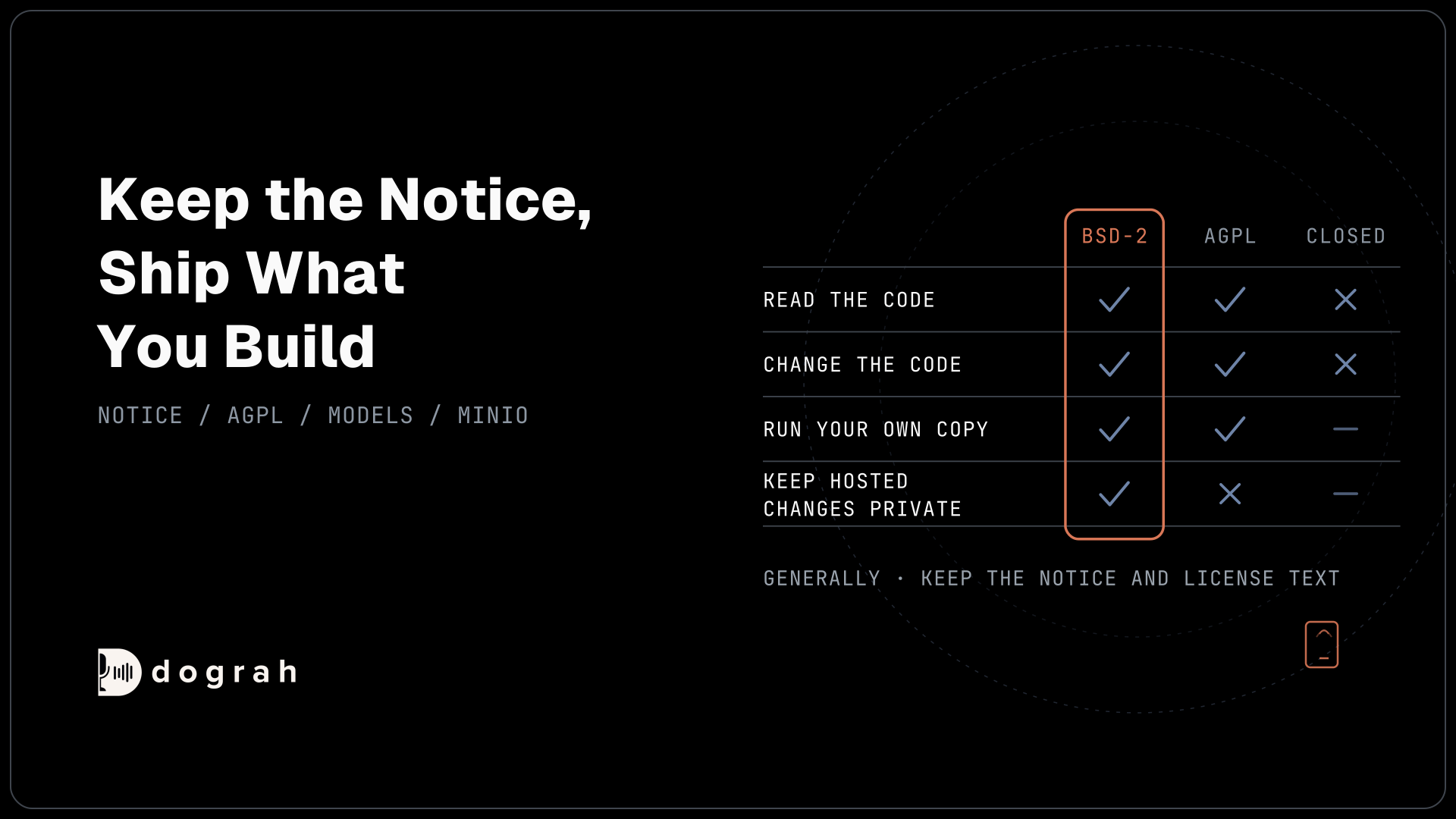
- BSD-2 has two conditions: keep the notice and the license text.
- Unlike the AGPL, it never asks you to publish changes you host.
- Models and bundled services carry their own licenses, separate from Dograh's.
This post is part of our guide to open-source voice AI agents, where BSD-2 is the permissive license that lets you ship what you build on Dograh. Below, we read the license line by line, then compare it with the AGPL and with closed platform terms.
What the BSD 2-Clause license says
The BSD 2-Clause license is short. It lets anyone use, copy, change and share the code, in source or built form, with or without changes. It sets two conditions. Copies of the source keep the copyright notice, the two conditions and the disclaimer. Built copies reproduce the same text in their documentation or other materials. The disclaimer says the software comes "as is", with no warranty.
Dograh's license file is the standard BSD 2-Clause text, with the copyright held by Zansat Technologies, the company behind Dograh. The Python and TypeScript SDKs carry the same license. Dograh's call engine is a fork of Pipecat, which Daily publishes under BSD 2-Clause too. The project asks contributors to sign no contributor license agreement, so outside contributions arrive under the same terms as the rest of the code.
What it lets you do with Dograh
You can use, change, sell and ship Dograh, inside a closed product if you like, as long as the copyright notice and license text travel with it. A software company can build voice agents into its product and sell that product under its own terms. An agency can run Dograh for clients under its own brand. A team can change the call engine for a hospital's PBX and never show anyone the change.
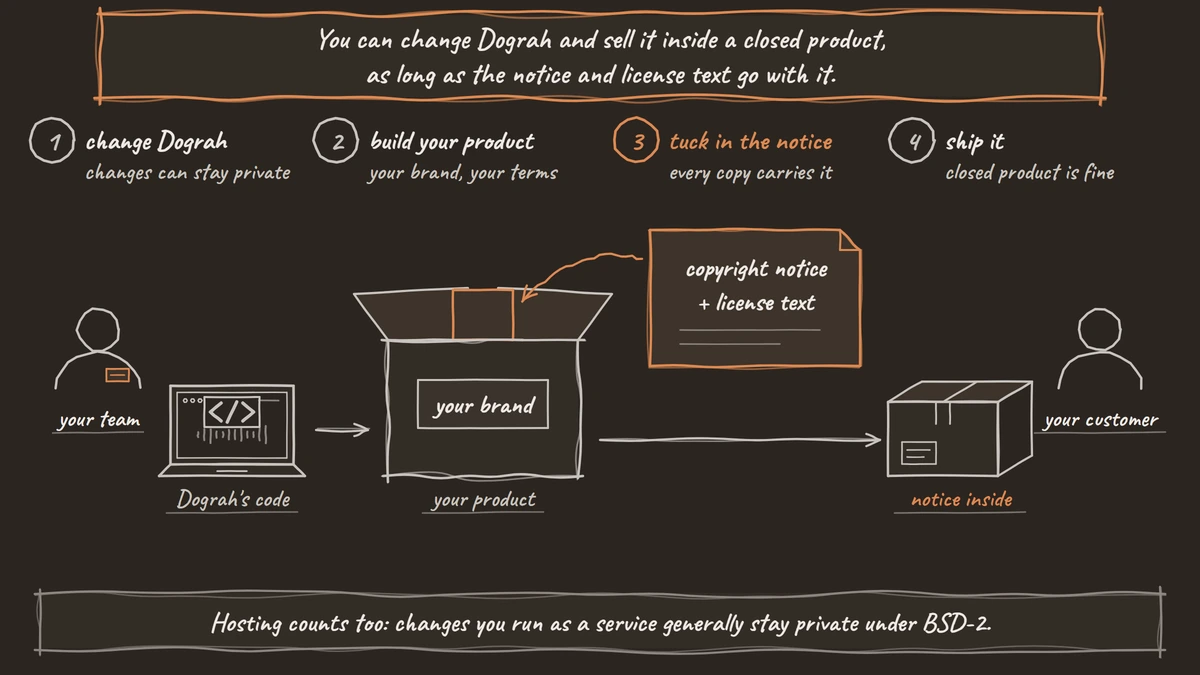
Hosting is covered too. Change Dograh and run it as a service, and BSD-2 does not ask you to publish your changes. Under the AGPL you would have to offer them to every user. The license gives no rights to the Dograh name or logo, though, so a white-label product ships under your own brand.
BSD-2 vs the AGPL and closed licenses
Copyleft licenses trade some of that freedom for a promise to share. Under the GNU Affero General Public License, if you change the software and people use your changed version over a network, you have to offer them your source code.
Closed platforms sit at the other end. Their terms let you use the service while you pay for it, with no copy of the code to run, read or change.
The permissive choice has a cost, and AGPL supporters name it. Anyone may take BSD code, improve it privately and sell it as a hosted service, a large cloud provider or a competitor included, without giving anything back. For a team building voice agents into its own products, that same freedom is what it needs. Our comparison of the best open-source voice AI platforms shows which projects use which license.

Open Source Alternative to Vapi / Retell
Self-hosted voice agent platform — no per-minute fees
dograh-hq/dograh
Star on GitHub
What Dograh's license does not cover
Dograh's license covers Dograh's code. Two things in a working voice agent sit outside it.
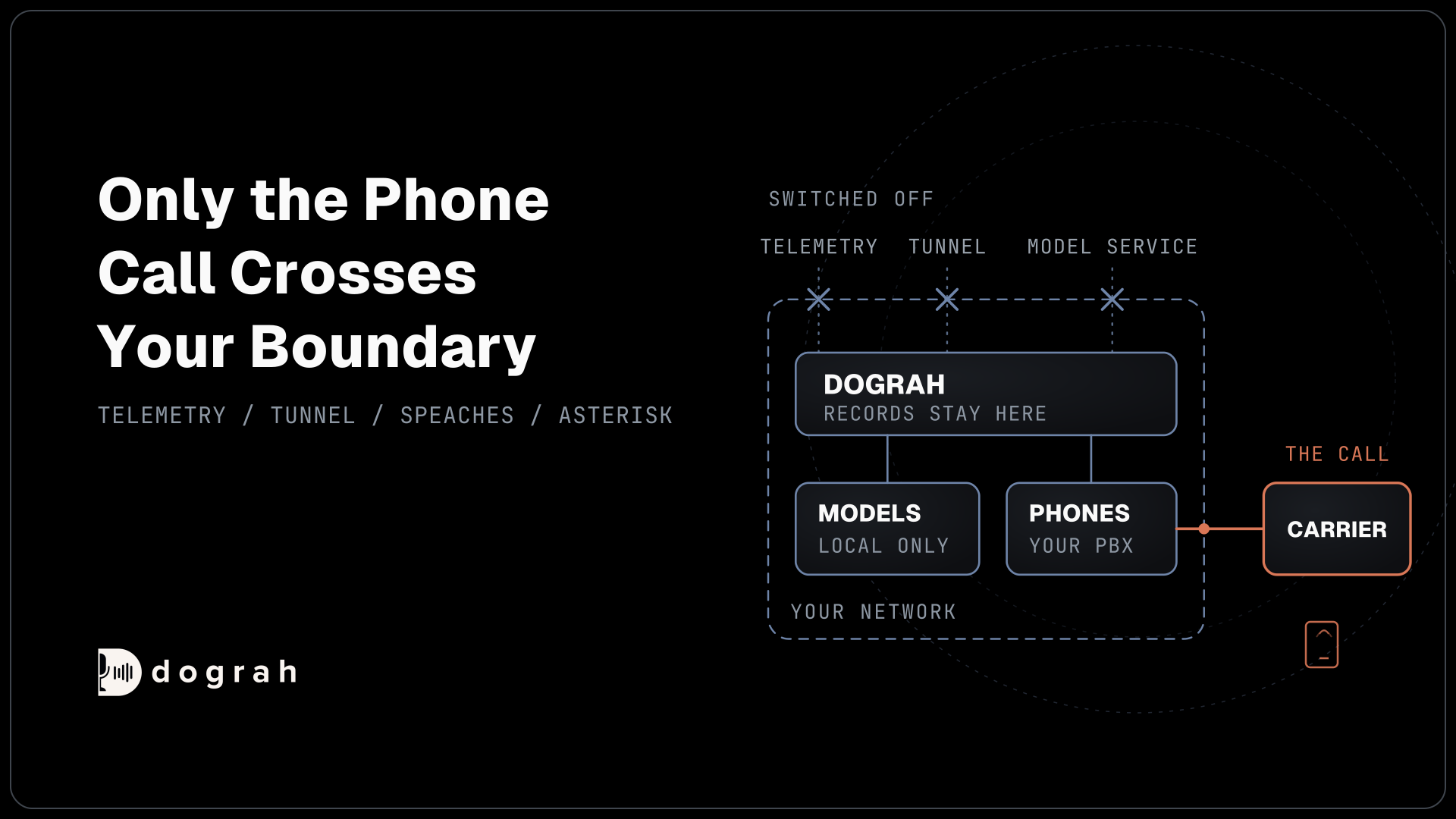
The first is the models. Each speech, language and voice model has its own license, and some limit what you can do. NVIDIA's Magpie TTS weights come under the NVIDIA Open Model License, which is open weights rather than open source. F5-TTS weights are licensed for non-commercial use only. Our guide to local and self-hosted voice AI models covers the model options.
The second is the services the Docker setup bundles. They run as separate programs under their own licenses. Storage runs on Dograh's fork of MinIO, which is AGPLv3. The redis:7 image resolves to Redis 7.4, which Redis publishes under source-available terms (RSALv2 or SSPLv1).
Running these services unchanged is the normal case, and you can replace MinIO with AWS S3 by setting ENABLE_AWS_S3=true. If you plan to change one of them, or to offer the whole stack to others as a service, confirm how its license applies with counsel.
Join the Dograh Community
Dograh is an OSS alternative to Vapi. Join our Slack community for queries, releases, best practices & community interactions.
What to check before you ship
Before you ship a product built on Dograh, keep the LICENSE file in your source tree and put the same text in your product's documentation or about screen. Then list the license of every model your agents use and every bundled service you ship, with a note on whether you changed any of them.
To read the code and the license in a running install, start with our tutorial on how to self-host a voice AI agent with Docker.
Glossary
- Permissive license
- An open-source license that lets you use, change and ship code, including inside closed products, with few conditions. BSD 2-Clause, MIT and Apache 2.0 are permissive.
- Network clause
- The AGPL condition that turns hosting into sharing. If users reach your changed version over a network, you must offer them its source code.
- Source-available terms
- Terms that publish the code but limit how you may use it, often by banning competing hosted services. Redis 7.4's RSALv2 and SSPLv1 are examples, and neither is on the Open Source Initiative's list.