
Move from a closed voice API to self-hosting when platform fees keep rising, a data rule arrives that no contract covers, a vendor limit keeps blocking you, or you need a change only open code allows. Move the platform first. Dograh is an open-source AI voice agent platform, and you can self-host it or run it on Dograh Cloud.
Key Takeaways
- Test each signal on your own minutes, contracts and limits, not a vendor's average.
- Moving the platform needs no GPUs, because hosted models still work with your keys.
- Self-host the models later, and only when volume or a data rule calls for it.
A closed voice API that felt cheap at launch can become a heavy monthly fee as minutes grow. We test four signals on your own numbers, explain why the platform moves before the models and plan a move to Dograh agent by agent. It is part of our guide to voice agent ROI.
Signal one: fees that grow with your minutes
A closed voice API charges a platform fee on every minute, so the first signal is that fee growing faster than the value of the calls. Take the vendors' own rates. Vapi's pricing page lists $0.05 a minute for hosting, so at 1,000 minutes a day the hosting fee alone works out, by our arithmetic, to about $18,250 a year, before models, phone lines, a support package or the HIPAA add-on. Retell AI's pricing page lists its Voice Infra at $0.055 a minute, which the same sum puts at about $20,000 a year on that volume.
The test is simple. Multiply the platform fee by your real monthly minutes, then compare it with what a self-hosted platform costs you: servers, and the hours someone spends running them. If your minutes are still climbing, run the numbers at next year's volume too.
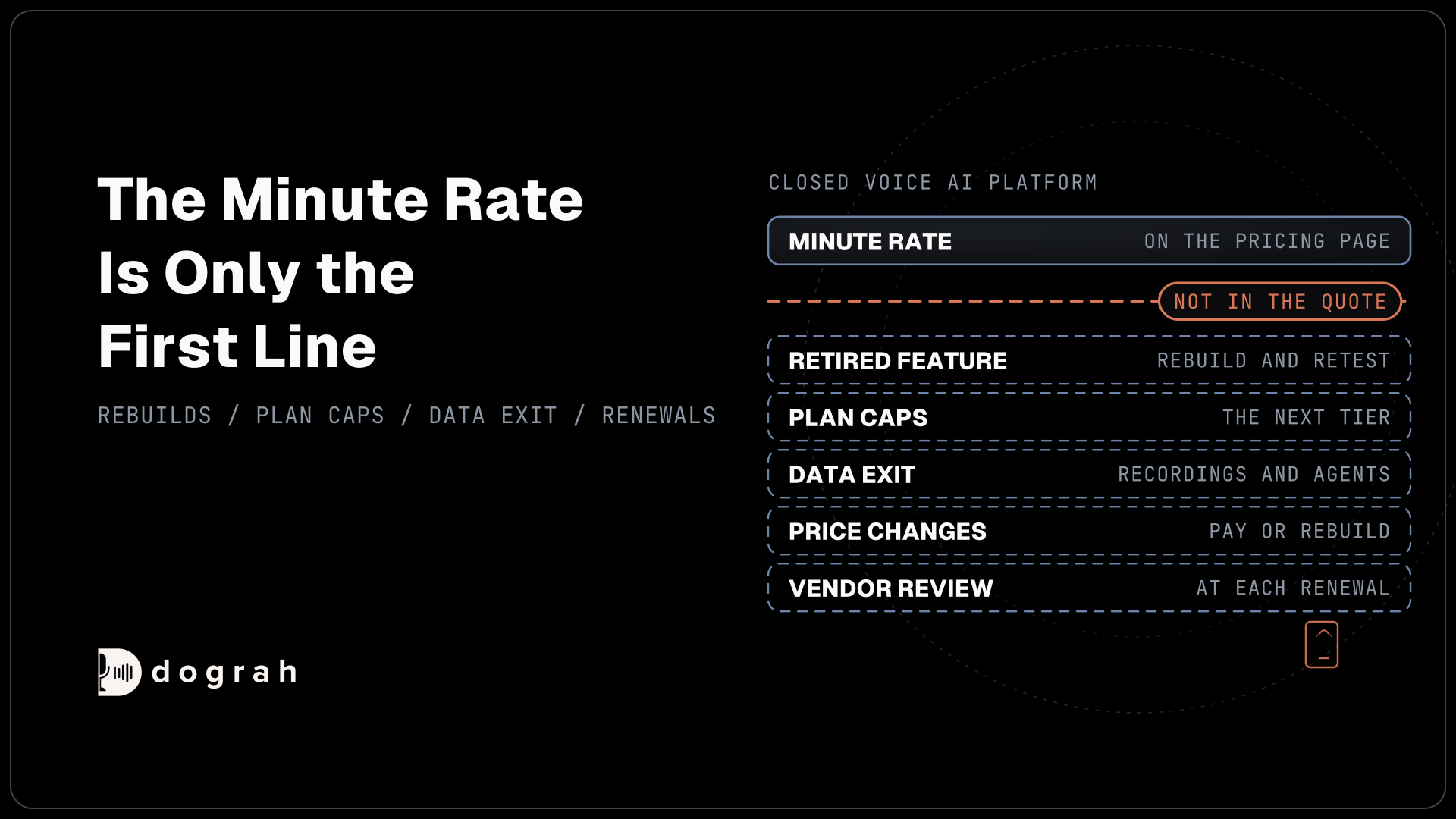
The fee is the visible part. Our post on the hidden costs of closed voice AI platforms covers the costs that sit outside the minute rate, such as re-platforming and data exit.
Signal two: a data rule no contract covers
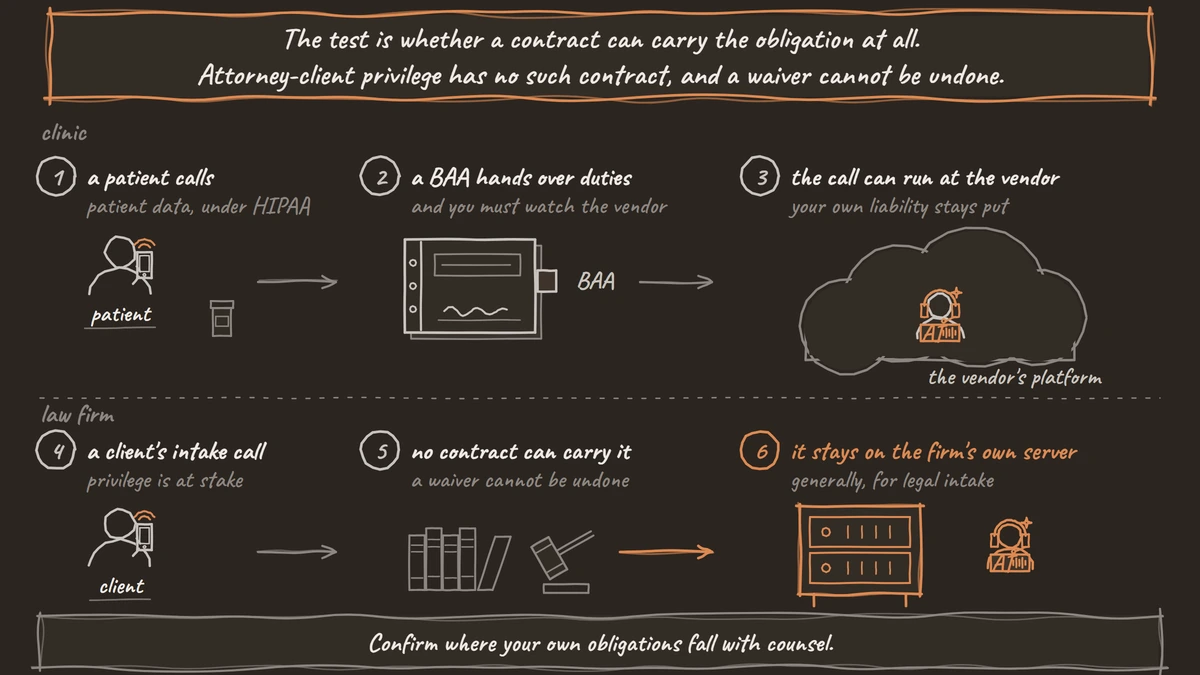
The second signal is a data rule that a vendor contract cannot satisfy, and the test is whether a contract can carry the obligation at all. Under the Health Insurance Portability and Accountability Act (HIPAA), a business associate agreement lets a vendor handle patient data on your behalf. It hands the vendor duties and gives you a duty to watch them, while your own liability stays put. Vapi sells that agreement as an add-on at $2,000 a month. Attorney-client privilege has no such contract, and a waiver cannot be undone, so legal intake calls generally belong on your own servers. Confirm where your own obligations fall with counsel.
Using your own keys with a hosted model provider changes whose contract covers the models. The audio still reaches that provider. Only open-weight models on your own servers keep call audio in-house.
Many teams are already moving AI work inward. In Broadcom's Private Cloud Outlook 2026, a survey of 1,800 senior IT decision-makers, 56% said they run or plan to run production AI inference on private cloud, while public cloud use for it fell to 41%. If data rules are your reason to move, add one item to the checklist: a self-hosted Dograh install sends anonymous usage telemetry until you set ENABLE_TELEMETRY=false and remove POSTHOG_API_KEY.
Signal three: vendor limits you keep hitting
The third signal is a limit you keep paying to get around. Vapi includes 4 concurrent calls without a package, 10 on Core and 30 on Pro, and charges $10 a month for each extra line. Retell AI includes 20 concurrent calls and charges $8 a month for each one above that. A campaign that needs 100 calls at once pays for the gap every month.
Features can also disappear. Vapi retired its Workflows product in August 2026, and teams that built on it had to rebuild their flows. When that happens twice, the vendor's roadmap is setting yours.
Self-hosted Dograh runs 10 concurrent calls by default, and DEFAULT_ORG_CONCURRENCY_LIMIT raises that number. Past it, your servers and your phone provider set the ceiling, and you add capacity by adding servers.

Open Source Alternative to Vapi / Retell
Self-hosted voice agent platform — no per-minute fees
dograh-hq/dograh
Star on GitHub
Signal four: a change only open code allows
The fourth signal is a feature request the vendor keeps declining. Some needs only open code can meet. You may need calls to run through your own Asterisk PBX over ARI, or the whole stack to sit on your own network. You may want to change how the pipeline handles turn-taking, or add a phone carrier or speech provider nobody else uses.
On a closed API, each of those waits on a vendor's roadmap. With Dograh, the code is public under the BSD 2-Clause license, so your team can make the change and then decide whether it stays private or goes upstream. If you have filed the same request three times, this signal has already fired.
Move the platform first, the models later
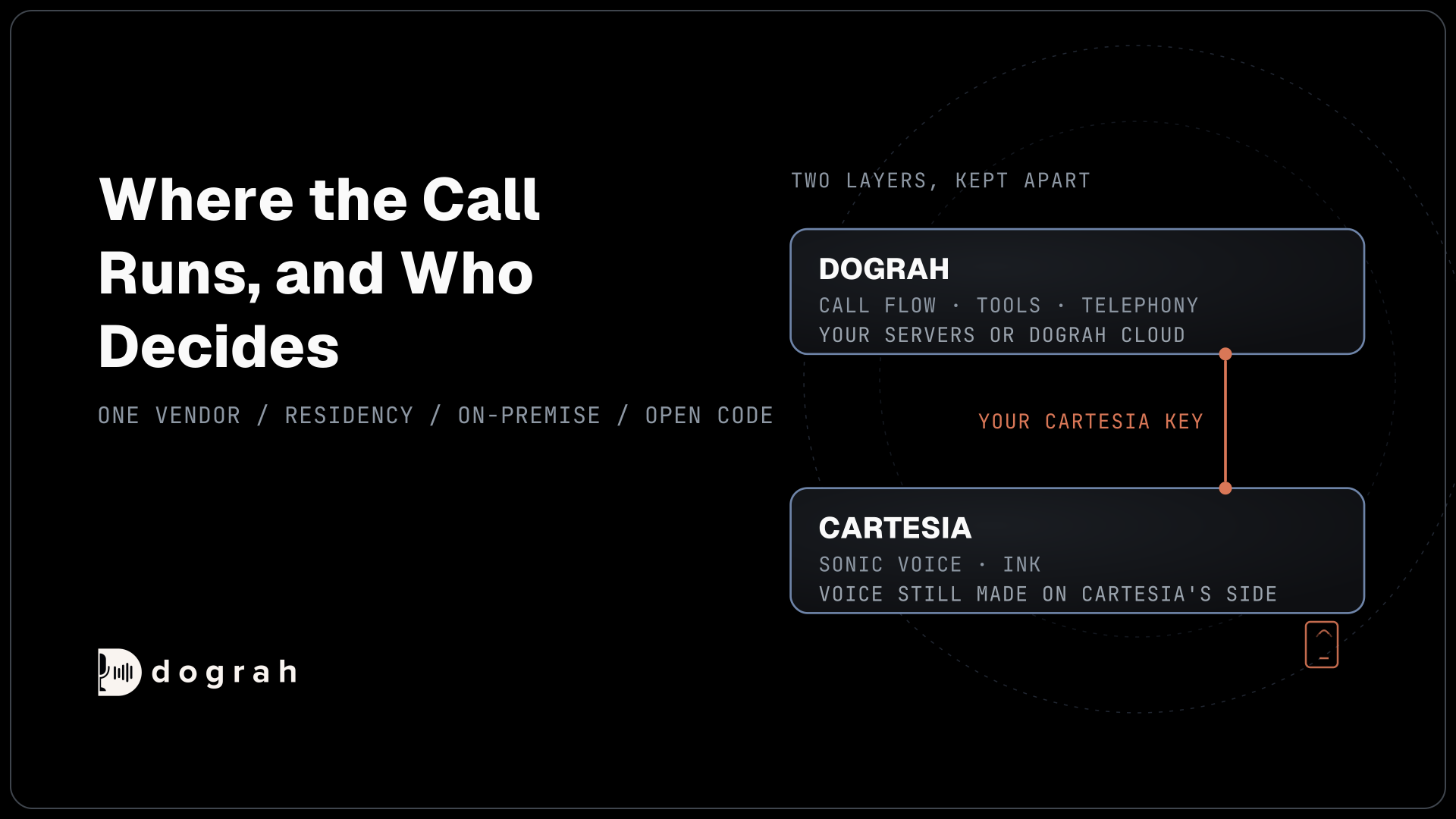
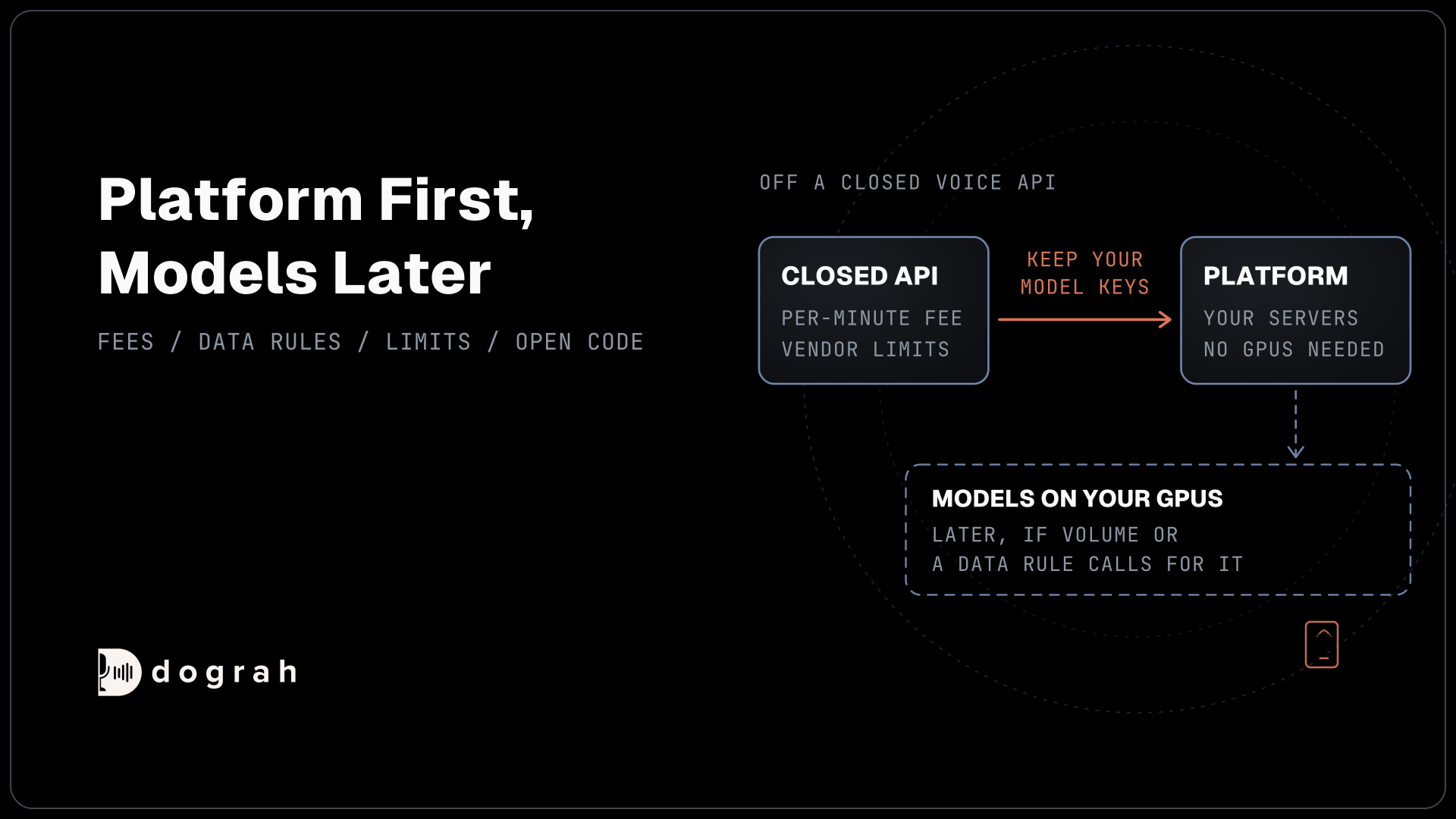
Self-hosting has two layers, and they do not have to move together. The platform layer is Dograh itself, running the call flow, tools and telephony. The speech and language models sit in a second layer you pick on their own. Moving the platform needs no GPUs, because you can keep your hosted models with your own keys.
The strongest case against moving early is about the second layer. Softcery's brief on self-hosting a voice AI stack, from a consultancy that sells such builds, puts the point where owned GPUs pay off at roughly 1 to 2 million connected minutes a month, and prices a new GPU inference team at $300,000 to $500,000 a year. Those figures are about running the models yourself. They do not apply to the platform step, which runs on ordinary servers.
So move in that order. Once the platform runs on your servers, the per-minute platform fee is gone, and the bill becomes servers, model keys and phone minutes. If you would rather not run servers yet, Dograh Cloud charges a 1¢-a-minute platform fee and runs the same agents. The scaling guide shows how a self-hosted install grows, and our comparison of Self-Hosted vs Managed-Cloud Voice AI covers who runs what.
Join the Dograh Community
Dograh is an OSS alternative to Vapi. Join our Slack community for queries, releases, best practices & community interactions.
How to make the move
Plan the move as a rebuild, done one agent and one phone number at a time. Rebuild each agent from its prompts and call flow, and test it on a real phone line next to the old one. A browser test hears 16 kHz audio, but most callers on the migrated numbers will arrive as 8 kHz, so a flow that sounds right in the browser can still mishear names on a phone call.
The Dograh MCP server can create agents from an AI assistant, which speeds up the rebuild. Then move numbers over one at a time. Our step-by-step guides for migrating from Vapi and migrating from Retell AI walk through each part, and there are matching guides for Bland AI, Synthflow, Voiceflow and PolyAI.
Glossary
- Platform fee
- The per-minute charge a voice platform adds for running the call, separate from the speech, language model and phone costs. Self-hosting an open-source platform removes it, while servers and the people who run them become the cost.
- BYOK (bring your own key)
- Using your own account and API key with a model provider instead of the platform's. It changes whose contract covers the models, while the call audio still reaches that provider.
- Business associate agreement (BAA)
- The HIPAA contract that lets a vendor handle patient data for a covered entity. It delegates duties to the vendor and adds a duty to monitor it, without moving the covered entity's own liability.
- Open-weight model
- A speech or language model whose trained weights you can download and run on your own servers. It is the step that keeps call audio in-house, and the one that needs GPUs and volume to pay off.