
The Cartesia alternatives that matter for phone agents replace Managed Agents, Cartesia's hosted agent platform. ElevenAgents, Vapi, Retell AI, Deepgram's Voice Agent API and Bland AI are hosted and closed. Dograh, our open-source AI voice agent platform, lets a team that switches keep Cartesia's voices and Ink speech-to-text under its own key, self-hosted or on Dograh Cloud.
Key Takeaways
- Cartesia's Sonic voices and Ink speech-to-text run inside Dograh with your own key.
- Cartesia's on-prem option covers its models and is arranged through Enterprise sales.
- Managed Agents lists $0.03 a minute, with the phone line and LLM on top.
Teams that like Cartesia's voices often still want to read their agents' code and pick their own model. This guide compares hosted platforms, open routes and voice swaps in one table, then covers prices, when staying wins and moving off Managed Agents to Dograh. You can self-host Dograh or run it on Dograh Cloud.
What Cartesia sells today
Cartesia sells speech models, and now a hosted agent platform built around them. Sonic is its text-to-speech model, and the current version, Sonic 3.6, speaks 44 languages. Ink is its speech-to-text. Ink 2 covers English, French, Hindi, Japanese and Spanish and has turn detection built in, while the older ink-whisper covers about 100 languages.
On October 29, Cartesia launched Managed Agents, which it calls an end-to-end voice agent platform for enterprise conversations. You build an agent in a Playground or through the API, pick a language model from Cartesia's catalog of OpenAI, Anthropic and Gemini models, and connect a Cartesia number, Twilio or a SIP trunk. Its system tools end the call, detect voicemail, send keypad tones and transfer to a number, and outbound batches go out through the API.
The voice is why most teams know the name. Sonic 3.6 ranks fourth on the Artificial Analysis Speech Arena, where listeners vote blind between voices, and two ElevenLabs models hold the top two places. Our guide to Cartesia's features walks through Sonic, cloning, Ink and the agent tools one at a time.
Why teams look past Managed Agents
Managed Agents is a closed platform. Cartesia's SDKs and its code-first Line SDK are open source under Apache-2.0, but the platform and the Sonic and Ink models are not, so the code behind your agents is not yours to read or run. The language model comes from its catalog too. It manages that integration, so you need no provider account or key of your own, and the agent runs on whichever catalog model you pick.
Hosting is the other trigger. Cartesia runs Managed Agents in its own cloud. On Enterprise, its sales team arranges on-premise or private-cloud deployment of its models, and dedicated regional deployments in the US, EU, UK, India and Australia. Zero Data Retention for speech and a business associate agreement (BAA) under the Health Insurance Portability and Accountability Act (HIPAA) are Enterprise features too. Each one starts with a sales conversation.
Some teams also face a date. Cartesia stops hosting agents built with its Line SDK on December 1, 2026, according to its Line SDK migration guide, so hosted Line users need a new home before then anyway. Our take on Cartesia Managed Agents looks at the launch itself in more depth.
Cartesia alternatives in one table
Four questions sort the field: the license, where the platform can run, which models you can use, and the list price. Latency is left out, because it depends on your models and phone path far more than on the platform around them.
| Product | Open source | Self-host or on-prem | List price | Models you can use | What you get, and what's missing |
|---|---|---|---|---|---|
| Cartesia Managed Agents (baseline) | No. Closed platform with open SDKs and an open Line SDK | Cartesia's cloud. On Enterprise, on-prem or private-cloud deployment of its models, and regional deployments in the US, EU, UK, India and Australia | $0.03/min, down from $0.06. $0.014/min on a Cartesia number. LLM tokens extra | Cartesia's speech models. LLMs from its catalog of OpenAI, Anthropic and Gemini models | Playground or API, keypad tones out, transfer by number or SIP URI, batch calls by API. BAA on Enterprise |
| Dograh | Yes, BSD-2-Clause | Yes, with one Docker command. On-prem or private cloud on Enterprise, or Dograh Cloud | Self-hosted: no per-minute platform fee. Dograh Cloud: a per-minute platform fee (see the Dograh section). Models and phone extra | Any supported provider with your own keys, Cartesia's Sonic and Ink included, Dograh's models, or open-weight models on your servers | Visual builder, your own carrier, Knowledge Base, call traces, per-step QA and an MCP server. Callers answer by voice, and self-hosting puts the servers on your team |
| ElevenAgents | No. Closed platform with public SDKs | ElevenLabs' cloud. EU, India or Singapore residency and private deployment in your own AWS or GCP account on Enterprise | Paid plans $6 to $990/mo with included minutes. Extra minutes $0.08, LLM and carrier on top | ElevenLabs' own speech models. Hosted LLMs or your own OpenAI-compatible LLM | Workflows, tests, keypad input and output, several transfer types. BAA on Enterprise |
| Vapi | No | Vapi's cloud | $0.05/min hosting, plus models and phone. HIPAA add-on $2,000/mo | A wide model catalog passed through at cost | Developer platform built as Assistants and Squads. Visual Workflows retired in August 2026 |
| Retell AI | No | Retell's cloud, with a dedicated server add-on on Enterprise | $0.07 to $0.31/min, from $0.055 voice infrastructure. 20 concurrent calls free, then $8/mo each | A choice of language models, including OpenAI's realtime speech-to-speech | Visual Conversation Flow builder |
| Deepgram Voice Agent API | No | Deepgram's cloud. Self-hosted containers in your VPC or on-prem on Enterprise | $0.075/min standard on pay as you go, less with your own LLM or voice | Deepgram speech-to-text, a managed or your own LLM, Deepgram's or your own voice | One WebSocket connection and one bundled rate |
| Bland AI | No | On-prem or VPC on Enterprise | Start $0.14/min with 100 calls a day. Build $0.12/min plus $299/mo | Bland's own models | One per-minute rate covers the models. BAA on Enterprise |
| LiveKit Agents | Yes, Apache-2.0 | Yes, or LiveKit Cloud | Free to self-host | Any model you wire in, Cartesia included | Open-source framework. Your developers build the agent and the product around it |
| Pipecat | Yes, BSD-2-Clause | Yes, or Pipecat Cloud | Free to self-host | Any model you wire in, Cartesia included | Python framework from Daily. Phone wiring, call history and QA are yours to build |
Of the open-source rows, Dograh is the only one whose open code is a full product, from the visual builder to telephony, call traces and QA. LiveKit Agents and Pipecat give your developers a framework to build that product on.
Dograh: keep Cartesia's voices, own the platform
Dograh's whole platform is open under BSD-2-Clause in its GitHub repository, from the visual workflow builder to Campaigns for outbound lists, HTTP API tools that read and write your systems during a call, a Knowledge Base, call traces and automatic QA.
Cartesia is a built-in provider, so changing platforms does not mean losing the voice. In the voice settings you pick Sonic 3.6, the default, or Sonic 3.5 or Sonic 3, paste any Cartesia voice ID, cloned voices included, and add your own Cartesia key. Speed and volume are there too. For speech-to-text, ink-whisper is the default. Ink 2 is offered for English, and with it Cartesia's own turn events decide when the caller has finished. For other languages, pick ink-whisper. Our page on how to use Cartesia voices in Dograh walks through the voice ID, your own key and cloned voices.
Leaving Managed Agents swaps only the layer that runs the call flow, tools and telephony, and the speech and language models remain a choice you make. Cartesia sits next to 15 other voice providers, Dograh's own models, and local voices such as Kokoro through Speaches, an OpenAI-compatible speech server. With bring your own key (BYOK), the Cartesia account is in your name, yet Cartesia still processes every line it voices or transcribes, as our post on BYOK vs managed models explains.
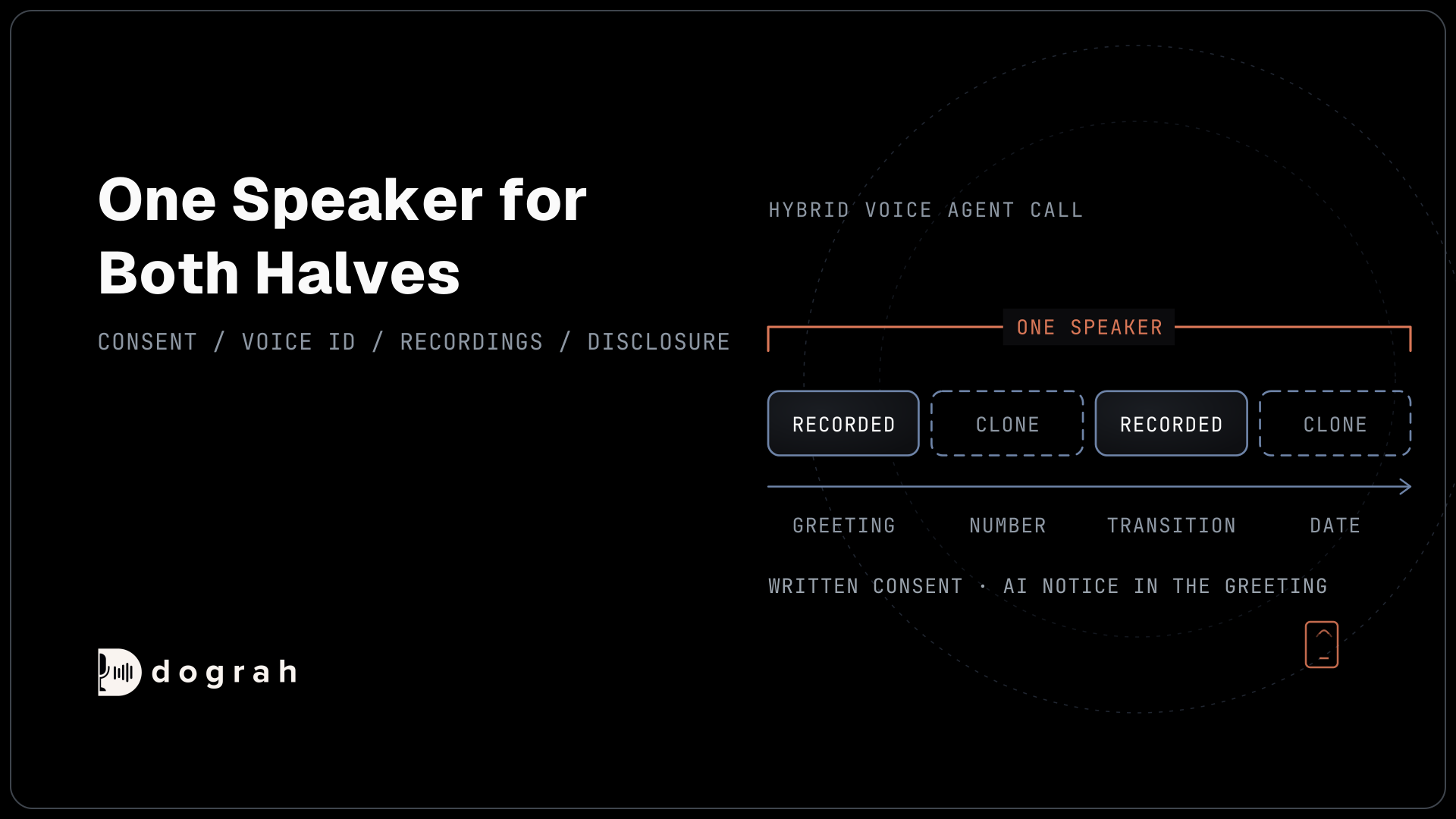
Cartesia also fits the pre-recorded clip pattern. You record real lines, clone the same speaker with a Cartesia Instant Clone from about 10 seconds of audio, and the agent plays a recording when one fits and falls back to the cloned voice for everything else.
Agents are built in the visual builder, or by an AI assistant through the MCP server. You connect your own carrier, such as Twilio, Vonage, Plivo or Telnyx, or Dograh SIP. If a caller asks for a person, Transfer Call hands them over on Twilio, Telnyx, Plivo, Cloudonix or Asterisk ARI. The destination is rung first, the caller joins only once someone picks up, and on Twilio both people can hear a short spoken introduction before the line connects.
Callers answer by voice, and CRMs connect through HTTP API tools and webhooks. Self-hosting with Docker runs 10 calls at once by default, and the servers and their upkeep sit with your team. Run it yourself and the per-minute platform fee drops away, leaving servers, model keys and phone minutes to pay for. Dograh Cloud adds a 1¢-a-minute platform fee instead.

Open Source Alternative to Vapi / Retell
Self-hosted voice agent platform — no per-minute fees
dograh-hq/dograh
Star on GitHub
Hosted alternatives to Managed Agents
Each of the five hosted platforms below is closed code that runs in its vendor's cloud by default, the same model as Managed Agents.
ElevenAgents
ElevenAgents is the closest match, because ElevenLabs also pairs top-ranked voices with its own hosted agent platform. Paid plans run from $6 to $990 a month with minutes included, extra minutes cost $0.08, and the language model comes on top while your own carrier bills the phone line. EU, India or Singapore residency and a BAA come on Enterprise, and its private deployment runs ElevenAgents in your own AWS or GCP account through sales.
Cartesia vs ElevenLabs compares the two vendors' voices, speech-to-text and agent platforms, and our guide to ElevenLabs alternatives covers the rest of its field.
Vapi and Retell AI
Vapi is a developer platform with a $0.05-a-minute hosting fee, models and phone billed on top, and a $2,000-a-month HIPAA add-on. Building there means Assistants and Squads, since Vapi retired its visual Workflows in August 2026.
Retell AI publishes $0.07 to $0.31 a minute for a full agent, from $0.055 for its voice infrastructure. Up to 20 concurrent calls cost nothing extra, and each one past that adds $8 a month. Flows are drawn in its visual Conversation Flow builder, and OpenAI's realtime speech-to-speech models are among the models it sells.
Deepgram and Bland AI
Deepgram's Voice Agent API bundles its speech-to-text, a managed language model and a voice in one connection for $0.075 a minute on pay as you go, less if you bring your own LLM or voice. Self-hosted containers in your own VPC or on-prem hardware come on Enterprise. Our guide to Deepgram alternatives covers both of its layers.
Bland AI runs on its own models under one per-minute rate, $0.14 on Start with 100 calls a day or $0.12 plus $299 a month on Build. On-prem or VPC deployment and a BAA come on Enterprise.
Join the Dograh Community
Dograh is an OSS alternative to Vapi. Join our Slack community for queries, releases, best practices & community interactions.
Open-source routes, Line SDK included
Open source means anyone can read the code and run it without a contract. A licensed deployment of closed models in your own cloud is a different thing, even when the servers are yours.
Cartesia's Line SDK is open source under Apache-2.0, and Line agents you run yourself keep working after December 1. Your agent code runs on your servers and connects to Cartesia through a self-hosted deployment URL, so Cartesia remains in the loop on each call.
LiveKit Agents (Apache-2.0) and Pipecat (BSD-2-Clause) are the two open frameworks teams weigh most, and both can call Cartesia's voices. Pipecat is a Python framework from Daily, and Dograh is built on a fork of it. In our experience it is an excellent base, but production needs phone integrations, call history, QA on live calls and the call lifecycle, which is the part Dograh ships.
For a closer look at those frameworks, see our comparison of the best open-source voice AI platforms. If open source is your main reason for leaving, our post on the open-source alternative to Cartesia sorts open voices, open SDKs and an open platform.
Swapping only the voice
Some teams keep their agent platform and only want a different voice. ElevenLabs, Deepgram Aura and Rime are hosted speech APIs in the same class as Sonic, and each is a built-in voice provider in Dograh.
Open-weight voices are the other route. Kokoro is an 82-million-parameter model under Apache-2.0 with fixed voices and no cloning, and it runs in Dograh through Speaches. Chatterbox is MIT-licensed and clones a voice from a short clip, served from your own GPU. On the Speech Arena, Kokoro 82M ranks 62nd and Chatterbox 80th, far below Sonic 3.6, so test them on real calls before you commit.
What Cartesia costs
Cartesia bills speech in credits and the agent in dollars. On Cartesia's pricing page, plans run from Free to Pro at $5, Startup at $49 and Scale at $299 a month, and each paid plan comes with a credit allowance plus the same amount in prepaid agent dollars. Enterprise is custom. Sonic uses about 1 credit a character, cloned voices included, and Ink 2 uses 3 credits for each second of audio, silence included.
Cartesia lists Managed Agents at $0.03 a minute, down from $0.06. A Cartesia phone number adds $0.014 a minute, and the language model is billed on top at its token price. Agent calls have their own concurrency limit, from 8 at once on Free to 60 on Scale. Our breakdown of Cartesia pricing works through credits, overages and a sample call minute.
When staying on Cartesia makes sense
If you want one of the top-ranked real-time voices and the agent from one vendor, with nothing to run, Managed Agents gives you that. It also covers jobs some phone lines need. The agent can send keypad tones, transfer by SIP REFER and dial batches of up to 5,000 people through the API, and you can rent numbers from Cartesia directly.
Cartesia is SOC 2 Type II certified, and regulated buyers on Enterprise add BAAs, regional deployments and Zero Data Retention for speech. A self-hosted Dograh install sits inside your own perimeter instead, so no BAA with Dograh is needed. Cartesia still needs one, on Enterprise, if its voices or speech-to-text handle patient data, and the phone carrier may too, depending on what it stores. If your servers run in a cloud account such as AWS, that provider needs one as well.
What moving off Managed Agents takes
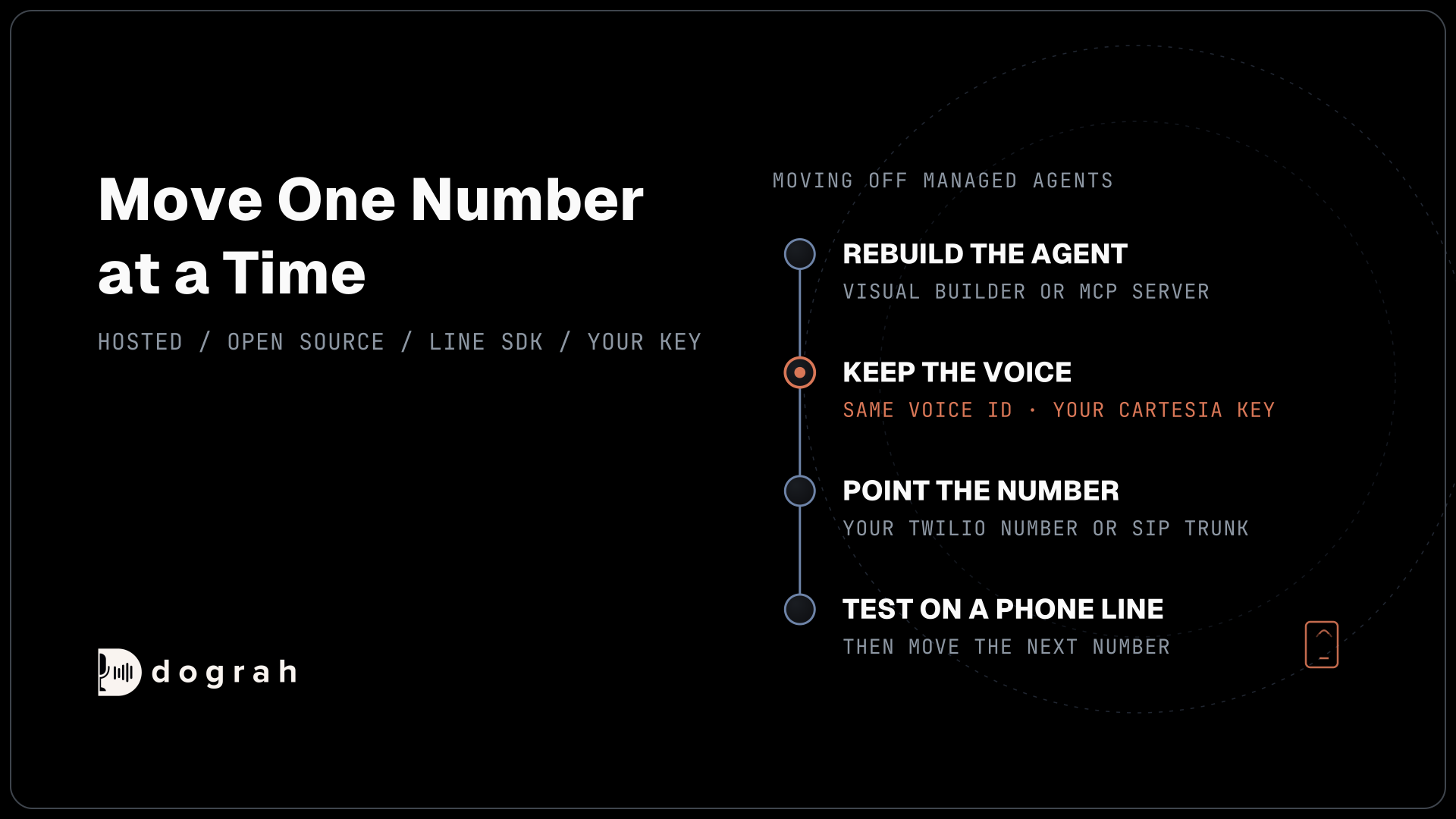
Move one number at a time, with Managed Agents answering the rest until each rebuilt agent passes its tests. Treat each agent's prompt and configuration as the spec. You can rebuild it in the visual builder or let an AI assistant draft it through Dograh's MCP server, and either way you review every step before it takes calls.
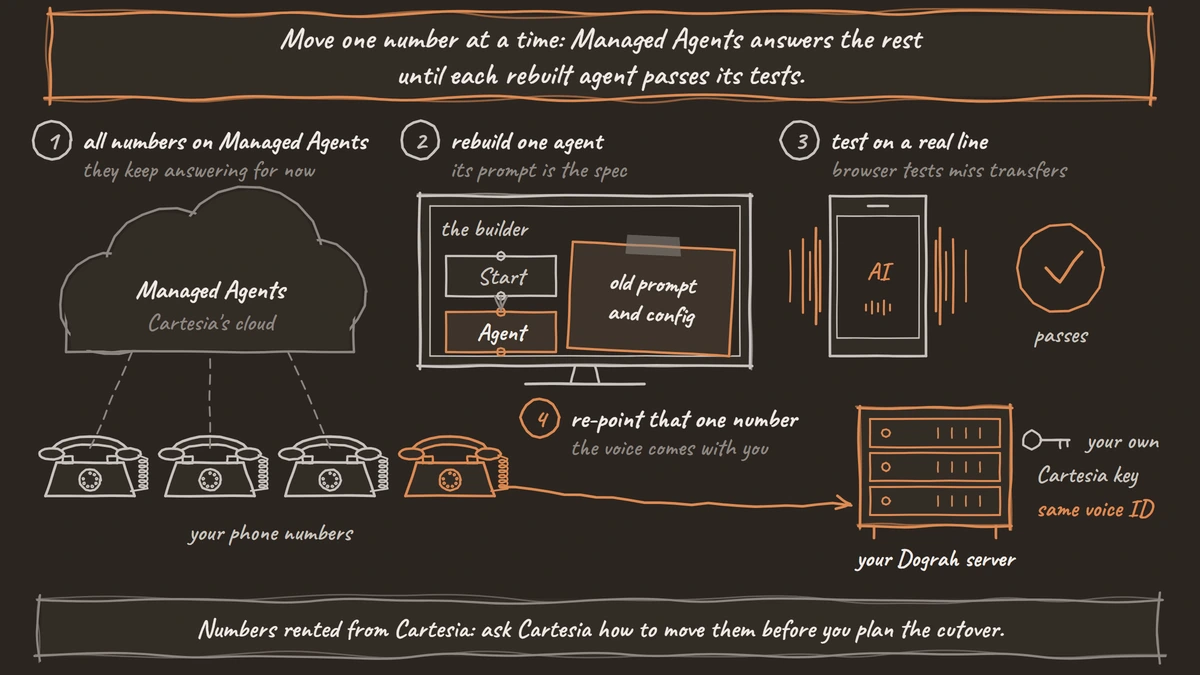
The voice comes with you, as the same voice ID under your own Cartesia key. Numbers on your own Twilio account or SIP trunk can point at Dograh as each agent goes live. If you rent numbers from Cartesia, ask Cartesia how to move them before you plan the cutover. Test every rebuilt agent on a real phone line, because Transfer Call runs on phone calls, not browser tests.
Hosted Line SDK agents need a decision before December 1. You can move them to Managed Agents, run the same Line code on your own servers, or rebuild them on another platform. A move to Dograh follows the same steps as above, with the Line code as the spec.
Picking your Cartesia alternative
Teams that would rather write the agent in code can start with LiveKit Agents or Pipecat, or keep their Line agents running on their own servers. On a hosted plan, ElevenAgents is the nearest like-for-like swap. Vapi suits developers who want an API and a wide model catalog, and Retell AI suits teams that want a drawn flow with a rate card. Deepgram's Voice Agent API fits a team that wants one bundled connection, and Bland AI fits teams happy for the vendor to pick every model.
If you want the platform's code in your own hands and the option to keep Sonic and Ink, Dograh is built for exactly that. Run it from GitHub with Docker, or start on Dograh Cloud. Whichever you shortlist, run the same call script on a real phone line, because a browser demo plays at 16 kHz while most real callers reach the agent as 8 kHz audio.
Each part of this guide has its own deep dive:
- Open-Source Alternative to Cartesia: Own the Agent, Pick the Voice
- Cartesia Pricing Explained: Credits, Agent Minutes and Extras
- Cartesia Features Explained: Sonic, Ink, Cloning and Agents
- Cartesia vs ElevenLabs: Voices, Speech-to-Text and Agents
Glossary
- Managed Agents
- Cartesia's hosted voice agent platform, launched in October 2026. Agents run in Cartesia's cloud with a language model from its catalog, and the platform bills by the call minute.
- Line SDK
- Cartesia's open-source Python SDK for code-first voice agents, under Apache-2.0. Cartesia stops hosting Line agents on December 1, 2026, while Line code you run on your own servers keeps working.
- Private-cloud deployment
- Cartesia's Enterprise option to run its models on-premise or in a private cloud, arranged through its sales team. It is licensed software, not open source.
- Bring your own key (BYOK)
- Using your own account with a model provider instead of the platform's. You hold the contract and the bill, but the call audio still goes to that provider.