
Cartesia's features are Sonic 3.6 voices in 44 languages, voice cloning from 10 seconds or 30 minutes of audio, Ink 2 speech-to-text with built-in turn detection, and the Managed Agents platform. Dograh, the open-source AI voice agent platform we build, runs Sonic and Ink with your own key. You can self-host it or run it on Dograh Cloud.
Key Takeaways
- Sonic 3.6 speaks 44 languages and ranks fourth on the Speech Arena.
- Professional voice clones sound native only in their training language.
- Inside Dograh, Ink 2 runs English calls using Cartesia's own turn detection.
Sonic 3.6 speaks 44 languages, yet Ink 2, Cartesia's newest speech to text, hears only five of them. We go through Sonic 3.6, instant and professional cloning, Ink with its turn detection and Managed Agents, then which settings carry over in Dograh. Our guide to Cartesia alternatives covers the wider choice.
Sonic 3.6, Cartesia's voice model
Sonic is Cartesia's text-to-speech model, and Sonic 3.6 is the current version. It speaks 44 languages, from English and Hindi to Tamil and Arabic, and it is backwards compatible with Sonic 3.5, so existing requests keep working.
On the Artificial Analysis Speech Arena, where listeners vote blind between voices, Sonic 3.6 ranks fourth, with Eleven v4 Turbo and Eleven v4 in first and second place. Sonic 3.5 ranks 21st.
Sonic 3.6 adds a locale setting, so the same voice can carry a British or other regional accent. It also switches between Hindi and English inside one sentence, and Cartesia says romanized Hindi reads better on 3.6 than before.
Each request can set speed from 0.6 to 1.5 and volume from 0.5 to 2.0. Emotion control is in beta for English, with about 60 values, and how well it works depends on the voice. SSML tags handle pauses and spelling, and pronunciation dictionaries swap in your own spellings or phonetic forms for names and product terms before the model speaks.
Voice cloning, instant and professional
Cartesia offers two kinds of clone. An Instant Clone needs about 10 seconds of audio and is available from the Pro plan. A Professional Voice Clone fine-tunes a model on your recordings, needs at least 30 minutes of audio, trains on up to 3 hours, and starts on the Startup plan.
According to Cartesia's cloning docs, a professional clone can speak every language the model supports but sounds native only in the language it was trained on. Speech from a clone costs the same credits as a stock voice. Professional clones do not take a speed setting at request time.
Cloning a real person's voice needs that person's consent, and our post on voice cloning with pre-recorded TTS covers how to pair a clone with recorded lines.
Ink speech-to-text and turn detection
Ink is Cartesia's speech-to-text. Ink 2 covers English, French, Hindi, Japanese and Spanish, and it has turn detection built in. As the caller talks, it sends events when a turn starts, updates, may be ending, resumes and ends, so the agent knows when to reply without a separate voice activity detector.
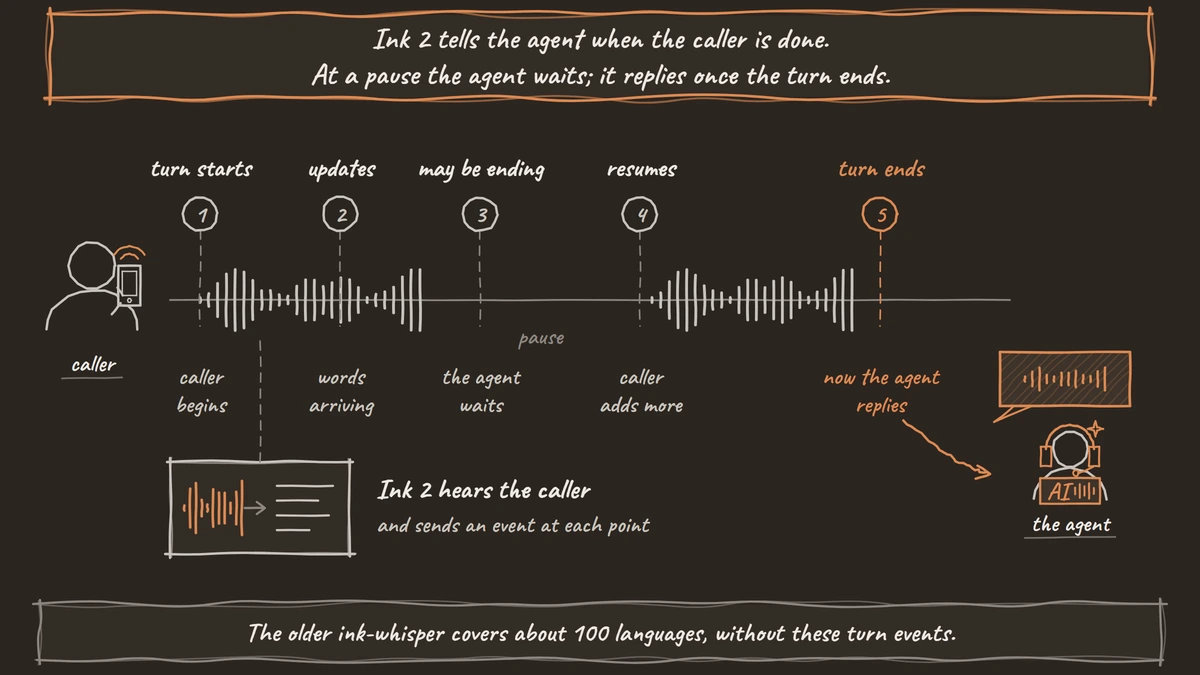
The older ink-whisper model covers about 100 languages without those turn events. Both are billed by the second of audio, with Ink 2 at three times ink-whisper's credit rate. Cartesia describes Ink 2 as the most accurate streaming speech-to-text available, so measure it on your own recorded calls before you rely on that.

Open Source Alternative to Vapi / Retell
Self-hosted voice agent platform — no per-minute fees
dograh-hq/dograh
Star on GitHub
Managed Agents, the agent platform
Managed Agents is Cartesia's hosted agent platform, launched on October 29. You build an agent in a Playground or through the API and pick a language model from Cartesia's catalog of OpenAI, Anthropic and Gemini models, with no provider key of your own.
Its system tools end the call, skip a turn, detect voicemail, send keypad tones and transfer to a phone number or SIP address. Webhook and client tools reach your own systems, and evaluations test agents before release. Calls come in through Cartesia numbers, Twilio or a SIP trunk, and outbound batches of up to 5,000 people go out through the API. Every configuration change is saved as a new version you can roll back.
Cartesia's launch post announced knowledge bases and 44 languages for agents, and its migration guide lists them as coming soon. Our look at Cartesia Managed Agents weighs the launch in more depth.
Using Cartesia's features inside Dograh
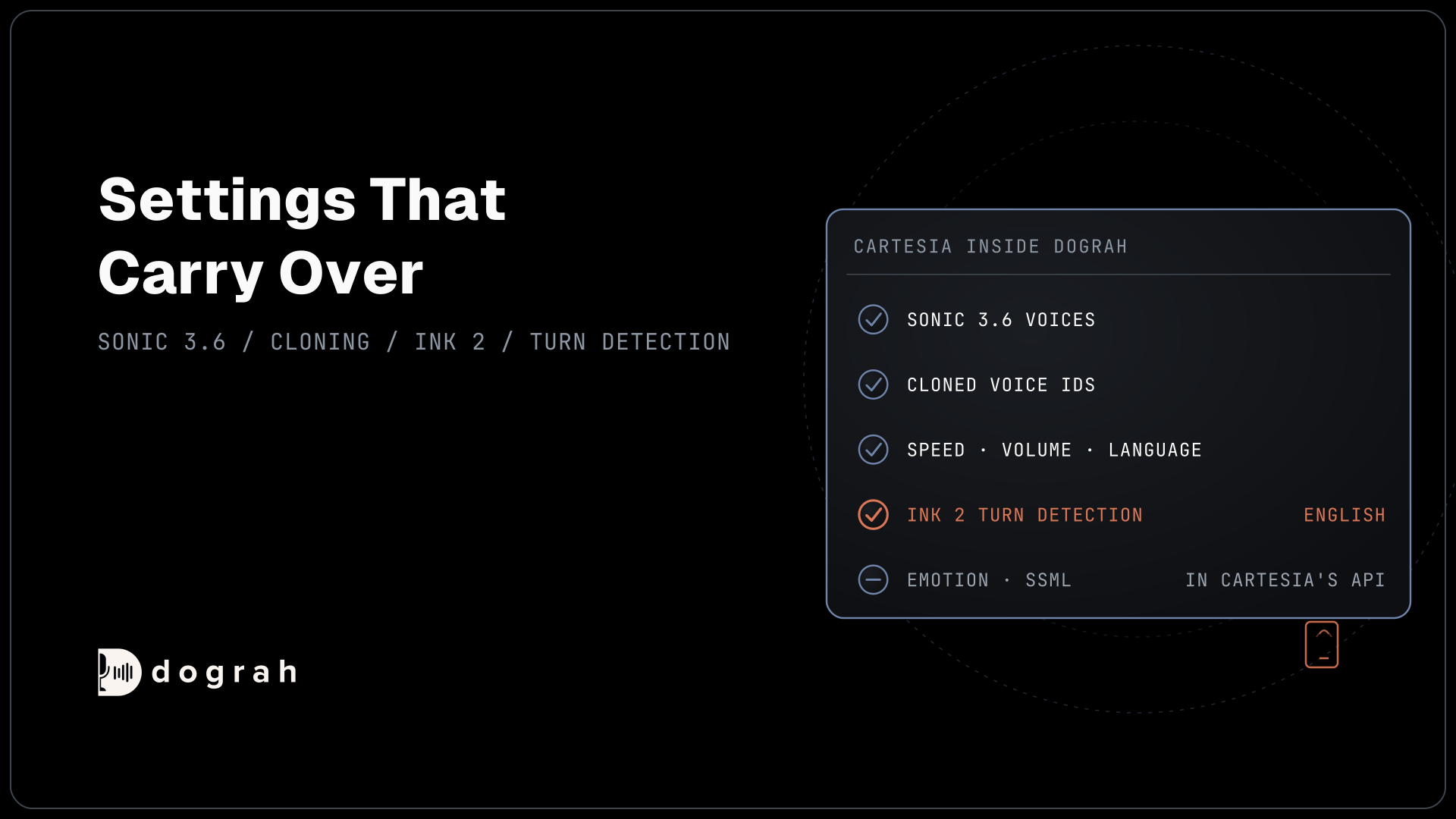
Dograh has Cartesia as a built-in provider for both voice and speech-to-text, with your own Cartesia key. In the voice settings you pick Sonic 3.6, the default, or Sonic 3.5 or Sonic 3, choose a voice from your account or paste any voice ID, and set speed, volume and language. Instant and professional clones work the same way as stock voices.
In the transcriber settings, ink-whisper is the default. Ink 2 is offered for English, and with it Dograh uses Cartesia's turn events to decide when the caller has finished. For other languages, pick ink-whisper.
Emotion tags, SSML and pronunciation dictionaries are set through Cartesia's own API. Inside Dograh, the agent's prompt shapes how it words things, and the model, voice, speed and volume shape how it sounds.
A Cartesia clone also fits the pre-recorded clip pattern. Record the fixed lines in a real voice, clone the same speaker, and the agent plays the recording where one fits and the cloned voice everywhere else.
Join the Dograh Community
Dograh is an OSS alternative to Vapi. Join our Slack community for queries, releases, best practices & community interactions.
Which Cartesia features matter for phone calls
Language coverage decides more than voice quality for many teams. Sonic 3.6 speaks 44 languages, while Ink 2 hears five, so callers in other languages rely on ink-whisper. Our guide to multilingual voice agents covers how to plan for that.
Test on a real phone line before you decide, because most phone calls reach the agent as 8 kHz audio while a browser demo runs at 16 kHz. Then price the features you keep, since cloning tiers and Ink 2 change the bill, as our breakdown of Cartesia pricing shows.
Glossary
- Sonic
- Cartesia's text-to-speech model family. Sonic 3.6 is the current version, speaks 44 languages and is backwards compatible with Sonic 3.5.
- Ink 2
- Cartesia's newest streaming speech-to-text model, covering five languages. It sends turn events as the caller starts, pauses and finishes speaking.
- Professional Voice Clone
- A Cartesia voice clone built by fine-tuning a model on at least 30 minutes of recordings. It sounds native only in the language it was trained on.
- Locale
- A Sonic 3.6 setting that picks a regional accent, such as British English, for the same voice and language.